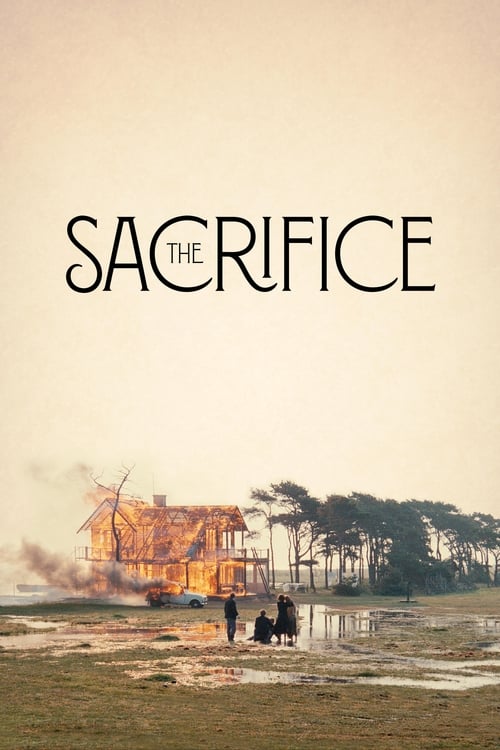
The Sacrifice
A poetic, apocalyptic drama suffused with spiritual dread and hope. Through the haunting image of a burning house and a barren tree, it explores the ultimate cost of faith in a world on the brink of nuclear annihilation.
The Sacrifice

The Sacrifice

Offret

"The final film of Andrei Tarkovsky"

09 May 1986 Sweden 149 min ⭐ 7.7 (596)
Director: Andrei Tarkovsky
Cast: Erland Josephson, Susan Fleetwood, Allan Edwall, Guðrún Gísladóttir, Sven Wollter
Drama
Sacrifice and Faith Materialism vs. Spirituality The Apocalypse Word vs. Action
Box Office: $1,095,380

Overview

Alexander, a retired actor and journalist, lives a quiet life with his family in a remote house on the Swedish island of Gotland. On the day of his birthday, the celebration is shattered by a terrifying television broadcast announcing the outbreak of World War III and an imminent nuclear holocaust. As panic and hysteria consume his family, Alexander wanders into the darkness, making a solemn vow to God.

Desperate to save his loved ones and humanity, Alexander promises to sacrifice everything he owns and loves—his home, his family, and even his voice—if the world is restored to its state before the catastrophe. Guided by his eccentric friend Otto, he seeks out Maria, a mysterious servant rumored to be a witch, believing that a spiritual union with her is the key to salvation.

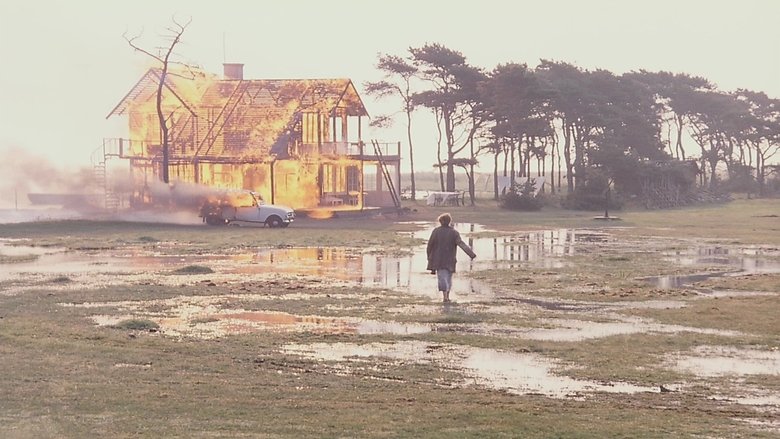
The following morning, Alexander wakes to a world that seems unchanged, with no sign of the previous night's doom. True to his word, he proceeds to systematically destroy his life, setting his beloved house on fire while his family watches in horror, leading to a climactic and ambiguous resolution that blurs the lines between madness, miracle, and divine intervention.
Core Meaning

The Sacrifice is Andrei Tarkovsky's final cinematic testament, conceived as a "poetic parable" about the necessity of individual spiritual action in a materialistic world. The film argues that modern humanity has lost its connection to the spiritual, leading it to the precipice of self-destruction.

At its heart, the film suggests that a single person's act of total, selfless sacrifice and faith—however irrational or "mad" it may appear to society—has the power to alter the course of history and save the world. It is a plea for a return to spiritual values and a rejection of the material attachments that bind the human soul.

Thematic DNA

Sacrifice and Faith 35%
Materialism vs. Spirituality 25%
The Apocalypse 20%
Word vs. Action 20%

Sacrifice and Faith

The central theme is the concept of a gift requiring a sacrifice. Alexander's bargain with God represents the ultimate leap of faith: giving up everything he holds dear (his family, his home, his sanity) to save a world that may not even understand his act. It parallels the biblical story of Abraham and Isaac, questioning what true faith demands.

Materialism vs. Spirituality

Tarkovsky critiques modern Western civilization's obsession with material goods and technological progress at the expense of the soul. Alexander's burning of his house—a beautiful, curated object of bourgeois success—symbolizes the violent rejection of materialism necessary for spiritual rebirth.

The Apocalypse

The looming threat of nuclear war serves as the catalyst for the narrative. It is not just a physical threat but a spiritual crisis, revealing the fragility of human existence and the hollowness of modern security. The fear of the end times strips the characters down to their core essence.

Word vs. Action

The film opens with a discussion on the phrase "In the beginning was the Word," yet Alexander eventually chooses silence and action over empty speech. He laments that humanity talks too much and does too little. His vow of silence and his physical act of burning the house represent a shift from intellectualizing to being.

Character Analysis

Alexander

Erland Josephson

Archetype: The Tragic Hero / The Holy Fool
Key Trait: Spiritual desperation

Motivation

To save his family and humanity from nuclear destruction through a personal, spiritual offering.

Character Arc

Starts as a weary, intellectual observer critical of modern life. Under the threat of apocalypse, he transforms into a man of radical action, entering a "holy madness" to fulfill his pact with God, ultimately sacrificing his social standing and sanity.

Otto

Allan Edwall

Archetype: The Mentor / The Messenger
Key Trait: Eccentric wisdom

Motivation

To guide Alexander toward the spiritual solution (Maria) that can avert the catastrophe.

Character Arc

A local postman and self-described "gatherer of incidents" who acts as a spiritual guide. He remains constant, bridging the gap between the ordinary world and the supernatural realm of Maria.

Maria

Guðrún Gísladóttir

Archetype: The Savior / The Sacred Witch
Key Trait: Mystical grace

Motivation

To provide comfort and, implicitly, to act as the conduit for the world's salvation through love.

Character Arc

A humble servant who is revealed to possess a mystical, saint-like power. Her sexual union with Alexander is portrayed not as adultery but as a sacred ritual of healing and salvation.

Little Man (Gossen)

Tommy Kjellqvist

Archetype: The Innocent / The Future
Key Trait: Silence

Motivation

To learn from his father and tend to the tree of faith.

Character Arc

Alexander's mute son, who observes the world in silence. In the final moments, he speaks the film's last line, inheriting his father's spiritual task.

Symbols & Motifs

The Dead Tree

Meaning:

Symbolizes faith, hope, and the power of ritual. Based on the legend of the monk who watered a dead tree until it blossomed, it represents the belief that persistent, irrational spiritual effort will eventually yield life.

Context:

Appears in the opening and closing scenes. Alexander plants it with his son, and in the final shot, the son waters it alone, suggesting the continuity of faith and the potential for a new beginning.

The House

Meaning:

Represents the material world, Alexander's ego, and his attachment to earthly life. It is a vessel of memories and comfort that must be destroyed to fulfill the covenant with God.

Context:

The house is the central setting of the film, meticulously designed only to be burned to the ground in a continuous six-minute take at the climax.

The Pitcher of Milk

Meaning:

Symbolizes the fragility of life, purity, and the disruption of the natural order by the impending war.

Context:

During the terrifying sequence where jets fly overhead, the vibrations cause a pitcher of milk to fall and shatter, spilling its contents—a visceral image of destruction intruding on domestic peace.

Leonardo da Vinci's 'Adoration of the Magi'

Meaning:

Represents the offering of gifts to the divine and the intersection of the sacred and the profane. It foreshadows the theme of giving one's all for a higher purpose.

Context:

The painting is shown during the opening credits and appears in the house. The camera lingers on the tree in the painting, linking it to the dead tree Alexander plants.

Memorable Quotes

In the beginning was the Word. Why is that, Papa?

— Little Man

Context:

Spoken by the boy as he lies under the barren tree after his father has been taken away in the ambulance.

Meaning:

The final line of the film, spoken by the previously mute child. It signifies the return of the Word, not as empty chatter, but as a vessel of truth and a new beginning, cycling back to the biblical opening of John.

I will give Thee all I have. I'll give up my family, whom I love. I'll destroy my house... I'll be mute, and never speak another word to anyone.

— Alexander

Context:

Alexander prays alone in the darkness of his room while the others are downstairs, after hearing the news of the war.

Meaning:

The core vow of the film. It defines the absolute nature of the sacrifice required to avert the apocalypse—a total renunciation of the self and worldly attachments.

Every gift involves a sacrifice. If not, what kind of gift would it be?

— Otto

Context:

Otto says this while giving Alexander a framed antique map as a birthday present.

Meaning:

A philosophical key to the film's premise. It suggests that true giving hurts and requires giving up something of value, foreshadowing Alexander's ultimate act.

Philosophical Questions

Can a single individual's spiritual act save the collective world?

The film posits that the spiritual interconnection of humanity is so strong that one person's pure faith and sacrifice can avert a global physical catastrophe. It challenges the materialist view that only political or physical actions have consequences.

Is faith a form of madness?

Tarkovsky blurs the line between the holy fool and the lunatic. Alexander's actions are objectively insane (burning his house, silence), yet the film frames them as the only sane response to an insane world (nuclear war).

What is the relationship between the gift and the sacrifice?

Through Otto's dialogue and Alexander's actions, the film explores the idea that a true gift is not something surplus, but something that costs the giver everything, stripping them of their attachments.

Alternative Interpretations

The Dream Theory: Many critics argue that the entire sequence of the nuclear war and the burning house is a nightmare Alexander has after falling asleep. The world "restoring" itself is simply him waking up. However, the presence of the ambulance suggests consequences in the real world.

The Madness Theory: Another reading is that there was no nuclear war; Alexander simply had a psychotic break on his birthday. His "sacrifice" was the act of a madman destroying his family's life for a delusion. The film offers no objective evidence of the war other than the TV broadcast and the characters' reactions.

The Gnostic Interpretation: Alexander is a Gnostic hero who realizes the material world is a trap (a "wrong path") and must destroy his material existence to liberate the divine spark within.

Cultural Impact

The Sacrifice is revered as the spiritual last will and testament of one of cinema's greatest poets. Released shortly before Tarkovsky's death, it cemented his legacy as a director who treated film as a sacred art form.

It won the Grand Prix at the 1986 Cannes Film Festival. While some critics initially found it overly theatrical or heavy compared to his earlier Russian works, its reputation has grown as a masterpiece of "slow cinema." It heavily influenced directors like Lars von Trier (who dedicated Antichrist to Tarkovsky) and Béla Tarr. The film's philosophical depth and the technical mastery of the burning house scene remain reference points in film schools worldwide.

Audience Reception

The Sacrifice is generally regarded as a masterpiece by cinephiles and critics, holding high ratings on platforms like IMDb and Letterboxd. Praised aspects include Sven Nykvist's stunning cinematography, the philosophical depth, and the emotional resonance of the ending. The burning house sequence is universally cited as a technical marvel.

Criticisms often focus on the film's pacing (it is very slow) and the theatrical, sometimes hysterical acting style of the supporting cast (particularly Susan Fleetwood as Adelaide), which some viewers find grating or melodramatic compared to the subtlety of Tarkovsky's earlier films. It is considered a demanding watch that requires patience and active engagement.

Interesting Facts

  • The famous burning house scene had to be shot twice. During the first take, the camera jammed, and the entire house burned down without being recorded. The production had to rebuild the house in two weeks and burn it again.
  • This was Andrei Tarkovsky's final film. He was dying of lung cancer during post-production and passed away shortly after its release.
  • The film was shot on the island of Gotland, Sweden, close to Fårö, where Ingmar Bergman lived and worked. Tarkovsky originally wanted to shoot on Fårö but was denied access by the military.
  • Many of the crew members, including cinematographer Sven Nykvist and actor Erland Josephson, were regular collaborators of Ingmar Bergman, giving the film a distinct 'Bergmanesque' quality.
  • The character of the postman Otto was originally written for Tarkovsky's favorite actor, Anatoly Solonitsyn, who died before production began.
  • Tarkovsky dedicated the film 'To my son Andriosha,' with hope and confidence.
  • The 6-minute long take of the house burning is one of the most famous shots in cinema history, choreographed with complex character movement and practical effects.
  • Alexander's vow of silence mirrors a similar theme in Bergman's 'The Seventh Seal' and 'Persona,' emphasizing the inadequacy of language.

Easter Eggs

Leonardo da Vinci's 'Adoration of the Magi'

The painting appears in the opening credits and within the film. It references the theme of bringing gifts to the divine, paralleling Alexander's sacrifice.

The Yin-Yang Shirt

In the final sequence where Alexander runs wildly around the burning house, he is wearing a robe with a Yin-Yang symbol on the back, representing the balance of order and chaos, or the union of opposites (material/spiritual) he has achieved.

Reference to 'Ivan's Childhood'

The motif of the tree and the child connects back to Tarkovsky's first film, Ivan's Childhood, creating a bookend to his career—starting and ending with a child and a tree.

The Ambulance

The arrival of the ambulance to take Alexander away echoes the ending of Solaris and Stalker where the protagonist's spiritual experience is pathologized or misunderstood by the outside world.

⚠️ Spoiler Analysis

Click to reveal detailed analysis with spoilers

Frequently Asked Questions

Explore More About This Movie

Dive deeper into specific aspects of the movie with our detailed analysis pages

Comments (0)

Leave a comment

No comments yet. Be the first to share your thoughts!