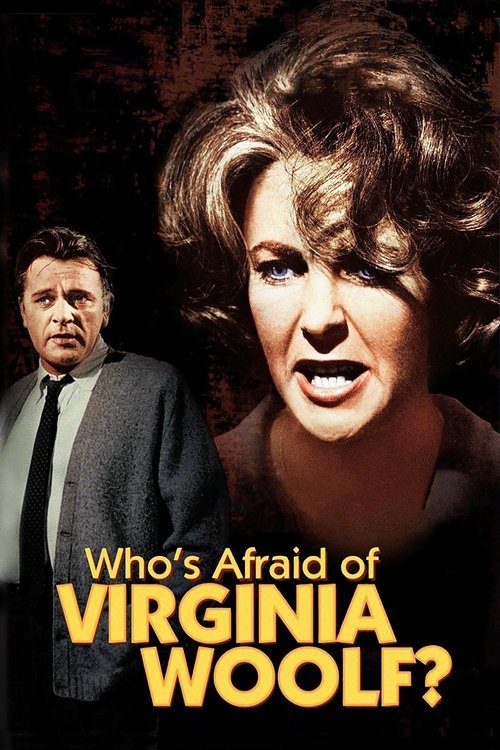
Who's Afraid of Virginia Woolf?
A savage, booze-soaked descent into the hell of a disintegrating marriage. Amidst the sterile gloom of an academic campus, four souls strip away illusions until only the raw, terrifying bone of truth remains.
Who's Afraid of Virginia Woolf?

Who's Afraid of Virginia Woolf?

"You are cordially invited to George and Martha's for an evening of fun and games"

22 June 1966 United States of America 131 min ⭐ 7.7 (883)
Director: Mike Nichols
Cast: Elizabeth Taylor, Richard Burton, George Segal, Sandy Dennis, Agnes Flanagan
Drama
Illusion vs. Reality The sterility of the American Dream Marriage as a Battlefield Success and Failure
Budget: $7,500,000
Box Office: $33,736,689

Overview

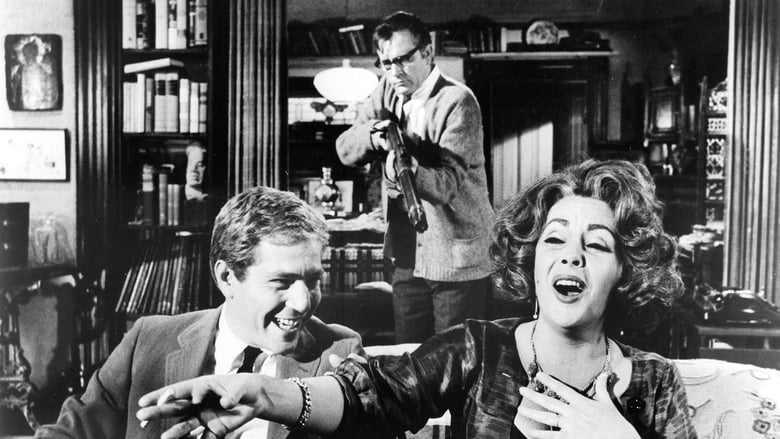
In the dead of night, George, a weary associate history professor, and his volatile wife Martha, daughter of the university president, return home from a faculty party. Drunk and quarrelsome, they welcome a young couple, Nick and Honey, for a nightcap. What begins as awkward social niceties quickly devolves into a vicious psychological bloodsport.

Fueled by endless rounds of alcohol, George and Martha drag their guests into their toxic marital games, exposing their own deep-seated resentments and the younger couple's secrets. The night spirals through humiliation and betrayal, culminating in a devastating revelation that shatters the fragile fantasy holding George and Martha's lives together.
Core Meaning

At its heart, the film is a brutal examination of the human necessity for illusion to survive the pain of reality. It posits that truth, while purifying, can be destructive. The director explores whether love can exist without the protective lies couples construct, suggesting that stripping away these fabrications—the "exorcism"—is a terrifying but necessary act to reach genuine connection, even if that connection is born of shared despair.

Thematic DNA

Illusion vs. Reality 35%
The sterility of the American Dream 25%
Marriage as a Battlefield 20%
Success and Failure 20%

Illusion vs. Reality

The central conflict where characters cling to fabrications (the imaginary son, Honey's feigned illnesses) to mask their emptiness. The removal of these illusions is the film's violent climax.

The sterility of the American Dream

Set in 'New Carthage', the film critiques the hollowness of academic and social success. George and Martha (named after the Washingtons) represent a failed, barren national myth, while Nick represents a cold, opportunistic future.

Marriage as a Battlefield

Love and hate are shown as inseparable forces. The couple's sadomasochistic dynamic suggests that their conflict is the only thing keeping their passion—and their marriage—alive.

Success and Failure

George is tormented for his lack of ambition, contrasting with Nick's ruthless drive. The film questions the value of societal status and the cost of achieving it.

Character Analysis

George

Richard Burton

Archetype: The Disillusioned Intellectual / Anti-hero
Key Trait: Cynical wit

Motivation

To survive Martha's dominance and eventually to force her to face the terrifying truth of their existence.

Character Arc

Starts as a passive victim of Martha's abuse, but slowly takes control of the 'games'. He moves from defense to offense, ultimately committing the act of 'murdering' the illusion to save them both from total madness.

Martha

Elizabeth Taylor

Archetype: The Monstrous Feminine / Tragic Figure
Key Trait: Volatile vulnerability

Motivation

To elicit a strong emotional response—whether love or hate—to fill the void of her barren life.

Character Arc

begins as a boisterous, domineering force, but as the night wears on, her vulnerability is exposed. The destruction of her 'son' leaves her broken, fearful, and stripped of her defenses.

Nick

George Segal

Archetype: The Opportunist / The New Man
Key Trait: Arrogant ambition

Motivation

To advance his career and status, willing to use seduction and sycophancy to do so.

Character Arc

Arrives as a polite, ambitious academic. He is systematically broken down, his moral ambiguity exposed, and his ego shattered by George's psychological warfare.

Honey

Sandy Dennis

Archetype: The Fragile Innocent
Key Trait: Willful ignorance

Motivation

To maintain a facade of propriety and avoid the painful reality of her own trapped marriage.

Character Arc

Serves as a passive observer who is gradually traumatized. Her drunkenness reveals her own secrets (fear of childbirth), and she becomes a collateral casualty of the older couple's war.

Symbols & Motifs

The Imaginary Son

Meaning:

Represents the shared delusion that binds George and Martha. He is the symbol of their creation, their hope, and their ultimate failure to produce anything 'real' together.

Context:

Discussed reverently by Martha, used as a weapon, and finally 'killed' by George in the film's climax.

New Carthage

Meaning:

The fictional college town name references the ancient city destroyed by Rome (and salted to be barren), symbolizing the spiritual and emotional sterility of the characters' environment.

Context:

The setting of the film, constantly referred to as a place of confinement and stagnation.

Alcohol

Meaning:

A truth serum and a numbing agent. It strips away social veneers, fueling the 'games' while simultaneously allowing the characters to endure their pain.

Context:

Consumed incessantly throughout the film; the characters are rarely seen without a glass, marking the progression of their descent.

Snapdragons

Meaning:

Symbolize 'flowers for the dead' and the warding off of evil. They foreshadow the 'death' of the son and the exorcism of the illusion.

Context:

George throws them at Martha and Nick in a manic display while reciting a Latin requiem mass.

Memorable Quotes

Who's afraid of Virginia Woolf? ... I am, George. I am.

— Martha

Context:

The very last lines of the film, spoken softly after the 'son' has been declared dead.

Meaning:

The final admission of vulnerability. It signifies that without the 'big bad wolf' (illusion), she is terrified of the reality (Virginia Woolf/madness/truth) she must now face.

What a dump!

— Martha

Context:

Spoken immediately upon entering the messy house, quoting a Bette Davis film.

Meaning:

Establishes Martha's theatrical discontent and her reliance on pop culture to express her dissatisfaction with her domestic life.

I swear to God George, if you even existed I'd divorce you.

— Martha

Context:

During one of their early arguments in front of the guests.

Meaning:

Highlights the existential nature of their conflict; George is so passive and beaten down he barely registers as a 'real' man to her.

Truth or illusion, George; you don't know the difference.

— Martha

Context:

Spoken during the escalation of their games, accusing George of losing his grip.

Meaning:

Encapsulates the central theme of the film: the blurring lines between their fabricated reality and the actual world.

A drowning man takes down those nearest.

— Martha

Context:

Reflecting on George's behavior and the inevitable collateral damage of their fighting.

Meaning:

A warning about the destructive nature of their relationship and how it will consume Nick and Honey.

Philosophical Questions

Is a comforting lie better than a harsh truth?

The film relentlessly asks if humans can survive without illusion. George's destruction of the fantasy suggests that while truth is necessary for sanity, it leaves us 'afraid' and vulnerable in the cold light of reality.

What defines a 'real' relationship?

Despite their hatred and abuse, George and Martha have a deep, twisted bond. The film challenges the notion of a 'happy' marriage, suggesting that their shared battle is a form of profound, albeit toxic, intimacy that the superficial Nick and Honey lack.

Alternative Interpretations

While the standard reading is that the 'son' was a mutual delusion, some critics have argued that the son might have been real and died, or that he represents a real miscarriage, and the 'game' is a twisted way of coping with that actual trauma. Another interpretation views the film as a political allegory, with George (History/Humanism) and Nick (Biology/Pragmatism) fighting for the soul of the future (Honey/The Next Generation), while the 'son' represents the impossible ideal of American perfection.

Cultural Impact

Who's Afraid of Virginia Woolf? was a watershed moment in American cinema. Released in 1966, it played a pivotal role in the death of the strict Hays Code and the birth of the modern MPAA rating system due to its profanity and sexual themes. It proved that audiences were ready for mature, abrasive, and psychologically complex dramas. The film cemented Elizabeth Taylor's reputation as a serious actress, moving her beyond her 'glamour queen' image. It remains a definitive text on marital dysfunction, influencing countless subsequent films like Revolutionary Road and Carnage.

Audience Reception

Upon release, the film shocked audiences with its vulgarity and raw emotional violence, yet it was a massive box office success. Critics hailed it as a masterpiece of the 'New Hollywood', praising the electric chemistry between Taylor and Burton. Modern audiences continue to revere the film for its biting dialogue and acting masterclass, though some find the relentless shouting and cynicism exhausting. It is universally regarded as one of the best screen adaptations of a play.

Interesting Facts

  • It is one of only two films in history (along with 'Cimarron') to be nominated in every eligible Academy Award category.
  • The first film where the entire credited cast (Elizabeth Taylor, Richard Burton, George Segal, Sandy Dennis) received Oscar nominations.
  • Elizabeth Taylor gained nearly 30 pounds and wore aging makeup to play the 52-year-old Martha, despite being only 33 at the time.
  • The film was shot in black and white at director Mike Nichols' insistence to enhance the gritty atmosphere and help hide Taylor's aging makeup.
  • The melody for the song 'Who's Afraid of Virginia Woolf?' was changed to 'Here We Go 'Round the Mulberry Bush' because the rights to the Disney song 'Who's Afraid of the Big Bad Wolf?' were too expensive.
  • The production code office (MPAA) fought the film over its language, specifically 'screw you' and 'hump the hostess'. 'Screw you' was changed to 'Goddamn you', but 'hump the hostess' remained, helping to usher in the new MPAA rating system.
  • Director Mike Nichols and the crew had to spray the trees with grey paint to maintain the winter look during the shoot as spring arrived.
  • Edward Albee was initially surprised by the casting of the glamorous Taylor and Burton but later admitted they were incredible in the roles.

Easter Eggs

Bette Davis Reference

Martha's opening line, "What a dump!", is a direct quote from the 1949 Bette Davis film Beyond the Forest. Martha spends the first scene trying to make George guess the movie.

Nick's Name

Playwright Edward Albee stated that Nick was named after Nikita Khrushchev, representing the Cold War threat of a new, scientific, and perhaps soulless future threatening the old establishment (George/History).

George and Martha

The main characters are named after the first US President and his wife, George and Martha Washington, symbolizing the failure of the American Dream.

⚠️ Spoiler Analysis

Click to reveal detailed analysis with spoilers

Frequently Asked Questions

Explore More About This Movie

Dive deeper into specific aspects of the movie with our detailed analysis pages

Comments (0)

Leave a comment

No comments yet. Be the first to share your thoughts!