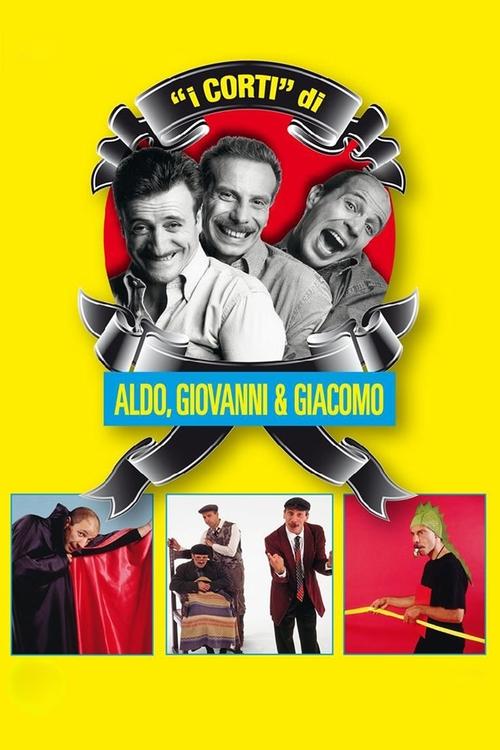
“The Shorts” by Aldo, Giovanni and Giacomo
“I Corti” di Aldo, Giovanni e Giacomo
Overview
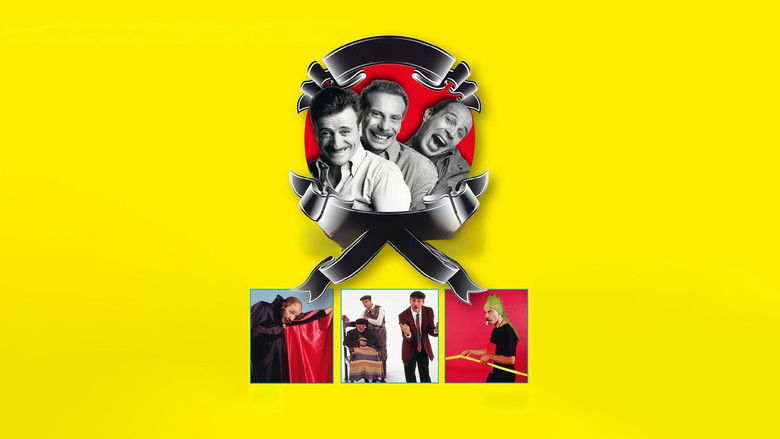
"The Shorts" (original title: “I Corti”) is not a conventional narrative film but a live recording of the first and iconic theatrical show by the Italian comedy trio Aldo, Giovanni e Giacomo. Recorded in March 1996 at the Teatro Nuovo in Ferrara and directed by the renowned quick-change artist Arturo Brachetti, the production captures the raw energy and brilliant comedic timing that launched the trio into stardom. The show is a collection of sketches, or "shorts," that showcase their unique blend of surreal humor, physical comedy, and sharp observational wit.
The performance is structured as a series of unrelated vignettes, ranging in length from a few seconds to thirty minutes. These sketches cover a wide array of bizarre situations: three astronauts dealing with mundane problems during a spacewalk, a disastrous mountain climbing expedition, and the recurring meta-theatrical bit of the trio themselves sitting in the audience commenting on the show. Supported by the versatile actress Marina Massironi, Aldo, Giovanni, and Giacomo established their distinct comedic personas that would define their careers, creating a fast-paced, hilarious experience that was a cornerstone of 1990s Italian comedy.
Core Meaning
The core message of "I Corti" is a celebration of the absurdity inherent in everyday life and human interaction. Director Arturo Brachetti and the trio aimed to elevate the art of the sketch, moving beyond simple gags to create self-contained comedic worlds. The show suggests that beneath the veneer of normality lies a wellspring of surrealism, which can be triggered by the slightest deviation from routine. It explores how simple miscommunications, personality clashes, and the anxieties of modern life can spiral into hilarious chaos. By blending slapstick, witty dialogue, and meta-commentary, the film conveys that laughter is the best response to the baffling and often illogical nature of human behavior. It's a statement on the power of physical and observational comedy to dissect and find joy in the universal quirks of being human.
Thematic DNA
The Absurdity of Everyday Life
This is the central theme, where ordinary situations are twisted into surreal and illogical scenarios. For example, the 'Mountain Trip' sketch takes the simple act of shouting for an echo and turns it into a competitive, chaotic, and ultimately disastrous event. The 'Astronauts' sketch shows space explorers grappling not with cosmic dangers, but with the frustratingly mundane problem of finding the right key for a hatch. This theme is revealed by placing relatable characters in recognizable settings and then introducing a single illogical premise that snowballs into complete absurdity, highlighting the thin line between order and chaos in daily existence.
Meta-Comedy and Theatricality
A significant portion of the show is dedicated to a series of sketches titled 'Spectators in the Stalls' ('Spettatori in platea'). In these interludes, Aldo, Giovanni, and Giacomo play audience members watching their own show, providing a running commentary that is both critical and ludicrous. This meta-narrative breaks the fourth wall, analyzing the nature of comedy, audience expectations, and the structure of the show itself from within. It’s a sophisticated comedic device that adds a layer of self-awareness and intellectual wit to the slapstick.
Communication Breakdown
Many sketches derive their humor from the characters' inability to communicate effectively. Giovanni's pedantic and fussy nature often clashes with Aldo's simple-minded and literal interpretations, while Giacomo tries to mediate with intellectual but ultimately useless observations. In the 'Count Dracula' sketch, the vampire's menacing intentions are constantly thwarted by the Sardinian shepherd Nico's complete misunderstanding and mundane concerns. This highlights how language can be a barrier as much as a tool, and how much of comedy arises from people talking past one another.
Physical and Slapstick Comedy
Drawing from their training in mime and theater, the trio excels at physical comedy. The humor is often visual and gestural, relying on exaggerated movements, acrobatics, and perfectly timed slapstick that transcends language. Sketches like 'The Animals', where they embody various creatures, or the almost dialogue-free 'Astronauts' are prime examples of their mastery of non-verbal comedy, rooted in the Italian tradition of 'Commedia dell'arte'.
Character Analysis
Aldo Baglio's Persona
Aldo Baglio
Motivation
His motivation is usually driven by immediate, simple needs: to win a silly competition (the echo), to understand a simple concept that eludes him, or to simply have fun, often in defiance of the rules Giovanni tries to impose.
Character Arc
Aldo's character across the sketches does not have a single arc, but consistently embodies the archetype of the naive, often dim-witted but good-natured individual. He is the agent of chaos, whose literal-mindedness and simple desires derail the more 'sophisticated' plans of his friends. He is often portrayed with a Sicilian accent, representing the stereotypical 'Southern' Italian character in contrast to his 'Northern' friends.
Giovanni Storti's Persona
Giovanni Storti
Motivation
Giovanni is motivated by a desperate need for control and for things to be done 'the right way'. He is fussy, precise, and easily irritated by the illogical behavior of others, making him the perfect comedic foil for Aldo.
Character Arc
Giovanni is the de facto leader and organizer, the one who craves order and logic. His comedic path in each sketch involves establishing a set of rules or a plan, only to have it meticulously dismantled by Aldo's incompetence and Giacomo's intellectual detachment. His arc is a repeated journey from composure to exasperation.
Giacomo Poretti's Persona
Giacomo Poretti
Motivation
His primary motivation is to maintain a sense of intellectual and emotional superiority, often trying to explain their predicament in philosophical or artistic terms. He wants to appear above the fray, but can't resist engaging in the absurdity.
Character Arc
Giacomo often starts as the calm, detached observer, the intellectual of the group who attempts to apply reason and sophisticated language to their absurd situations. His comedic journey sees him inevitably dragged down into the surrounding madness, with his composure cracking under the strain of his friends' idiocy. He is the bridge between Giovanni's frustrated order and Aldo's chaotic energy.
Marina Massironi's Roles
Marina Massironi
Motivation
Her motivations are role-dependent: the bored computer voice in 'Astronauts', the target of Dracula's affections, or the sensible person reacting to the chaos. Her core function is to facilitate and react to the comedy of the male leads.
Character Arc
Marina Massironi plays various roles throughout the show rather than a single persona. She is the crucial fourth element, often acting as the straight woman whose normality highlights the trio's madness. In other sketches, she is the catalyst for the comedic conflict or the object of their misguided efforts. Her presence grounds the sketches and provides a necessary contrast to the main trio's dynamic.
Symbols & Motifs
Tafazzi
Tafazzi, a character who famously and repeatedly hits his own groin with a plastic bottle, symbolizes self-inflicted, pointless suffering and masochistic futility. He represents the concept of the 'Zero Comico Assoluto' (The Absolute Comedic Zero), the most basic and primal form of comedy rooted in pain and repetition. He is a metaphor for anyone who engages in self-destructive behavior without any clear purpose.
Tafazzi appears as a recurring character in the trio's television work and is presented as the finale in 'I Corti'. His brief, intense, and bizarre performance serves as a punctuation mark for the show, embodying a raw, almost philosophical form of slapstick.
The Mountain
In the famous 'La gita in montagna' (The mountain trip) sketch, the mountain and its echo symbolize the absurdity of competition and the fragility of the male ego. What starts as a simple joy of hearing one's voice echo becomes a desperate contest to 'win' the echo, leading to chaos. It represents how a beautiful, natural phenomenon can be co-opted and destroyed by human pettiness.
The sketch is a centerpiece of the show. The three friends are on a mountain hike and begin shouting into the valley to hear their echo. Giovanni and Giacomo get perfect echoes, but when Aldo tries, a passing train always drowns him out, leading to his immense frustration and increasingly ridiculous attempts to succeed.
Memorable Quotes
Ma sono dei professionisti! ...Minchia, tre ore di spettacolo!
— Aldo (as an audience member)
Context:
This is said by Aldo while he, Giovanni, and Giacomo are playing audience members. Giovanni is trying to explain the sophisticated structure of the show, while Aldo is just bored and impressed in a simplistic way, undercutting Giovanni's intellectualism.
Meaning:
Translation: "But they are professionals! ...Damn, a three-hour show!" This quote, from the 'Spectators in the Stalls' sketch, is a perfect example of the show's meta-humor. Aldo, playing a spectator, complains about the show's length, which was a real issue during its initial run. It's an inside joke that acknowledges the audience's experience while simultaneously being part of the performance.
Scusate, non è che mi sono perso niente, vero? No perché c'era un traffico...
— Giovanni (as an audience member)
Context:
This is one of Giovanni's first lines in the 'Spectators in the Stalls' sketch as he arrives late to his seat, disrupting Giacomo and immediately launching into a litany of complaints about traffic and parking, setting up his character's personality.
Meaning:
Translation: "Excuse me, I haven't missed anything, have I? No, because there was such traffic..." This line captures Giovanni's fussy, anxiety-ridden persona perfectly. His concern is not about missing the show, but about the social faux pas of arriving late and the justification for it. It highlights his tendency to get bogged down in mundane details.
Ma dai, ma è un avvoltoio vero! Ma come fa un umano a essere così ingrugnato?
— Aldo (as an audience member)
Context:
During another 'Spectators in the Stalls' segment, Aldo and Giovanni are discussing the sketch they just saw. Aldo is deeply impressed by the 'actor' playing the vulture, leading to a ridiculous argument with Giovanni about the logistics of keeping a real vulture in a dressing room.
Meaning:
Translation: "Come on, that's a real vulture! How can a human be so grumpy?" This line showcases Aldo's hilarious naivety. While watching the 'Animals' sketch, he mistakes a real vulture on stage for an incredibly committed actor, praising his performance while Giovanni tries to explain it's a real animal. It's a classic example of his inability to distinguish reality from performance.
Philosophical Questions
Where is the line between order and chaos in daily life?
The show constantly explores this question by taking mundane, orderly situations and injecting a single element of chaos, usually through Aldo's character. Giovanni represents the futile human attempt to impose order on an inherently chaotic world. His meticulously planned activities are always undone by unpredictable human behavior. The sketches suggest that chaos is the natural state, and our attempts to structure it are the primary source of both frustration and comedy.
What is the 'true' meaning of art and performance?
The 'Spectators in the Stalls' sketches directly tackle this question. Giovanni offers convoluted, pseudo-intellectual interpretations of the ongoing performance, while Aldo provides visceral, simple-minded reactions. The film doesn't offer a definitive answer but presents a humorous conflict between intellectual analysis and pure, unadulterated experience. It questions whether art should be deeply analyzed or simply felt, leaving the audience to ponder their own role as consumers of entertainment.
Alternative Interpretations
While largely a straightforward comedy show, some critics and audiences have interpreted the recurring 'Spectators in the Stalls' sketch as a subtle critique of the passive nature of the audience and the intellectual pretension of critics. Giovanni's character, with his verbose and nonsensical explanations of the show's 'meaning', can be seen as a parody of art critics who over-analyze simple entertainment. Aldo's simple, bored reactions represent the 'everyman' spectator who just wants to be entertained, creating a dialogue about the different ways people consume art.
Furthermore, the finale with the character Tafazzi hitting himself has been interpreted beyond a simple gag. Some see it as a nihilistic statement on the human condition, a representation of self-destructive tendencies and existential struggle, presented in the most absurdly comedic form possible. It can be viewed as the 'comedic absolute zero,' where comedy is stripped of all narrative and context, leaving only pure, unexplained (and self-inflicted) action.
Cultural Impact
"I Corti" was a watershed moment in 1990s Italian entertainment. It marked the definitive consecration of Aldo, Giovanni e Giacomo, transitioning them from popular television personalities on the show 'Mai dire Gol' to national comedy icons. The show arrived at a time when stand-up monologists were dominating Italian comedy; the trio revitalized the art of the sketch, blending traditions of Italian 'avanspettacolo' (revue theatre) with modern, surreal humor.
The home video release of "I Corti" became a massive commercial success, making the performance accessible to millions and turning many of its sketches and catchphrases into cultural touchstones in Italy. Lines from sketches like 'The Mountain Trip' or 'The Spectators' became part of the everyday lexicon for a generation of Italians. The success of this raw, theatrical format proved their comedic prowess and gave them the creative capital to launch their film career. Their first movie, "Tre uomini e una gamba" (1997), directly incorporated and expanded upon sketches from "I Corti," becoming a box office smash and cementing their status as the most important comedic force in Italy of that era. The show established a comedic style—relatable characters thrust into absurd situations—that would define their work for decades to come.
Audience Reception
The audience reception for "I Corti," both in theaters and for its home video release, was overwhelmingly positive, bordering on phenomenal in Italy. It was the show that defined the trio's popularity in the mid-90s. Audiences praised the originality, the high energy of the performances, and the perfect chemistry between the three comedians. The blend of high-concept surrealism, relatable situations, and pure slapstick appealed to a broad demographic. The 'Spectators in the Stalls' meta-sketches were particularly lauded for their cleverness. The show was considered fresh, intelligent, and, most importantly, consistently hilarious. There is virtually no record of significant criticism or controversy; it is widely regarded as a classic of modern Italian comedy and the trio's masterpiece in the theatrical medium.
Interesting Facts
- "I Corti" was the trio's very first full theatrical show, debuting in 1995.
- The show was directed by Arturo Brachetti, a world-famous Italian quick-change artist, who directed all of their subsequent stage shows.
- The home video version was recorded live at the Teatro Nuovo in Ferrara on March 28th and 29th, 1996.
- The show was a phenomenal success, running for over 250 performances between 1995 and 1998 to an audience of over 250,000 people.
- The trio's producer, Paolo Guerra, was convinced to back the show after a private performance where the only person laughing in the empty theatre was his three-year-old son, Mattia.
- The show's debut version was over three hours long and had to be significantly shortened because the initial audiences, mostly friends, found it exhausting.
- This show's success on stage and on home video was the direct launching pad for their incredibly successful film career, which began the following year with "Tre uomini e una gamba" (1997).
- Many sketches from "I Corti" were later integrated into their debut film, "Tre uomini e una gamba".
⚠️ Spoiler Analysis
Click to reveal detailed analysis with spoilers
Frequently Asked Questions
Explore More About This Movie
Dive deeper into specific aspects of the movie with our detailed analysis pages
Comments (0)
No comments yet. Be the first to share your thoughts!