
Skip to content
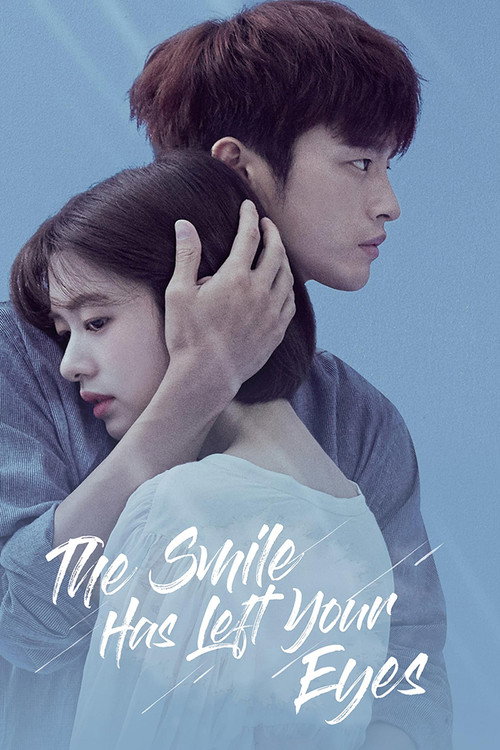
The Smile Has Left Your Eyes
A wintry Korean noir-melodrama where love arrives like a confession and a suspicion at once — two damaged people orbiting a staged suicide, smiling with everything except their eyes.
The Smile Has Left Your Eyes

하늘에서 내리는 일억개의 별

03 October 2018 — 22 November 2018 South Korea 1 season 16 episode Ended 8.0 (103)

Cast: Seo In-guk, Jung So-min, Park Sung-woong, Seo Eun-soo, Jang Young-nam

Drama Crime Mystery Memory, amnesia and the invention of a self Love as recognition between damaged people The sins of the fathers Suspicion and the impossibility of knowing another person Exhaustion, guardianship and the wearing-down of a family

The Smile Has Left Your Eyes — Ending Explained

⚠️ Spoiler Analysis

Full spoilers for the entire series.

The inciting crime. The story begins with the death of university student Jeong Mi-yeon, presented as a suicide but in fact a murder. That single act of disguise sets the pattern for everything that follows: in this world, violence is routinely dressed as something more palatable, and the people with the means to do the dressing are the people with money.

The suspect. Detective Yoo Jin-kook's investigation drives Kim Moo-young to the center of the case just as Moo-young becomes involved with Jin-kook's sister, Jin-kang. The series sustains its tension by keeping Moo-young genuinely ambiguous — his amnesia means neither he nor the audience can vouch for him, and his charm is indistinguishable from menace by design.

The sibling threat. The drama's cruellest late-stage device is the possibility that Moo-young and Jin-kang are blood relatives, which would make their relationship not merely dangerous but forbidden. The finale resolves it: they were not siblings. The revelation arrives too late to do them any good, which is precisely its function — the fear alone was enough to inflict the damage.

The real villains. The mystery's answer is not a lone psychopath but a family. The wealthy CEO's household is exposed as the force behind the story's deaths, and in the endgame the CEO father dispatches a subordinate to kill the couple. This is the point at which the drama's investigative plot collapses into its thematic one: the sins of the fathers, paid for by the children, enforced by hired hands.

The finale. Episode 16 is a tragedy in the plainest sense. The ending is unhappy and disconcerting, explicitly compared by recappers to Romeo and Juliet — two people who could have been happy, destroyed by an older generation's power. The series closes on Moo-young's last words: I love you.

What only becomes clear afterward. Rewatched with the ending known, the show reveals itself as never having been a whodunit. The question was never did he do it but will anyone let him be anything other than what his origins assigned him — and the answer, delivered by a hired killer, is no. Moo-young's emotional flatness in the early episodes reads differently too: not the blankness of a suspect, but the anaesthesia of someone who learned early that feeling is a liability. His final line is therefore the arc's completion rather than its consolation. A man introduced as incapable of genuine emotion dies having produced exactly one certainty, and the series ends without letting that certainty save him.

Alternative Interpretations

Tragedy of fate versus tragedy of class. One reading takes the show at its Romeo-and-Juliet word: two people simply born under the wrong star, whose love was never survivable. The competing reading — the one most reviewers gravitated toward — is materialist: nothing about the ending is cosmic, because it is the CEO's family that sends a killer. The stars are a metaphor the powerful can afford; the deaths are a business decision.

Is Kim Moo-young a monster or a mirror? The series is engineered so that both stay live. Read one way, his emptiness is pathology and the investigation is correct to circle him. Read the other, he is the surface on which everyone else projects their guilt — the amnesiac who can be assigned any past, and the character everyone finds guilty because it is cheaper than examining themselves.

The ending as cruelty or as mercy. Some viewers experienced the finale as a betrayal — a punishment inflicted on characters who had already suffered enough. Others argued that a happy ending would have been unrealistic for a story this dark, and that the tragedy fits both the narrative and the character arcs. A third reading is quieter: that Moo-young's last words make the ending a completion rather than a defeat, since a man who began the story unable to feel ends it able to say the one true thing.

The sibling question. The late revelation that the pair were not blood-related can be read as relief, as bitter irony (the barrier was never real, and they died anyway), or as a critique of how thoroughly the fear of taboo can poison a relationship before any fact arrives to settle it.

Explore More About This Movie

Dive deeper into specific aspects of the movie with our detailed analysis pages

Similar Movies