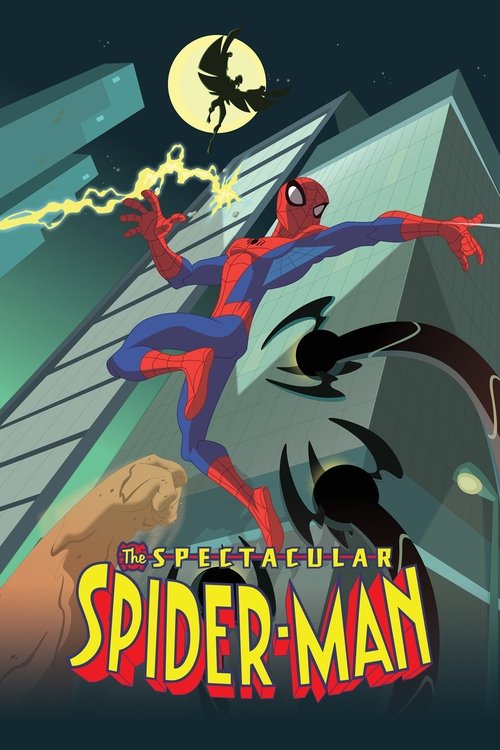
The Spectacular Spider-Man
Overview
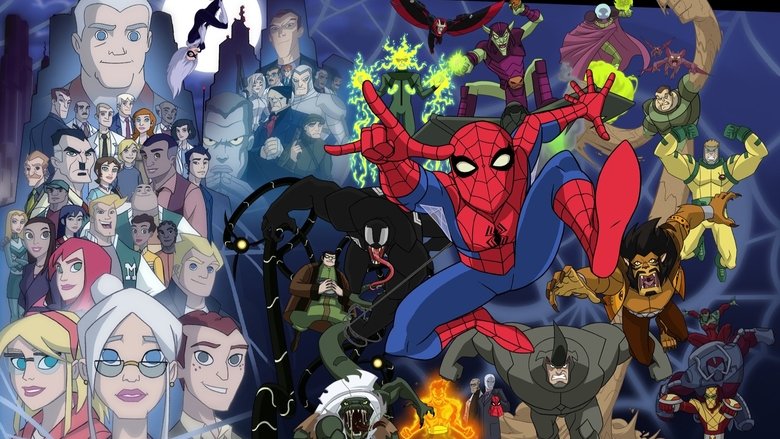
"The Spectacular Spider-Man" chronicles the early adventures of Peter Parker, a high school junior recently endowed with superhuman abilities. The series is structured by school semesters, with Season 1 covering the fall and Season 2 the winter. Peter must navigate the dual challenges of being a teenager—dealing with friendships, romance, and school bullies—while also protecting New York City as the masked hero Spider-Man. He takes on a freelance photography job at the Daily Bugle to help his Aunt May with their finances, all while trying to maintain a lab internship at Empire State University under Dr. Curt Connors.
Throughout its two seasons, the series introduces a vast array of iconic villains, many of whom are scientifically created, often with ties to major corporations like Oscorp or the crime lord known as the Big Man (Tombstone). These introductions are methodical, often establishing the characters as regular people before their villainous transformations. The overarching narrative masterfully weaves Peter's personal life with his superhero exploits, demonstrating how his choices in one realm directly and often tragically impact the other. The series blends classic comic book storylines from various eras with a modern, cohesive sensibility, focusing intently on the theme of "the education of Peter Parker".
Core Meaning
The core meaning of "The Spectacular Spider-Man" revolves around the immense difficulty and inherent sacrifice of living a life of responsibility. It explores the idea that true heroism isn't just about defeating villains, but about enduring the personal costs that come with doing the right thing. The series poignantly illustrates that for every victory Spider-Man achieves, Peter Parker often suffers a loss, whether it's a strained friendship, a missed opportunity, or a personal heartbreak. The creators aimed to convey the classic Spider-Man message—"With great power comes great responsibility"—not as a simple catchphrase, but as a relentless, character-defining struggle that Peter must face every single day, forcing him to grow from an intelligent teenager into a mature, resilient hero.
Thematic DNA
Responsibility vs. Personal Desire
This is the central theme of the series. Peter constantly struggles to balance his duties as Spider-Man with his life as a high school student. His superhero activities frequently cause him to be late, miss dates with Gwen Stacy and Liz Allan, and neglect his friendships, particularly with Harry Osborn. The show emphasizes that his responsibility is a choice he must remake daily, often at the expense of his own happiness, such as having to leave a date to fight a supervillain or seeing his relationships crumble because he cannot explain his frequent absences.
The Consequences of Power and Science
Many of the series' villains are born from scientific ambition gone awry, funded by powerful figures like Norman Osborn and Tombstone. Characters like Dr. Otto Octavius (Doctor Octopus) and Dr. Curt Connors (The Lizard) are tragic figures whose pursuit of knowledge or self-improvement leads to their monstrous transformations. The show consistently explores the theme that scientific power, much like Peter's own, carries immense risks and can corrupt even those with good intentions, acting as a dark mirror to Peter's own journey.
Secrets and Double Lives
Peter's secret identity is a constant source of conflict and isolation. The inability to share his biggest secret strains his relationships with everyone he cares about, including Aunt May, Gwen Stacy, and Harry Osborn. This theme is amplified through other characters who also lead double lives, most notably Norman Osborn as the Green Goblin. The series delves into the psychological toll of maintaining these secrets and the inevitable catastrophic fallout when they are threatened or revealed, as seen during Venom's attempts to expose Peter.
Growing Up and Making Choices
Structured around the high school calendar, the series is fundamentally a coming-of-age story. Peter is forced to make adult choices with life-and-death consequences while still navigating typical teenage problems like love triangles and bullying. His evolution from a nerdy outcast to a more confident individual is a key arc, as is his complex relationship with Flash Thompson, who develops from a simple bully into a surprising ally. The series posits that growing up is a series of difficult, often painful choices that define one's character.
Character Analysis
Peter Parker / Spider-Man
Josh Keaton
Motivation
Peter's primary motivation is the lesson taught by the death of his Uncle Ben: "With great power comes great responsibility." This guilt and sense of duty drive him to protect the innocent, no matter the personal cost. Initially, he's also motivated by the need to help Aunt May financially. As the series progresses, his motivation deepens to protecting his friends and loved ones from the dangerous world he inhabits, a world his own existence as Spider-Man often complicates.
Character Arc
Peter begins the series as a brilliant but socially awkward high school junior, still grappling with his newfound powers and the guilt over his Uncle Ben's death. Across two seasons, he grows in confidence, both as Peter Parker and as Spider-Man. Season 1 sees him learning the ropes, making mistakes, and establishing his moral code. The symbiote saga in particular forces him to confront his own inner darkness. In Season 2, his life becomes exponentially more complicated with a messy love triangle between Gwen Stacy and Liz Allan, and his relationships are tested to their limits. By the end of the series, he has matured significantly, accepting the immense personal sacrifices required of him and solidifying his commitment to being Spider-Man, tragically demonstrated by his inability to be with Gwen after her father's death, despite them both confessing their love.
Gwen Stacy
Lacey Chabert
Motivation
Gwen is motivated by her loyalty and affection for her friends, especially Peter. She consistently tries to do the right thing, whether it's helping Peter with his studies, worrying about Harry's strange behavior, or supporting her father. Her motivation evolves to include a desire for a genuine, honest relationship with Peter, which is constantly thwarted by circumstances.
Character Arc
Initially Peter's best friend, Gwen is depicted as intelligent, kind, and observant. Throughout Season 1, her unrequited crush on Peter is a central emotional thread. She supports him academically and emotionally, even while he remains oblivious to her feelings. In Season 2, she gains more confidence, begins dating Harry Osborn, but her feelings for Peter remain. Her arc culminates in her confessing her love for Peter, and he for her, in the final episode. However, their future is left uncertain due to the tragic death of her father and Harry's descent into villainy, forcing her to stand by Harry in his time of need.
Harry Osborn / Green Goblin
James Arnold Taylor
Motivation
Harry's core motivation is a desperate need for his father's approval and affection. This drives him to take the Globulin Green and later fuels his resentment and anger. After Norman's supposed death, his motivation shifts entirely to seeking revenge against Spider-Man, whom he believes murdered his father.
Character Arc
Harry starts as Peter's best friend, living in the shadow of his brilliant and emotionally distant father, Norman. Desperate for his father's approval, he experiments with a performance-enhancing formula ('Globulin Green'), which increases his physical abilities but also makes him erratic and aggressive. He briefly takes on the mantle of the Green Goblin, though it's later revealed this was part of his father's manipulation. In Season 2, after a stint in Europe, he returns seemingly more stable but is deeply resentful of Spider-Man, whom he blames for his problems. His arc ends in tragedy as he discovers his father was the true Green Goblin all along and, following Norman's apparent death, vows revenge on Spider-Man, embracing a darker path.
Norman Osborn / Green Goblin
Alan Rachins
Motivation
Norman is driven by an insatiable hunger for power and control. He sees everyone, including his own son, as a pawn in his intricate schemes. His creation of the Green Goblin persona is the ultimate expression of his desire to operate without limits, sowing chaos to achieve his goals and eliminate his rivals in the criminal underworld.
Character Arc
Presented as a brilliant but ruthless businessman and a neglectful father, Norman Osborn is a master manipulator. Throughout Season 1, he is secretly orchestrating events, testing his Globulin Green formula and observing Spider-Man. He masterfully frames Harry as the first Green Goblin to divert suspicion. In Season 2, he takes on a mentor role for Peter while secretly continuing his criminal activities. His arc climaxes with the revelation that he has been the Green Goblin all along, leading to a dramatic final battle with Spider-Man. He fakes his own death and flees the country, leaving his son to believe Spider-Man is a murderer and cementing his legacy of manipulation and destruction.
Symbols & Motifs
The Spider-Man Mask
The mask symbolizes the barrier between Peter Parker's personal life and his heroic responsibilities. It represents the secret he must keep and the isolation that comes with it. Visually, the series often uses a half-masked face to show his internal conflict, a direct homage to the art of Steve Ditko.
The symbol is present in every episode. Pivotal moments, like his struggle to remove the symbiote suit or his emotional turmoil over his choices, are often accompanied by shots of him putting on, taking off, or being reflected in the mask's lenses, highlighting his divided self.
The Color Green
According to the creators, the color green was intentionally used to symbolize evil, corruption, and threat within Spider-Man's world. It connects many of his greatest adversaries and the corrupting influences in his life.
The color is prominent in the costumes and powers of major villains like the Green Goblin, Doctor Octopus, the Vulture, Sandman, and the Lizard. It also appears in the environments associated with danger or negativity, subtly reinforcing the presence of evil.
Oscorp and The Big Man's Empire
These two entities symbolize the pervasive, institutional nature of corruption. They represent the idea that evil isn't just random street crime, but a systemic force driven by greed and ambition. Many of Spider-Man's villains are products of these organizations, showing that his fight is against a much larger, interconnected web of crime and unethical science.
Throughout both seasons, it's revealed that Oscorp technology or funding from the Big Man (Tombstone) is behind the creation of villains like Rhino, Sandman, and Electro. This creates an ongoing narrative thread where Spider-Man isn't just fighting individual criminals, but chipping away at a larger, organized threat.
Memorable Quotes
Face it, Tiger... you just hit the jackpot!
— Mary Jane Watson
Context:
Season 1, Episode 6, "The Invisible Hand". After much anticipation and Peter's reluctance, Aunt May finally arranges for him to meet Mary Jane. When she appears at the door and delivers the line, both Peter and the audience are instantly captivated.
Meaning:
This iconic line, adapted from the comics, signifies Mary Jane's confident, charismatic, and scene-stealing personality. It marks her official, impactful introduction into Peter's life, immediately establishing her as a significant and dynamic presence who is the polar opposite of the more reserved Gwen Stacy.
With great power comes great responsibility.
— Ben Parker
Context:
Season 1, Episode 12, "Intervention". As Peter struggles to free himself from the corrupting influence of the alien symbiote, he delves into his own subconscious. A memory of his Uncle Ben saying these words gives him the strength to finally reject the suit, reaffirming his identity as a hero.
Meaning:
This is the foundational credo of the Spider-Man mythos. The quote serves as Peter's moral compass and the driving force behind all of his actions as a hero. The series uses it not as an origin story beat, but as a recurring memory that strengthens Peter's resolve during his darkest moments.
You can web me up anytime, Petey.
— Liz Allan
Context:
This line is spoken when Liz reacts to Peter's Spider-Man “costume” at the school's Halloween party, showing her growing affection for him and complicating Peter's feelings for Gwen.
Meaning:
This quote highlights Liz Allan's transformation from Flash Thompson's girlfriend who barely noticed Peter to someone openly attracted to him. It signifies the shift in Peter's social standing and the beginning of the complex love triangle that defines much of Season 2.
Episode Highlights
Natural Selection
This episode features the tragic transformation of Dr. Curt Connors into the Lizard. It's a pivotal early episode that establishes the series' theme of personal connections to villains. Peter is forced to fight his mentor and friend, showcasing his determination to save people, not just defeat them. It also deepens the character of Eddie Brock, who blames Spider-Man for the transformation.
It sets the emotional stakes for the series by demonstrating that Peter's battles will often be against people he knows and cares about, making his victories bittersweet and his struggles more profound.
Group Therapy
The Sinister Six (Doctor Octopus, Vulture, Shocker, Rhino, Sandman, and Electro) band together for the first time to take down Spider-Man. Overwhelmed, Peter is almost defeated until the alien symbiote, which he is wearing as his new black suit, takes over his unconscious body and defeats the villains with brutal efficiency.
This episode marks a major turning point in the symbiote arc, revealing the suit's dangerous and violent nature. It's the first clear sign that the black suit is not just a costume but a malevolent entity influencing Peter's actions.
Intervention
Peter realizes the symbiote is evil and struggles to remove it. The episode delves into his psyche, exploring his origin and the memory of Uncle Ben for the first time in the series. He relives the guilt that drives him and uses that emotional core to find the strength to finally reject the symbiote in a church bell tower.
It serves as the show's de-facto origin story, grounding Peter's heroism in his past trauma and moral foundation. It's a powerful character study that sets the stage for the creation of Venom.
Nature vs. Nurture
The Season 1 finale features the birth of Venom. After Peter rejects the symbiote, it bonds with a disgraced and vengeful Eddie Brock. The resulting battle is intensely personal, as Venom knows everything about Peter, including his secret identity. The fight culminates during the Thanksgiving Day Parade, with Venom targeting Gwen Stacy to hurt Peter.
This episode establishes Venom as Peter's ultimate dark reflection and most personal nemesis. It masterfully pays off the season-long arc of Peter and Eddie's deteriorating friendship, ending the season on a dramatic and emotional cliffhanger.
Shear Strength
While dealing with the aftermath of a fight with Doctor Octopus that leaves him with a broken leg, Peter must also juggle his increasingly complicated love life. The episode culminates in an iconic sequence where Spider-Man, pushed to his absolute limit, must summon all his strength to save civilians from a collapsing structure created by Doc Ock.
This episode is a testament to Spider-Man's indomitable will. It highlights his physical and emotional vulnerability while ultimately showcasing the core of his heroism: refusing to give up, no matter the odds or the personal pain.
Final Curtain
The series finale. Spider-Man confronts the Green Goblin, believing it to be Harry, only to discover that it was Norman Osborn all along. The ensuing battle appears to end with Norman's death. The fallout is immense: Peter and Gwen finally confess their love but cannot be together, and a grieving Harry vows revenge on Spider-Man, setting up a tragic conflict for the cancelled third season.
As the final episode, it brings the season's central mystery to a stunning and tragic conclusion. It resolves the love triangle in the most painful way possible and leaves the series on a powerful, emotionally complex cliffhanger that has resonated with fans for years.
Philosophical Questions
Can one maintain a moral compass when constantly forced to make impossible choices?
The series continuously tests Peter's ethics through the 'Parker Luck,' where any choice he makes seems to have a negative consequence for his personal life. He is constantly forced to choose between his duty as Spider-Man and his responsibilities as Peter Parker. The show explores whether it's possible to remain a good person when your actions, even heroic ones, inadvertently cause pain to those you love. This is exemplified in the finale, where his victory over the Green Goblin leads to the destruction of his relationships with both Harry and Gwen.
What is the true nature of identity: the person you are, or the mask you wear?
Peter Parker's dual life is the central conflict exploring this question. The series delves into how his confidence as Spider-Man begins to influence Peter, and conversely, how Peter's anxieties and vulnerabilities affect Spider-Man. The symbiote arc is the most direct exploration of this, where the 'mask' literally tries to consume the person underneath. Furthermore, characters like Norman Osborn show a complete merging of the man and the monstrous 'mask' of the Green Goblin, suggesting that a secret identity can ultimately reveal, rather than conceal, one's true nature.
Alternative Interpretations
One alternative reading of the series, particularly its villain portrayals, is that it serves as a critique of corporate greed and the military-industrial complex. Many of the supervillains are not independent criminals but are created, funded, or manipulated by powerful corporate figures like Norman Osborn and Tombstone for profit or to eliminate competition. From this perspective, Spider-Man isn't just fighting costumed criminals; he's fighting the symptoms of a corrupt system where scientific ethics are abandoned for power and financial gain. The villains become tragic, blue-collar victims of this system, transformed against their will or out of desperation, making them foils for the working-class hero Peter Parker.
Cultural Impact
Despite its short run of only 26 episodes, "The Spectacular Spider-Man" is widely regarded by critics and audiences as one of the best, if not the best, animated adaptations of the character. Its acclaim stems from its mature and intelligent writing, which balanced high-stakes action with genuine teen drama and emotional depth, reminiscent of series like "Batman: The Animated Series". The show was praised for its faithfulness to the spirit of the early Stan Lee, Steve Ditko, and John Romita Sr. comics while modernizing the setting and condensing the timeline effectively.
The series' premature cancellation due to corporate rights issues between Sony and Disney/Marvel became a rallying cry for its dedicated fanbase. For over a decade, fans have campaigned for its revival with hashtags like #SaveSpectacularSpiderMan, demonstrating its lasting legacy and emotional connection with viewers. Its influence is seen in the high bar it set for subsequent Spider-Man adaptations. Many later shows and films have been compared, often unfavorably, to its nuanced characterizations and serialized storytelling. The brief, fan-celebrated cameo of its specific Spider-Man in "Spider-Man: Across the Spider-Verse" was a direct acknowledgment of the show's enduring popularity and impact on pop culture.
Audience Reception
"The Spectacular Spider-Man" received widespread critical acclaim and overwhelmingly positive audience reception during and after its run. It is frequently cited by fans as the definitive animated version of the character. Viewers praised its intelligent, multi-layered storytelling, complex character development, and respect for the source material. The voice acting, particularly Josh Keaton's performance as Peter Parker/Spider-Man, was consistently highlighted for its perfect balance of witty humor and emotional weight. The unique, stylized animation, while initially divisive for some, was ultimately praised for allowing incredibly fluid and dynamic action sequences.
The main point of criticism is virtually nonexistent, with the overwhelming sentiment being profound disappointment at its abrupt cancellation. The unresolved cliffhangers of the Season 2 finale—Norman Osborn's escape, Harry's vow of revenge, and the fractured relationship between Peter and Gwen—are a constant point of discussion and lament within the fanbase, fueling the persistent and passionate campaigns for the show's revival.
Interesting Facts
- The series was co-developed by Greg Weisman, famous for creating the acclaimed animated series "Gargoyles".
- The show's cancellation after two seasons was not due to poor ratings but because of a complex rights issue between Sony (who produced the show) and Disney (who had acquired Marvel). Sony gave up the TV rights to Spider-Man to retain the more lucrative film rights, but they still owned the specific assets of "The Spectacular Spider-Man," making it impossible for Disney's Marvel to continue it without licensing it back from a competitor.
- The creators had plans for the series to run for five seasons (65 episodes), which would have followed Peter through his high school graduation, with direct-to-DVD movies planned to cover his college years.
- The iconic opening credits feature a shot of Spider-Man swinging with a criminal under his arm, which is a direct recreation of the cover of his first appearance in "Amazing Fantasy #15".
- This was the first Spider-Man animated series where Gwen Stacy and her father, Captain George Stacy, were series regulars, giving Gwen a prominent role that was often overlooked in previous adaptations in favor of Mary Jane Watson.
- The initial DVD release plan was to edit three-episode arcs into mini-movies with additional bridging footage, but this idea was scrapped after the first volume.
- Several voice actors from "Gargoyles" were cast in the show, including Keith David (who briefly voiced Tombstone) and Ed Asner (who voiced Uncle Ben).
- Josh Keaton's version of the character made a canon appearance in the 2023 film "Spider-Man: Across the Spider-Verse," officially bringing this iteration into the wider multiverse.
Easter Eggs
Creator Cameos
Several members of the production staff have brief, hidden cameos in the show. Supervising producer Greg Weisman appears in the opening credits in the crowd in Times Square and again in the episode "Gangland". Supervising director Victor Cook appears as a DJ in "Blueprints".
Shocker's Identity
In the series, Shocker's alter ego is Jackson Brice. In the comics, Brice is the villain Montana, a member of the Enforcers, while Shocker is Herman Schultz. The show combined these characters to streamline the story.
A Background Romance
A man and a woman who Spider-Man saves in Season 1, Episode 8 ("Reaction") are later seen in the background of Season 2, Episode 10 ("Gangland"), where the man proposes to the woman. This creates a subtle, ongoing romantic storyline for two background characters across the series.
⚠️ Spoiler Analysis
Click to reveal detailed analysis with spoilers
Frequently Asked Questions
Explore More About This Movie
Dive deeper into specific aspects of the movie with our detailed analysis pages
Comments (0)
No comments yet. Be the first to share your thoughts!