Skip to content
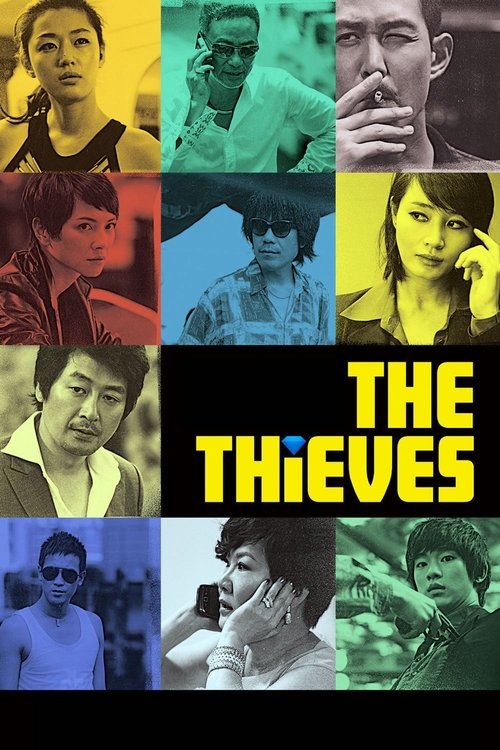
The Thieves
A slick, neon-drenched caper radiating kinetic romance and bitter cynicism, playing out like a razor-sharp high-wire tango danced across towering skyscrapers where every partner conceals a blade.
The Thieves

The Thieves

도둑들

"All for the money. One for the revenge. Every man for himself."

25 July 2012 Hong Kong 135 min 6.7 (338)

Director: Choi Dong-hoon

Cast: Kim Yun-seok, Kim Hye-soo, Lee Jung-jae, Gianna Jun, Simon Yam

Crime Action The Illusion of Trust & Betrayal Lingering Regret & Unspoken Love Pride, Professional Identity & Status Fate, Luck, and Ill-Gotten Gain
Box Office: $83,519,699

Overview

Following an audacious museum robbery in Seoul, a nimble Korean crew of thieves—composed of wire-walking specialist Yenicall, scheming leader Popeye, seasoned swindler Chewing Gum, and agile technician Zampano—find themselves attracting excessive heat from local police. To lay low, Popeye accepts an overseas contract proposed by his estranged mentor and mastermind, Macau Park. As an added complication, safesmith Pepsee joins them right after her release from prison, carrying deep emotional baggage and lingering resentment toward Macau Park over an unresolved heist from their past.

The team arrives in Macau and meets an allied Hong Kong contingent arranged by Macau Park: calculating gang leader Chen, tactical safe technician Julie, gunslinger Johnny, and Korean-Chinese translator Andrew. The joint 10-person syndicate targets the "Tear of the Sun," a 318-carat yellow diamond valued at $20 million, held in a high-security vault inside a heavily guarded casino-resort belonging to ruthless criminal mastermind Wei Hong.

Beneath the veneer of cross-border collaboration, mutual paranoia festers. Both crews quickly devise their own hidden agendas and double-crosses to walk away with the prize solo, igniting a tense, multi-layered game of cat and mouse where deception is the only currency.
Core Meaning

Director Choi Dong-hoon uses the high-stakes heist format to examine how greed, emotional insecurity, and unhealed betrayal erode human relationships. The film's underlying thesis suggests that material wealth never truly satisfies a thief's spiritual void: characters are perpetually trapped in cycles of poverty not from a lack of skill, but because their emotional debts, mistrust, and self-serving impulses devalue whatever they manage to steal.

Thematic DNA

The Illusion of Trust & Betrayal 35%
Lingering Regret & Unspoken Love 25%
Pride, Professional Identity & Status 20%
Fate, Luck, and Ill-Gotten Gain 20%

The Illusion of Trust & Betrayal

In an industry built on subterfuge, genuine alliance is impossible. Every alliance between the thieves fractures under the gravitational pull of personal greed, yet complete isolation proves equally fatal.

Lingering Regret & Unspoken Love

Beneath the gunfire and jewel chases, the primary conflicts are driven by heartbreak—Macau Park and Pepsee's tragic misunderstanding, Chewing Gum and Chen’s late-in-life romance, and Zampano’s unreciprocated devotion to Yenicall.

Pride, Professional Identity & Status

Characters consistently prioritize personal professional pride over practical safety, driven by the desire to prove they are the premier operators in their respective crafts.

Fate, Luck, and Ill-Gotten Gain

Fortune within criminal ventures is transient. Ill-gotten wealth invariably extracts an emotional or physical toll on those who seize it.

Character Analysis

Macau Park

Kim Yun-seok

Archetype: The Mysterious Mastermind / Antihero Key Trait: Cunning, stoic, and exceptionally composed under pressure.

Motivation

Avenge his father's death by bringing down Wei Hong, while protecting Pepsee from afar.

Character Arc

Shifts from a seemingly cold traitor into an emotionally wounded protector seeking retribution and closure.

Pepsee

Kim Hye-soo

Archetype: The Safecracker / Tragic Romantic Key Trait: Highly perceptive, sharp-tongued, yet emotionally vulnerable.

Motivation

Seek the truth about Macau Park's four-year-old betrayal and reclaim her identity.

Character Arc

Evolves from an embittered ex-convict seeking closure into an observant woman who uncovers the truth of the past.

All 5 characters and cast

Symbols & Motifs

The "Tear of the Sun" Diamond

Meaning:

Represents vanity, unattainable desire, and catastrophic temptation.

Context:

The jewel acts as the central prize that brings ruin and death to almost everyone who attempts to claim or hold it.

Wires and Ropes

Meaning:

Symbolize precarious existence, physical dependence, and emotional suspension.

Context:

Used throughout acrobatic infiltrations; a cut wire represents lethal betrayal, while clinging to one becomes a literal fight for survival.

Safes and Locks

Meaning:

Represent guarded human hearts and hidden truths.

Context:

Pepsee can crack complex mechanical combinations with ease, yet struggles to open the vault of her own suppressed emotions and past trauma.

Chewing Gum / Dreams

Meaning:

An omen of manufactured optimism and false security.

Context:

Chewing Gum purchasing a dream from Yenicall highlights how fleeting romantic illusions cannot protect criminals from harsh realities.

Macau vs. Busan Architecture

Meaning:

Contrasts grandiose ambition with raw survival instincts.

Context:

The gleaming, sterile casino towers of Macau reflect elaborate greed, whereas the decaying, weathered facade of the Busan apartment complex strips the characters down to primal desperation.

Memorable Quotes

너 도둑이 왜 가난한 줄 아니? 비싼 거 훔쳐서 싸게 팔잖아.
— Pepsee (Kim Hye-soo)

Context

Spoken to Yenicall during a car ride right after Pepsee's release from prison.

Meaning

Succinctly encapsulates the tragic economic irony and perpetual cycle of their profession.

아주 어~마어마한 쌍년 같아.
— Yenicall (Jun Ji-hyun)

Context

Spoken when Chewing Gum asks Yenicall about her first impression of Pepsee.

Meaning

Became one of the most famous pop-culture lines of 2012 due to its comedic, brassy delivery.

All 6 quotes

Philosophical Questions

Can trust exist between people whose entire survival is predicated on deception?

Explored through the fragile alliances of the syndicate, where professional reliance constantly collides with pre-emptive betrayals and hidden agendas.

Is revenge worth the absolute destruction of one's remaining relationships?

Examined through Macau Park’s relentless pursuit of Wei Hong, which forces him to deceive allies and conceal truths from the woman he loves.

Does extreme wealth bring freedom, or simply create larger, more dangerous prisons?

Highlighted by the fate of the thieves, who remain trapped by economic ironies, legal pursuit, and emotional isolation regardless of their monetary scores.

Alternative Interpretations

Critics and audiences frequently analyze two key ambiguities:

Full ending explanation

Cultural Impact

The Thieves marked the pinnacle of modern Pan-Asian blockbuster packaging in 2012. Following a period where Korean blockbusters were strictly domestic or historical dramas, Choi Dong-hoon successfully merged Korean screenwriting with Hong Kong cinema legacy. The film revitalized Jun Ji-hyun’s domestic star power, directly paving the way for her pan-Asian TV renaissance in My Love from the Star (co-starring Kim Soo-hyun).

Audience Reception

The Thieves received widespread acclaim and achieved historic commercial success:

  • Praise: Universally praised for electric cast chemistry, Jun Ji-hyun’s comedic timing, slick editing, and the inventive vertical wire shootout in Busan.
  • Criticism: Minor criticisms targeted its 135-minute runtime and the tonal pivot from an upbeat caper into a bleak, violent gangland thriller in the third act.
  • Overall Verdict: Considered one of the most entertaining and commercially accomplished heist films in Asian cinema history.

Interesting Facts

  • The Thieves recorded over 12.98 million admissions domestically, breaking the 6-year box-office record previously held by Bong Joon-ho's The Host (2006) to become South Korea's highest-grossing domestic film at that time.
  • Director Choi Dong-hoon wrote the character of Yenicall specifically for Jun Ji-hyun after meeting her in person and noticing her dynamic, unfiltered humor.
  • Jun Ji-hyun performed the vast majority of her rooftop rappelling and horizontal wire-jumping sequences without a stunt double.
  • The complex exterior wall shootout in Busan took an entire month to film in sweltering summer heat, utilizing intricate harness rigs on an actual residential complex.
  • Dialogue across the film organically switches between Korean, Cantonese, Mandarin, Japanese, and English, shot across Macau, Hong Kong, Seoul, and Busan.

Easter Eggs

Shin Ha-kyun's Cameo

Star actor Shin Ha-kyun makes a comedic special appearance as Lee, the art gallery director seduced and robbed by Yenicall in the opening prologue.

Homage to Hong Kong Heroic Bloodshed

The shootout involving Simon Yam pays stylistic tribute to classic Johnnie To and John Woo crime thrillers, especially through Yam's stoic two-gun posture.

Reference to Fellini's La Strada

The character name Zampano is a direct nod to Anthony Quinn's strongman character in Federico Fellini's 1954 classic La Strada.

Yenicall's Ankle Tattoo

Yenicall sports an ankle tattoo reading "Happy Ending Is Mine," which foreshadows her ultimate survival and opportunistic instincts.

Frequently Asked Questions

Explore More About This Movie

Dive deeper into specific aspects of the movie with our detailed analysis pages

Comments (0)

Leave a comment

No comments yet. Be the first to share your thoughts!

Similar Movies