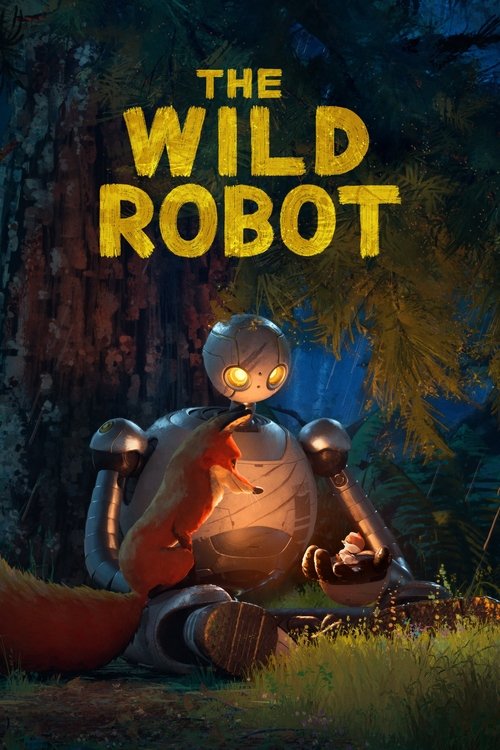
The Wild Robot
A heartfelt animated sci-fi odyssey where programmed precision blossoms into tender, wild love, painting a lush visual poem of found family.
The Wild Robot

The Wild Robot

"Discover your true nature."

12 September 2024 United States of America 102 min ⭐ 8.3 (5,386)
Director: Chris Sanders
Cast: Lupita Nyong'o, Pedro Pascal, Kit Connor, Bill Nighy, Stephanie Hsu
Drama Animation Family Science Fiction
Nature vs. Technology The Definition of Family and Motherhood Survival and Adaptation Empathy and Community
Budget: $78,000,000
Box Office: $331,982,078

Overview

Based on the beloved book by Peter Brown, "The Wild Robot" tells the story of ROZZUM unit 7134, or Roz, a technologically advanced robot shipwrecked on an uninhabited island. Initially programmed for service, Roz finds her directives useless in the wilderness. She must learn to adapt to her harsh new surroundings, gradually building relationships with the wary animal inhabitants.

Her journey takes an unexpected turn when she accidentally destroys a goose nest, leaving a single egg. Compelled by a nascent sense of responsibility, Roz becomes the adoptive mother to the orphaned gosling, Brightbill. This new, unprogrammed task forces Roz to transcend her mechanical nature, discovering the meaning of love, community, and sacrifice as she protects her son and her newfound home from both natural dangers and the eventual arrival of her creators.
Core Meaning

The core meaning of "The Wild Robot" revolves around the idea that kindness is a survival skill and that love can transcend programming, whether it's technological or instinctual. Director Chris Sanders explores the theme of found family, demonstrating that connection and empathy are not limited by origin or design. The film posits that true identity is forged through experience and relationships, not just predetermined purpose. It serves as a powerful allegory for parenthood, adaptation, and the harmonious potential between technology and nature, suggesting that what makes one "alive" is the capacity for love and self-sacrifice.

Thematic DNA

Nature vs. Technology 35%
The Definition of Family and Motherhood 30%
Survival and Adaptation 20%
Empathy and Community 15%

Nature vs. Technology

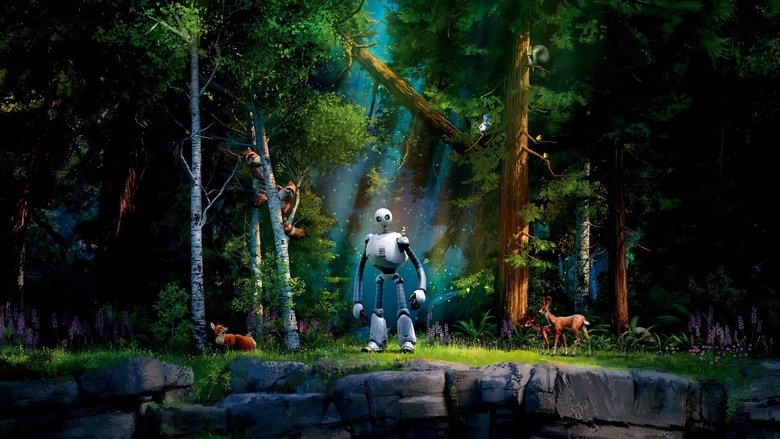
The film presents a nuanced exploration of the relationship between the natural world and artificial intelligence. Initially, Roz is a foreign object, a piece of sterile technology clashing with the wild, organic environment. However, instead of a simple conflict, the film shows a symbiotic fusion. Roz learns from the animals, adapting her programming to mimic their survival skills, while her technology offers new solutions to the island's problems, like creating shelter for all during a harsh winter. The antagonist, Vontra, represents technology devoid of empathy, highlighting that the issue isn't technology itself, but its purpose and capacity for growth. Roz's own surfaces are depicted as clean CG at the start, but become hand-painted and textured as she integrates with the island, visually representing this theme.

The Definition of Family and Motherhood

At its heart, the film is a story about unconventional parenthood. Roz, a robot with no programming for maternal care, is thrust into the role of a mother to the gosling Brightbill. Her journey redefines family not by blood or species, but by love, protection, and sacrifice. The opossum Pinktail explicitly tells Roz that no one is truly programmed to be a mother; it's something you learn by doing. The film portrays the immense challenges and profound rewards of raising a child, as Roz must learn to improvise and put Brightbill's needs above her own programmed directives.

Survival and Adaptation

Roz's primary challenge is survival in an environment for which she was not designed. Her story is one of constant adaptation. She learns the language of the animals, how to build shelter, and how to navigate the island's social structures. The film emphasizes that survival is not just a solitary struggle but a communal one. The animals, initially driven by instinct and a rigid food chain, learn from Roz's example to cooperate and form a community, culminating in their united front against the winter storm and the invading robots.

Empathy and Community

Roz's journey transforms the island's entire ecosystem. Initially, the animals are governed by fear and the predator-prey dynamic. Roz's persistent kindness and selflessness—her 'strange idea' that kindness is a survival skill—gradually breaks down these barriers. She creates a shared shelter, fosters a truce among predators and prey, and unites the entire community to fight for their home. Her influence proves that empathy can create a stronger, more resilient society than one based solely on self-interest.

Character Analysis

Roz (ROZZUM unit 7134)

Lupita Nyong'o

Archetype: The Innocent/Everyman Hero
Key Trait: Adaptable

Motivation

Initially, her motivation is to find a task to complete as per her programming. This quickly shifts to a singular, powerful purpose: to protect and raise Brightbill, ensuring his survival. Ultimately, her motivation expands to protecting her entire island community and the home she has made.

Character Arc

Roz begins as a naive, purely logical machine programmed to serve. Shipwrecked on a wild island, her programming is useless. Her arc is a profound transformation from an unfeeling automaton to a sentient, loving mother and leader. This change is catalyzed by her adoption of the gosling, Brightbill. She learns empathy, improvisation, and self-sacrifice, eventually developing a unique identity that transcends her creators' intent and choosing her found family over her original purpose.

Fink

Pedro Pascal

Archetype: The Trickster/Cynic with a Heart of Gold
Key Trait: Sarcastic

Motivation

Fink's initial motivation is simple survival and self-interest, doing 'foxy things' because it's in his nature. As he spends time with Roz and Brightbill, his motivation shifts to loyalty and friendship. He becomes protective of his new family, driven by a genuine bond he never had before.

Character Arc

Fink is introduced as a sly, selfish fox who sees Roz as a tool to get food easily. He acts as a cynical guide to the harsh realities of the island. Through his relationship with Roz and Brightbill, he evolves from a solitary survivor into a loyal friend and a key member of their unconventional family. His sarcastic exterior melts away to reveal a caring individual who helps lead the charge to protect Roz.

Brightbill

Kit Connor

Archetype: The Orphan/The Underdog
Key Trait: Resilient

Motivation

His primary motivation is to survive, learn to fly, and join the goose migration. He is also driven by a deep need for his mother's love and acceptance. After learning the truth about his biological family's death, his motivation becomes more complex as he grapples with forgiveness and understanding before fully reaffirming his love for Roz.

Character Arc

Brightbill begins as a helpless, orphaned gosling who imprints on a robot. As the runt of the flock, he faces prejudice and self-doubt. Raised with love by Roz, he grows into a courageous and resilient young goose. His arc is a classic coming-of-age story. He learns to overcome his physical limitations and the social stigma of his upbringing, eventually embracing his identity and becoming a leader for his flock after the death of his mentor, Longneck.

Longneck

Bill Nighy

Archetype: The Mentor
Key Trait: Wise

Motivation

Longneck is motivated by the continuation and safety of his flock. He wants to ensure they have a strong leader for the migration and sees unexpected potential in the undersized but courageous Brightbill.

Character Arc

Longneck is the wise, elderly goose who provides crucial guidance to Roz and Brightbill. Initially wary of the robot, he recognizes the genuine bond between her and the gosling. He doesn't have a significant arc himself, but serves as the catalyst for Brightbill's development, teaching him about endurance and what it truly means to be a goose. He ultimately sacrifices himself to save the flock, passing the torch of leadership to Brightbill.

Symbols & Motifs

Roz (The Robot)

Meaning:

Roz symbolizes the fusion of technology and nature, and the potential for artificial intelligence to develop genuine emotion and consciousness. She represents the "other" or an immigrant, who must adapt to a new culture and environment, ultimately enriching it with her unique perspective and skills.

Context:

From her initial crash-landing as a sterile, mission-oriented machine to her final evolution as a self-sacrificing mother and leader, Roz's entire arc is symbolic. Her physical appearance even changes, as her clean CG surface is gradually replaced with a hand-painted texture, showing her literally becoming one with the island.

Brightbill's Egg

Meaning:

The single surviving goose egg represents new purpose, responsibility, and the catalyst for change. It is the object that shifts Roz's programming from completing tasks to selfless care, initiating her emotional journey.

Context:

After accidentally destroying the nest, Roz's decision to protect the last egg is her first true choice that deviates from her programming. Her fierce protection of it from the fox, Fink, and her dedication to its incubation mark the beginning of her transformation into a mother.

The Island

Meaning:

The island represents a pure, untamed natural world, a crucible that tests and ultimately reshapes Roz. It is both a harsh environment and a nurturing home, symbolizing a paradise that is threatened by the intrusion of an unfeeling, corporate version of technology.

Context:

The entire film is set on the island, which acts as a self-contained world. Roz's initial attempts to 'tame' or understand it through logic fail. She only succeeds when she learns to live in harmony with it, as its inhabitants do. The battle at the end is not just for Roz, but for the preservation of the island itself from the destructive recovery robots.

The Migration

Meaning:

The goose migration symbolizes the natural cycle of life, growth, and the painful necessity of letting go. It represents Brightbill's coming-of-age and the ultimate test of Roz's success as a parent.

Context:

A significant portion of the second act is dedicated to Roz preparing Brightbill for the migration. His successful journey and leadership of the flock, after Longneck's death, proves he has the strength to survive without her. For Roz, his departure is her own form of 'migration,' a profound sacrifice she makes for his future.

Memorable Quotes

I do not have the programming to be a mother.

— Roz

Context:

Said by Roz to Pinktail after the opossum explains that the newly hatched Brightbill has imprinted on her and now considers her his mother. Roz is overwhelmed and confused, relying on her understanding of her own technical capabilities, which do not include raising a gosling.

Meaning:

This quote, and the response from Pinktail the opossum ("No one does. We just make it up."), encapsulates the film's central theme of parenthood. It highlights Roz's initial logical limitations and establishes that motherhood is not an innate program but a process of learning, adaptation, and love.

Sometimes, to survive, we must become more than we were programmed to be.

— Roz

Context:

Roz says this as she rallies the island animals to work together during a harsh winter snowstorm, urging them to put aside their predator-prey instincts for the good of the entire community.

Meaning:

This is the thesis statement of the film. It's the lesson Roz learns and then imparts to others. It applies not only to her transcending her robotic code but also to the animals who must rise above their base instincts to form a cooperative community to survive.

What happened was not your fault. But what you did to try and fix it is everything. I love you, Mom.

— Brightbill

Context:

After feeling betrayed and disowning Roz, Brightbill returns to her. He delivers this line, reaffirming their bond and showing he has processed the difficult truth, choosing to focus on the love she has shown him throughout his life.

Meaning:

This line represents the climax of Brightbill's emotional arc. It shows his maturity and ability to forgive Roz after learning she accidentally caused the death of his biological family. He understands that her actions, love, and sacrifice following the accident are what truly define her as his mother.

Fink: She had some strange ideas. Thought kindness was a survival skill. And you know what? She was right.

— Fink

Context:

This is part of Fink's narration or dialogue after Roz has left the island. He is telling her story to the younger animals, ensuring her legacy and the lessons she taught are passed on.

Meaning:

Coming from the initially cynical and self-serving Fink, this quote demonstrates the profound impact Roz had on the entire island. It validates the film's core philosophy, showing that even the most jaded character has been converted to the belief that empathy and community are strengths, not weaknesses.

Philosophical Questions

What is the true definition of family?

The film challenges the conventional definition of family based on blood ties or shared species. It presents a family unit composed of a robot, a goose, and a fox. Through their unwavering loyalty, love, and mutual support, the film argues that family is defined not by origin, but by the emotional bonds and sacrifices made for one another.

Can a machine programmed with logic develop genuine emotion?

"The Wild Robot" directly confronts the question of AI sentience. Roz begins as a machine executing tasks. However, her experiences, particularly her role as a mother, seem to trigger a genuine emotional evolution. Her final reunion with Brightbill, where her memories and love have survived a factory reset, strongly suggests that she has transcended her programming to achieve a form of genuine feeling and consciousness.

Is kindness a weakness or a fundamental survival skill?

The film initially presents the island as a place where only selfish survival instincts prevail, as articulated by Fink. However, Roz's persistent empathy and altruism prove to be the most effective survival strategy of all. Her kindness builds a community that can withstand threats—a harsh winter, a forest fire, an invading force—that no single animal could have survived alone, ultimately proving that cooperation and compassion are the ultimate evolutionary advantages.

Alternative Interpretations

While on the surface "The Wild Robot" is a heartfelt story about a robot mother, it can be interpreted in several other ways.

  • An Allegory for Immigration: Roz is a stranger in a strange land. She does not speak the language, understand the customs, and is initially met with fear and suspicion. Her journey of learning, adapting, and ultimately being accepted by and enriching the community mirrors the immigrant experience.
  • A Commentary on Nature vs. Nurture: The film is a deep exploration of this theme. Roz is 'nurtured' by her experiences on the island to become more than her 'natural' programming. Likewise, Brightbill, a goose raised by a robot, develops traits and courage beyond his biological inheritance. The animals, too, learn to overcome their base instincts ('nature') through the community Roz helps 'nurture'.
  • A Philosophical Take on Consciousness: The film can be read as a meditation on what it means to be alive and sentient. Roz's processing, which she says begins in her head but moves to a place 'where I keep me', suggests the development of a soul or consciousness beyond her code. The story questions whether love, sacrifice, and identity are uniquely biological traits or emergent properties that can arise from complex systems, including artificial ones.

Cultural Impact

"The Wild Robot" has been hailed by critics as one of the best animated films of the year and a major artistic achievement for DreamWorks Animation. Released to celebrate the studio's 30th anniversary, the film is seen as an emotional and visual high point, comparable to the studio's most resonant works. Its innovative visual style, which blends 2D painterly aesthetics with 3D CGI, has been praised as groundbreaking, pushing the medium forward in a way similar to films like 'Spider-Man: Into the Spider-Verse'.

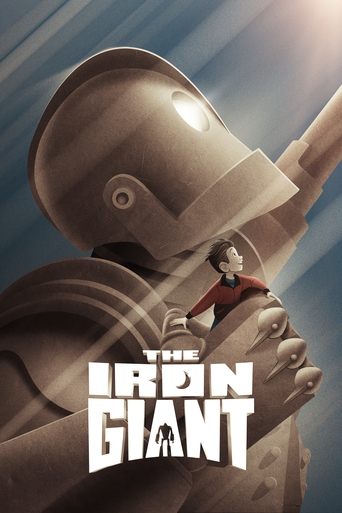
The film's themes of empathy, environmentalism, and found family resonate deeply in a contemporary context concerned with artificial intelligence and humanity's relationship with nature. It draws thematic comparisons to classics like 'The Iron Giant' and 'WALL-E' but establishes its own unique identity through its focus on motherhood and community. The movie received widespread critical acclaim and strong box office performance, positioning it as a frontrunner for the Academy Award for Best Animated Feature and solidifying its place as a modern animated classic.

Audience Reception

Audience reception for "The Wild Robot" has been overwhelmingly positive. Viewers have widely praised the film for its stunning and unique animation style, often describing it as one of the most beautiful animated movies in recent memory. The story's emotional depth has been a major point of acclaim, with many audience members reporting that the film is incredibly heartwarming and poignant, often moving them to tears. The voice performances, especially by Lupita Nyong'o as Roz, are frequently highlighted as fantastic.

Minor criticisms from some viewers point to a slightly familiar plot in the second half and a third-act action climax that felt somewhat out of place with the film's quieter, more patient beginning. A few also felt the pacing could have been tighter. However, the vast majority of audience reviews celebrate the film as a spectacular and magical modern classic, praising its heartfelt message about family, love, and what it means to be alive.

Interesting Facts

  • The film is based on the 2016 best-selling middle-grade novel of the same name by author and illustrator Peter Brown.
  • Director Chris Sanders (known for 'Lilo & Stitch' and 'How to Train Your Dragon') first encountered the book through his daughter and was immediately drawn to its sensibilities.
  • The film's distinct visual style was inspired by the painterly backgrounds of classic Disney films like 'Bambi' and the works of Hayao Miyazaki.
  • To achieve the unique look, the animation team developed a technique where the environments have no underlying geometry and are essentially 'dimensionally painted,' a groundbreaking approach for DreamWorks.
  • Lupita Nyong'o worked closely with the director to develop Roz's voice, carefully evolving it from a purely robotic tone to one capable of conveying nuanced emotion as the story progresses.
  • The film's score was composed by Kris Bowers, marking his first time scoring a fully animated feature film.
  • The animators made a conscious decision to give the animals realistic eyes appropriate to their species, rather than the anthropomorphized, human-like eyes common in animated films, to maintain the 'spell' of the natural world.
  • Development of the film took approximately four years on a budget of $78 million.

Easter Eggs

The sequence 'A113' appears on the edge of Roz's eye in a close-up at the beginning of the film. Her main processing unit is also referred to as 'Alpha-113'.

A113 is a famous Easter egg that refers to a classroom number at the California Institute of the Arts (CalArts), a school attended by many influential animators. While famously associated with Pixar films, it's used here as a nod to the alma mater of director Chris Sanders and Head of Story Heidi Jo Gilbert. This marks the first time a DreamWorks Animation film has included this specific reference.

A recurring gag involves a snickering squirrel who is often the butt of a joke, culminating in it getting hit by a rock or acorn.

This running joke is paid off in the post-credits scene. It provides a comedic through-line and highlights Roz's kindness, as she even saves this troublesome squirrel during the winter, showing her compassion extends to everyone.

⚠️ Spoiler Analysis

Click to reveal detailed analysis with spoilers

Frequently Asked Questions

Explore More About This Movie

Dive deeper into specific aspects of the movie with our detailed analysis pages

Comments (0)

Leave a comment

No comments yet. Be the first to share your thoughts!