Skip to content
Thrash
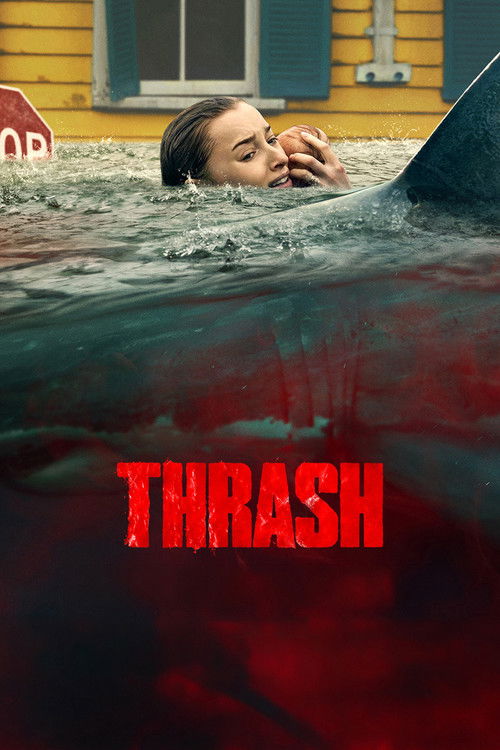
Drenched in torrential terror and relentless survival anxiety, human lives are trapped inside an aquatic cage of rising floodwaters where apex predators stalk through domestic ruins.
Thrash

Thrash

"If the flood doesn't kill you..."

09 April 2026 United States of America 84 min 6.1 (786)

Director: Tommy Wirkola

Cast: Phoebe Dynevor, Whitney Peak, Djimon Hounsou, Alyla Browne, Stacy Clausen

Thriller Horror Ecological Disruption & Climate Consequences Survival Instinct & Maternal Protection Conquering Trauma and Domestic Confinement Kinship and Resilience in Neglect

Overview

Set against the apocalyptic landfall of Category 5 Hurricane Henry, Thrash chronicles the harrowing plight of several disconnected residents in the fictional coastal town of Annieville, South Carolina. As the storm surge breaches sea defenses and rapidly submerges the town, the rising floodwaters bring along an invasive, hyper-aggressive shiver of bull sharks.

The narrative weaves together multiple vulnerable viewpoints: Lisa, a woman days past her pregnancy due date stranded in her submerged vehicle; Dakota, a young woman incapacitated by severe grief and agoraphobia inside her flooding family home; and a trio of neglected foster siblings scrambling for high ground inside their rapidly filling residence.

As water levels reach second stories and attics, the trapped survivors are forced to navigate floating debris, structural collapse, and underwater ambushes. Survival transforms into an escalating race against time, where every physical barrier between human shelter and the open ocean collapses.


Core Meaning

Writer-director Tommy Wirkola, in collaboration with producer Adam McKay, crafts the film as a high-octane collision between the creature feature and climate-disaster commentary. The central message underscores human fragility when extreme ecological events strip away civilization's artificial barriers. By placing characters with personal vulnerabilities into direct confrontation with displaced marine life, the film illustrates that humanity cannot isolate itself from nature's shifting patterns and volatile power.

Thematic DNA

Ecological Disruption & Climate Consequences 35%
Survival Instinct & Maternal Protection 25%
Conquering Trauma and Domestic Confinement 20%
Kinship and Resilience in Neglect 20%

Ecological Disruption & Climate Consequences

The storm surge and shark encroachment are depicted as the plausible, catastrophic byproduct of intensifying climate crises and altered marine migratory paths rather than supernatural anomalies.

Survival Instinct & Maternal Protection

Lisa's struggle to deliver and shield her child in open water mirrors biological endurance in its purest, most primal state.

Conquering Trauma and Domestic Confinement

Dakota's psychological imprisonment and agoraphobia are violently shattered when external perils invade her safe space, forcing emotional and physical emergence.

Kinship and Resilience in Neglect

The foster siblings represent community self-reliance, banding together to outwit danger despite adult abandonment.

Character Analysis

Lisa

Phoebe Dynevor

Archetype: The Maternal Hero Key Trait: Relentless determination and stoic physical endurance

Motivation

Keeping her unborn child alive through the disaster.

Character Arc

Starts as an exhausted, heavily pregnant worker caught off-guard and evolves into a fiercely protective fighter who endures labor amidst apex predators.

Dakota

Whitney Peak

Archetype: The Reluctant Warrior / Recluse Key Trait: Quick-witted resourcefulness under intense claustrophobic stress

Motivation

Self-preservation and protecting fellow townspeople.

Character Arc

Paralyzed by grief and agoraphobia inside her late mother's house, she is forced to overcome psychological confinement when the sea invades her home.

All 4 characters and cast

Symbols & Motifs

Rising Floodwaters

Meaning:

Symbolizes the inevitable encroachment of external reality and repressed trauma flooding into formerly safe, domestic spaces.

Context:

Used as the primary environmental threat that steadily submerges domestic residences and town infrastructure.

The Trapped Vehicle

Meaning:

Represents modern isolation and the illusion of technological safety against environmental forces.

Context:

Serves as Lisa's initial submerged enclosure where she is stranded at the onset of labor.

Amniotic Fluid and Blood

Meaning:

A dual motif of creation and vulnerability, acting as a life-giving event that simultaneously invites lethal predation.

Context:

Disperses in the waist-deep floodwater during Lisa's active labor, drawing nearby predators.

The Great White ("Nellie")

Meaning:

Represents an ancient, indifferent force of nature operating purely on predatory instinct as an apex equalizer.

Context:

Appears in the climactic scene in the shallow storm surge, attacking the smaller bull sharks.

Memorable Quotes

Fast forward to a world going off its rails when it comes to global warming and flash floods... this could be a great setting-off point.
— Director Tommy Wirkola

Context

Spoken regarding the conceptual framing of the film's premise.

Meaning

Highlights the conceptual foundation connecting climate-induced disaster to animal behavioral shifts.

More and more, you're hearing marine biologists acknowledge that climate is changing where these sharks go. It's changing how they behave.
— Dr. Dale Edwards

Context

Delivered during the ecological prologue exposition.

Meaning

Establishes the scientific context behind altered predator patterns caused by environmental disruption.

All 3 quotes

Philosophical Questions

Can humanity adapt to an environment where civilization no longer dictates the rules of engagement?

The film explores how quickly modern infrastructure, such as cars, houses, and electrical grids, turns into death traps when baseline environmental conditions shift.

Where does human agency end and pure biological instinct begin during catastrophe?

Lisa's childbirth in deep water juxtaposes conscious human will against instinctual animal predation in an extreme survival scenario.

Alternative Interpretations

The film can be analyzed through multiple lenses:

Full ending explanation

Cultural Impact

Released in April 2026 during a wave of renewed interest in high-concept survival cinema, Thrash bridged the gap between B-movie creature tropes and the existential dread of modern extreme weather events. It established a presence as an unpretentious, pulpy, 86-minute creature feature highlighting ecological dread.

Audience Reception

Audience metrics celebrated the film's efficient 86-minute runtime, fast pacing, signature gory set pieces, and Phoebe Dynevor's committed lead performance. While mainstream critics noted thin character dialogue, derivative plot elements reminiscent of Crawl and Bait, underutilized supporting roles, and variable CGI effects, the consensus viewed it as an entertaining streaming creature thriller.

Interesting Facts

  • The project underwent multiple title shifts during development and post-production, transitioning from The Rising to Beneath the Storm, then to Shiver, before Netflix finalized the release as Thrash.
  • Originally developed by Sony Pictures as a theatrical summer tentpole, distribution rights were transferred directly to Netflix for a global streaming premiere on April 10, 2026.
  • Principal photography took place primarily in soundstages and massive water tanks in Melbourne, Victoria, Australia.
  • Produced by Adam McKay and Kevin Messick through Hyperobject Industries, reuniting McKay with Netflix following Don't Look Up.
  • Phoebe Dynevor performed extensive aquatic physical acting while wearing prosthetic pregnancy gear in temperature-controlled water tanks.

Easter Eggs

"McKay's" Meat Delivery Truck

A submerged commercial delivery truck bearing the name McKay's serves as an inside nod to producer Adam McKay and acts as the plot device creating a chum slick that attracts predators.

Homage to Jaws 2 & 1970s Creature Features

Sequences directly echo John D. Hancock's Jaws 2 (1978), which director Tommy Wirkola cited as an underappreciated inspiration for aquatic tension.

B-Movie Disaster Parallels

The film structurally references modern ecological survival movies such as Alexandre Aja's Crawl (2019) and Kimble Rendall's Bait 3D (2012).

Frequently Asked Questions

Explore More About This Movie

Dive deeper into specific aspects of the movie with our detailed analysis pages

Comments (0)

Leave a comment

No comments yet. Be the first to share your thoughts!

Similar Movies