Three Colors: Red
A hauntingly beautiful drama where lives intersect by chance, exploring a fragile, telephonic connection that bridges the chasm between youthful empathy and aged cynicism through a vibrant crimson thread of fate.
Three Colors: Red

Three Colors: Red

Trois couleurs : Rouge

"The invisible thread of destinies."

12 May 1994 France 100 min ⭐ 7.9 (1,484)
Director: Krzysztof Kieślowski
Cast: Irène Jacob, Jean-Louis Trintignant, Frédérique Feder, Jean-Pierre Lorit, Samuel Le Bihan
Drama Mystery Romance
Fraternity and Interconnection Chance, Fate, and Destiny Voyeurism and Communication Judgment and Redemption
Box Office: $4,127,033

Overview

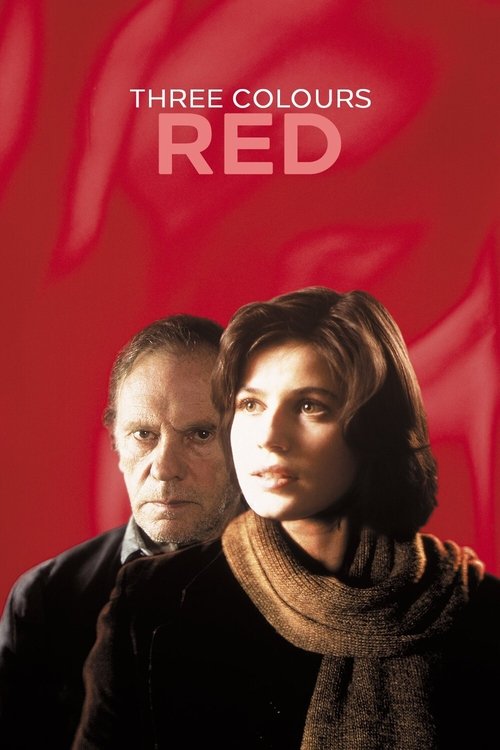
"Three Colors: Red" is the final and most acclaimed film in Krzysztof Kieślowski's trilogy based on the ideals of the French flag. The story centers on Valentine (Irène Jacob), a young, compassionate model and student in Geneva. One night, she accidentally hits a dog with her car, which leads her to its owner, Joseph Kern (Jean-Louis Trintignant), a reclusive and cynical retired judge. Initially disturbed by his apathy and his illegal hobby of eavesdropping on his neighbors' telephone conversations, Valentine finds herself drawn into a complex and profound platonic relationship with him.

Running parallel is the story of Auguste (Jean-Pierre Lorit), a young law student living near Valentine whose life mysteriously mirrors the judge's past. Though Valentine and Auguste's paths cross fleetingly without them ever meeting, the film masterfully weaves their stories together, exploring themes of chance, destiny, and the invisible ties that connect human lives. Their fates, along with those of the main characters from the trilogy's other films, "Blue" and "White," converge in a dramatic and unifying climax.
Core Meaning

The core meaning of "Three Colors: Red" is a profound exploration of fraternity, not in a political sense, but as a deep, almost metaphysical interconnectedness between human beings. Director Krzysztof Kieślowski suggests that lives are intertwined by forces beyond our comprehension, such as chance, destiny, and coincidence. The film posits that true connection can bridge vast differences in age and experience, as seen in the unlikely bond between the optimistic Valentine and the disillusioned Judge Kern. It explores the idea of second chances and redemption, suggesting that one life can unknowingly correct the mistakes of another. The Judge, seeing his own past failures mirrored in the life of his young neighbor Auguste, seems to guide Valentine towards a destiny that he himself missed. Ultimately, the film is a meditation on communication, empathy, and the mysterious, invisible threads that create a fraternity of strangers.

Thematic DNA

Fraternity and Interconnection 35%
Chance, Fate, and Destiny 30%
Voyeurism and Communication 20%
Judgment and Redemption 15%

Fraternity and Interconnection

As the final installment of a trilogy based on the French Revolutionary ideals, the film's central theme is fraternity. However, Kieślowski interprets this not as political brotherhood but as a complex web of unseen connections between individuals. The narrative demonstrates how the lives of Valentine, the Judge, and Auguste are deeply intertwined through parallels and coincidences, even when they are unaware of each other. The dramatic ferry accident at the end, which brings together the protagonists of all three films, serves as the ultimate testament to this shared human destiny and interconnectedness.

Chance, Fate, and Destiny

The film constantly questions the role of chance versus fate in shaping human lives. Valentine's accidental running over of the Judge's dog is the catalyst for their transformative relationship. The narrative is filled with near-misses and coincidences, suggesting that a larger, unseen force is at play. The parallelism between the Judge's past and Auguste's present life raises questions about pre-destination and the possibility of altering one's fate. Kieślowski creates a world where seemingly random events are part of a grander, mysterious design.

Voyeurism and Communication

The film opens with a shot traveling through telephone wires, immediately establishing communication as a key theme. However, this communication is often flawed or invasive. Valentine's conversations with her boyfriend are distant and possessive, while the Judge's primary connection to the world is through illegally eavesdropping on his neighbors' private calls. This act of voyeurism explores the ethics of privacy and the loneliness that drives the desire to connect, even illicitly. The film contrasts this technological, invasive communication with the genuine, face-to-face fraternity that develops between Valentine and the Judge.

Judgment and Redemption

Joseph Kern is a retired judge who has become cynical about justice after a lifetime of witnessing human fallibility. His illegal surveillance is a form of passing judgment from a detached, god-like position. Valentine's compassion and non-judgmental nature challenge his worldview, forcing him to confront his own past and seek a form of redemption. He confesses his actions, not out of legal obligation, but as a result of the human connection he forms with her. This relationship allows him a chance to vicariously "rewrite" his past tragedies, offering a path to peace and redemption.

Character Analysis

Valentine Dussaut

Irène Jacob

Archetype: The Empath / The Catalyst
Key Trait: Compassionate

Motivation

Her primary motivation is a deep-seated desire for genuine human connection and understanding. She is driven by compassion, first for the dog she hits, and then for the lonely, bitter man who owns it. She seeks to bridge the emotional distance that defines her other relationships.

Character Arc

Valentine begins as a somewhat lonely and passive young woman, caught in an unsatisfying long-distance relationship and a modeling career that objectifies her. Her encounter with the Judge awakens her moral agency and deep capacity for empathy. She moves from being repulsed by his actions to understanding his pain, challenging his cynicism with her compassion. Through their connection, she finds a deeper understanding of life and fate, culminating in her survival, which the Judge sees as a form of grace.

Joseph Kern

Jean-Louis Trintignant

Archetype: The Mentor / The Cynic
Key Trait: Disillusioned

Motivation

Initially, his motivation is a cynical curiosity about human fallibility. After meeting Valentine, his motivation shifts to a desire to protect her innocence and guide her toward the happiness he was denied. He sees a chance to correct the past through her future.

Character Arc

Kern starts as a misanthropic, retired judge who has completely withdrawn from society, finding solace only in the secret, flawed lives of his neighbors. He is embittered by a past betrayal and disillusioned with the concept of justice. His relationship with Valentine shatters his cynicism. Her empathy forces him to confront his own morality, and he develops a paternal, protective affection for her. He moves from passive observer to an active, albeit subtle, agent in shaping a better fate for her, achieving a form of vicarious redemption and emotional release, crying in the final scene as he sees her safe.

Auguste Bruner

Jean-Pierre Lorit

Archetype: The Doppelgänger / The Seeker
Key Trait: Aspiring

Motivation

His motivation is to succeed in his law career and build a life with his girlfriend. When he is betrayed, his motivation becomes escape and recovery, leading him to board the fateful ferry where his destiny intersects with Valentine's.

Character Arc

Auguste's arc is a direct parallel to the Judge's youth. He is an aspiring judge who experiences a painful betrayal by his lover, mirroring the event that made Kern a cynic. Throughout the film, he is shown on a path of disillusionment, unknowingly repeating Kern's history. His story unfolds separately from Valentine's, but their paths are destined to merge. His rescue from the ferry alongside Valentine at the end signifies the breaking of the cynical cycle, offering the possibility of a different, more hopeful future than the one the Judge experienced.

Symbols & Motifs

The Color Red

Meaning:

Red symbolizes fraternity, but also a complex dichotomy of opposing forces: intimacy and invasion, passion and danger, love and pain. It represents the vibrant thread of connection that runs through the characters' lives, appearing in crucial moments and objects to highlight their fated bond.

Context:

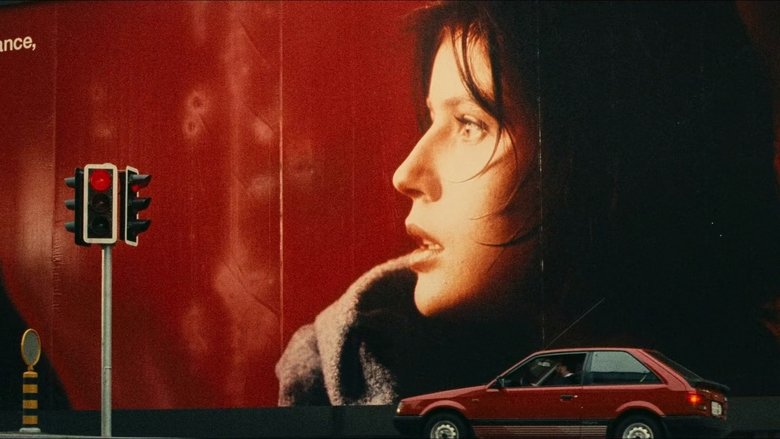
The color permeates the film, from the massive billboard of Valentine against a red background to her red car, clothing, and even the cherries on a slot machine. Its most iconic use is in the final shot, where Valentine's face is framed by the red coat of a rescuer, an image that cinematographer Piotr Sobociński decided should inform the look of the entire movie.

Telephones and Wires

Meaning:

Telephones symbolize the paradox of modern communication: the potential for connection and the reality of invasion and misunderstanding. The opening sequence, which rushes through undersea cables only to end in a busy signal, establishes this theme of failed or difficult communication. They represent both a yearning for intimacy and a violation of privacy.

Context:

The plot is driven by phone calls. Valentine's relationship with her boyfriend exists only through the phone. The Judge's central activity is eavesdropping on phone calls. The technology that is meant to bring people together becomes a tool for isolation and moral transgression.

Broken Glass

Meaning:

Broken glass symbolizes fragile connections, breached privacy, and emotional vulnerability. It represents the shattering of illusions and the painful but necessary act of breaking down barriers between people.

Context:

After the Judge's neighbors discover his eavesdropping, they throw rocks through his windows. He then watches the news of the ferry rescue through the broken panes, a powerful visual metaphor for his shattered cynicism and newfound connection to the world via Valentine. Earlier, Valentine cleans up broken glass, suggesting her role in mending the Judge's fractured life.

The Ferry

Meaning:

The ferry symbolizes the convergence of destinies. It is the physical space where the separate narrative threads of the entire "Three Colors" trilogy are brought together by a catastrophic event, representing a shared fate.

Context:

In the film's climax, both Valentine and Auguste board a ferry to England. The ferry sinks in a storm, but they, along with the main characters from "Blue" and "White," are among the few survivors. This event solidifies the trilogy's theme of an overarching, interconnected human experience.

Philosophical Questions

Are our lives governed by chance or by a pre-ordained destiny?

The film delves deeply into the debate between free will and determinism. Characters' lives are altered by seemingly random events, like a car hitting a dog or dropping a book. Yet, the narrative is filled with such perfect parallels and echoes—Auguste's life mirroring the Judge's—that it suggests a powerful, underlying pattern. Kieślowski doesn't provide a clear answer, instead presenting a world where chance appears to be the instrument of destiny, and every coincidence is pregnant with meaning, leaving the audience to ponder the invisible forces that shape our existence.

What is the nature of true fraternity or human connection?

"Red" challenges the conventional meaning of fraternity, presenting it not as a social or political ideal but as a profound, often unspoken, bond between strangers. The central relationship between Valentine and the Judge transcends age, background, and initial moral judgment. It suggests that genuine connection is born from shared vulnerability and empathy, and can exist outside of romance or family. The film explores how technology both helps and hinders this connection, ultimately championing direct, compassionate engagement as the highest form of fraternity.

Is it possible to achieve redemption for past failures?

The character of the Judge embodies this question. Embittered by a life of perceived mistakes, he lives in a state of self-imposed exile. His connection with Valentine offers him a unique opportunity for redemption—not by undoing his past, but by positively influencing the future. By guiding Valentine towards Auguste, he vicariously corrects his own history, suggesting that redemption can be found by facilitating the happiness of others and fostering the connections we failed to make ourselves. His tears at the end signify a release from his cynical prison.

Alternative Interpretations

One of the most debated aspects of "Three Colors: Red" is the nature of the Judge's role. Some interpretations view him not merely as a retired man but as a god-like figure or a stand-in for the director himself. In this reading, the Judge is an omniscient observer who, seeing his own past being replayed by Auguste, actively manipulates events to ensure a better outcome for Valentine, the object of his platonic affection. His foreknowledge of the weather and his subtle push for Valentine to take the ferry can be seen as acts of a puppet master arranging the pieces on a chessboard. This transforms the film from a story about coincidence into a fable about a secular, retired god finding a reason to intervene in human affairs one last time.

Another interpretation focuses on the idea of "present retrospection," a term Kieślowski himself used. The story of Auguste isn't just a parallel life; it's the Judge's past being lived out in the present. The film could be seen as a metaphysical construct where the Judge is essentially reliving his life through Auguste, but this time, with the wisdom of age and the intervention of Valentine, he is able to correct his crucial mistake—failing to connect with the right person. The ferry crash, therefore, is not just a chance event but a necessary catalyst created by this metaphysical framework to finally unite the two souls who were always meant to be together.

Cultural Impact

"Three Colors: Red" was released in 1994 to universal critical acclaim, and is often regarded as Krzysztof Kieślowski's magnum opus and the strongest film in the trilogy. It holds a 100% approval rating on Rotten Tomatoes and a score of 100 out of 100 on Metacritic, signifying its revered status among critics. The film's success at Cannes and its three Oscar nominations brought significant international attention to Polish cinema and cemented Kieślowski's reputation as a master filmmaker.

Its influence on cinema can be seen in films that explore themes of chance, interconnectedness, and parallel lives. The intricate, multi-narrative structure pre-dates and arguably influenced later films like "Magnolia" and "Babel." The film's philosophical depth, exploring concepts of destiny, morality, and communication, has made it a staple in film studies courses. Though it was Kieślowski's final work, its thoughtful and poetic examination of human connection continues to resonate with audiences and filmmakers, securing its place as a landmark of 1990s world cinema.

Audience Reception

Audiences have overwhelmingly praised "Three Colors: Red" for its profound emotional impact, stunning cinematography, and intellectual depth. Viewers frequently describe the film as beautiful, hypnotic, and deeply moving, often citing the powerful performances by Irène Jacob and Jean-Louis Trintignant. Many consider it not only the best of the trilogy but one of the greatest films ever made. The main points of praise focus on its masterful exploration of fate and human connection, and the satisfying way the ending ties the entire trilogy together. Criticisms are rare, but some viewers find the film's pacing slow or its themes of fate and coincidence to be overly contrived or heavy-handed. A few have found the narrative somewhat dull or pointless if the philosophical underpinnings don't resonate. However, the vast majority of audience reviews are laudatory, celebrating the film as a transcendent and unforgettable piece of cinema.

Interesting Facts

  • This was director Krzysztof Kieślowski's final film before his retirement and subsequent death less than two years later.
  • The film was nominated for three Academy Awards: Best Director, Best Original Screenplay, and Best Cinematography.
  • Actor Jean-Louis Trintignant initially turned down the role of the judge but was persuaded by the depth of the script.
  • Irène Jacob, who plays Valentine, also starred in Kieślowski's earlier film, "The Double Life of Véronique".
  • The final scene of the film, showing the ferry rescue, was the very first scene shot for the entire trilogy.
  • Kieślowski jokingly stated that the films were named for the colors of the French flag because the funding was French; had the money come from Germany, the trilogy might have been called "Black, Red, and Yellow".
  • The character's name, Valentine, was chosen by Irène Jacob herself when Kieślowski asked her what name she wished she had as a child.
  • The dog, Rita, was played by two different dogs during filming.

Easter Eggs

At the end of the film, the main characters from all three films in the trilogy—Julie and Olivier from "Blue", Karol and Dominique from "White"—are shown as survivors of the ferry disaster alongside Valentine and Auguste.

This is the ultimate connecting thread of the trilogy, a powerful and climactic reveal that solidifies the theme of fraternity and shared destiny. It suggests that all these disparate lives, explored under the banners of liberty, equality, and fraternity, are part of a single, interconnected human story, culminating in a shared moment of tragedy and survival.

The recurring character of an old, hunchbacked person struggling to put a bottle into a recycling bin appears in all three films.

This motif serves as a moral barometer for the protagonists. In "Blue," Julie doesn't notice the woman. In "White," Karol smirks at the man's struggle. Only in "Red" does the compassionate Valentine pause to help the old woman. This progression shows an evolution towards the ideal of fraternity, with Valentine being the only character to offer assistance, thus embodying the film's core theme.

When Valentine is in a music store, the theme music from "Three Colors: White" can be heard playing in the background.

This is one of many subtle audio and visual links between the films, reinforcing the idea that these stories are occurring in a shared universe where lives and experiences overlap, often without the characters' knowledge.

When Julie from "Blue" peeks into a courtroom, she briefly witnesses a scene from "White" where Karol is pleading his case before a judge.

This is another direct crossover that ties the first two films together, showing how the characters' paths intersect even before the final convergence in "Red". It highlights the theme that individual stories are just one part of a larger, interconnected reality.

⚠️ Spoiler Analysis

Click to reveal detailed analysis with spoilers

Frequently Asked Questions

Explore More About This Movie

Dive deeper into specific aspects of the movie with our detailed analysis pages

Comments (0)

Leave a comment

No comments yet. Be the first to share your thoughts!