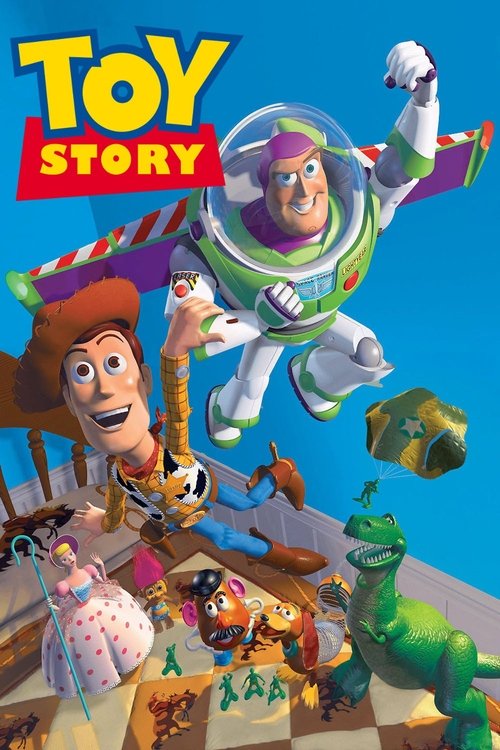
Toy Story
"The adventure takes off when toys come to life!"
Overview
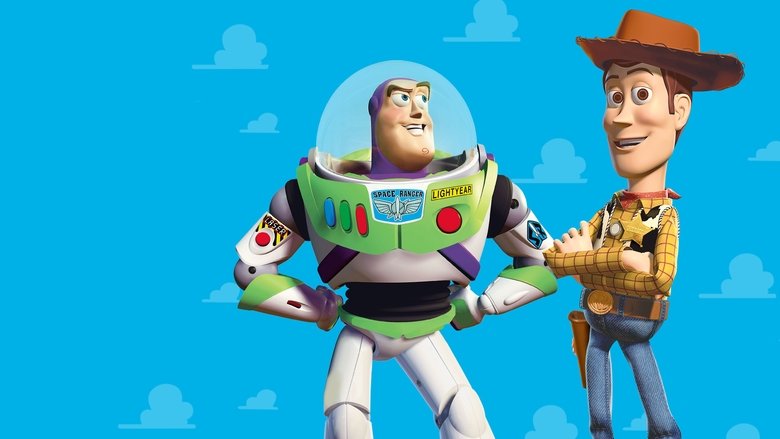
In a world where toys come to life when humans aren't around, Sheriff Woody, a pull-string cowboy doll, is the undisputed leader of the toys in his owner Andy's room. His reign as Andy's favorite toy is jeopardized by the arrival of Buzz Lightyear, a high-tech space ranger action figure who believes he is a real space ranger on a mission. Buzz's impressive features quickly win over the other toys, making him Andy's new favorite and fueling Woody's jealousy.
A rivalry ensues, leading to Woody accidentally knocking Buzz out of a window. The other toys, believing Woody acted out of malice, ostracize him. To clear his name and regain his standing, Woody embarks on a mission to rescue Buzz. Their adventure takes them to the outside world, including a trip to the Pizza Planet restaurant and the clutches of Sid Phillips, a sadistic neighborhood boy who enjoys torturing toys. Faced with the dangers of Sid's house and the impending move of Andy's family, Woody and Buzz must overcome their differences and work together to find their way back to Andy.
Core Meaning
At its heart, "Toy Story" is an exploration of friendship, identity, and the fear of obsolescence. The film delves into the emotional lives of toys, portraying their deepest desire to be loved and played with by their owner. The central conflict between Woody and Buzz highlights the anxieties of being replaced and the struggle to accept change. Ultimately, the film's message is one of unity and the realization that one's worth is not determined by being the favorite, but by the bonds of friendship and the joy they bring to others. It champions the idea that everyone has a purpose and a place, even in the face of new and exciting competition.
Thematic DNA
Friendship and Loyalty
The core of "Toy Story" is the evolution of the relationship between Woody and Buzz. Initially rivals competing for Andy's affection, they are forced to rely on each other to survive the perils of the outside world. Their journey transforms their animosity into a deep and abiding friendship, teaching them the value of loyalty and mutual respect. This theme is further emphasized by the community of toys in Andy's room and their collective efforts to support one another.
Identity and Self-Discovery
The film explores the concept of identity through Buzz Lightyear's existential crisis. Convinced he is a real space ranger, Buzz's worldview is shattered when he discovers he is a mass-produced toy. His journey is one of self-acceptance, as he comes to understand that being a toy and bringing joy to a child is a noble purpose in itself. Woody also undergoes a journey of self-discovery, learning that his identity is not solely defined by his status as Andy's favorite toy.
Jealousy and Fear of Replacement
Woody's character arc is driven by his intense jealousy of Buzz and the fear of being replaced in Andy's affections. This very human emotion is a central theme, exploring the insecurity and anxiety that comes with the threat of being forgotten or becoming obsolete. The film realistically portrays the negative consequences of jealousy while also showing the path to overcoming it through friendship and self-worth.
Change and Acceptance
"Toy Story" emphasizes the inevitability of change and the importance of adapting to new circumstances. Woody's initial resistance to Buzz's arrival represents a fear of change. Through their shared experiences, he learns to accept Buzz and embrace the new dynamic in Andy's room. The impending move to a new house also serves as a backdrop for this theme, forcing the toys to confront a major life change together.
Character Analysis
Woody
Tom Hanks
Motivation
Woody's primary motivation is to remain Andy's favorite toy and maintain his status as the leader of the toys in the room. He is driven by a deep-seated need for Andy's affection and a desire to preserve the familiar order of his world.
Character Arc
Woody begins as the proud and somewhat arrogant leader of Andy's toys, secure in his position as the favorite. The arrival of Buzz Lightyear triggers his insecurity and jealousy, leading him to make poor decisions. Stranded in the outside world with Buzz, Woody is forced to confront his flaws and learn the value of friendship and cooperation. He evolves from a selfish leader to a selfless and loyal friend who understands that being there for Andy is what truly matters.
Buzz Lightyear
Tim Allen
Motivation
Initially, Buzz is motivated by his perceived mission to protect the galaxy from the evil Emperor Zurg. After accepting he is a toy, his motivation shifts to being the best toy he can be for Andy and being a good friend to Woody and the other toys.
Character Arc
Buzz Lightyear starts the film under the delusion that he is a real space ranger on a mission. His journey is one of harsh self-realization as he confronts the truth of his existence as a toy. This initially sends him into a state of despair, but with Woody's help, he comes to accept his identity and finds a new purpose in being a toy for Andy. He transforms from a naive and solitary figure into a brave and loyal friend.
Sid Phillips
Erik von Detten
Motivation
Sid's motivation is simple: he enjoys taking toys apart, creating monstrous hybrids, and destroying them for his own amusement. He is a foil to Andy's loving and imaginative play, representing the dark side of a child's interaction with their toys.
Character Arc
Sid does not have a significant character arc in the traditional sense. He serves as the primary antagonist and a source of external conflict for Woody and Buzz. He represents the destructive and uncaring side of childhood play. His comeuppance at the hands of the toys he has tormented serves as a moral lesson about respecting others' property and, on a deeper level, the beings around him.
Symbols & Motifs
Andy's Signature on Woody's Boot
This symbolizes Woody's identity and belonging. It is a physical mark of his connection to Andy and his role as a cherished toy. When Woody sees the faded signature, it reminds him of his purpose and his history with Andy.
The signature is visible on the bottom of Woody's boot throughout the film. It becomes particularly poignant when Woody is feeling lost or questioning his place, serving as a reminder of who he is and who he belongs to.
Buzz Lightyear's Wings
Initially, Buzz's wings represent his delusion of being a real space ranger and his belief that he can fly. After he accepts that he is a toy, the wings come to symbolize his unique abilities as a toy and his capacity for "falling with style." They represent his transformation from a delusional hero to a self-aware and capable friend.
Buzz frequently attempts to fly using his wings, which leads to his moment of crisis when he realizes he cannot. Later, during the climax of the film, he uses his wings to help him and Woody glide back to the moving truck, showcasing his acceptance of his toy nature and his ingenuity.
The Claw
The claw in the Pizza Planet claw machine is seen by the alien toys as a mystical, god-like entity that chooses which of them will ascend to a better place. It symbolizes a naive belief in a higher power and a yearning for something more, even within the confines of their existence as prizes in a game.
Woody and Buzz encounter the alien toys and their reverence for "The Claw" inside the claw machine at Pizza Planet. Sid wins Buzz and an alien with the claw, taking them back to his house. The aliens' chant of "The claw!" is a memorable and recurring element.
Memorable Quotes
To infinity... and beyond!
— Buzz Lightyear
Context:
Buzz says this multiple times throughout the film, often when he is about to embark on a daring feat. Woody also says it during the climax of the film as they are flying back to the moving truck, signifying his full acceptance of Buzz as his friend.
Meaning:
This is Buzz's catchphrase, representing his adventurous spirit and his initial belief that he is a real space ranger. It later becomes a symbol of his and Woody's enduring friendship and their shared adventures. The line has become one of the most iconic quotes in film history.
You are a sad, strange little man, and you have my pity.
— Buzz Lightyear
Context:
Woody, in a fit of jealousy, confronts Buzz and tells him he is just a child's plaything. Buzz, still believing he is a real space ranger, delivers this line with an air of superiority before bidding Woody farewell.
Meaning:
This quote is Buzz's calm and condescending response to one of Woody's jealous tirades. It highlights the initial personality clash between the two characters and has become a widely recognized and quoted line from the film.
This isn't flying, this is falling with style!
— Buzz Lightyear
Context:
During the climax of the film, as Woody and Buzz are launched into the air by a rocket, Woody exclaims that Buzz is flying. Buzz, having come to terms with being a toy, corrects him with this memorable line before they glide to safety.
Meaning:
This line signifies a turning point for Buzz's character. After accepting he is a toy and cannot truly fly, he re-contextualizes his ability to glide as something unique and impressive in its own right. It shows his newfound self-awareness and acceptance of his toy identity.
Philosophical Questions
What does it mean to be 'real'?
The film explores this question primarily through Buzz Lightyear, who initially believes he is a real space ranger and not a toy. His existential crisis upon discovering the truth forces him to grapple with his identity and purpose. The film suggests that being 'real' is not about one's origin or material composition, but about the love and joy one brings to others. Woody helps Buzz understand that being a toy for Andy is a meaningful and 'real' existence.
How do we cope with the fear of being replaced or becoming obsolete?
Woody's jealousy and anxiety about being replaced by Buzz is a central theme of the film. The narrative explores the negative emotions that arise from this fear and how it can lead to destructive behavior. Ultimately, the film suggests that the way to overcome this fear is not through competition, but through friendship, acceptance, and finding value in oneself beyond being the 'favorite.' Woody learns that there is enough love to go around and that change can lead to new and meaningful relationships.
Do inanimate objects have a consciousness or inner life?
The entire premise of "Toy Story" is built on the imaginative idea that toys have a secret life of their own. The film anthropomorphizes the toys, giving them complex emotions, desires, and social structures. While not a literal philosophical treatise, the movie playfully engages with the question of what it would be like if the objects we interact with every day had their own thoughts and feelings, encouraging empathy and a different perspective on the world around us.
Alternative Interpretations
One popular fan theory suggests that Andy's father is either dead or that his parents are divorced. The complete absence of a father figure in the film, with no photographs or mentions of him, has led to speculation that Woody, a classic toy, may have been a gift from his father, explaining Andy's deep attachment to him. This theory posits that Woody and Buzz, two male role models, serve as substitutes for the lack of a father in Andy's life. Another interpretation views the conflict between Woody and Buzz as a metaphor for the transition from traditional hand-drawn animation to computer-generated animation. Woody, the old-fashioned cowboy, represents the former, while Buzz, the modern and high-tech space ranger, represents the latter. Their eventual friendship symbolizes the successful merging of these two forms of animation under the Disney-Pixar banner. A darker theory proposes that Sid is not inherently evil but a creative child in a neglectful home environment, with his destructive tendencies being a manifestation of his troubled upbringing.
Cultural Impact
"Toy Story" had a revolutionary and lasting impact on the film industry and popular culture. As the first entirely computer-animated feature film, it marked a turning point in animation, demonstrating the potential of CGI to create visually stunning and emotionally resonant stories. Its success paved the way for the dominance of CGI in animation and inspired a new generation of animators. The film's sophisticated storytelling, with its blend of humor, heart, and universal themes, appealed to both children and adults, setting a new standard for family entertainment. The characters of Woody and Buzz Lightyear have become cultural icons, beloved by audiences worldwide. The film's influence can be seen in the countless animated movies that have followed, and it solidified Pixar's reputation as a powerhouse of creative and technological innovation in filmmaking. "Toy Story" not only launched a successful franchise but also fundamentally changed the landscape of animated cinema.
Audience Reception
"Toy Story" was met with widespread critical acclaim and was a major commercial success upon its release. Critics praised its groundbreaking computer animation, witty screenplay, and the emotional depth of its story. The voice performances, particularly by Tom Hanks and Tim Allen, were also highly lauded. Audiences of all ages responded positively to the film's humor, heart, and relatable themes of friendship and belonging. While some have noted that the animation of human characters appears dated by modern standards, the overall visual storytelling and character animation remain impressive. The film is widely regarded as a classic of animated cinema and holds a near-perfect rating on various review aggregator websites.
Interesting Facts
- "Toy Story" was the first feature-length film to be created entirely using computer-generated imagery (CGI).
- In early drafts of the script, Woody was portrayed as a much meaner and more unlikable character, a ventriloquist's dummy who was the villain.
- Billy Crystal was originally offered the role of Buzz Lightyear but turned it down, a decision he later called the biggest mistake of his career.
- The animation team studied the movement of toy soldiers by gluing sneakers to a wooden plank and trying to walk.
- The Pizza Planet truck, which makes its first appearance in this film, has become a recurring Easter egg in subsequent Pixar movies.
- Mattel initially refused to license Barbie for the film, fearing it would be a failure. After the movie's success, Barbie appeared in "Toy Story 2".
- The film's production was shut down by Disney executives after a disastrous screening of early story reels, an event later dubbed the "Black Friday Incident". The creative team was given two weeks to rework the story.
Easter Eggs
The ball from Pixar's 1986 short film "Luxo Jr." appears in Andy's room.
This is a nod to one of Pixar's earliest and most iconic animated shorts. The Luxo Ball has since become a recurring Easter egg in many Pixar films, representing the studio's heritage.
Several books on the shelf behind Woody have titles that are the names of Pixar short films, such as "The Adventures of André and Wally B." and "Tin Toy."
This is another tribute to Pixar's early work and the creative minds behind the studio. "Tin Toy" in particular was a direct inspiration for "Toy Story."
The carpet in Sid's house has the same hexagonal pattern as the carpet in the Overlook Hotel from the horror film "The Shining."
This is a subtle and somewhat dark homage to Stanley Kubrick's classic horror film, adding to the unsettling atmosphere of Sid's house.
A bin in Andy's room has a sticker for "Binford Tools," the fictional company that sponsored Tim Allen's character's show in the sitcom "Home Improvement."
This is an inside joke referencing the career of Tim Allen, the voice of Buzz Lightyear, who was starring in the popular sitcom at the time the film was made.
⚠️ Spoiler Analysis
Click to reveal detailed analysis with spoilers
Frequently Asked Questions
Explore More About This Movie
Dive deeper into specific aspects of the movie with our detailed analysis pages
Comments (0)
No comments yet. Be the first to share your thoughts!