Castle in the Sky
天空の城ラピュタ
"One day, a girl came down from the sky…"
Overview
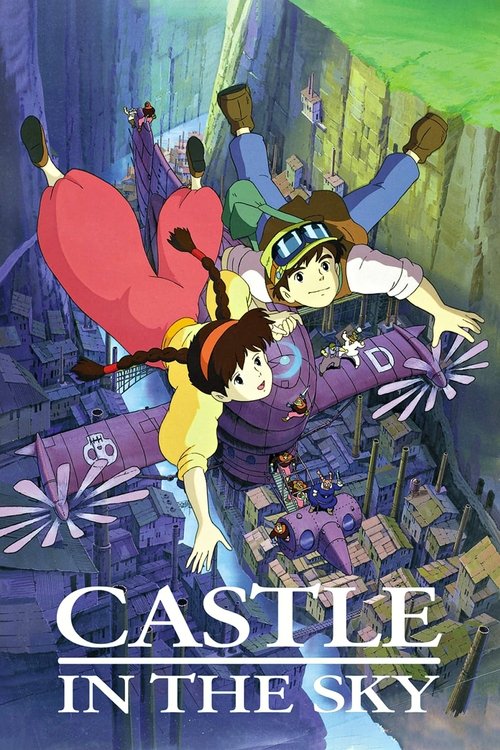
"Castle in the Sky" follows the thrilling adventures of a young boy named Pazu, an apprentice engineer in a mining town, and a mysterious girl named Sheeta who literally falls from the sky. Sheeta possesses a glowing crystal pendant that holds the key to the legendary floating castle, Laputa. Their journey to uncover the secrets of Laputa is a perilous one, as they are relentlessly pursued by air pirates, led by the formidable Dola, and government agents under the command of the cunning and ruthless Muska.
Together, Pazu and Sheeta must navigate a world of fantastical airships, dangerous alliances, and ancient technology. Their quest is not just a search for a mythical place, but a journey of self-discovery and a fight to protect Laputa from those who would exploit its immense power for their own destructive ambitions.
Core Meaning
At its core, "Castle in the Sky" is a cautionary tale about the relationship between humanity, technology, and nature. Director Hayao Miyazaki explores the idea that technological advancement, when driven by greed and a desire for power, leads to destruction. Laputa itself is a powerful symbol of this duality: a technologically advanced civilization that ultimately fell because its power was misused. The film suggests that true strength and a sustainable future lie not in dominating nature with technology, but in living in harmony with it. It champions the innocence and courage of its young protagonists, suggesting that the hope for a better world rests in the hands of those who value love, friendship, and respect for the natural world over power and greed.
Thematic DNA
Nature vs. Technology
This is a central and recurring theme in Miyazaki's work, and it is powerfully depicted in "Castle in the Sky." Laputa embodies this conflict: it is a marvel of advanced technology that is now overgrown and reclaimed by nature. The film contrasts the destructive potential of Laputa's technology, sought by Muska for military power, with the peaceful, life-sustaining harmony of the castle's gardens, which have thrived in humanity's absence. Miyazaki suggests that technology itself is not inherently evil, as seen in the benevolent Laputian robots, but its use by greedy humans is what poses a threat to the natural world.
The Perils of Greed and Power
The antagonists in the film are driven by an insatiable desire for power and wealth. Muska, a descendant of Laputa's royal family, seeks to control the castle's devastating weapons to dominate the world. The military, led by General Mouro, is also after Laputa for its strategic advantages. The Dola pirate gang initially seeks the treasures of Laputa but evolves throughout the story. The film critiques the destructive nature of these ambitions, showing how they lead to violence and a disregard for life and the environment.
The Innocence and Resilience of Youth
Like many of Miyazaki's films, "Castle in the Sky" places young protagonists at the center of the story. Pazu and Sheeta embody courage, loyalty, and a fundamental goodness that contrasts with the cynicism and greed of the adult world. They are not superheroes, but their determination and their strong bond of friendship allow them to overcome incredible obstacles. Miyazaki uses their perspective to highlight the importance of purity of heart and the potential for the younger generation to create a better future.
The Allure of Flight and Adventure
A signature motif in Miyazaki's filmography, the theme of flight is central to "Castle in the Sky." The film is filled with a variety of imaginative flying machines, from the pirates' ornithopters to massive airships and the floating island of Laputa itself. Flight represents freedom, the pursuit of dreams, and the spirit of adventure that drives the narrative. Pazu's dream of building his own plane and finding Laputa, just as his father did, is a powerful motivator for his actions.
Character Analysis
Sheeta (Lusheeta Toel Ul Laputa)
Keiko Yokozawa
Motivation
Initially motivated by survival, Sheeta's primary motivation becomes the protection of Laputa and the world from the destructive power that Muska seeks to unleash. She feels a deep sense of responsibility tied to her ancestry.
Character Arc
Sheeta begins her journey as a frightened and seemingly helpless girl on the run. As she learns about her true heritage as the heir to the throne of Laputa, she grows in courage and determination. She ultimately makes the difficult choice to use the Spell of Destruction to prevent Laputa's power from being misused, demonstrating her transformation into a strong and responsible young woman who prioritizes the well-being of the world over her own royal legacy.
Pazu
Mayumi Tanaka
Motivation
Pazu is driven by a desire to validate his father's legacy and by his unwavering loyalty and affection for Sheeta. His motivation is pure, rooted in a love for adventure and a strong sense of justice.
Character Arc
Pazu is a hardworking and optimistic orphan who dreams of proving the existence of Laputa, a quest started by his late father. His chance encounter with Sheeta propels him into the adventure he always longed for. Throughout their journey, Pazu's courage and resourcefulness are constantly tested. He evolves from a dreamer into a brave protector and a loyal friend, willing to risk everything to help Sheeta and safeguard Laputa.
Colonel Muska (Romuska Palo Ul Laputa)
Minori Terada
Motivation
Muska is driven by a lust for power and a desire to resurrect the lost glory of Laputa, which he intends to rule. He believes it is his birthright to control the castle's advanced technology and wield its power over the world.
Character Arc
Muska is a government agent who is also a descendant of a branch of the Laputian royal family. He presents himself as a sophisticated and intelligent individual, but as the story progresses, his ruthless and power-mad nature is revealed. His arc is a descent into megalomania, culminating in his attempt to control Laputa's ultimate weapon. He remains an unredeemable villain throughout the film.
Dola
Kotoe Hatsui
Motivation
Initially, Dola is motivated by the prospect of riches and treasure believed to be on Laputa. As the story unfolds, her motivations shift to helping and protecting Pazu and Sheeta from the greater threat posed by Muska and the military.
Character Arc
Dola is the matriarch of a family of air pirates and is initially presented as an antagonist, chasing Sheeta for her crystal. However, she proves to be more complex than a simple villain. She develops a soft spot for Pazu and Sheeta, and her pragmatic and resourceful nature eventually leads her to become their ally. She evolves from a greedy pirate into a maternal and protective figure, showcasing a surprising depth of character.
Symbols & Motifs
Laputa, the Castle in the Sky
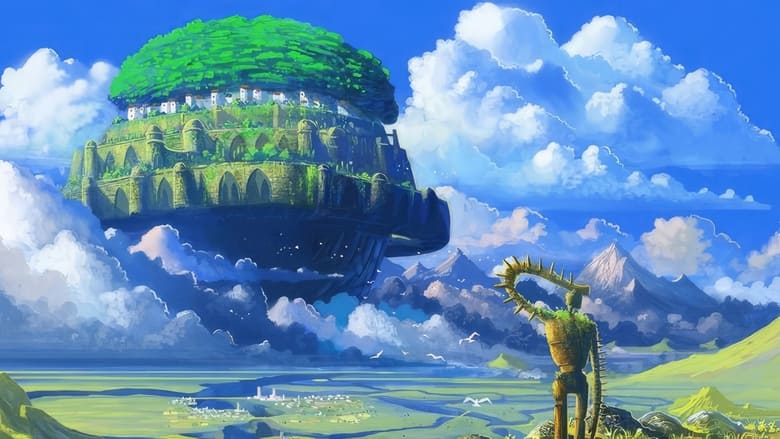
Laputa symbolizes the duality of human civilization and technology. It is a place of incredible beauty and advanced knowledge, but also one of immense destructive power. Its abandoned state, with nature reclaiming the technological marvels, represents the potential consequences of humanity's hubris and the enduring power of the natural world.
The entire film revolves around the search for this legendary floating island. It is the object of desire for all the main factions, each for their own reasons: Pazu to prove his father's story, Sheeta to understand her heritage, and Muska and the military to exploit its power.
Sheeta's Aetherium Crystal
The crystal is a symbol of both heritage and immense power. It is the key to unlocking the secrets and technology of Laputa. It represents a connection to the natural world, as it is made of the glowing Aetherium found deep within the earth. The crystal's power can be used for both good and evil, highlighting the responsibility that comes with great power.
The crystal is worn by Sheeta as a necklace and is the catalyst for the entire plot, as various groups pursue her to obtain it. It has the power to levitate, guide the way to Laputa, and activate the castle's ancient technology.
The Giant Tree of Laputa
The giant tree at the center of Laputa represents the life-giving and resilient force of nature. It has preserved the heart of the castle even after its inhabitants disappeared. The tree's roots run deep throughout the structure, symbolizing the inextricable link between the natural and the man-made. Ultimately, it is the tree that saves the most vital part of Laputa, allowing it to ascend peacefully into space, free from human corruption.
The tree is discovered when Pazu and Sheeta finally reach the upper gardens of Laputa. In the film's climax, after the destructive technology of Laputa is cast away, the tree and the surrounding ecosystem are what remain, ascending into the upper atmosphere.
Memorable Quotes
No matter how many weapons you have, no matter how great your technology might be, the world cannot live without love.
— Sheeta
Context:
Sheeta says this to Muska during their final confrontation in the throne room of Laputa, just before she and Pazu invoke the Spell of Destruction. It is her ultimate rejection of Muska's power-hungry ideology.
Meaning:
This quote encapsulates the core message of the film. It is a powerful statement about the importance of love and compassion over technological might and military power. It reflects the film's humanistic and environmentalist themes.
バルス (Balse)
— Sheeta and Pazu
Context:
Sheeta and Pazu chant this word together to destroy the core of Laputa, foiling Muska's plans and causing the castle's technological and military sections to crumble into the sea.
Meaning:
This is the Spell of Destruction, a powerful word of Laputian magic. Its utterance signifies the ultimate sacrifice and the choice to destroy great power to prevent it from being used for evil. It represents the idea that some technology is too dangerous for humanity to possess.
A girl just fell from the sky, boss!
— Pazu
Context:
Pazu says this to his boss in the mine shortly after he catches Sheeta as she gently floats down from the sky, saved by her glowing crystal.
Meaning:
This quote marks the beginning of the adventure. It is a simple, yet fantastical statement that perfectly captures the inciting incident of the story and the sense of wonder that pervades the film.
Philosophical Questions
What is the proper relationship between technology and nature?
The film delves into this question by presenting Laputa as a case study. The advanced civilization of Laputa ultimately destroyed itself, suggesting that technology without wisdom or a respect for nature is unsustainable. However, the film doesn't condemn technology outright. Pazu is a skilled mechanic, and the benevolent robots on Laputa demonstrate that technology can coexist peacefully with nature. The film proposes that the morality of technology is determined by the intentions of its users, advocating for a balanced and harmonious integration of human ingenuity with the natural world.
Is it better to destroy immense power than to risk it falling into the wrong hands?
This is the central ethical dilemma faced by Sheeta in the climax. Muska, representing the worst of human ambition, seeks to control Laputa's devastating weapons. Rather than trying to control this power for good, Sheeta and Pazu make the ultimate decision to destroy it completely with the "Spell of Destruction." This act suggests a profound skepticism about humanity's ability to wield such power responsibly and posits that some knowledge and technology are too dangerous to exist.
Alternative Interpretations
While the film's primary message is quite direct, some alternative readings exist. One interpretation focuses on the ending as a more somber or unsettling view of humanity's relationship with nature. When Laputa, freed of its destructive technology, ascends into space with its ecosystem intact, it could be seen as nature literally removing itself from the corrupting influence of humankind, suggesting that humanity may not be worthy of coexisting with such a pristine world.
Another perspective could analyze the film through a post-colonial lens. Laputa represents a powerful, advanced civilization that has vanished, leaving behind its potent technology. The modern world's military and political powers scramble to claim and control this legacy for their own imperialistic ambitions. Sheeta's decision to destroy Laputa's technological core can be interpreted as a rejection of this colonialist impulse, choosing to let the past rest rather than allowing its power to be used for further conquest and destruction.
Cultural Impact
"Castle in the Sky" holds a significant place in the history of animation. As the first official Studio Ghibli production, it set a high standard for the studio's future works, establishing many of the recurring themes and stylistic elements that would define their films, such as a strong environmental message, fascination with flight, and resilient young protagonists. The film is considered a major influence on the steampunk genre, particularly in Japan, popularizing aesthetic features like fantastical airships and retro-futuristic technology.
Critically, the film was highly acclaimed in Japan and has gained international cult status over the years, praised for its breathtaking animation, imaginative world-building, and thrilling sense of adventure. It has influenced numerous animators and filmmakers, with John Lasseter of Pixar citing it as one of his favorite films. The movie's blend of action, fantasy, and heartfelt emotion has resonated with audiences worldwide, and its themes regarding the conflict between technology and nature remain highly relevant.
Audience Reception
"Castle in the Sky" has been overwhelmingly well-received by audiences since its release. In Japan, it has been voted as one of the greatest animated films of all time in various polls. Audiences worldwide praise its thrilling sense of adventure, endearing characters, and stunningly imaginative visuals. The relationship between Pazu and Sheeta is frequently highlighted as a heartwarming and genuine portrayal of youthful friendship and loyalty.
Points of praise often center on the film's perfect pacing, beautiful animation that holds up decades later, and Joe Hisaishi's iconic musical score. The Dola pirate gang is also a fan favorite, beloved for their comedic relief and their eventual transformation into allies. While there is very little criticism, some viewers find the main villain, Muska, to be somewhat one-dimensional compared to the more nuanced antagonists in later Ghibli films. The English dub, while featuring notable voice actors like Mark Hamill, has received mixed reviews, with some purists preferring the original Japanese version with subtitles.
Interesting Facts
- "Castle in the Sky" was the very first animated feature film produced by Studio Ghibli.
- Director Hayao Miyazaki was influenced by a visit to a Welsh mining town in 1985, where he witnessed a miners' strike. He admired their spirit and work ethic, which is reflected in the depiction of Pazu's hometown.
- The name "Laputa" is a reference to the flying island in Jonathan Swift's 18th-century novel "Gulliver's Travels." However, Miyazaki was reportedly unaware at the time that "la puta" is a derogatory term in Spanish. Consequently, the film's title was shortened to "Castle in the Sky" in some international releases.
- The fox squirrels that appear on Laputa are a cameo from Miyazaki's previous film, "Nausicaä of the Valley of the Wind."
- For the 2003 Disney English dub, composer Joe Hisaishi created a new, more orchestral score, as he was not entirely satisfied with the original, more minimalist electronic soundtrack due to time constraints during the initial production.
- The design of the robot soldiers in Laputa was influenced by the Fleischer Studios' "Superman" cartoon "The Mechanical Monsters."
Easter Eggs
Fox squirrels from "Nausicaä of the Valley of the Wind" can be seen on Laputa.
These creatures, particularly Teto from the earlier film, make a brief appearance among the animals living peacefully in Laputa's gardens. This serves as a small nod to Miyazaki's previous work and connects the two films thematically through their shared reverence for nature.
⚠️ Spoiler Analysis
Click to reveal detailed analysis with spoilers
Frequently Asked Questions
Explore More About This Movie
Dive deeper into specific aspects of the movie with our detailed analysis pages
Comments (0)
No comments yet. Be the first to share your thoughts!