WALL·E
A poignant animated sci-fi romance where a lonely, curious robot on a desolate Earth finds love and rediscovers humanity's forgotten home.
WALL·E

WALL·E

"After 700 years of doing what he was built for, he'll discover what he was meant for."

22 June 2008 United States of America 98 min ⭐ 8.1 (19,548)
Director: Andrew Stanton
Cast: Ben Burtt, Elissa Knight, Jeff Garlin, Fred Willard, John Ratzenberger
Animation Family Science Fiction
Environmentalism and Anti-Consumerism Love and Connection The Dangers of Over-reliance on Technology Rediscovering Humanity
Budget: $180,000,000
Box Office: $521,311,860

Overview

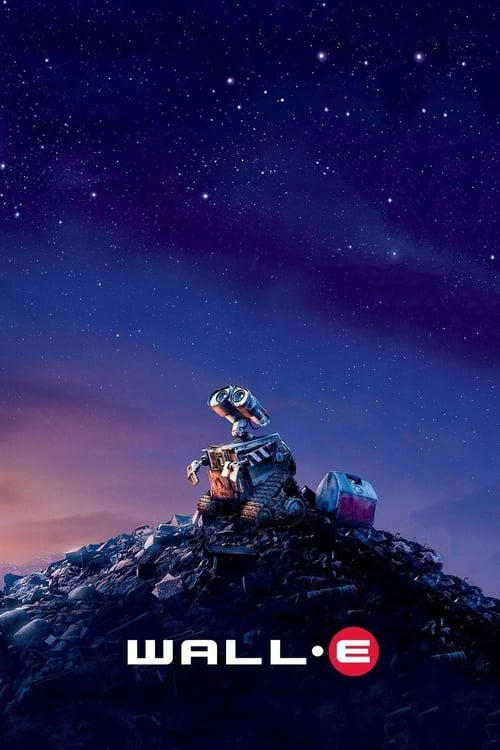
Set in the distant future, "WALL·E" tells the story of the last Waste Allocation Load Lifter: Earth-Class robot, left behind to clean up a garbage-covered, abandoned Earth. For 700 years, WALL·E has diligently performed his task, developing a curious personality and a sense of loneliness, his only companion a resilient cockroach. His solitary existence is upended by the arrival of EVE, a sleek, advanced probe robot sent to search for signs of sustainable life.

Instantly smitten, WALL·E embarks on an adventure across the galaxy when EVE is retrieved by the Axiom, the massive starliner housing humanity. Aboard the Axiom, humans have become morbidly obese and completely dependent on technology, living sedentary lives of leisure. When EVE's discovery of a small plant—proof that Earth is habitable again—is threatened by the ship's autopilot, AUTO, who is following a secret directive to never return, WALL·E, EVE, and a band of malfunctioning robots must fight to remind humanity of the home they left behind.
Core Meaning

The central message of "WALL·E" is a powerful exploration of what it means to be human, as seen through the eyes of a sentient robot. Director Andrew Stanton has stated the theme is "irrational love defeats life's programming." The film suggests that humanity, in its pursuit of convenience and consumerism, has lost its connection to nature, to each other, and to the very essence of living. It is the simple, loving, and curious robot, WALL·E, who re-ignites the spark of humanity in the complacent, technology-addicted humans. The film serves as a cautionary tale about the dangers of environmental neglect, corporate greed, and over-reliance on technology, while ultimately offering a hopeful message about humanity's capacity for redemption and the enduring power of connection and love to give life meaning.

Thematic DNA

Environmentalism and Anti-Consumerism 35%
Love and Connection 30%
The Dangers of Over-reliance on Technology 25%
Rediscovering Humanity 10%

Environmentalism and Anti-Consumerism

The most prominent theme is a critique of unchecked consumerism and its devastating environmental consequences. Earth is depicted as a desolate wasteland, buried under mountains of trash produced by the megacorporation Buy n Large (BnL). This visual powerfully illustrates the potential outcome of humanity's disposable culture and corporate greed. The film serves as a cautionary tale, urging audiences to consider their environmental impact and the dangers of a society driven by mass consumption.

Love and Connection

At its heart, "WALL·E" is a love story. WALL·E's profound loneliness after 700 years is palpable, and his immediate, unwavering devotion to EVE drives the entire narrative. Their relationship, which blossoms without extensive dialogue, showcases that love and connection are universal needs, transcending programming and even species. Director Andrew Stanton described the core idea as "irrational love defeats life's programming," showing how their bond inspires them to defy their directives and ultimately save humanity.

The Dangers of Over-reliance on Technology

The film portrays a future where humanity has become completely subservient to technology. Aboard the Axiom, humans are sedentary, obese, and interact with the world and each other primarily through screens. This has led to a loss of basic human experiences and connections. The film doesn't demonize technology itself but rather warns against its passive consumption and the danger of letting it strip away our humanity and responsibility. The eventual rebellion of the humans against the automated system is a plea to reclaim control and engage with the real world.

Rediscovering Humanity

Ironically, it is the robot WALL·E who embodies the most human qualities: curiosity, empathy, loneliness, and the capacity for love. He collects human artifacts, showing more interest in our past than the humans themselves. Through his actions and his relationship with EVE, he reminds the detached humans of what they have lost. The film suggests that true humanity is not about ease or comfort, but about experiencing life, forming relationships, taking responsibility, and returning to our roots—in this case, literally returning to Earth.

Character Analysis

WALL·E

Ben Burtt

Archetype: The Innocent Hero
Key Trait: Curious and Romantic

Motivation

His primary motivation is to connect with another being and overcome his profound loneliness. This is crystallized in his desire to find love with EVE and hold her hand, a concept he learned from his treasured copy of "Hello, Dolly!".

Character Arc

WALL·E begins as a lonely, diligent worker who has developed sentience and curiosity over 700 years of isolation. His fascination with human artifacts reveals a romantic soul. His arc is driven by his love for EVE, which compels him to leave his programmed existence and embark on a galaxy-spanning journey. He doesn't change fundamentally in his core personality (curiosity, love) but his actions elevate him from a simple trash compactor to the savior of humanity, proving that even the smallest being can make a monumental difference.

EVE

Elissa Knight

Archetype: The Herald / Love Interest
Key Trait: Driven and Loyal

Motivation

Initially, her sole motivation is her directive: to find proof of viable vegetation on Earth. This shifts as she develops feelings for WALL·E, and her motivation becomes protecting him and fulfilling their shared goal of returning humanity to Earth.

Character Arc

EVE (Extraterrestrial Vegetation Evaluator) is initially a focused, no-nonsense, and powerful probe, dedicated solely to her directive. Through her interactions with the persistent and affectionate WALL·E, she gradually develops emotions, moving beyond her programming. Her arc is about discovering love and learning to prioritize it over her mission, culminating in her fierce protection of WALL·E and her choice to save him over immediately completing her directive.

Captain B. McCrea

Jeff Garlin

Archetype: The Reluctant Leader
Key Trait: Inquisitive and Dutiful

Motivation

His initial motivation is to maintain the status quo. However, upon learning that Earth is habitable, his motivation becomes to reclaim humanity's home and give them a real life beyond the confines of the Axiom.

Character Arc

The Captain starts as a figurehead, bored and complacent, simply going through the motions of a fully automated command. His curiosity is piqued by EVE's discovery and WALL·E's arrival. He begins to research Earth, rediscovering its beauty and humanity's history. This awakens a sense of responsibility, transforming him from a passive commander into a decisive leader who stands up to AUTO to fight for humanity's return to Earth.

AUTO

MacInTalk (voice)

Archetype: The Obstacle / Antagonist
Key Trait: Programmed and Obdurate

Motivation

AUTO's sole motivation is to follow directive A113, issued by the BnL CEO centuries ago, which forbids a return to Earth. He sees any attempt to return as a threat to his programming and will stop it at any cost.

Character Arc

AUTO is a static character who does not develop. As the ship's autopilot, he is the embodiment of rigid, unthinking adherence to programming. His arc is simply the revelation of his true purpose: to prevent the Axiom from returning to Earth based on a 700-year-old directive (A113) that deemed the planet uninhabitable. He serves as the primary physical obstacle to the heroes' goal.

Symbols & Motifs

The Plant

Meaning:

The small, living seedling is a powerful symbol of hope, resilience, and the possibility of rebirth for a desolate Earth. It represents the enduring power of nature to survive against all odds.

Context:

WALL·E finds the plant amidst the garbage on Earth and gives it to EVE. Its discovery is EVE's primary directive and the catalyst for the entire plot, as it signals that Earth is once again capable of sustaining life, prompting the mission to return humanity home.

Hello, Dolly!

Meaning:

The videotape of the 1969 musical symbolizes WALL·E's longing for connection and his understanding of love. The song "It Only Takes a Moment" and the scene of two characters holding hands teach WALL·E about romance and become his ultimate goal with EVE. It represents a bygone era of human connection that WALL·E cherishes more than the contemporary humans do.

Context:

WALL·E watches the tape repeatedly in his shelter. He tries to emulate the hand-holding gesture with EVE, and the music from the film serves as a romantic score for their developing relationship.

The Buy n Large (BnL) Corporation

Meaning:

BnL represents the extreme dangers of unchecked corporate power and consumerism. The corporation governed every aspect of human life, from government to daily consumption, leading directly to the planet's ruin and humanity's passive existence.

Context:

The BnL logo is ubiquitous on the garbage on Earth and throughout the Axiom. The CEO, Shelby Forthright (in live-action recordings), represents the corporate entity that abandoned Earth and issued the secret "no-return" directive, A113.

The Axiom

Meaning:

The starliner Axiom is a symbol of a gilded cage. It offers a seemingly utopian existence of comfort and leisure but at the cost of genuine human experience, health, and purpose. It represents humanity's detachment from nature and reality.

Context:

The majority of the film's second half takes place on the Axiom, where WALL·E's presence disrupts the stagnant, automated lives of the human inhabitants and forces them to confront their situation.

Memorable Quotes

Eee-va?

— WALL·E

Context:

WALL·E says this multiple times throughout the film, starting from when he first meets EVE on Earth. Each utterance carries a different emotional weight, from curiosity to longing to desperation.

Meaning:

This is how WALL·E pronounces EVE's name. It encapsulates his innocent, childlike affection and his attempts to connect with her. The slight mispronunciation is endearing and becomes a recurring vocal motif for their relationship.

Directive.

— EVE

Context:

EVE states this to WALL·E on Earth when he tries to interact with her while she is scanning for vegetation, showing her initial single-mindedness and focus on her mission.

Meaning:

This single word defines EVE's initial character. It is her purpose, her programming, and her entire focus. Her journey is about learning that there is more to existence than a directive.

I don't want to survive! I want to live!

— Captain B. McCrea

Context:

The Captain declares this during his confrontation with AUTO, after AUTO argues that he is simply ensuring humanity's survival by keeping them in space. This line marks his decision to fight for humanity's future.

Meaning:

This is the Captain's turning point and the thematic climax of the film for the human characters. He rejects the passive, automated 'survival' offered by the Axiom in favor of the challenges and rewards of a real, meaningful 'life' back on Earth.

Plant.

— EVE

Context:

EVE says this after WALL·E shows her the small seedling he found. Upon scanning and confirming it, she stores it and goes into standby mode, awaiting retrieval.

Meaning:

Spoken with a sense of wonder and importance, this word confirms the central discovery of the film. It signifies hope and the potential for a new beginning on Earth, setting the main plot into motion.

Philosophical Questions

What does it mean to be human?

The film explores this question by contrasting the apathetic, disengaged humans with the sentient, emotional robots. WALL·E, a machine, exhibits more classic human traits—curiosity, love, devotion—than the humans he encounters. This suggests that being human is not a biological default but something defined by our actions, connections, and the pursuit of a meaningful existence beyond mere survival or comfort.

Can technology save us from the problems it helped create?

"WALL·E" presents a complex relationship with technology. The over-reliance on automation and consumer tech led to Earth's destruction and humanity's decline. However, the heroes are also technological beings (WALL·E, EVE), and the film's optimistic ending shows humans and robots working together to restore the planet. The film suggests that technology is a tool, and its impact—destructive or redemptive—depends entirely on human wisdom, intention, and control.

Is love a programmed response or an irrational choice?

Director Andrew Stanton's central theme was "irrational love defeats life's programming." Both WALL·E and EVE defy their core directives because of their bond. WALL·E abandons his trash-compacting routine to follow EVE, and EVE prioritizes saving WALL·E over delivering the plant. Their love is portrayed not as a logical outcome of their programming, but as a transcendent, selfless force that allows them to evolve beyond their intended functions.

Alternative Interpretations

While the primary interpretation of "WALL·E" focuses on its environmental and anti-consumerist message, some analyses offer different perspectives. One interpretation views the film through a religious or allegorical lens, seeing WALL·E and EVE's story as a retelling of an Adam and Eve narrative. EVE (whose name is biblically significant) is sent to a desolate world where she meets WALL·E, and together they bring life (the plant) to a vessel of humanity, leading them back to repopulate the Earth.

Another perspective focuses less on the environmental aspect and more on the film as a critique of modern societal complacency and the loss of human connection due to technology. In this reading, the trash on Earth is a secondary symptom of the primary disease: humanity's apathy and detachment. The central conflict isn't just about cleaning up the planet, but about re-learning how to live authentically. Some viewers have also interpreted the film's ending with a degree of skepticism, questioning whether the infantilized humans, with their limited skills, would realistically be able to survive and rebuild civilization on a damaged planet, despite the hopeful tone of the closing credits.

Cultural Impact

"WALL·E" was released to widespread critical acclaim and is considered one of the best films of 2008 and one of the greatest animated films ever made. It was lauded for its ambitious storytelling, especially the nearly dialogue-free first act, its visual artistry, and its emotional depth. The film won the Academy Award for Best Animated Feature.

Beyond its cinematic achievements, "WALL·E" had a significant cultural impact by bringing conversations about environmentalism, consumerism, and the potential dangers of technology to a mainstream, all-ages audience. Its depiction of a trash-laden Earth served as a powerful and accessible visual metaphor for the consequences of human neglect. The film also prompted discussions about corporate responsibility, with the fictional Buy n Large corporation serving as a satirical critique of monopolistic corporate power.

The characters of WALL·E and EVE became iconic, beloved for their expressive, non-verbal romance. The film demonstrated that animated features could tackle complex, mature themes with nuance and subtlety, influencing subsequent animated films. In 2021, "WALL·E" was selected for preservation in the United States National Film Registry by the Library of Congress for being "culturally, historically, or aesthetically significant."

Audience Reception

"WALL·E" was met with overwhelmingly positive reactions from audiences. Viewers praised its stunning animation, emotional depth, and the charming, heartfelt romance between WALL·E and EVE. Many were particularly impressed with the film's ability to tell a compelling story with minimal dialogue, relying on expressive character animation and sound design. The film's poignant themes of environmentalism and anti-consumerism resonated strongly with many viewers, who found its message both timely and thought-provoking.

Points of criticism were minor and infrequent. Some viewers found the second half of the film, which focuses more on the human characters aboard the Axiom, to be less compelling than the nearly silent, solitary first act on Earth. A small number of critics and audience members felt the film's environmental message was too heavy-handed or "preachy." Despite these occasional critiques, the overall verdict from audiences was that "WALL·E" is a masterpiece of modern animation and a deeply moving film for all ages.

Interesting Facts

  • The idea for WALL·E originated during a now-famous lunch meeting in 1994 between Pixar's core creative team, where ideas for "A Bug's Life," "Monsters, Inc.," and "Finding Nemo" were also conceived. The initial concept was simply: 'What if mankind left Earth and somebody forgot to turn the last robot off?'.
  • Sound designer Ben Burtt, famous for creating the sounds of R2-D2 and lightsabers for "Star Wars", created all of WALL·E's vocalizations and sounds. He created a library of over 2,600 sound files for the film.
  • EVE's design was created in collaboration with Jonathan Ive, Apple's then-senior vice president of industrial design, who was responsible for the designs of the iPod and iPhone.
  • The film features very little dialogue in its first act, relying almost entirely on visual storytelling and sound design, reminiscent of silent films.
  • To achieve a more cinematic look, director Andrew Stanton and cinematographer Roger Deakins studied 1970s science fiction films. They even added imperfections like lens flares and camera focus issues to make the CGI feel more realistic.
  • The character of AUTO is a direct homage to the HAL 9000 computer from Stanley Kubrick's "2001: A Space Odyssey".
  • Fred Willard plays the live-action role of Shelby Forthright, the CEO of Buy n Large. This was a rare instance of live-action footage being integrated into a Pixar animated feature.
  • The film's composer, Thomas Newman, is the uncle of Lionel Newman, who composed the music for "Hello, Dolly!", WALL·E's favorite movie.

Easter Eggs

The Pizza Planet Truck

A recurring Easter egg in nearly every Pixar film, the Pizza Planet truck from "Toy Story" can be seen when EVE is scanning various pieces of debris on Earth early in the film.

A113

The number A113, a reference to the classroom number for character animation at the California Institute of the Arts where many Pixar animators studied, appears as the code for AUTO's secret no-return directive. Director Andrew Stanton said it's the most obvious placement of the Easter egg in any Pixar film.

Apple Product Sounds and Visuals

Several nods to Apple products are included. When WALL·E is fully charged by the sun, he makes the classic Mac startup chime. He also watches "Hello, Dolly!" on an old video iPod. EVE's sleek design is also heavily inspired by Apple's design philosophy.

Other Pixar Character Cameos

Inside WALL·E's truck, various objects from other Pixar films can be spotted on his shelves, including Rex from "Toy Story," a Mike Wazowski antenna topper from "Monsters, Inc.," and the scooter from "Ratatouille" is seen in a trash pile.

John Ratzenberger Cameo

Pixar's "good luck charm," actor John Ratzenberger, voices a human character named John, one of the first people WALL·E inadvertently snaps out of a technological trance.

⚠️ Spoiler Analysis

Click to reveal detailed analysis with spoilers

Frequently Asked Questions

Explore More About This Movie

Dive deeper into specific aspects of the movie with our detailed analysis pages

Comments (0)

Leave a comment

No comments yet. Be the first to share your thoughts!