
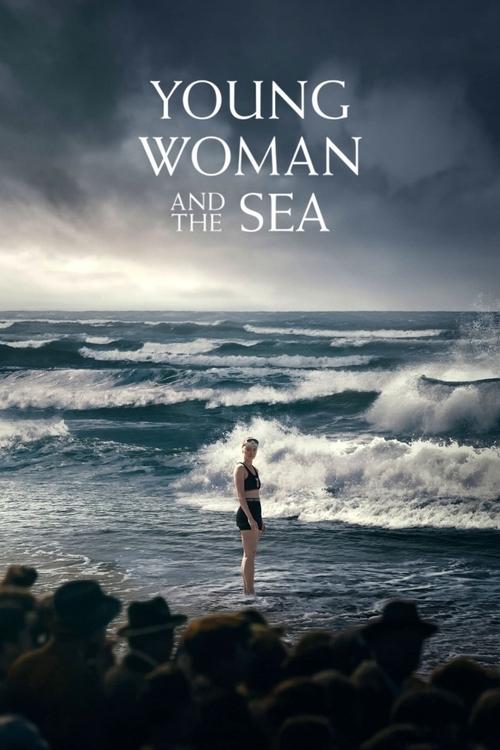
Young Woman and the Sea
An inspiring biographical drama, this film captures the relentless spirit of a young woman battling societal norms and the unforgiving sea, painted with hues of fierce determination and triumphant courage.
Young Woman and the Sea

Young Woman and the Sea

"Defy the odds."

31 May 2024 United States of America 129 min ⭐ 7.9 (378)
Director: Joachim Rønning
Cast: Daisy Ridley, Tilda Cobham-Hervey, Stephen Graham, Kim Bodnia, Jeanette Hain
Drama History
Perseverance Against Adversity Feminism and the Fight for Equality Sisterhood and Family Support Humanity vs. Nature
Budget: $40,000,000
Box Office: $581,725

Overview

"Young Woman and the Sea" chronicles the incredible true story of Gertrude "Trudy" Ederle, the first woman to successfully swim the English Channel. Born in New York City in 1905 to German immigrant parents, Trudy overcomes a near-fatal bout of measles in her childhood which results in significant hearing loss. This early brush with mortality, coupled with a local ferry disaster where many women perished because they couldn't swim, ignites in her a passion for the water.

Despite societal expectations and her father's initial disapproval of women in sports, Trudy, with the encouragement of her mother and sister Meg, becomes a competitive swimmer. She rises through the ranks, even competing in the 1924 Paris Olympics. However, it's her ambition to conquer the treacherous 21-mile English Channel that forms the core of the narrative. The film depicts her struggles against not just the harsh elements of the sea, but also the pervasive sexism of the era, embodied by unsupportive male coaches and officials.


Core Meaning

The central message of "Young Woman and the Sea" is one of perseverance, courage, and the defiance of societal limitations. Director Joachim Rønning aimed to explore what drives an individual to risk their life to prove a point, showcasing Trudy Ederle's journey not just as an athletic achievement, but as a fight for recognition and equality for women in sports and society at large. The film celebrates the power of the human spirit to overcome adversity, whether it be physical ailments, patriarchal resistance, or the formidable forces of nature. It's a testament to the idea that with unwavering determination, one can achieve the seemingly impossible and inspire generations to come.

Thematic DNA

Perseverance Against Adversity 35%
Feminism and the Fight for Equality 30%
Sisterhood and Family Support 20%
Humanity vs. Nature 15%

Perseverance Against Adversity

Trudy Ederle's story is the epitome of perseverance. From surviving a severe case of measles that permanently damaged her hearing to facing the treacherous and unpredictable conditions of the English Channel, she consistently pushes through obstacles. The film highlights her relentless spirit as she is repeatedly told that women are not physically or emotionally equipped for such demanding athletic feats. Her journey is a powerful illustration of overcoming both physical and societal barriers through sheer willpower and dedication.

Feminism and the Fight for Equality

The film is set in an era where women's roles were largely confined to the domestic sphere, and their participation in competitive sports was met with skepticism and outright hostility. Trudy's ambition to swim the English Channel is not just a personal goal but a direct challenge to the patriarchal norms of the 1920s. Her success becomes a symbol of female strength and capability, paving the way for future generations of female athletes. The narrative consistently portrays the condescending and obstructive attitudes of men in power, emphasizing the societal currents Trudy had to swim against.

Sisterhood and Family Support

The bond between Trudy and her sister, Meg, is a central emotional anchor of the film. Meg is her initial companion in learning to swim and remains a source of unwavering support, even when she chooses a more traditional path herself. While her father is initially resistant, the steadfast belief of her mother and sister provides Trudy with the emotional foundation to pursue her dreams. This theme explores the importance of a strong support system in achieving extraordinary goals.

Humanity vs. Nature

The film vividly portrays the raw and unforgiving power of the sea. Trudy's swim is depicted as a monumental battle against the elements: freezing temperatures, strong currents, jellyfish, and the sheer vastness of the open water. Director Joachim Rønning uses the expansive oceanic setting to emphasize the scale of her challenge, framing her as a tiny, determined figure against the immense power of nature. This theme highlights the physical and mental fortitude required to conquer one of the world's most dangerous bodies of water.

Character Analysis

Gertrude "Trudy" Ederle

Daisy Ridley

Archetype: The Hero
Key Trait: Unwavering Determination

Motivation

Trudy is driven by a profound need to prove her own capabilities and, by extension, the capabilities of all women. Initially sparked by a desire for self-reliance after witnessing a tragedy, her motivation evolves into a quest to shatter the societal and athletic barriers of her time. She rejects the prescribed path for women and is determined to carve her own legacy.

Character Arc

Trudy begins as a frail child who overcomes a near-fatal illness. This initial victory instills in her a quiet but fierce determination. Initially overshadowed by her sister in swimming, she hones her skills through relentless dedication, eventually becoming an Olympic athlete. Her arc is one of continually defying expectations—first her family's, then her coaches', and finally, the world's. She transforms from an underdog into a pioneering icon who proves that a woman can not only equal but surpass the athletic achievements of men.

Margaret "Meg" Ederle

Tilda Cobham-Hervey

Archetype: The Ally/Foil
Key Trait: Supportive

Motivation

Meg is motivated by her love and support for her sister. While she may not share Trudy's singular, world-changing ambition, her motivation is to see her sister succeed. She also represents the societal pressure to conform, choosing a life that, while different from Trudy's, is one of stability and accepted norms.

Character Arc

Meg starts as the more naturally gifted swimmer and Trudy's supportive older sister. Her arc represents the more conventional path for women of that era. While she initially shares Trudy's passion for swimming, she eventually chooses the security of marriage and family life. Despite giving up her own competitive dreams, she remains Trudy's steadfast supporter, her presence on the boat during the Channel swim providing crucial emotional encouragement.

Bill Burgess

Stephen Graham

Archetype: The Mentor
Key Trait: Eccentric and Encouraging

Motivation

Burgess is motivated by a genuine respect for Trudy's skill and spirit. Having conquered the Channel himself, he understands the monumental effort required and is disgusted by the attempts to undermine her. He is driven by a sense of fairness and a desire to see a true champion achieve her goal, regardless of gender.

Character Arc

Bill Burgess is introduced as an eccentric but respected swimmer, being the second man to have successfully crossed the English Channel. Initially a competitor and observer, he recognizes Trudy's immense talent and determination, especially after her first attempt is sabotaged. He evolves from a fellow swimmer into a crucial mentor and coach, providing her with the trust and technical support she needs to succeed.

Jabez Wolffe

Christopher Eccleston

Archetype: The Antagonist
Key Trait: Sabotaging

Motivation

Wolffe's primary motivation is his own ego and deep-seated sexism. He sees Trudy not as an athlete to be coached but as a threat to his own fragile sense of masculinity and accomplishment. He is driven to see her fail to preserve his own standing and reinforce his prejudiced worldview.

Character Arc

Jabez Wolffe is presented as a resentful and misogynistic coach. Having failed multiple times to swim the Channel himself, he cannot stomach the idea of a young woman succeeding where he could not. His arc is static; he begins as an obstacle to Trudy and remains one until the end. He actively sabotages her first attempt, revealing his character to be driven by jealousy and prejudice.

Henry Ederle

Kim Bodnia

Archetype: The Skeptic
Key Trait: Traditionalist (initially)

Motivation

Initially, Henry is motivated by a desire to protect his family and uphold societal norms. He believes he is doing what is best for his daughters by steering them towards a traditional life. His motivation shifts as he recognizes the depth of Trudy's passion and the historic nature of her quest; his love for his daughter ultimately outweighs his adherence to tradition.

Character Arc

Henry, Trudy's father, begins as a traditional patriarch, believing a woman's place is not in competitive sports but in the home, preparing for marriage. He is initially dismissive and resistant to his daughters' swimming aspirations. However, as he witnesses Trudy's incredible talent and unbreakable will, his skepticism melts away. His arc is one of transformation, culminating in him becoming one of her most ardent supporters, fully embracing her journey.

Symbols & Motifs

The English Channel

Meaning:

The English Channel symbolizes more than just a physical body of water; it represents the ultimate barrier to Trudy's ambition and a tangible manifestation of the societal limitations placed upon women. Conquering it is synonymous with shattering the glass ceiling of her time.

Context:

Throughout the film, the Channel is discussed with a sense of dread and impossibility, with numerous stories of men who failed in their attempts. For Trudy, the 21-mile stretch of treacherous water is the final frontier she must cross to prove her worth and the capabilities of all women.

The Red Roadster

Meaning:

While a detail from the true story that is altered in the film (where her father is initially unsupportive), the real-life promise of a red roadster from her father symbolizes tangible belief and the reward for achieving an audacious goal. It represents a shift from skepticism to wholehearted support.

Context:

In reality, Trudy's father promised her a red roadster if she successfully swam the Channel, showcasing his support. Though the film portrays his support as evolving more slowly, the idea of a concrete, celebratory prize underscores the magnitude of her undertaking.

Jellyfish

Meaning:

The swarms of jellyfish represent the unexpected, painful, and venomous obstacles that life and nature throw in one's path. They are a physical manifestation of the painful struggles Trudy endures on her journey.

Context:

During her swim across the Channel, Trudy encounters a large smack of jellyfish, and the painful stings threaten to derail her attempt. This scene is a harrowing depiction of her enduring immense pain to continue her quest, symbolizing her resilience against all forms of adversity.

Memorable Quotes

I will swim!

— Trudy Ederle

Context:

This quote is used early in the film, establishing Trudy's determination after surviving measles and being told that swimming could worsen her hearing. It's a foundational moment that defines her character's driving force throughout all her subsequent challenges.

Meaning:

This simple, declarative statement encapsulates Trudy's unwavering resolve from a young age. It's not just a desire but a promise to herself and a defiance against all who doubt her. It becomes her mantra throughout the film.

Philosophical Questions

What is the nature of human will against overwhelming natural and societal forces?

The film explores this question by pitting Trudy's singular determination against two immense forces: the raw, indifferent power of the English Channel and the deeply entrenched patriarchal structures of the 1920s. Her struggle is both physical and ideological. The film visually contrasts her small human form with the vast, dangerous sea, while the narrative details the constant dismissal and sabotage she faces from men. Her ultimate triumph suggests that individual will, when sufficiently focused and relentless, can overcome seemingly insurmountable obstacles, reshaping both personal limits and societal expectations.

How do personal achievements ripple outwards to create societal change?

Trudy's goal is intensely personal, born of her own drive and passion. However, the film demonstrates that her individual quest does not happen in a vacuum. Her swim becomes a public spectacle, followed by millions on the radio. Her success is not just a personal victory; it becomes a powerful symbol for the women's suffrage movement and the burgeoning fight for female equality in sports. The film explores how one person's groundbreaking achievement can capture the public imagination and serve as a catalyst for broader cultural shifts, inspiring countless others and altering the perception of what is possible.

Alternative Interpretations

While the film presents a largely straightforward and heroic narrative, some critics have pointed out that its interpretation simplifies the complexities of Trudy Ederle's character and historical context. One perspective is that the film, in its effort to be an uplifting Disney sports movie, creates mustache-twirling villains out of characters like Jabez Wolffe and portrays the sexism of the era in a very direct, sometimes heavy-handed manner, potentially sacrificing nuance for clear-cut conflict. For instance, the sabotage scene involving drugged tea is a dramatic invention to heighten Wolffe's villainy.

Another interpretation focuses on the characterization of Trudy herself. Some analyses suggest that in making her an unwavering symbol of determination, the film sidesteps a deeper exploration of her internal life, her fears, and the obsessive drive required for such a feat. This perspective argues that by making her journey seem almost pre-destined due to her unflappable nature, the film might unintentionally downplay the true psychological torment and struggle involved, presenting a less complex and more one-dimensional portrait of a real-life hero.

Cultural Impact

"Young Woman and the Sea" resurrects the story of Trudy Ederle, a pivotal but often forgotten figure in sports history. Created in a post-#MeToo era, the film resonates with contemporary conversations about gender equality and the historical struggles of women to be recognized in male-dominated fields. By highlighting the blatant sexism of the 1920s, it provides a historical context for the ongoing fight for equality in sports and beyond.

Critics received the film positively, praising it as an inspiring and well-crafted, if somewhat conventional, sports biopic. Many compared it to classic Disney sports dramas like "Remember the Titans" and "Miracle," noting its crowd-pleasing and emotional appeal. Daisy Ridley's performance was widely lauded as a highlight, showcasing her range beyond her famous "Star Wars" role. The film's release was strategically considered to tie in with the 2024 Summer Olympics, aiming to capture the public's interest in athletic achievement. While not a blockbuster, its impact lies in its power to educate and inspire, re-inserting Trudy Ederle's monumental achievement into the popular consciousness and reminding audiences of the pioneers who paved the way for today's female athletes.

Audience Reception

Audiences have responded very positively to "Young Woman and the Sea," often describing it as an inspiring, emotional, and captivating film. Viewers praised Daisy Ridley's powerful and charming performance as Trudy Ederle, finding her portrayal of quiet determination highly effective. The thrilling and emotional third act, depicting the Channel swim itself, was frequently cited as a highlight that had audiences cheering and emotionally invested. The film's old-fashioned, crowd-pleasing nature, reminiscent of classic inspirational Disney sports movies, was a major point of praise.

Criticism from audiences was minimal, but some viewers and critics alike noted that the script could be predictable and followed a standard biopic formula. The villains were sometimes seen as one-dimensionally sexist, and the dialogue occasionally lacked subtlety. However, the overall consensus was that the film's emotional power, strong performances, and breathtaking cinematography more than compensated for any narrative clichés. It has been widely regarded as a feel-good movie that successfully tells a story of triumph against the odds.

Interesting Facts

  • The film was initially slated for a streaming-only release on Disney+, but positive test screenings prompted a limited theatrical release.
  • Daisy Ridley underwent three months of intensive swimming training with an Olympic swimmer to prepare for the role, often spending 10-12 hours a day filming in the cold waters of the Black Sea.
  • The project was in development for a long time; producer Jerry Bruckheimer first acquired the rights to the book in 2015, with Lily James originally cast as Trudy Ederle.
  • For authenticity, much of the swimming was filmed in the open sea rather than a tank, which Daisy Ridley described as a "scary" but rewarding experience.
  • The film's screenplay was written by Jeff Nathanson, who was inspired to write the story for his daughters.
  • Director Joachim Rønning also made the film with his teenage daughters in mind, wanting to bring Trudy Ederle's forgotten story to a new generation.
  • The real Trudy Ederle's successful swim was met with the largest ticker-tape parade for an athlete in New York City's history at the time, a fact highlighted with archival footage at the end of the film.
  • Test audiences for "Young Woman and the Sea" gave it the highest scores for a Jerry Bruckheimer-produced film since "Pirates of the Caribbean: The Curse of the Black Pearl."

⚠️ Spoiler Analysis

Click to reveal detailed analysis with spoilers

Frequently Asked Questions

Explore More About This Movie

Dive deeper into specific aspects of the movie with our detailed analysis pages

Comments (0)

Leave a comment

No comments yet. Be the first to share your thoughts!