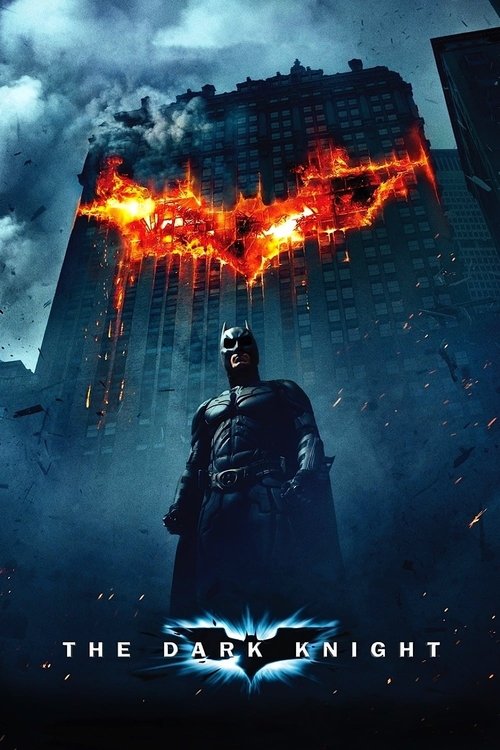
The Dark Knight
"Welcome to a world without rules."
Overview
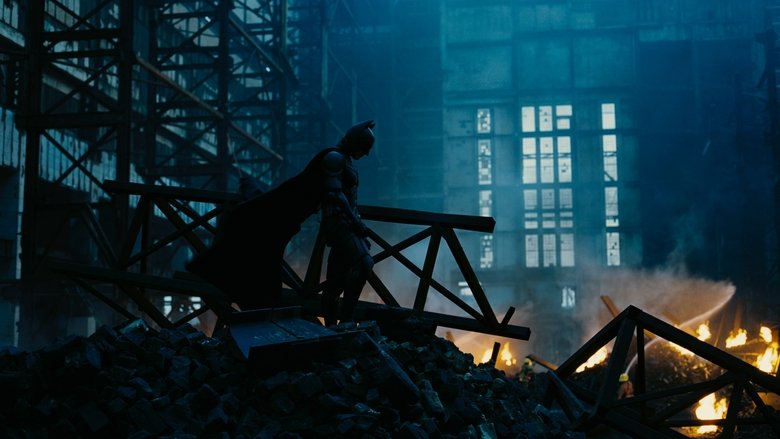
In "The Dark Knight," Batman, portrayed by Christian Bale, escalates his war on Gotham City's criminal underworld. He forms a powerful alliance with the incorruptible Lieutenant Jim Gordon (Gary Oldman) and the zealous new District Attorney, Harvey Dent (Aaron Eckhart), to dismantle the remaining organized crime syndicates. Their joint efforts prove remarkably effective, bringing a new sense of hope to the beleaguered city.
However, their success is short-lived as a new breed of criminal emerges from the shadows—a mysterious and terrifying mastermind known as the Joker (Heath Ledger). Driven by a desire for chaos and a twisted philosophy, the Joker unleashes a reign of terror on Gotham, pushing its heroes and citizens to their absolute limits. Batman is forced to confront one of the greatest psychological and physical tests of his crusade, questioning his own methods and the very nature of justice as he battles an enemy who wants to prove that anyone can be corrupted and that society is only a thin veneer over chaos.
Core Meaning
The core meaning of "The Dark Knight" revolves around the complex and often blurred line between heroism and villainy, order and chaos. Director Christopher Nolan explores the immense sacrifices required to uphold justice in a morally ambiguous world. The film posits that true heroism isn't about accolades or public adoration but about making impossible choices for the greater good, even if it means being misunderstood or condemned. It delves into the idea that symbols of hope are fragile and that society's moral fabric is constantly under threat from forces of anarchy. Ultimately, the film questions whether humanity is inherently good or if, as the Joker believes, civilization is a fragile construct that can be shattered with 'a little push.'
Thematic DNA
Order vs. Chaos
This is the central philosophical conflict of the film. Batman, Gordon, and Dent represent different facets of order: vigilantism, the justice system, and political idealism, respectively. The Joker is the antithesis, an agent of chaos who seeks to dismantle societal structures and prove that deep down, people are savage and self-serving. His 'social experiments,' such as the ferry dilemma, are designed to expose the fragility of morality and order when faced with anarchy. The film suggests that the struggle to maintain order is perpetual and comes at a great cost.
Heroism and Sacrifice
"The Dark Knight" presents a nuanced exploration of what it means to be a hero. It argues that true heroism demands immense personal sacrifice, not just of physical well-being but of reputation and personal happiness. Bruce Wayne sacrifices a normal life for Batman. Harvey Dent sacrifices his principles after immense loss. The film culminates in Batman making the ultimate sacrifice: taking the blame for Dent's crimes to preserve Gotham's hope in a 'white knight.' Gordon's final monologue about Batman being a 'Dark Knight' encapsulates this theme, defining a hero as someone who can endure being hated for doing what is necessary.
Duality and the Fragility of Morality
The film is replete with dualities: Batman and Bruce Wayne, Batman and the Joker, and most tragically, Harvey Dent and Two-Face. Batman and the Joker are presented as two sides of the same coin, an 'unstoppable force' meeting an 'immovable object,' each a response to the other. Harvey Dent's transformation into Two-Face is the film's most potent symbol of this theme, illustrating how even the most righteous individual can be corrupted by tragedy and a loss of faith. His descent is the Joker's primary victory, proving his philosophy that 'madness is like gravity... all it takes is a little push.'
Escalation
A key theme carried over from "Batman Begins" is the concept of escalation. Batman's existence as a masked vigilante operating outside the law inevitably prompts a more extreme and theatrical response from the criminal element. As Gordon notes at the end of the first film, Batman's presence leads to criminals who are not motivated by simple greed. The Joker is the ultimate manifestation of this escalation—a villain who isn't after money but is a direct ideological challenge to Batman himself. His chaos is a direct reaction to Batman's order.
Character Analysis
Bruce Wayne / Batman
Christian Bale
Motivation
To inspire hope and rid Gotham of the organized crime and corruption that led to his parents' murder. He is motivated by a strict moral code and the desire to prove that the people of Gotham can be saved without compromising their principles. He also longs for a personal life free from the burden of being Batman.
Character Arc
Batman begins the film hoping his crusade is temporary, seeking an end to his vigilante career so Bruce Wayne can have a life with Rachel Dawes. He sees Harvey Dent as Gotham's true, legitimate hero who can succeed where Batman cannot. The Joker's reign of terror forces Batman to confront the limits of his one rule (no killing) and push his moral and technological boundaries, such as using a city-wide surveillance system. His arc culminates in a profound act of self-sacrifice, where he relinquishes his own reputation and becomes a pariah to save Gotham's soul, embracing his role as the city's silent guardian, the 'Dark Knight.'
The Joker
Heath Ledger
Motivation
His motivation is purely philosophical and anarchic. As Alfred explains, he is a man who 'some men aren't looking for anything logical, like money... They can't be bought, bullied, reasoned, or negotiated with. Some men just want to watch the world burn.' He wants to prove that society's rules are a 'bad joke' and that chaos is the true state of nature by pushing Gotham to the brink of self-destruction.
Character Arc
The Joker is a static character who experiences no development or change; as Christopher Nolan states, he has no arc. He is presented as an absolute force of nature, an 'agent of chaos' who serves as a catalyst for the arcs of other characters. He simply exists to challenge and dismantle the established order, test the morality of others, and prove his nihilistic worldview that deep down, everyone is as ugly as he is. His victory isn't in escaping, but in corrupting Harvey Dent, Gotham's 'White Knight.'
Harvey Dent / Two-Face
Aaron Eckhart
Motivation
Initially, his motivation is a fervent belief in the law and a desire to clean up Gotham's streets to make it a safe place to live with Rachel. After his transformation, his sole motivation is revenge, enacted through what he sees as the only real justice: chance. He targets those he blames for Rachel's death—the corrupt cops and the mob—but his grief and nihilism ultimately lead him to threaten Gordon's family.
Character Arc
Harvey Dent's arc is the central tragedy of the film. He starts as Gotham's courageous and idealistic District Attorney, the 'White Knight' who can fight crime within the bounds of the law. He is the symbol of hope that Bruce Wayne believes can replace Batman. However, after the Joker orchestrates Rachel's death and his own disfigurement, Dent's faith in the fairness of the justice system is shattered. Manipulated by the Joker in the hospital, he abandons his principles and embraces a new identity, Two-Face, letting a scarred coin dictate his vengeful actions, thus fulfilling his own adage: 'You either die a hero, or you live long enough to see yourself become the villain.'
Symbols & Motifs
Two-Face's Coin
Initially, Harvey Dent's two-headed coin symbolizes his belief that he can make his own luck and control his destiny within the justice system. After his transformation, the scarred coin comes to represent his shattered psyche and his new philosophy that chance is the only true justice in a cruel world. It embodies his duality and the loss of his former idealism, as he abdicates all moral choice to the flip of the coin.
Dent frequently flips the coin throughout the film. Before his accident, he uses the two-headed coin to project confidence and bend rules for what he sees as the greater good. After Rachel's death and his disfigurement, one side of the coin is burned. He then uses it to decide the fate of those he holds responsible for his loss, including himself, Batman, and Gordon's son.
The Joker's Makeup
The Joker's smeared, chaotic clown makeup is his 'war paint,' a mask that symbolizes his embrace of anarchy and his rejection of societal norms. It's a terrifying perversion of a traditionally harmless figure, representing his unpredictable and unstable nature. Unlike Batman's mask which hides an identity, the Joker's makeup seems to reveal his true, chaotic self, making him a faceless agent of chaos with no verifiable past.
The makeup is present in every scene featuring the Joker. Its grotesque, decaying appearance enhances his menace. He offers conflicting, tragic stories for the scars beneath the makeup, further obscuring any human connection and cementing his status as a symbol of pure anarchy.
The Bat-Signal
The Bat-Signal represents the fragile trust and alliance between Batman and the official justice system, embodied by Lieutenant Gordon. It is a symbol of hope for the citizens of Gotham, a sign that someone is watching over them. However, it also highlights Batman's status as an outsider, a figure who can only be summoned and never truly be part of the system he protects.
The signal is used several times by Gordon to summon Batman. In a pivotal moment, Harvey Dent uses it, violating the personal connection it represents between Batman and Gordon. The film concludes with Gordon destroying the Bat-Signal with an axe after Batman becomes a fugitive, a powerful visual representation of their alliance being publicly severed to protect Dent's legacy.
Memorable Quotes
Why so serious?
— The Joker
Context:
The Joker delivers this line in multiple scenes, each time offering a different, contradictory story about how he got his facial scars. One account involves his abusive father, and another involves self-mutilation for his wife. This use of the line underscores his unreliable and purely chaotic nature.
Meaning:
This is the Joker's iconic, chilling catchphrase. It encapsulates his worldview, mocking the gravity and order that others try to impose on life. It's a taunt that highlights his love for chaos and his twisted perception of the world as a grim joke. The line is used to intimidate and unsettle his victims and adversaries, exposing the madness beneath his humor.
You either die a hero, or you live long enough to see yourself become the villain.
— Harvey Dent
Context:
Spoken by Harvey Dent during a dinner with Bruce Wayne, Rachel Dawes, and his date. They are discussing Batman's role in Gotham and the nature of heroism. The line becomes tragically ironic as it perfectly describes his own fate.
Meaning:
This quote is the thematic core of the film, a profound statement on the corrupting influence of a dark world on even the most noble intentions. It foreshadows Harvey's own tragic transformation into the vengeful Two-Face and also reflects Batman's ultimate decision to become a villain in the public's eye to protect Harvey's heroic legacy.
Some men just want to watch the world burn.
— Alfred Pennyworth
Context:
Alfred says this to Bruce as they struggle to comprehend the Joker's actions after he burns a mountain of the mob's money. Alfred recounts a story from his past about a bandit in Burma who was stealing for the thrill of it, drawing a parallel to the Joker's incomprehensible and anarchic nature.
Meaning:
Alfred's observation provides Bruce Wayne—and the audience—with the clearest explanation of the Joker's motivations. It defines a new type of enemy who operates outside the logical frameworks of crime. The Joker cannot be understood through conventional means because his goal is not material gain but destruction and chaos for its own sake. This quote has become a widely used expression to describe senseless, destructive behavior.
I'm an agent of chaos.
— The Joker
Context:
The Joker says this to a hospitalized and disfigured Harvey Dent. He is manipulating Dent, absolving himself of direct responsibility for Rachel's death and blaming the 'schemers' of Gotham. This conversation is the final 'push' that corrupts Dent and turns him into Two-Face.
Meaning:
This is the Joker's explicit self-identification and a declaration of his philosophical mission. He explains that while others, like the mob or the police, are 'schemers' trying to control their worlds, he is a force that exists to dismantle that control by introducing anarchy. It cements his role not just as a criminal, but as an ideological opponent to the very concept of societal order.
Because he's the hero Gotham deserves, but not the one it needs right now. So we'll hunt him. Because he can take it. Because he's not our hero. He's a silent guardian, a watchful protector. A dark knight.
— James Gordon
Context:
Gordon delivers this speech to his son as they watch Batman flee from the police at the site of Harvey Dent's death. He has just destroyed the Bat-Signal, and the city's law enforcement now sees Batman as a murderer and an enemy.
Meaning:
This final monologue powerfully defines the film's concept of heroism as a thankless, sacrificial role. It explains why Batman must become a fugitive, taking the blame for Two-Face's crimes to preserve the symbol of hope that Harvey Dent represented. It cements Batman's new title, the 'Dark Knight,' a hero who operates from the shadows, accepts being vilified, and endures it all for the city's greater good.
Philosophical Questions
Are people inherently good, or is societal order just a fragile facade over our chaotic nature?
This is the central question posed by the Joker. He believes that when the chips are down, people will 'eat each other.' He orchestrates 'social experiments,' most notably the ferry dilemma, to prove this point. In this scenario, two ferries—one with civilians, one with prisoners—are given the means to detonate the other, with the threat of both being destroyed at midnight. The film's climax hinges on their choice. Ultimately, both boats refuse to act, suggesting an inherent morality or at least a reluctance to commit mass murder that refutes the Joker's hypothesis, offering a glimmer of hope amidst the darkness.
Is it justifiable to sacrifice principles and civil liberties for the sake of security and order?
The film explores this through Batman's actions. To find the Joker, he creates a surveillance system that spies on every citizen in Gotham, a clear violation of privacy. Lucius Fox calls it 'too much power for one person' and threatens to resign. Batman uses it but agrees it must be destroyed afterward. This reflects the real-world debate over government surveillance and the Patriot Act. The film also questions this through its ending: Batman and Gordon lie to the public and preserve Harvey Dent's heroic image by turning Batman into a villain. They sacrifice the truth for what they believe is the greater good of maintaining public faith and order.
What is the true nature of heroism?
"The Dark Knight" challenges the traditional definition of a hero. Harvey Dent begins as the 'White Knight,' a public hero working within the system. Batman is a 'Dark Knight,' a vigilante operating in the shadows. The film suggests that true heroism lies not in public adoration but in the willingness to make profound sacrifices. The film ends with Batman, the true hero, being hunted as a criminal, having sacrificed his own image to save the city's hope. It posits that a hero is someone who can endure being hated to do what is right.
Alternative Interpretations
One of the most debated aspects of "The Dark Knight" is its ending and its political subtext. Some interpretations view the film as a right-leaning allegory for the War on Terror, with Batman representing a George W. Bush-like figure who must use morally questionable means (like the city-wide surveillance device) to fight an unconventional, terroristic threat (the Joker). In this reading, the film justifies extra-legal measures for the sake of security.
Conversely, other analyses argue the film is a critique of such power. They point to Lucius Fox's refusal to control the surveillance system and Batman's decision to destroy it as evidence of the film's caution against unchecked power. Furthermore, the film's ending, where Batman becomes a scapegoat and is hunted, can be read as a commentary on society's need to vilify those who make difficult choices, rather than a simple endorsement of his actions. The ultimate failure of the Joker's ferry experiment, where citizens and prisoners refuse to kill each other, can be seen as a more optimistic take on human nature, directly contradicting the Joker's nihilism and the film's darker tones.
Cultural Impact
"The Dark Knight" is widely regarded as one of the greatest superhero films ever made and a landmark of 21st-century cinema. Released in 2008, it transcended the comic book genre to become a critically acclaimed crime thriller, drawing comparisons to films like "Heat." Its gritty, realistic tone and complex themes significantly influenced subsequent superhero movies, many of which sought to emulate its success. The film shattered box office records, becoming the highest-grossing film of 2008. Heath Ledger's iconic and chilling performance as the Joker earned him a posthumous Academy Award for Best Supporting Actor, the first time a major acting Oscar was awarded for a comic book film adaptation. The film's exploration of post-9/11 anxieties, themes of surveillance, and the nature of terrorism resonated deeply with audiences and critics, sparking extensive philosophical and political discussion. Its critical and commercial success is often cited as a key reason the Academy of Motion Picture Arts and Sciences expanded the Best Picture category from five to ten nominees, after the film was notably snubbed for a nomination.
Audience Reception
"The Dark Knight" was met with widespread critical acclaim and was a massive commercial success. Audiences and critics alike praised its dark and complex narrative, which was seen as elevating the superhero genre to the level of serious crime drama. Heath Ledger's performance as the Joker was universally lauded as iconic and transcendent, becoming a cultural phenomenon. The film holds a 94% approval rating on Rotten Tomatoes from both critics and audiences, indicating near-universal praise. Common points of praise included the film's intelligent screenplay, Nolan's direction, the practical effects and action sequences, and its philosophical depth. The main point of minor criticism, even among fans, has often been directed at Christian Bale's increasingly gruff and sometimes difficult-to-understand 'Batman voice.' Overall, it is considered a masterpiece of the genre and one of the best films of the 2000s.
Interesting Facts
- To prepare for his role, Heath Ledger lived alone in a hotel room for a month, developing the Joker's psychology, posture, and voice. He kept a diary filled with the Joker's thoughts and feelings.
- The film was the first major feature film to use high-resolution IMAX cameras for key action sequences, including the opening bank heist.
- During the interrogation scene, Heath Ledger encouraged Christian Bale to actually hit him to make the scene feel more authentic, though Bale refused to hit him as hard as Ledger wanted.
- The hospital explosion scene was a practical effect, with the building being a real, defunct candy factory scheduled for demolition. The pause in the explosions, where the Joker fiddles with the detonator, was planned as a safety precaution, not an improvisation by Ledger.
- Michael Caine (Alfred) was so startled by Heath Ledger's appearance as the Joker during their first scene together at Bruce's party that he forgot his lines.
- The Joker's mask during the opening bank heist is a direct homage to a mask worn by Cesar Romero's Joker in the 1966 'Batman' TV series episode "The Joker is Wild".
- Christian Bale's gruff Batman voice was made more intense in post-production at Christopher Nolan's direction, compared to its initial sound during filming.
- Heath Ledger self-directed the two homemade videos the Joker sends to the news station.
- One of the four IMAX cameras in the world at the time was destroyed during the filming of a stunt sequence.
Easter Eggs
The security camera footage of the Joker that Gordon shows Batman has a timestamp of '07/18/2008'.
This date, July 18, 2008, was the official U.S. release date of "The Dark Knight".
Bruce Wayne drives a Lamborghini Murciélago.
In Spanish, 'murciélago' means 'bat,' making it a fitting car for Batman's alter ego.
When Lucius Fox is presenting Bruce with his new, more flexible armor, Bruce asks if it will hold up against dogs. Lucius replies, 'Should do fine against cats.'
This is a subtle nod to the future appearance of Selina Kyle, also known as Catwoman, who would be a prominent character in the next film, "The Dark Knight Rises".
The name of the Gotham City judge who is killed is Judge Surrillo.
This is a likely homage to one of the film's second assistant directors, Jesus 'Chuy' Surrillo.
⚠️ Spoiler Analysis
Click to reveal detailed analysis with spoilers
Frequently Asked Questions
Explore More About This Movie
Dive deeper into specific aspects of the movie with our detailed analysis pages
Comments (0)
No comments yet. Be the first to share your thoughts!