Hidden Figures
An inspiring historical drama that charts the brilliant ascent of three Black female mathematicians at NASA, painting a powerful portrait of perseverance against a backdrop of prejudice.
Hidden Figures

Hidden Figures

"Meet the women you don't know, behind the mission you do."

10 December 2016 United States of America 127 min ⭐ 8.1 (10,115)
Director: Theodore Melfi
Cast: Taraji P. Henson, Octavia Spencer, Janelle Monáe, Kevin Costner, Kirsten Dunst
Drama History
Racism and Segregation Sexism and Gender Discrimination Perseverance and Empowerment The Power of Community and Sisterhood
Budget: $25,000,000
Box Office: $235,957,472

Overview

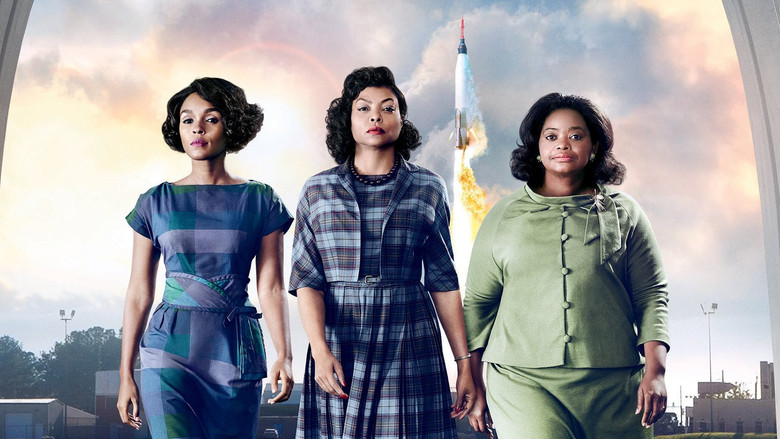
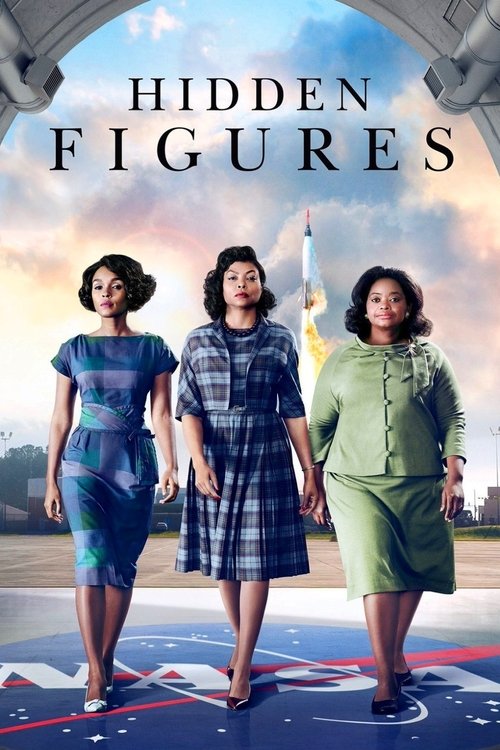
"Hidden Figures" tells the incredible untold story of Katherine G. Johnson, Dorothy Vaughan, and Mary Jackson—brilliant African-American women working at NASA who served as the brains behind one of the greatest operations in history: the launch of astronaut John Glenn into orbit. This stunning achievement restored the nation's confidence, turned around the Space Race, and galvanized the world. The film is set in Virginia in 1961, during the era of racial segregation.

The visionary trio crossed all gender and race lines to inspire generations to dream big. We see them navigate the daily injustices of Jim Crow laws, from segregated bathrooms and buses to the dismissive and hostile attitudes of their white, male colleagues. Despite the obstacles, their intellectual prowess and determination prove indispensable to the success of the American space program.

The film follows their individual journeys: Katherine's fight for recognition within the elite Space Task Group, Dorothy's struggle to be officially promoted to supervisor, and Mary's battle to attend an all-white school to become an engineer. Their stories intertwine to showcase their collective strength, friendship, and unwavering commitment to their work and to breaking down barriers.


Core Meaning

The central message of "Hidden Figures" is a powerful testament to the triumph of intellect, perseverance, and human dignity over systemic discrimination. Director Theodore Melfi aims to illuminate a forgotten chapter of American history, celebrating the monumental contributions of Black women who were instrumental in the Space Race yet erased from the narrative. The film carries a message of equality, demonstrating that genius is not confined by race or gender. It underscores the idea that for a nation to achieve its greatest potential—like sending a man into orbit—it must utilize the talents of all its citizens. Ultimately, the film argues that the most significant barriers to progress are not technical, but social, and that breaking them requires courage, resilience, and a demand for respect.

Thematic DNA

Racism and Segregation 35%
Sexism and Gender Discrimination 30%
Perseverance and Empowerment 25%
The Power of Community and Sisterhood 10%

Racism and Segregation

The film vividly portrays the daily indignities and systemic barriers imposed by Jim Crow laws in 1960s Virginia. This is shown through segregated bathrooms, coffee pots, libraries, and the dismissive attitudes the three protagonists face from their white colleagues. Katherine Johnson's half-mile run to the "colored" restroom becomes a powerful symbol of this injustice. The theme is central to the characters' struggles, as they must constantly prove their worth in a system designed to limit them based on their race.

Sexism and Gender Discrimination

Alongside racism, the protagonists battle pervasive sexism in the male-dominated field of science and engineering at NASA. They are initially relegated to the role of "computers," their work often uncredited by male engineers like Paul Stafford. Katherine is told women are not permitted in Pentagon briefings, and Mary must petition a court to attend engineering classes at an all-white, all-male high school. The film highlights their fight to be seen not just as women, but as brilliant minds capable of contributing at the highest levels.

Perseverance and Empowerment

"Hidden Figures" is fundamentally a story of resilience and empowerment. Despite facing dual barriers of racism and sexism, Katherine, Dorothy, and Mary refuse to be defeated. Dorothy teaches herself and her colleagues FORTRAN to adapt to the new IBM electronic computers. Mary fights in court for her right to education. Katherine tirelessly proves her mathematical genius until she is indispensable. Their individual and collective persistence demonstrates that empowerment comes from demanding recognition and creating opportunities where none exist.

The Power of Community and Sisterhood

The bond between Katherine, Dorothy, and Mary is a cornerstone of the film, showcasing the strength found in community. They support each other through personal and professional challenges, from car troubles to career frustrations. This sisterhood provides the emotional and strategic support needed to navigate the hostile environment at NASA. The film emphasizes that their individual successes are intertwined and that progress is a collective effort, a theme reinforced by Dorothy's commitment to uplifting all the women in her unit.

Character Analysis

Katherine G. Johnson (née Goble)

Taraji P. Henson

Archetype: The Hero / The Genius
Key Trait: Brilliant

Motivation

Driven by her profound love for mathematics and a deep-seated belief in her own abilities, Katherine's primary motivation is to do the work she was born to do. She is also motivated by a desire to provide for her three daughters and to contribute to her country's success in the Space Race, proving that her mind is as valuable as anyone else's, regardless of race or gender.

Character Arc

Katherine begins as a brilliant but reserved mathematician, intimidated by the hostile, all-white, all-male environment of the Space Task Group. She endures the daily humiliation of the segregated bathroom and has her work credited to others. Her arc is one of finding her voice and demanding the respect she deserves. Fueled by her passion and the urgency of the mission, she evolves from a hidden figure into an assertive and indispensable member of the team, culminating in John Glenn's personal request for her to verify the IBM computer's calculations.

Dorothy Vaughan

Octavia Spencer

Archetype: The Mentor / The Leader
Key Trait: Visionary

Motivation

Dorothy is motivated by a powerful sense of responsibility for the women in her charge. She fights not just for her own advancement but to ensure that her "gals" have secure futures and are treated with fairness and respect. Her motivation is rooted in community uplift and a pragmatic understanding of the changing technological landscape.

Character Arc

Dorothy starts the film performing the duties of a supervisor without the title or pay. Her journey is about fighting for official recognition and ensuring the survival and advancement of the Black women she leads. Seeing the threat of the new IBM computer, she proactively learns FORTRAN and teaches her entire group, transforming them from "computers" into programmers. Her arc is a testament to foresight, leadership, and advocating for her community, culminating in her finally being offered the official title of supervisor, which she accepts only on the condition that her entire team comes with her.

Mary Jackson

Janelle Monáe

Archetype: The Trailblazer / The Rebel
Key Trait: Tenacious

Motivation

Mary is driven by a desire to fulfill her potential and a refusal to accept the limitations placed upon her by society. Her motivation is fueled by a strong sense of justice and the ambition to become an engineer, not just for herself, but to be the "first," creating a path where one did not exist before.

Character Arc

Mary begins as a gifted "computer" with the mind of an engineer, but is blocked by segregation laws from obtaining the necessary qualifications. Encouraged by a colleague, her arc follows her determined and outspoken fight to break down legal barriers. She petitions the court to be allowed to attend night classes at an all-white high school. Her journey is about actively challenging the unjust laws of her time, and she ultimately becomes NASA's first African-American female engineer, paving the way for others to follow.

Al Harrison

Kevin Costner

Archetype: The Pragmatic Mentor
Key Trait: Pragmatic

Motivation

Harrison's overriding motivation is to win the Space Race. He is relentlessly results-driven. His actions, while seemingly progressive, stem from a practical need to have his team operate at peak efficiency. He simply wants the best minds working on the problem, and he is not willing to let prejudice stand in the way of progress and American victory.

Character Arc

Al Harrison is the director of the Space Task Group, a composite character based on several real NASA directors. Initially, he is oblivious to the racial segregation Katherine faces, focused solely on beating the Russians into space. His arc is one of growing awareness and pragmatism. Once he understands that the discriminatory rules are hindering the efficiency and talent of his best mathematician, he takes decisive action, famously desegregating the restroom in his building. He evolves from a task-oriented boss to a true leader who values talent above all else.

Symbols & Motifs

Segregated Bathrooms

Meaning:

The separate, and often distant, "colored" bathrooms symbolize the daily, demeaning reality of segregation and the systemic obstacles placed before the Black employees at NASA. It represents the physical and psychological distance the institution creates to reinforce racial hierarchy.

Context:

Katherine Johnson's recurring, frantic run across the Langley campus to use the only designated restroom for Black women is a major plot point. Her supervisor, Al Harrison, eventually tearing down the "Colored Ladies Room" sign serves as a climactic, albeit fictionalized, moment of desegregation and recognition within their immediate workspace.

The IBM 7090 Computer

Meaning:

The massive IBM electronic computer symbolizes the dawn of a new technological era and the threat of human obsolescence. For Dorothy Vaughan, it represents both a challenge and an opportunity—the potential for her and her team of human "computers" to be replaced, but also the chance to evolve and secure their future at NASA.

Context:

The computer is installed at Langley, and the engineers struggle to make it operational. Dorothy, denied the official title of supervisor, secretly learns the FORTRAN programming language from a book she takes from the segregated section of a public library. She then teaches her entire team, making them indispensable for programming the new machine, thus securing their jobs.

Chalk and Blackboard

Meaning:

The chalk and blackboard represent pure, unadulterated intellectual power and Katherine's unique genius. In an era before digital displays, complex calculations were done by hand. Her ability to fill vast blackboards with intricate equations that even her male colleagues cannot solve visually demonstrates her superior mathematical ability and her indispensable role in the Space Race.

Context:

When faced with complex trajectory calculations that have been redacted in official reports, Katherine takes to a large blackboard to solve them from scratch, impressing her supervisor Al Harrison. The final, crucial calculation of the landing coordinates for John Glenn's mission is also performed by her on a blackboard, showcasing the triumph of human intellect over machine error.

Pearl Necklace

Meaning:

The pearl necklace symbolizes professionalism, dignity, and the quiet fight for respect. In the film, Katherine is told that there is no protocol for women in high-level briefings and that they should not wear jewelry. Her decision to wear a simple string of pearls is a subtle act of defiance, asserting her femininity and her right to be in that professional space on her own terms.

Context:

Before attending a critical briefing, Katherine is reminded of the dress code. She chooses to wear her pearls anyway, a small but significant gesture of her refusal to be erased or made to conform to a male-centric environment. It represents her quiet strength and unwavering self-respect.

Memorable Quotes

Every time we get a chance to get ahead, they move the finish line. Every time.

— Mary Jackson

Context:

Mary says this in a moment of frustration to her friends after learning she needs additional, previously unmentioned qualifications to become an engineer—qualifications that require her to attend a segregated school she is legally barred from entering.

Meaning:

This quote encapsulates the immense frustration of living under a system of institutional racism and sexism, where the goalposts for success are constantly shifted for Black women, making advancement an ongoing, uphill battle.

There's no protocol for a man circling the earth either, sir.

— Katherine Johnson

Context:

Katherine delivers this sharp retort to her colleague, Paul Stafford, when he tries to exclude her from a Pentagon briefing by stating, "There is no protocol for women attending."

Meaning:

This is a powerful assertion of Katherine's right to be present in spaces where no woman, particularly a Black woman, has been before. It highlights the pioneering nature of their work at NASA, arguing that old rules and protocols do not apply when they are doing the unprecedented.

Here at NASA, we all pee the same color.

— Al Harrison

Context:

After Katherine tearfully explains why she is away from her desk for long periods, Harrison, in a dramatic and public display, takes a sledgehammer to the "Colored Ladies Room" sign and says this to the entire office, effectively desegregating the restrooms in their building.

Meaning:

This blunt statement signifies a pivotal moment where pragmatism and basic human decency override prejudice. It's a declaration that at NASA, what matters is the work and the shared mission, rendering the color of one's skin, and the segregation based upon it, absurd and irrelevant.

I have no choice but to be the first.

— Mary Jackson

Context:

Mary says this in her powerful appeal to the judge, arguing for her right to attend engineering classes at an all-white high school. She compares her situation to that of the astronauts, who are also preparing to be the first to touch space.

Meaning:

This line captures the essence of a trailblazer. Mary recognizes that to achieve her dream of becoming an engineer, she must do something that has never been done before. It speaks to her courage and her understanding that her personal ambition is also a historic act of breaking barriers for others.

Philosophical Questions

What is the relationship between individual genius and systemic barriers?

The film explores how societal structures like racism and sexism can suppress extraordinary talent. Katherine, Dorothy, and Mary possess brilliant minds, yet their potential is constantly constrained by the discriminatory rules of their time. The film asks whether individual excellence is enough to overcome deeply entrenched prejudice. While the women's genius ultimately proves indispensable, their journey shows that it required immense perseverance, strategic maneuvering, and the eventual, pragmatic acknowledgment of their value by those in power. It questions the societal cost of such barriers, which prevent the most capable individuals from contributing fully.

Does the pursuit of a common, transcendent goal (like space exploration) have the power to overcome social divisions?

"Hidden Figures" presents the Space Race as a national imperative that, out of sheer necessity, begins to break down racial and gender barriers. Al Harrison's primary goal is to beat the Russians; he doesn't have time for segregation if it impedes progress. This raises the question of whether a shared, ambitious goal can force a society to confront and discard its prejudices for the sake of a greater good. The film suggests that while such goals can be a catalyst for change, the change is often driven by pragmatism rather than a true moral awakening, and the underlying social issues do not simply disappear.

Alternative Interpretations

While widely praised, "Hidden Figures" has been subject to critical analysis regarding its narrative choices, particularly the use of the "white savior" trope. Some critics argue that the character of Al Harrison, who single-handedly desegregates the restrooms in a dramatic, fictionalized scene, diminishes the agency of the Black women who fought for their own rights. This interpretation suggests the film softens the harsh realities of segregation to make the story more palatable for a mainstream white audience, thereby creating a feel-good narrative that downplays the protagonists' own resistance.

Another interpretation focuses on the film's potential to present the fight for racial and gender equality as a problem that was largely solved in the past. By ending on a triumphant note in 1962, some critics suggest the film might inadvertently allow contemporary audiences to disconnect from the ongoing struggles for workplace equality, containing the issue within a historical framework rather than connecting it to present-day injustices. This view holds that while inspirational, the film's streamlined, Hollywood ending risks oversimplifying the long and continuing fight for equity.

Cultural Impact

"Hidden Figures" had a significant cultural impact upon its release. It brought to light a crucial, yet largely unknown, story of the contributions of African-American women to science and the American space program. The film was a critical and commercial success, earning three Academy Award nominations, including for Best Picture. Its success challenged Hollywood's conventional wisdom about the box-office viability of films led by Black women and focused on STEM subjects.

The movie played a vital role in popularizing the stories of Katherine Johnson, Dorothy Vaughan, and Mary Jackson, turning them into household names and icons of "Black Girl Magic." It inspired numerous educational initiatives and discussions about the roles of women and minorities in science and history. The film became a cultural touchstone, often cited in conversations about representation in media and the importance of telling inclusive stories. By reframing a well-known historical event—the Space Race—from the perspective of marginalized figures, the film enriched the public's understanding of American history and the Civil Rights Movement, showing that the fight for equality was waged not just on the streets but also in the laboratories and offices of the nation's most prestigious institutions.

Audience Reception

"Hidden Figures" was overwhelmingly well-received by audiences, who praised it as an inspirational, uplifting, and crowd-pleasing film. Viewers were particularly drawn to the powerful performances of the three leads—Taraji P. Henson, Octavia Spencer, and Janelle Monáe—and their compelling chemistry. The film was celebrated for shedding light on an important and unknown true story, with many viewers expressing surprise and admiration for the real-life women it portrayed. The main points of praise focused on its feel-good nature, its celebration of intelligence, and its positive message of empowerment. Criticism was minimal but sometimes pointed to the film's use of conventional Hollywood storytelling formulas and historical inaccuracies made for dramatic effect, such as the fictionalized "white savior" moment with Al Harrison's character. Despite these critiques, the overall verdict from audiences was that it was a vital and entertaining piece of historical drama.

Interesting Facts

  • The character of Al Harrison, played by Kevin Costner, is a composite of three different NASA directors at Langley.
  • Similarly, Paul Stafford (Jim Parsons) and Vivian Mitchell (Kirsten Dunst) are fictional characters created to represent the racist and sexist attitudes of the time.
  • The film's timeline is condensed for dramatic effect. In reality, Dorothy Vaughan became a supervisor in 1949, and Mary Jackson became an engineer in 1958, years before the film's 1961 setting.
  • The real Katherine Johnson was aware of the segregated bathrooms but, in her own words, she just used the white women's restroom and no one ever said anything. The dramatic half-mile run was a cinematic invention to symbolize the struggles of all Black women at Langley.
  • Astronaut John Glenn's famous line, "Get the girl to check the numbers," is historically accurate. He specifically asked for Katherine Johnson to verify the trajectory calculations before his Friendship 7 mission.
  • Screenwriter Allison Schroeder grew up near Cape Canaveral and her grandparents worked at NASA. She even interned there as a teenager.
  • Before filming, director Theodore Melfi and star Taraji P. Henson visited the real Katherine Johnson, who was 98 at the time, at her home.
  • The real Katherine Johnson gave her blessing for the film on the condition that it highlighted the contributions of all the women, not just her.

Easter Eggs

In a brief scene, a woman is seen hand-painting the logo on John Glenn's Friendship 7 capsule.

This is a tribute to the real-life spacecraft logo artist, Cece Bibby, the first and only woman to ascend the gantry to the "white room" on the launch pad. The actress playing Bibby is Cyndy Powell, the mother of Glen Powell, who plays John Glenn.

The wind tunnel where Mary Jackson gets her heel stuck is a real, period-correct location.

The scene was filmed at a Lockheed Martin facility in Georgia that had a wind tunnel from the 1960s that was about to be renovated. This allowed the film to use an authentic piece of aeronautical history as a set.

In the background of a lobby scene at Langley, two paintings of airplanes are visible.

These were actual paintings that hung in the headquarters building at the real Langley Research Center, adding a layer of authenticity to the set design.

The final shot of the film shows Katherine Johnson's desk adorned with a small globe.

This is a recreation of a real photograph of Katherine Johnson at her desk at NASA, which showed her with a similar globe and a mechanical calculating machine.

⚠️ Spoiler Analysis

Click to reveal detailed analysis with spoilers

Frequently Asked Questions

Explore More About This Movie

Dive deeper into specific aspects of the movie with our detailed analysis pages

Comments (0)

Leave a comment

No comments yet. Be the first to share your thoughts!