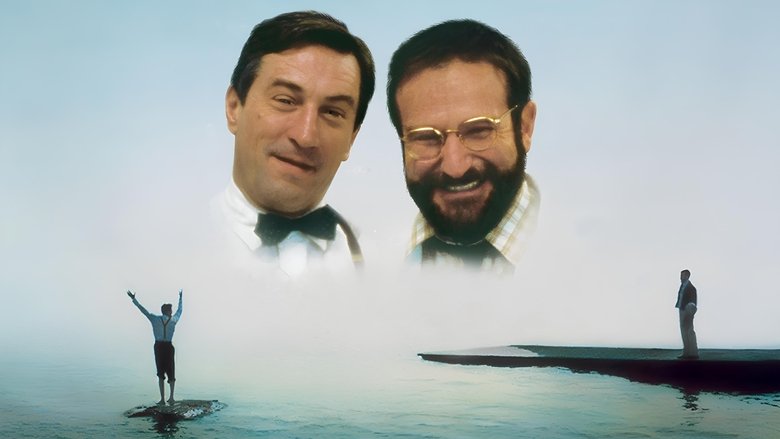
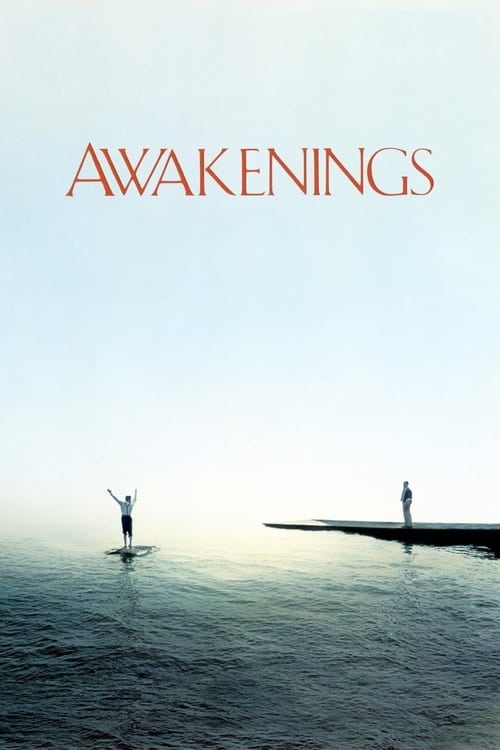
Awakenings
A heart-wrenching biographical drama where a shy neurologist breathes life into long-catatonic patients, only to face the fleeting nature of their miraculous recovery—a fragile dance between medical hope and the resilient human spirit.
Awakenings

Awakenings

"There is no such thing as a simple miracle."

04 December 1990 United States of America 120 min ⭐ 7.8 (2,738)
Director: Penny Marshall
Cast: Robert De Niro, Robin Williams, John Heard, Julie Kavner, Penelope Ann Miller
Drama
The Resilience of the Human Spirit The Ethics of Medical Innovation The Loss of Time and Identity The Awakening of the Observer
Budget: $31,000,000
Box Office: $52,096,475

Overview

Set in 1969, the film follows Dr. Malcolm Sayer (Robin Williams), a socially awkward but brilliant research neurologist who takes a position at Bainbridge Hospital in the Bronx. He is assigned to a ward of "statue-like" patients who have been catatonic for decades, victims of the 1920s encephalitis lethargica epidemic. While the rest of the medical staff has long since dismissed them as unresponsive shells, Sayer discovers that they possess a hidden awareness triggered by specific sensory stimuli like music or catching a falling object.

Inspired by new developments in the treatment of Parkinson's disease, Sayer receives permission to administer the experimental drug L-Dopa to one patient, Leonard Lowe (Robert De Niro). The result is a stunning medical miracle: Leonard "awakens" after thirty years of silence, followed soon by the rest of the ward. The patients find themselves in a world that has moved on without them, struggling to reconcile their lost youth with the realities of the present day.

The narrative explores the joy of their second chance at life, including Leonard's budding romance with a visitor named Paula. However, the triumph is soon overshadowed by the discovery that the drug's effects may be temporary. As the patients face the terrifying prospect of regressing into their former states, Sayer must confront the limitations of science and the profound meaning of the human connection he helped restore.

Core Meaning

The core meaning of Awakenings lies in its assertion that the value of life is not defined by neurological health or medical benchmarks, but by the capacity to experience the "simplest things": work, play, friendship, and family. It serves as a critique of a clinical, detached approach to medicine, suggesting that empathy and recognition of human dignity are as vital as any pharmaceutical cure. The film posits that even a temporary return to consciousness is a profound victory for the human spirit, teaching the "healthy" characters—particularly the introverted Dr. Sayer—how to truly live.

Thematic DNA

The Resilience of the Human Spirit 30%
The Ethics of Medical Innovation 25%
The Loss of Time and Identity 25%
The Awakening of the Observer 20%

The Resilience of the Human Spirit

The film emphasizes that the patients remained "present" within their frozen bodies for decades. This is most clearly revealed through Leonard's intellectual hunger and his refusal to be treated as a medical specimen, proving that the human spirit is more powerful than any drug.

The Ethics of Medical Innovation

Sayer's journey highlights the tension between cautious medical bureaucracy and the moral imperative to treat suffering. It explores the responsibility of the physician and the double-edged sword of giving hope when the outcome is uncertain.

The Loss of Time and Identity

The patients awake to find their parents elderly or deceased and their own youth vanished. This theme is poignantly illustrated through Leonard's struggle to adjust to being a middle-aged man with the emotional needs of the twenty-year-old he was when he first fell ill.

The Awakening of the Observer

While the patients undergo a literal awakening, Dr. Sayer undergoes a metaphorical one. Through his friendship with Leonard, he breaks out of his own social catatonia, learning to value human relationships over laboratory solitude.

Character Analysis

Dr. Malcolm Sayer

Robin Williams

Archetype: Mentor/Seeker
Key Trait: Introverted Compassion

Motivation

To prove that his patients are not "ghosts" and to find a way to restore their humanity through scientific discovery and empathy.

Character Arc

Moves from a socially paralyzed researcher who prefers earthworms to humans, to a compassionate physician who discovers his own capacity for friendship and love. He is "awakened" by his patients as much as he awakens them.

Leonard Lowe

Robert De Niro

Archetype: Hero/Tragic Figure
Key Trait: Intellectual Vitality

Motivation

To live a life of freedom, to experience love with Paula, and to be recognized as a person rather than a medical phenomenon.

Character Arc

Experiencing a literal rebirth, Leonard transitions from a thirty-year slumber to a vibrant, intellectual man, only to suffer a heart-wrenching regression as the drug fails. He chooses to face his decline with dignity, helping Sayer document the process for future science.

Nurse Eleanor Costello

Julie Kavner

Archetype: Supportive Confidante
Key Trait: Pragmatic Empathy

Motivation

Deep empathy for the patients and a desire to see Sayer succeed both professionally and personally.

Character Arc

The steady emotional anchor of the ward. She supports Sayer's unorthodox methods from the beginning and ultimately becomes the catalyst for Sayer's personal social awakening.

Paula

Penelope Ann Miller

Archetype: Emotional Catalyst
Key Trait: Gentle Acceptance

Motivation

Kindness and a genuine attraction to Leonard's spirit, unburdened by his medical diagnosis.

Character Arc

A woman who visits her father in the hospital and forms a deep, fleeting connection with Leonard. She represents the "normal" life Leonard craves but can never fully possess.

Symbols & Motifs

The Panther (Rilke's Poem)

Meaning:

Symbolizes the suffocating entrapment of the patients. The poem describes a panther pacing behind bars until its "gaze is so exhausted that it no longer holds a thing." It mirrors the patients' existence: a great will numbed by a thousand bars.

Context:

Leonard reads the poem to Sayer to explain the feeling of being locked inside his own body, illustrating the psychological weight of his condition.

The Falling Glasses/The Ball

Meaning:

Represents the latent life and subconscious reflexes that remain when conscious will is suppressed. It is the first clue that the patients are still "in there."

Context:

Sayer notices a patient catch her glasses before they hit the floor, leading him to experiment by tossing a ball to other patients, proving their brains still react to the world.

The Ouija Board

Meaning:

Symbolizes the bridge of communication and the desperate human need to reach out to others when traditional speech is impossible.

Context:

Before his full awakening, Leonard uses the board to spell out Rilke's name, providing Sayer with the key to his inner world.

The Window

Meaning:

A symbol of the barrier between life and observation. For the catatonic, it is a border they cannot cross; for the healthy, it is something they take for granted.

Context:

The film frequently frames patients looking out of barred windows at children playing, emphasizing their exclusion from the natural flow of life.

Memorable Quotes

The human spirit is more powerful than any drug.

— Dr. Malcolm Sayer

Context:

Delivered during Sayer's closing address to the hospital donors after the effects of L-Dopa have worn off.

Meaning:

This is the thematic heart of the film, asserting that while medicine may fail, the inherent value and resilience of the individual remain intact and must be nourished.

Read the newspaper. What does it say? All bad... People have forgotten what it is to be alive.

— Leonard Lowe

Context:

Leonard calls Sayer in the middle of the night, overwhelmed by the joy of his awakening and the beauty of existence.

Meaning:

A critique of the modern world, where healthy people take their freedom and simple joys for granted while focusing only on negativity.

I'm not a thing, I'm a person.

— Leonard Lowe

Context:

Leonard demands his right to walk outside the hospital without an escort, frustrated by the institutional controls on his life.

Meaning:

A powerful assertion of human dignity against a medical system that often views long-term patients as mere biological objects or "vegetables."

It's given to and taken away from all of us.

— Eleanor Costello

Context:

Eleanor comforts a grieving Sayer after Leonard begins to regress, reminding him that the transience of life applies to everyone.

Meaning:

Reflects the universal nature of the human condition—the fragility of life and the inevitability of loss, suggesting that the patients' tragedy is a concentrated version of the human experience.

Philosophical Questions

What defines a life well-lived?

The film explores this by contrasting the patients' brief, intense appreciation of life with the routine, uninspired existence of the "healthy" hospital staff who have forgotten how to be alive.

Is awareness a prerequisite for personhood?

Through Sayer’s discovery that the catatonic patients respond to music and touch, the film challenges the medical community’s tendency to dehumanize those who cannot communicate conventionally.

Is a temporary miracle better than no miracle at all?

The narrative forces the audience to weigh the profound joy of the 'extraordinary summer' against the devastating heartbreak of the inevitable regression.

Alternative Interpretations

While typically viewed as a sentimental drama about medical hope, some alternative readings suggest a darker perspective. Critics have argued the film serves as a cautionary tale about the cruelty of hope; by awakening the patients only to have them lose their freedom again, the medical intervention is seen by some as a psychological torture worse than the original illness. Another interpretation focuses on the meta-narrative of Sayer's social disability, suggesting that the patients are merely plot devices to facilitate the 'coming of age' of a middle-aged healthy man. Some viewers also see the film as a Flowers for Algernon-style tragedy where the horror lies in the characters' full awareness of their impending intellectual and physical decline.

Cultural Impact

Awakenings was a critical and commercial success, earning three Academy Award nominations (including Best Picture) and solidifying Penny Marshall's reputation as a director of serious drama. Culturally, it brought the work of neurologist Oliver Sacks into the mainstream, sparking public interest in medical anomalies and the philosophy of mind. It is often cited as one of the most significant films regarding medical ethics and the treatment of the disabled. Furthermore, it marked a turning point for Robin Williams, proving his immense range as a dramatic actor capable of deep restraint, contrasting his earlier high-energy comedic roles. The film's depiction of encephalitis lethargica remains the most well-known representation of the disease in popular culture.

Audience Reception

Audiences responded overwhelmingly to the film's emotional core, with CinemaScore giving it a rare 'A' grade. Critics praised the "virtuoso" performances of the lead duo, particularly Robert De Niro's physical transformation and Robin Williams' subdued vulnerability. While some critics, like those at The New York Times, found the film occasionally flirted with melodrama or "tearjerker" tropes, the majority lauded it for its intelligence and heart. The ending, though tragic, was widely viewed as life-affirming rather than purely depressing, leaving a lasting impression on viewers regarding the value of the 'simplest things' in life.

Interesting Facts

  • Robin Williams accidentally broke Robert De Niro's nose during a scene where their characters were meant to struggle; De Niro later remarked that the hit actually straightened a bump from a previous break.
  • A young, uncredited Vin Diesel appears in the film as a hospital orderly.
  • Robert De Niro prepared for the role by spending weeks with a real-life patient who had been treated by Dr. Oliver Sacks.
  • Jazz legend Dexter Gordon, who plays the patient Rolando, died in April 1990, just months before the film's release.
  • Robin Williams spent extensive time with Dr. Oliver Sacks to mimic his specific mannerisms and speech patterns, although the character's name and nationality were changed for the film.
  • Filming took place at the Kingsboro Psychiatric Center in Brooklyn, a functioning public hospital, which added a sense of stark realism to the production.
  • Director Penny Marshall chose Robert De Niro and Robin Williams after De Niro was given the choice of playing either the doctor or the patient; he chose the patient because he found it more challenging.

Easter Eggs

Early Vin Diesel Appearance

An uncredited Vin Diesel can be seen working as an orderly, representing one of his first professional roles in a major Hollywood production.

Authentic Neurological 'Tricks'

The scene where Sayer drops his glasses to provoke a reflex is an authentic method used by the real Dr. Oliver Sacks to identify 'hidden' movement in catatonic patients.

Leonard's Real Identity

The character of Leonard Lowe is based on the real-life patient 'Leonard L.' documented in Sacks' memoir; his surname in the film is a tribute to the original subject.

⚠️ Spoiler Analysis

Click to reveal detailed analysis with spoilers

Frequently Asked Questions

Explore More About This Movie

Dive deeper into specific aspects of the movie with our detailed analysis pages

Comments (0)

Leave a comment

No comments yet. Be the first to share your thoughts!