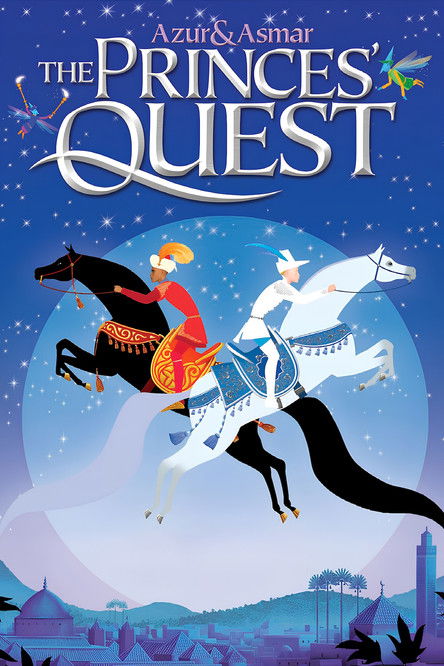
Azur & Asmar: The Princes' Quest
Azur et Asmar
Overview
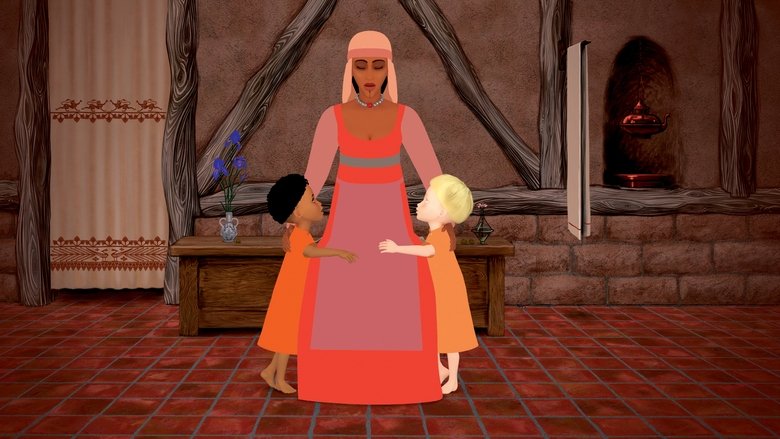
In medieval France, Azur, a nobleman's blond son, and Asmar, the dark-skinned son of the nurse Jenane, are raised as brothers. Brutally separated by Azur's father, Azur is sent away to school while Jenane and Asmar are banished. Years later, Azur travels across the sea to the Maghreb, feigning blindness to avoid persecution for his blue eyes, to find the legendary Djinn Fairy from his childhood stories.
reunited with Jenane, now a wealthy merchant, and Asmar, a dashing royal guard who harbors deep resentment, Azur insists on fulfilling their shared dream. The two princes must overcome physical trials, mythical beasts like the Scarlet Lion and the Simurgh, and their own rivalry to reach the Hall of Lights. Their quest transforms from a competition into a testament to their bond, proving that loyalty transcends blood and origin.
Core Meaning
The film is a profound allegory for immigration and cultural integration. By reversing the typical narrative—placing a white European as the vulnerable immigrant in a North African land—director Michel Ocelot challenges Eurocentric perspectives. The central message is that knowing two languages and two cultures makes one twice as rich, not divided. It advocates for a world where brotherhood is defined by shared love and experience rather than race or lineage.
Thematic DNA
The Wealth of Dual Identity
Jenane embodies this theme, declaring that knowing two languages and countries makes one know 'twice as much.' The film portrays multiculturalism not as a conflict, but as a superpower that allows characters to navigate diverse worlds with wisdom.
Prejudice and Superstition
Prejudice is explored through the 'Curse of the Blue Eyes,' forcing Azur to experience the marginalization often faced by immigrants. The film highlights how fear of the 'other' is rooted in ignorance, whether it's the villagers fearing Azur's eyes or Crapoux dismissing Arab culture.
Brotherhood and Reconciliation
The bond between Azur and Asmar survives separation and class divides. Their relationship evolves from childhood innocence to adult rivalry and finally to a mature partnership, illustrating that true family is chosen through action and loyalty.
Language as a Bridge
The film boldly leaves Arabic dialogue unsubtitled in the original version, placing the non-Arabic speaking audience in Azur's shoes. This forces the viewer to rely on non-verbal communication and empathy, mirroring the immigrant experience of isolation and eventual understanding.
Character Analysis
Azur
Cyril Mourali
Motivation
To find the Djinn Fairy and reunite with his milk-brother and nurse.
Character Arc
Starts as a privileged child, becomes a marginalized immigrant, and evolves into a humble hero who learns to see without eyes. He proves his worth not through noble birth, but through perseverance and respect for a culture not his own.
Asmar
Karim M'Ribah
Motivation
To prove himself equal to the nobleman's son and claim the Djinn Fairy.
Character Arc
Transforms from a rejected outcast in France to a proud, accomplished warrior in his homeland. He struggles with bitterness toward Azur's family but ultimately chooses love and brotherhood over revenge.
Jenane (The Nurse)
Hiam Abbass
Motivation
To see her two sons reunited and living in harmony.
Character Arc
She rises from a servant expelled without mercy to a powerful, wealthy merchant in her own land. She remains the moral anchor, loving both sons equally and refusing to let them be divided by blood or status.
Crapoux
Patrick Timsit
Motivation
To return to his homeland where there is 'fog and greyness.'
Character Arc
A comic relief beggar who refuses to assimilate, complaining about the 'noise' and 'colors' of the new land. He represents the refusal to integrate, serving as a foil to Azur's openness.
Princess Chamsous Sabah
Fatma Ben Khell
Motivation
To experience the world outside her gilded cage.
Character Arc
A precocious child princess trapped in her palace who aids Azur. She represents the curiosity of youth that sees past social taboos.
Symbols & Motifs
Blue Eyes
A symbol of stigma and 'otherness.' In Europe, Azur is privileged; in the Maghreb, his eyes mark him as a cursed outsider.
Azur keeps his eyes closed for a large portion of the film, pretending to be blind to avoid persecution, symbolizing the blindness of prejudice itself.
The Djinn Fairy
The ultimate goal of enlightenment and cross-cultural union. She represents the synthesis of the boys' shared childhood dreams.
She waits in a cage of lights, accessible only to those who can unite three magic keys, representing the unlocking of cultural barriers.
The Two Keys
Complementary strengths required to succeed. Neither Azur nor Asmar can open the Gate of Lights alone.
Azur finds the Warm Key and Asmar finds the Perfumed Key; they must use them together, symbolizing that East and West must cooperate to achieve the ideal.
Memorable Quotes
I know two countries, two languages. That means I know twice as much as others.
— Jenane
Context:
Jenane speaks this to the boys to heal the rift caused by their different origins and social standings.
Meaning:
The film's central thesis: biculturalism is an asset, not a deficit. It reframes the immigrant experience as an accumulation of wealth (knowledge) rather than a loss of identity.
The blue eyes bring bad luck!
— Villagers
Context:
Villagers scream this when they suspect Azur's identity, forcing him to feign blindness.
Meaning:
Highlights the arbitrary nature of prejudice. A trait considered beautiful in one culture is demonized in another.
In my country, we have soft rain, and beautiful grey fog!
— Crapoux
Context:
Crapoux complains about the vibrant sunshine and colors of the Maghreb while guiding Azur.
Meaning:
Illustrates the absurdity of chauvinism. Crapoux yearns for objectively gloomy weather simply because it is familiar, satirizing those who cannot appreciate new cultures.
Philosophical Questions
Does knowledge of a culture require belonging to it by blood?
The film argues 'no' through Azur, who learns the language and customs of the Maghreb and navigates them successfully, suggesting culture is learned, not inherited.
Is integration the responsibility of the immigrant or the host society?
Through Crapoux and Azur, the film shows two paths: Crapoux refuses to adapt and remains miserable, while Azur adapts (learning Arabic, respecting customs) and flourishes, suggesting integration is an active, personal effort.
Alternative Interpretations
Some critics view the film not just as a fable about racism, but as a critique of classism. Azur's father is the true villain, representing the rigid European aristocracy that creates division, while Jenane represents the fluidity of the merchant class that bridges worlds. Additionally, the ending where the couples 'swap' partners (Azur with the Djinn Fairy, Asmar with the Elf Fairy) can be interpreted as a subversion of the 'like with like' trope, rejecting racial segregation in romance. Others see Azur's feigned blindness as a metaphor for willful ignorance being a necessary shield against the harshness of societal judgment until one is strong enough to face it.
Cultural Impact
Azur & Asmar is celebrated as a landmark in European animation for its respectful and authentic representation of Islamic culture, a rarity in Western cinema. Released during a time of heightened tension in France regarding immigration and national identity, the film served as a bold political statement advocating for integration and mutual respect. It influenced a generation of European animators to explore non-Western aesthetic traditions, proving that 3D animation could be stylized and painterly rather than just pursuing realism. The decision to leave Arabic unsubtitled was a pioneering narrative device that has been discussed in film studies as a tool for empathy.
Audience Reception
The film holds a high rating among audiences and critics (80% on Rotten Tomatoes), praised universally for its breathtaking visual style and rich color palette. Parents and educators laud its educational value regarding tolerance. However, some mainstream audiences found the animation style stiff and the pacing slow compared to American blockbusters. The unsubtitled Arabic was a point of contention for some viewers who felt left out, though most understood it as an artistic choice. It is widely regarded as a cult classic in French animation.
Interesting Facts
- The character Crapoux is a self-caricature of director Michel Ocelot, representing his own difficulties adjusting to France after a childhood in Guinea.
- Director Michel Ocelot chose not to subtitle the Arabic dialogue in the original French release to force the audience to feel Azur's confusion and isolation.
- The film's budget was approximately €10 million, an unusually high amount for a European animated feature at the time.
- Visuals were heavily inspired by 15th-century Persian miniature paintings and the architecture of Andalusia and North Africa.
- The production team was intentionally diverse, with Ocelot noting in the credits that the film was made by people whose parents came from 'all over the planet'.
- Souad Massi, a famous Algerian singer, composed and performed the film's closing theme song.
- Ocelot animated the film using 3D CGI but applied a non-photorealistic rendering to make it look like 2D cut-outs, avoiding the 'uncanny valley' of realistic 3D.
Easter Eggs
The Simurgh
The giant mythical bird that aids the heroes is a direct reference to Persian mythology, specifically the Shahnameh, reinforcing the film's celebration of Middle Eastern folklore.
Crapoux's Name
The name 'Crapoux' is likely a portmanteau of the French words 'Crapaud' (Toad) and 'Pou' (Louse), reflecting his lowly status and unpleasant attitude.
The Scarlet Lion
A mythical beast that guards the secrets of the Djinn Fairy, designed to resemble traditional heraldic lions but with a surreal, magical twist fitting the Persian miniature aesthetic.
⚠️ Spoiler Analysis
Click to reveal detailed analysis with spoilers
Frequently Asked Questions
Explore More About This Movie
Dive deeper into specific aspects of the movie with our detailed analysis pages
Comments (0)
No comments yet. Be the first to share your thoughts!