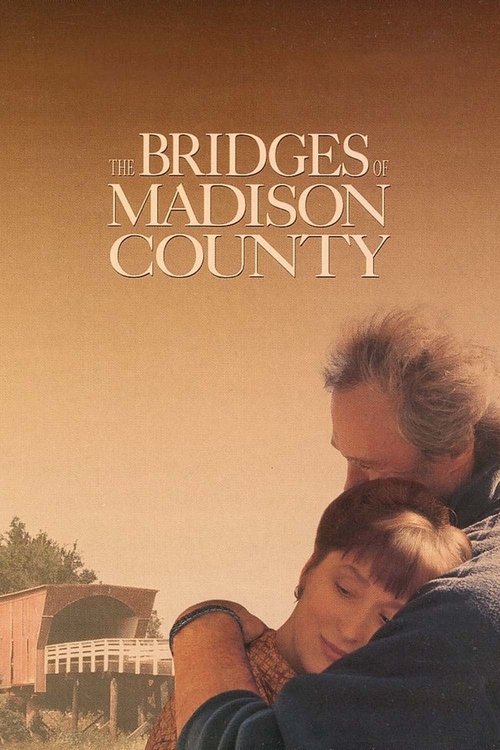
The Bridges of Madison County
"The path of Francesca Johnson's future seems destined due to an unexpected fork in the road..."
Overview
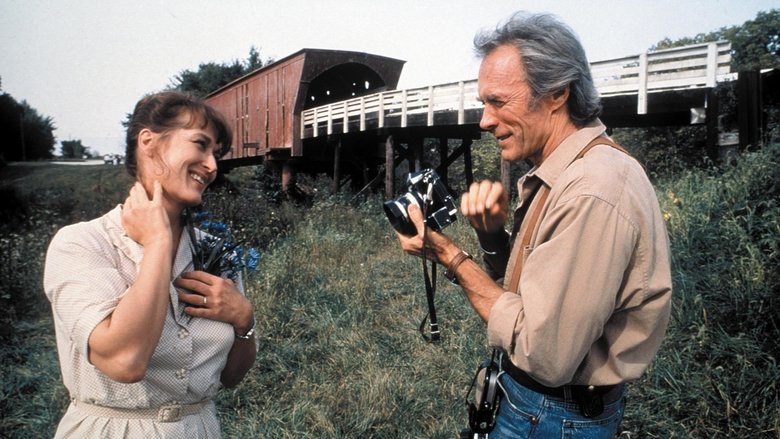
In 1965, Francesca Johnson (Meryl Streep) is an Italian war bride living a quiet, mundane life on an Iowa farm with her husband and two teenage children. When her family leaves for the State Fair for four days, she meets Robert Kincaid (Clint Eastwood), a National Geographic photographer who arrives to shoot the historic covered bridges of Madison County.
A chance request for directions blossoms into an intense, four-day romance that challenges everything Francesca knows about herself. As they share their pasts, dreams, and a profound emotional connection, Francesca is forced to make a heart-wrenching choice between her newfound soulmate and her responsibilities to her family. The story is framed by her adult children discovering her journals after her death, finally understanding the hidden depth of their mother's life.
Core Meaning
The film validates the significance of the "road not taken" and the enduring power of hidden love. It suggests that a love lasting only a few days can be as meaningful and defining as a lifetime of marriage. Ultimately, it honors the nobility of sacrifice, showing that choosing duty over passion does not negate the validity of the love left behind, but rather preserves it as a perfect, untouchable memory that sustains one's soul.
Thematic DNA
Duty vs. Desire
The central conflict reflects Francesca's internal struggle between her intense personal happiness with Robert and her moral obligation to her husband and children. The film presents duty not as a burden, but as a valid, albeit painful, choice that defines one's character.
The Transience of Time
The narrative contrasts the "lifetime" of a four-day affair against the decades of a mundane marriage. It posits that emotional depth is not measured by duration, and that brief moments can hold "a universe of ambiguity."
Feminine Identity and Sacrifice
Francesca represents the many women of her generation who buried their personal dreams and sexuality to serve their families. Her transformation from a "resigned housewife" to a passionate woman and back again highlights the hidden interior lives of mothers.
Isolation and Connection
Both characters are isolated—Francesca by her rural domesticity and foreign background, Robert by his rootless, nomadic lifestyle. Their meeting represents a rare, "once in a lifetime" collision of two lonely souls finding their perfect counterpart.
Character Analysis
Francesca Johnson
Meryl Streep
Motivation
To find a connection that validates her inner self, while maintaining the stability and emotional safety of her children and husband.
Character Arc
Starts as a dutiful, slightly bored housewife who has suppressed her Italian passion. She awakens to her true self through her affair with Robert, experiencing a profound emotional and sexual rebirth, before ultimately choosing to sacrifice her happiness to protect her family from pain.
Robert Kincaid
Clint Eastwood
Motivation
To capture the beauty of the world and, unexpectedly, to merge his life with the one woman who truly sees him.
Character Arc
A rootless loner who observes the world through a lens without fully engaging. He believes he is destined to be alone until he meets Francesca, who becomes his anchor. He transforms from a nomad into a man capable of profound, singular devotion.
Richard Johnson
Jim Haynie
Motivation
To provide for his family and maintain a peaceful, traditional farm life.
Character Arc
Static character representing stability, decency, and the mundane reality of marriage. He is never villainized; his very decency makes Francesca's choice harder. He loves her but cannot understand her deep complexity.
Michael & Caroline Johnson
Victor Slezak & Annie Corley
Motivation
To settle their mother's affairs, which turns into a journey of understanding their own parents as complex human beings.
Character Arc
They begin as judgmental children shocked by their mother's secret. Through reading her journals, they move from confusion to understanding, ultimately allowing their mother's lesson to change their own unhappy lives.
Symbols & Motifs
The Covered Bridges
They symbolize the transition between the public world and the private, hidden world of the lovers. They are shelters where Francesca and Robert can be their true selves, protected from the "exposure" of societal judgment.
Robert photographs them (capturing beauty), and they serve as the meeting points where their romance begins and deepens (Roseman Bridge).
The Camera
Represents the ability to see beauty in the ordinary and to freeze time. It is Robert's tool for engaging with the world, yet also a shield that keeps him an observer rather than a participant—until he meets Francesca.
Robert is constantly seen with his Nikon; he teaches Francesca to look through the lens, metaphorically showing her a new perspective on her own environment.
The Truck Door Handle
The ultimate symbol of Francesca's paralyzing indecision and the physical weight of her duty. It represents the threshold between running away to a new life and staying in her established one.
In the climactic rain scene, Francesca's hand grips the handle, trembling, as she watches Robert's truck in front of her, moments away from driving out of her life forever.
Bari, Italy
Symbolizes Francesca's lost youth, her exoticism, and the dreams she abandoned to become an American housewife. It represents the "other" life she gave up.
Francesca mentions her hometown early on, establishing her feeling of being an outsider in Iowa; Robert is the first person in years to recognize and validate this part of her identity.
The New Dress
A symbol of Francesca reclaiming her sexuality and womanhood. It signifies her desire to be seen not as a mother or wife, but as a desirable woman.
She buys a simple frock in Des Moines to wear for dinner with Robert, an act of vanity and anticipation she hasn't performed in years.
Memorable Quotes
This kind of certainty comes but just once in a lifetime.
— Robert Kincaid
Context:
Spoken by Robert to Francesca in the kitchen as he tries to convince her that what they have is worth fighting for and not just a casual fling.
Meaning:
The film's most iconic line, emphasizing the rarity and preciousness of their connection. It argues that true soulmate love is a singular, non-repeatable event that justifies the upheaval it causes.
And in that moment, everything I knew to be true about myself up until then was gone. I was acting like another woman, yet I was more myself than ever before.
— Francesca Johnson
Context:
Francesca's voiceover narration describing her internal transformation during her time with Robert.
Meaning:
Highlights the paradox of their affair: by stepping out of her socially defined role (wife/mother), she paradoxically found her authentic identity.
I want to love you the way I do now the rest of my life. Don't you understand? We'll lose it if we leave. I can't make an entire life disappear to start a new one.
— Francesca Johnson
Context:
The emotional climax where Francesca explains why she cannot run away with him despite loving him.
Meaning:
The core argument for her staying. She realizes that the reality of a runaway life would eventually tarnish the perfection of their love, and that building happiness on her family's pain would destroy the very thing she loves.
The old dreams were good dreams; they didn't work out, but I'm glad I had them.
— Robert Kincaid
Context:
Robert reflecting on his life and the path that brought him to Francesca (often cited, though similar to a line in Eastwood's Unforgiven, it resonates with Kincaid's philosophy).
Meaning:
Acceptance of life's imperfections. It reflects a gratitude for having had the capacity to dream and love, even if reality didn't align with those desires.
Philosophical Questions
Can a love be 'true' if it is based on infidelity?
The film challenges moral absolutism by presenting the affair not as a sin, but as a spiritual awakening. It asks if the 'purity' of a connection can transcend the social contract of marriage.
Does duty to others outweigh personal happiness?
Francesca's ultimate choice posits that personal fulfillment is secondary to the harm one's actions would cause to innocents (her children), suggesting a utilitarian ethics of love.
Is a 'life not lived' less real than the one we choose?
Robert and Francesca's four days become more 'real' to them than decades of their actual lives, raising questions about whether time or intensity defines the reality of an experience.
Alternative Interpretations
While typically viewed as a romantic tragedy, some critics interpret the film as a story of female empowerment. In this reading, Francesca's choice to stay is not an act of submission to patriarchy, but an active agency where she chooses the memory of perfect love over the messy reality of a new relationship, effectively preserving her fantasy forever. Others view it as a critique of the American Nuclear Family, exposing the quiet desperation and isolation inherent in the idealized 1950s/60s domestic life.
Cultural Impact
Upon release, the film was a significant critical and commercial success, grossing over $182 million. It redeemed the reputation of the source novel, which critics had largely dismissed as "purple prose" and sentimental kitsch. Eastwood's restrained direction and Streep's nuanced performance elevated the material into a respected cinematic drama.
Culturally, it struck a chord with middle-aged audiences, validating the concept of romance and passion later in life. It challenged the Hollywood norm that intense love stories were the exclusive domain of the young. The film remains a touchstone for the "weepie" genre and is frequently cited as one of the few instances where the movie is universally considered superior to the book.
Audience Reception
The film is widely beloved by audiences, often cited as a definitive "tearjerker." Viewers consistently praise the chemistry between Streep and Eastwood, noting that their mature acting sells a premise that could have been cheesy. The ending is the most discussed element, with audiences split between heartbreak over them not being together and respect for Francesca's noble sacrifice. Some criticism exists regarding the slow pacing and the framing device of the children, which some viewers find distracting from the main love story.
Interesting Facts
- Clint Eastwood filmed the movie chronologically, a rarity in filmmaking, to allow the actors' relationship to develop naturally in real-time.
- Meryl Streep gained 15 to 20 pounds for the role to realistically portray a middle-aged Iowa farm wife, eating heavily during pre-production.
- The farmhouse set was an actual abandoned property that had been empty for 30 years; the production team completely restored it for the film.
- Eastwood is known for his fast directing style; the film was completed 10 days ahead of schedule and under budget.
- The famous 'love theme' titled 'Doe Eyes' was composed by Clint Eastwood himself for the film.
- The 1963 GMC pickup truck used by Robert Kincaid belongs to Clint Eastwood in real life and is still kept at his Mission Ranch hotel in Carmel, California.
- Author Robert James Waller originally wanted Isabella Rossellini for the role of Francesca, while the studio pushed for younger stars; Eastwood insisted on Streep.
- The 'rain scene' at the end is considered one of the most heartbreaking moments in cinema history, relying almost entirely on minimal dialogue and intense facial acting.
Easter Eggs
Kyle Eastwood Cameo
Clint Eastwood's real-life son, Kyle Eastwood (a jazz musician), appears in the film as the bassist in the jazz band playing at the club Robert and Francesca visit.
Taylor Swift's 'Wildest Dreams'
The music video for Taylor Swift's Wildest Dreams is a direct homage to the film. It features a similar 1950s/60s aesthetic, a film set romance, and stars Scott Eastwood (Clint's son) as the love interest, mirroring his father's role.
The Green Truck 'Harry'
Robert's truck, which he affectionately names 'Harry' in the book, is a consistent character throughout the film. Its presence in the final rain scene serves as a visual anchor for Francesca's longing.
⚠️ Spoiler Analysis
Click to reveal detailed analysis with spoilers
Frequently Asked Questions
Explore More About This Movie
Dive deeper into specific aspects of the movie with our detailed analysis pages
Comments (0)
No comments yet. Be the first to share your thoughts!