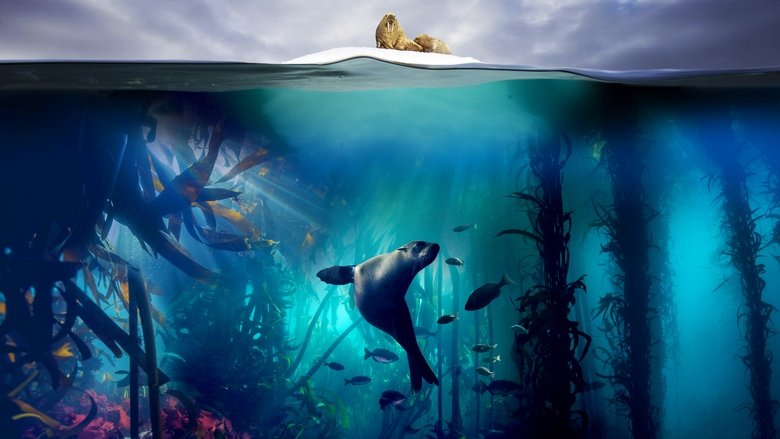
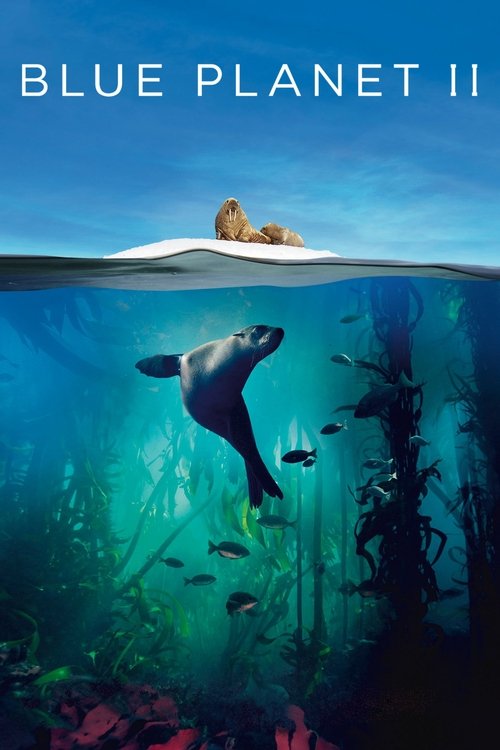
Blue Planet II
"Take a deep breath."
Overview
Blue Planet II is a groundbreaking 2017 nature documentary series that explores the world's oceans, a successor to the 2001 series The Blue Planet. Narrated by Sir David Attenborough, the series utilizes advanced camera technology and scientific discoveries to reveal new creatures and previously unseen animal behaviors. Over seven episodes, the program journeys from the sunlit coral reefs to the crushing pressures of the deep sea, from the vibrant green kelp forests to the vast, open 'blue desert'. Each episode focuses on a different marine environment, showcasing the intricate ecosystems and the remarkable strategies its inhabitants employ to survive.
Filmed over four years across 39 countries, the series presents a stunning cinematic experience, capturing moments new to science and television, such as fish using tools, octopus creating armor from shells, and giant trevally fish leaping from the water to catch birds in mid-air. Beyond the spectacle, Blue Planet II carries a powerful undercurrent of conservation. The final episode, in particular, directly addresses the profound and often devastating impact of human activity—specifically plastic pollution, climate change, and overfishing—on marine life, concluding with a powerful call to action for the preservation of our planet's oceans.
Core Meaning
The core meaning of Blue Planet II is a profound appeal to humanity to recognize both the breathtaking wonder of our oceans and our critical responsibility to protect them. The series masterfully builds a connection between the viewer and the marine world by showcasing incredible intelligence, emotion, and drama in animal behavior. It reveals an ocean far more complex and fascinating than previously imagined.
However, this celebration of life is deliberately juxtaposed with the stark reality of its destruction. The creators' ultimate message is that the future of this vital, beautiful world is in our hands. By revealing what we stand to lose—from the bleaching of vibrant corals to the suffering of animals entangled in plastic—the series serves as an urgent, emotional, and undeniable call to action, urging a fundamental shift in our relationship with the planet's blue heart.
Thematic DNA
The Unseen Wonders of the Ocean
Throughout the series, a primary theme is the sheer spectacle and undiscovered magic of the marine world. Using cutting-edge technology, the show unveils behaviors never filmed before, such as the tool-using tusk fish, the cooperative hunting of groupers and octopuses, and the underwater 'lake of doom' made of toxic brine. This theme serves to replace ignorance with awe, demonstrating that the ocean is not a barren void but a world filled with intelligence, complex social structures, and astonishing survival strategies, encouraging a deeper appreciation for its intrinsic value.
Human Impact and Environmental Crisis
A crucial and powerful theme is the pervasive and damaging impact of humanity on marine ecosystems. While woven throughout the series, this is brought into sharp focus in the final episode. Viewers are confronted with haunting images of plastic pollution killing albatross chicks, a mother pilot whale grieving her calf likely poisoned by contaminated milk, and the devastating effects of climate change on coral reefs and polar ice caps. This theme transforms the series from a simple nature documentary into a powerful piece of environmental advocacy.
The Intelligence and Complexity of Marine Life
Blue Planet II consistently challenges the notion of fish and other sea creatures as simple, unthinking beings. The series highlights remarkable cognitive abilities: a tusk fish using coral as an anvil to smash clams, bottlenose dolphins teaching their young to self-medicate using gorgonian coral, and an octopus outsmarting a pyjama shark by covering itself in shells. This theme fosters a sense of respect and empathy for marine animals, portraying them as complex individuals with intricate lives and problem-solving skills.
The Interconnectedness of All Life
The series repeatedly illustrates the delicate and intricate web of connections within ocean ecosystems and, by extension, to life on land. It shows how the health of a coral reef affects a quarter of all marine species and how the ocean currents regulate the planet's climate. The message about plastic pollution powerfully demonstrates this theme, showing how a disposable item discarded on land can end up causing suffering in the deepest parts of the ocean, emphasizing that human actions have far-reaching consequences for the entire planet.
Character Analysis
David Attenborough
David Attenborough (Narrator)
Motivation
Attenborough's primary motivation is to foster a deep love and understanding of the natural world in the audience. Initially, this is driven by a desire to share the beauty and wonder of the planet. As the series progresses, his motivation evolves to include a pressing need to expose the threats facing the oceans and to inspire a global conservation effort. He is driven by the conviction that awareness and passion are the essential first steps toward meaningful change.
Character Arc
As the narrator, David Attenborough's role is not one of personal development but of evolving perspective. He begins as the familiar, authoritative, and awe-struck guide to the natural world, a voice of wisdom and wonder. Throughout the series, his tone subtly shifts. While the wonder remains, a growing sense of urgency and sorrow permeates his narration. By the final episode, his arc completes as he transitions into the role of a direct advocate, a global conscience. He steps in front of the camera, breaking the observational fourth wall to deliver a personal, heartfelt plea for humanity to act, embodying the series' ultimate message of responsibility.
Symbols & Motifs
Plastic Debris
Plastic debris symbolizes humanity's careless and destructive footprint on the natural world. It represents a modern, pervasive, and persistent poison that infiltrates even the most remote and seemingly pristine environments.
This symbol appears with devastating effect throughout the series, culminating in the final episode. Key scenes include an albatross parent unwittingly feeding plastic to its chick, a grieving pilot whale carrying her dead calf (whose death is linked to plastics), and turtles entangled in plastic bags. These moments transform an abstract environmental issue into a tangible, emotional tragedy.
Coral Bleaching
The ghostly, white skeletons of bleached coral symbolize the direct and catastrophic impact of climate change. It is a visual representation of a vibrant, life-sustaining ecosystem dying due to rising sea temperatures, serving as a stark and urgent warning of planetary-scale damage.
The 'Coral Reefs' episode showcases the beauty and diversity of these underwater cities before revealing footage of their rapid decay. The contrast between the living, colorful reef and the barren, white graveyard is a powerful visual indictment of the consequences of global warming, illustrating the fragility of this vital habitat.
The Deep Sea Submersible
The manned submersibles, often seen with their spherical glass cockpits, symbolize human curiosity, scientific endeavor, and the quest for knowledge. They represent our ability to explore and understand the planet's last great wilderness, a hopeful counterpoint to the series' themes of destruction.
In 'The Deep' episode, the crew uses these submersibles to descend to depths of 1,000 meters, revealing creatures and phenomena new to science, like underwater brine lakes and hunting Humboldt squid. These sequences highlight that there is still so much to discover and, therefore, so much worth protecting.
Memorable Quotes
Never before have we had such an awareness of what we are doing to the planet, and never before have we had the power to do something about that. Surely we have a responsibility to care for our blue planet. The future of humanity, and indeed all life on Earth, now depends on us.
— David Attenborough
Context:
This quote is part of Attenborough's powerful closing monologue in the final episode, 'Our Blue Planet' (Season 1, Episode 7). He delivers it directly to the camera while standing on a beach, underscoring the personal and urgent nature of his message after showcasing the devastating impacts of human activity.
Meaning:
This is the thesis statement of the entire series. It moves beyond mere observation of nature to an explicit call to action, framing the current environmental crisis as a unique moment in human history defined by both unprecedented knowledge and unparalleled power. It is a profound appeal to our collective conscience.
A mother is holding her newborn young – it's dead. Pilot whales have big brains; they can certainly experience emotions. Judging from the behaviour of the adults, the loss of the infant has affected the entire family. Unless the flow of plastics and industrial pollution into the ocean is reduced, marine life will be poisoned by them for many centuries to come.
— David Attenborough
Context:
This narration occurs in the 'Big Blue' episode (Season 1, Episode 4) during one of the series' most heart-wrenching sequences: a pod of pilot whales, one of whom carries the body of her dead calf for days. The scene became a potent symbol of the plastic crisis.
Meaning:
This quote crystallizes the emotional cost of pollution. By attributing grief and emotion to the whales, the narration transforms an environmental statistic into a relatable tragedy. It directly links the death to human-made pollution, making the consequences of our actions painfully clear and unforgettable.
Some fish are much more clever than you might suppose.
— David Attenborough
Context:
This line is delivered in the first episode, 'One Ocean' (Season 1, Episode 1), while the camera follows an orange-dotted tusk fish. The fish repeatedly and deliberately uses a piece of coral as an anvil to smash open a clam, a clear demonstration of tool use that was captured on film for the series.
Meaning:
This simple statement encapsulates one of the series' key themes: revealing the surprising intelligence and complexity of marine life. It encourages viewers to reconsider their assumptions about these creatures and to develop a new level of respect for them.
Episode Highlights
One Ocean
This episode serves as a stunning introduction, showcasing a wide array of incredible behaviors. Highlights include bottlenose dolphins surfing 'for the sheer joy of it', a tusk fish using tools to open clams, and the jaw-dropping sequence of giant trevally fish leaping out of the water to catch fledgling terns in mid-air. It also introduces the problem of melting sea ice affecting walruses.
'One Ocean' sets the tone for the entire series by immediately establishing its groundbreaking cinematography and its focus on new scientific discoveries and animal intelligence. The final, unsettling scene with the walruses and their pups struggling to find resting places on shrinking icebergs introduces the underlying environmental theme that will become central to the series' message.
The Deep
A journey into the least explored part of our planet. Using deep-sea submersibles, the crew films bizarre creatures like the fangtooth, the mesmerizing bioluminescence of the abyss, and a startling feeding frenzy of sixgill sharks on a sperm whale carcass. A key discovery shown is a 'lake' of super-salty, toxic brine on the ocean floor, which puts any creature that enters it into toxic shock.
This episode highlights the spirit of exploration and the vastness of what we still don't know about our own planet. It underscores the incredible adaptations life has made to survive in extreme environments and reinforces the idea that the ocean is Earth's final frontier. The discovery of pollution even at these depths is a sobering revelation.
Coral Reefs
This episode explores the vibrant 'cities' of the sea. It features remarkable examples of animal intelligence and cooperation, such as a grouper using 'sign language' to team up with an octopus to hunt. It also showcases the fearsome Bobbit worm ambushing its prey and clownfish meticulously preparing an anemone for their eggs. The episode ends with a stark look at the devastation of coral bleaching.
By presenting the coral reef as a complex, thriving metropolis full of intricate relationships, this episode builds a deep appreciation for its value. This makes the subsequent reveal of coral bleaching all the more impactful, serving as a powerful and visually undeniable illustration of the consequences of climate change.
Green Seas
Focusing on the planet's underwater forests of kelp and seagrass, this episode is filled with drama. An octopus cleverly defends itself from a pyjama shark by creating an armor of shells. A huge army of spider crabs marches on the seabed, and weedy sea dragons perform a delicate mating dance. The episode showcases the seasonal nature of these habitats and the intense competition for resources.
This episode is significant for revealing ingenious and never-before-filmed survival strategies. The octopus and shark sequence, in particular, became an iconic moment that demonstrated the series' ability to capture complex, narrative-driven animal behavior that is both scientifically important and emotionally engaging.
Our Blue Planet
The final episode shifts focus from wonder to warning. It directly confronts the major threats facing the oceans: plastic pollution, climate change, noise pollution, and overfishing. It features the series' most emotionally devastating scenes, including a mother pilot whale mourning her dead calf and albatrosses feeding plastic to their young.
This episode is arguably the most culturally significant. It cemented the series' legacy not just as a nature documentary, but as a catalyst for global change. It is credited with creating the 'Blue Planet effect,' a massive surge in public awareness and political action against plastic pollution, making it one of the most impactful hours of television in recent history.
Philosophical Questions
What is humanity's responsibility to the natural world?
This is the central question of the series. Initially, it explores this implicitly by showcasing the incredible beauty and complexity of the ocean, suggesting a moral imperative to protect such wonder. The series then confronts the question directly by detailing the consequences of human negligence: plastic pollution, climate change, and noise pollution. The haunting images of suffering animals and dying ecosystems force the viewer to contemplate the ethics of a single species having the power to devastate the entire planet. Attenborough's final monologue explicitly frames this as a unique historical responsibility, stating that our generation has an unprecedented awareness and an unprecedented power to act.
Does non-human life possess consciousness and emotion?
Blue Planet II consistently pushes viewers to consider the inner lives of its animal subjects. The series is filled with examples that challenge a purely instinct-driven view of marine creatures. The narration for the grieving pilot whale explicitly states that they have large brains and 'can certainly experience emotions'. The cooperation between a grouper and an octopus, the apparent 'joy' of surfing dolphins, and the clever problem-solving of the tusk fish all suggest a level of intelligence, communication, and perhaps even subjective experience that blurs the lines between humans and other animals. The show encourages an empathetic interpretation of animal behavior, asking us to see them not as automatons, but as sentient beings.
Alternative Interpretations
While overwhelmingly praised, Blue Planet II did attract some critical discussion regarding its methods and message. One alternative viewpoint questions the heavily narrative and anthropomorphic approach to its animal subjects. Critics argue that by editing sequences to create distinct 'characters,' dramatic chase scenes, and emotional stories (like the grieving whale), the series prioritizes entertainment over pure scientific observation. This 'nature porn' perspective suggests the majestic score and cinematic editing manipulate viewer emotions rather than presenting an unvarnished look at the natural world.
Another interpretation focuses on the effectiveness of its environmental message. While the 'Blue Planet effect' is widely acknowledged for raising awareness, some studies and commentators have questioned whether this awareness translated into significant, long-term changes in individual consumer behavior. A 2020 study, for example, found that while viewers' understanding of the issues increased, it didn't necessarily change their preference for single-use plastic items in an experimental setting, suggesting that awareness alone is insufficient to overcome the complexities of human habit and convenience. This perspective posits that the series' main impact was in making the topic politically popular, rather than instigating widespread personal change.
Cultural Impact
Blue Planet II's cultural impact was monumental and arguably its most significant achievement. Premiering in 2017 to critical acclaim and massive viewership—it was the most-watched TV program in the UK that year—the series transcended television to become a global environmental movement. Its primary legacy is the coining of the term 'the Blue Planet effect,' which refers to the dramatic shift in public and political consciousness regarding plastic pollution.
The series' powerful, emotional storytelling, particularly in the final episode, brought the abstract concept of ocean plastic to the forefront of public discourse. Haunting scenes of wildlife suffering due to plastic waste sparked widespread public outcry. In the wake of the broadcast, there was a massive spike in internet searches for 'plastic recycling' and conservation charities. This public pressure translated into tangible political and corporate action. The UK government accelerated its plans to tackle plastic waste, major corporations pledged to reduce single-use plastics, and even Queen Elizabeth II reportedly banned plastic straws and bottles from the Royal Estates after watching the show.
Beyond plastic, the series renewed global interest in marine biology and conservation. Its stunning visuals, made possible by technological advancements in underwater cinematography, set a new benchmark for nature documentaries. The collaboration with composer Hans Zimmer and Radiohead also broadened its appeal, cementing its status as a major cultural event. Blue Planet II is remembered not just as a masterpiece of wildlife filmmaking, but as a rare example of a television program that directly inspired widespread behavioral change and influenced national policy, creating a lasting legacy of environmental awareness.
Audience Reception
Blue Planet II received overwhelmingly positive and often ecstatic reactions from audiences and critics worldwide, becoming the UK's most-watched television show of 2017. Viewers lauded the series for its breathtaking, cinematic visuals, made possible by groundbreaking camera technology that unveiled the ocean's mysteries in unprecedented detail. David Attenborough's narration was universally praised for its warmth, authority, and the profound sense of wonder it conveyed.
The most significant aspect of the audience reception was the powerful emotional response to the series' environmental message. The final episode, which directly addressed the crisis of plastic pollution, was a watershed moment. Audiences took to social media in droves to express their shock, sadness, and anger, particularly at scenes depicting a mother pilot whale grieving her dead calf and albatrosses being fed plastic. This emotional engagement translated into a massive surge in public consciousness, dubbed the 'Blue Planet effect.' Viewers were not passive consumers; they were galvanized into action, leading to increased support for conservation charities, widespread lifestyle changes, and demands for political action, cementing the series' reputation as not just entertainment, but a powerful catalyst for social change.
Interesting Facts
- The series took over four years to produce, involving 125 expeditions to 39 countries, and resulted in more than 6,000 hours of underwater footage.
- The production team often collaborated with marine scientists, and the discoveries made during filming led to the publication of at least 12 scientific papers.
- New camera technologies were crucial to the series, including UHD suction cameras placed on the backs of whale sharks and orcas, and ultra-low-light cameras that captured phenomena like the bioluminescence of mobula rays.
- The crew spent over 1,000 hours filming in deep-sea submersibles, descending to depths of up to 1,000 meters to capture footage of life in the abyss.
- The iconic score was composed by Hans Zimmer, who collaborated with the band Radiohead to create a new version of their song 'Bloom' specifically for the series.
- The phenomenon of the 'Boiling Sea,' a massive feeding frenzy of dolphins and tuna, had been a maritime legend for centuries but was captured on camera for the first time by the Blue Planet II crew.
- To find many of the unique animal stories, the production team scoured scientific papers, and also connected with a global network of divers, scientists, and fishermen, and even looked through platforms like YouTube and Instagram.
- The sequence of the giant trevally fish hunting birds had no existing footage; the crew had to rely solely on anecdotal reports from local fishermen to capture the never-before-seen behavior.
⚠️ Spoiler Analysis
Click to reveal detailed analysis with spoilers
Frequently Asked Questions
Explore More About This Movie
Dive deeper into specific aspects of the movie with our detailed analysis pages
Comments (0)
No comments yet. Be the first to share your thoughts!