Skip to content
Fantastic Planet
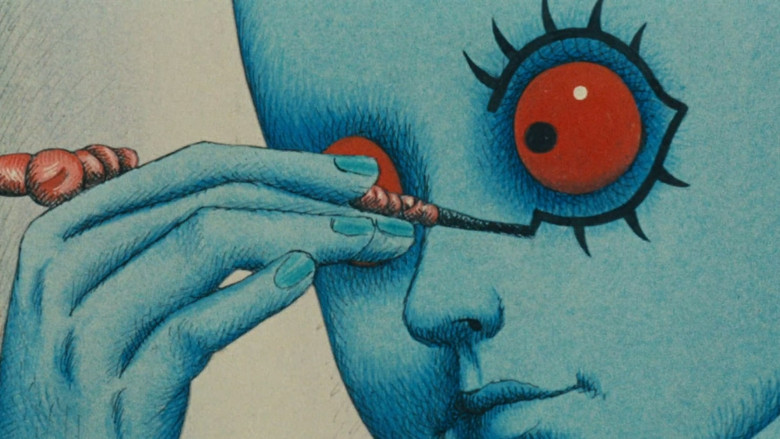
A hallucinatory cut-paper dream in which tiny humans scurry beneath the gaze of serene blue giants, so that wonder and horror fall together like a slow, psychedelic jazz rain.
Fantastic Planet

Fantastic Planet

La Planète sauvage

"A sublime trip to a fine new world!"

01 December 1973 Czechoslovakia 72 min 7.6 (1,077)

Director: René Laloux

Cast: Gérard Hernandez, Jean Valmont, Jennifer Drake, Yves Barsacq, Jeanine Forney

Animation Science Fiction Oppression, colonialism and dehumanization Knowledge as liberation Resistance and rebellion Perspective, scale and the relativity of 'civilization' Coexistence and mutual recognition

Overview

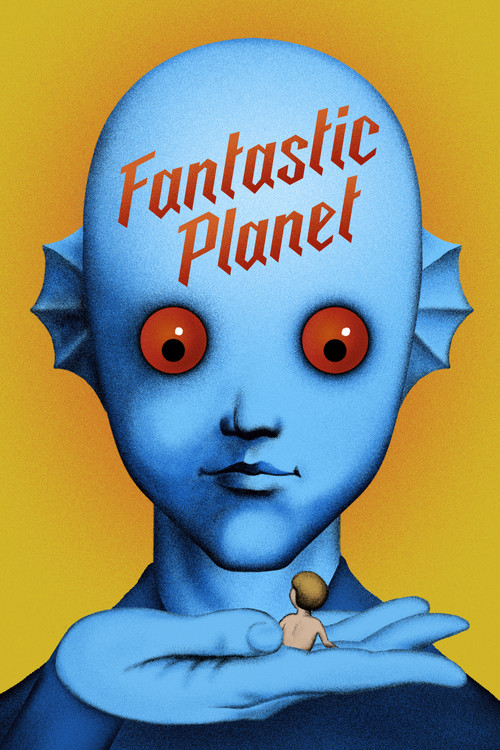
On the distant planet Ygam, humans called Oms share the world with the Draags, gigantic blue humanoids with red eyes who are far more technologically and spiritually advanced. To the Draags, Oms are pets at best and pests at worst. Domesticated Oms are kept on leashes and dressed up for amusement, while wild Oms live in the planet's strange, dangerous wilderness.

The story follows Terr, an orphaned Om taken in as a pet by Tiwa, a young Draag girl. Draag knowledge is passed on through headsets that transmit lessons directly into the mind. Because Tiwa wears hers with Terr close by, he picks up an education no Om was ever meant to have. That knowledge sets him on a path toward the wild Oms and toward a confrontation between the two species.

Directed by René Laloux and designed by Roland Topor, the film is based on Stefan Wul's 1957 novel Oms en série. It was animated with paper cutouts, partly at the Jiří Trnka Studio in Prague, and scored by Alain Goraguer with psychedelic jazz. The result is an allegory about power, knowledge and freedom, told in an eerie, dreamlike style.
Core Meaning

At its core, Fantastic Planet is a political allegory about oppression and liberation. By making humans the tiny, "lesser" species, Laloux and Topor ask viewers to feel from the inside what it is like to be treated as an animal by a civilization that considers itself enlightened. Critics have read the Draag–Om relationship as a commentary on colonialism and imperialism. Because production began in Prague and was interrupted by the 1968 Soviet invasion of Czechoslovakia, many also read it as a veiled comment on Soviet domination.

The film's most hopeful point is that education is the path to freedom. The Oms don't free themselves through brute strength. They do it by gaining knowledge, organizing, and using it tactically. The film also suggests that a lasting settlement comes from forcing mutual recognition, not from wiping out the other side.

Thematic DNA

Oppression, colonialism and dehumanization 30%
Knowledge as liberation 25%
Resistance and rebellion 20%
Perspective, scale and the relativity of 'civilization' 15%
Coexistence and mutual recognition 10%

Oppression, colonialism and dehumanization

The Draags treat Oms as vermin or toys. They leash them, dress them up, and carry out "de-Oming" campaigns, mass exterminations aimed at wild populations. The film turns the usual order of human dominance upside down so that the audience sits on the receiving end of casual cruelty.

Knowledge as liberation

Terr's secret education through Tiwa's learning headset is the story's engine. Laloux and Topor stress that an educated population can resist far more effectively. Once Terr brings the device to the wild Oms, their scattered, superstitious tribes start building a real society and fighting back.

Resistance and rebellion

The wild Oms move from fleeing extermination to organized resistance. They steal technology, build rockets, and learn to strike where the Draags are vulnerable. The film shows rebellion as a collective, strategic project rather than one person's heroics.

Perspective, scale and the relativity of 'civilization'

The Draags meditate, pursue spiritual enlightenment and consider themselves highly evolved, yet they are indifferent to Om suffering. The film asks whether a civilization can be advanced while being blind to the inner lives of others.

Coexistence and mutual recognition

The story doesn't end in annihilation. It ends with the two species acknowledging each other, which suggests that peace becomes possible only when the powerful are forced to recognize the weaker party as equals.

Character Analysis

Terr

Jean Valmont (French, adult Terr/narrator); Barry Bostwick (adult Terr, English dub); Mark Gruner (young Terr, English dub)

Archetype: Hero / Prometheus figure Key Trait: Curiosity

Motivation

Freedom, both his own and his people's, and the wish to understand the world that enslaves him.

Character Arc

Terr goes from an orphaned infant kept as a Draag girl's pet to a secretly educated young man who escapes. He brings knowledge to the wild Oms and helps lead them to freedom and to a planet of their own.

Tiwa

Jennifer Drake (French version)

Archetype: Innocent / unwitting benefactor Key Trait: Careless affection

Motivation

Childish affection and play, and later her own growing-up within Draag society.

Character Arc

Tiwa starts as a child who treats Terr as a beloved toy. As she grows, her attention shifts to Draag adulthood and meditation, and the gap between owner and pet widens until Terr escapes.

All 4 characters and cast

Symbols & Motifs

The learning headset

Meaning:

Stands for knowledge and education as power, the tool that turns a pet into a person and a scattered people into a movement.

Context:

Tiwa uses it for her lessons, and Terr absorbs Draag knowledge by accident. He later takes it with him when he escapes, and it becomes the basis of Om learning and resistance.

The leash and collar

Meaning:

Stand for domestication and subjugation: the idea that a thinking being can be owned.

Context:

As a pet, Terr wears a collar that lets Tiwa pull him back to her. Escaping it marks the start of his freedom.

De-Oming

Meaning:

Represents genocide dressed up as routine pest control, and echoes real historical atrocities carried out by colonial and totalitarian powers.

Context:

Draags periodically gas and hunt wild Oms in the parks where they live. These are the film's most brutal sequences.

The Draags' meditation and the Fantastic Planet

Meaning:

Stands for the hidden vulnerability of the powerful. Their spiritual practice is what keeps them alive, and it can be disrupted.

Context:

The Draags meditate to travel in spirit to a nearby moon, the Fantastic Planet. What the Oms discover there becomes their leverage.

Scale and giant hands

Meaning:

Symbolize unequal power. The Draags' huge bodies make the oppressor's physical dominance visible on screen.

Context:

In the opening, young Draags toy with Terr's fleeing mother, and giant fingers casually decide Om lives throughout the film.

Philosophical Questions

Can a civilization be truly advanced if it denies the inner lives of others?

The Draags are meditative, scientific and spiritually refined, yet they gas Oms like insects. The film separates technological and spiritual sophistication from moral progress.

Is knowledge inherently liberating?

Terr's stolen education is what turns the Oms from prey into a people. The film argues that access to knowledge is itself political, and that withholding it is a tool of control.

What makes a being a 'person' rather than an animal?

The Draags class Oms as animals largely because of their size and short lifespans. As the Oms show language, culture and ingenuity, the film exposes that classification as self-serving.

Must liberation involve violence, and can peace follow it?

The Oms resist, fight and ultimately threaten the Draags' survival. Peace comes only after that. The film leaves open whether this is justice, deterrence, or both.

How It Ends

Alternative Interpretations

Anti-Soviet allegory: Given the production history in Prague, the Draags can be read as the Soviet occupiers and the Oms as the Czechoslovak people resisting domination.Anti-colonial allegory: Many critics read the film as a commentary on European colonialism. It depicts a \"civilized\" power that treats native peoples as animals, carries out exterminations, and justifies itself through its own se...

Full ending explanation

Cultural Impact

Historical context: Fantastic Planet was made against the backdrop of the Cold War. Production began in Prague in 1968 and was disrupted when the Soviet Union invaded Czechoslovakia after the Prague Spring. Work moved to Paris, and the film was completed in time for Cannes in 1973. Because of this history, it is widely read as an allegory aimed at Soviet domination, and more broadly at colonialism and imperialism.

Recognition: The film competed for the Palme d'Or and won a special jury Grand Prix at Cannes 1973, which was very rare for an animated feature. It also won the International Jury Prize at the Trieste Science Fiction Film Festival. It helped prove that animation could carry serious, adult political allegory.

Music and pop culture: Alain Goraguer's score, a mix of American jazz-funk and French pop, has had a second life in hip-hop sampling. Mac Miller used it on \"Insomniak\" (Faces), and Madlib cites the film as an influence. Whole sample packs and DJ mixes are built around it.

Legacy: Its Criterion Collection release and a 50th-anniversary retrospective in Animation Magazine confirm its status as a cult classic of European animation and psychedelic science fiction.

Audience Reception

Reception has been overwhelmingly positive. On Rotten Tomatoes the film holds a 91% critics' score and an 87% audience score. The critics' consensus calls it \"an animated epic that is by turns surreal and lovely, fantastic and graceful.\"

Praised: Topor's eerie, unmistakable designs; the handcrafted cutout animation; Goraguer's hypnotic psychedelic jazz score; and the bold political allegory. Many viewers say it feels unlike any other animated film.

Criticized: Some viewers find the stiff, limited cutout movement and detached, narrated storytelling cold or slow. The strange imagery and brutal violence, including extermination scenes and alien creatures toying with prey, can be disturbing, and the film is not suited to young children despite being animated.

Verdict: It is a cult classic and a landmark of adult animation, admired more for its atmosphere, ideas and music than for conventional character drama.

Interesting Facts

  • The film is based on the 1957 novel Oms en série by French science fiction writer Stefan Wul.
  • It was a French–Czechoslovak co-production animated at the Jiří Trnka Studio in Prague.
  • Production began in Prague in 1968 but was interrupted by the Soviet invasion of Czechoslovakia. The filmmakers secured new financing and resumed work in Paris the following year.
  • The film uses paper cutout animation: still illustrations are cut into sections and moved frame by frame under a camera.
  • René Laloux met Roland Topor, the film's co-writer and production designer, through Laloux's work in psychiatry.
  • Roland Topor, a member of the Fluxus and Panic movements, served as art director and co-wrote the screenplay.
  • It premiered at the 1973 Cannes Film Festival, competed for the Palme d'Or, and won a special jury Grand Prix. It also won the International Jury Prize at the 11th Trieste Science Fiction Film Festival.
  • Alain Goraguer's jazz-influenced electroacoustic score has become heavily sampled in hip-hop. Mac Miller used it in "Insomniak" from his mixtape Faces, and Madlib has cited the film as an influence.
  • In the English dub, Barry Bostwick voices adult Terr and Hal Smith voices Master Sinh.
  • The film was released by the Criterion Collection, which described it as "a politically minded and visually inventive work of science fiction."

Frequently Asked Questions

Explore More About This Movie

Dive deeper into specific aspects of the movie with our detailed analysis pages

Comments (0)

Leave a comment

No comments yet. Be the first to share your thoughts!

Similar Movies