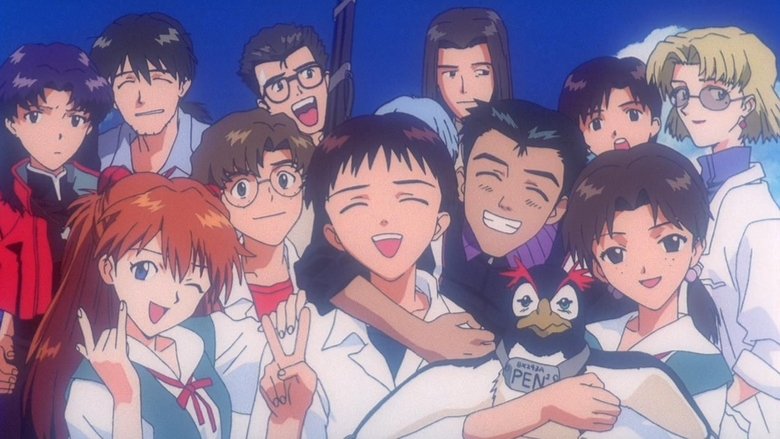
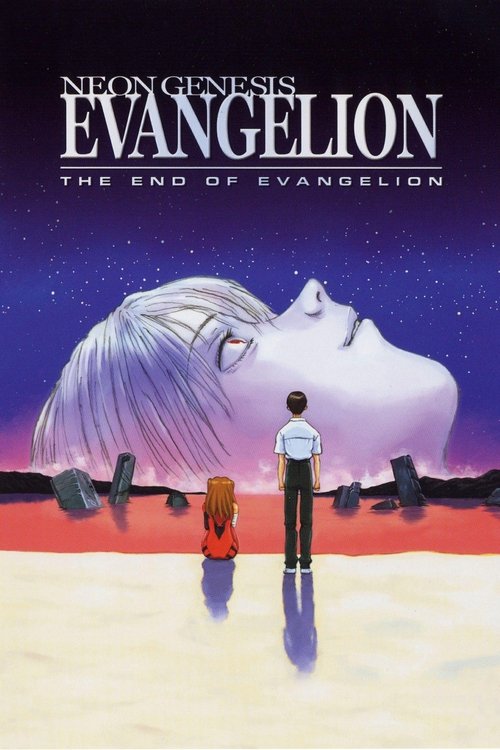
Neon Genesis Evangelion: The End of Evangelion
A devastatingly beautiful apocalyptic animation, exploring the depths of human despair and the fragile hope of connection amidst a maelstrom of psychological and visceral horror.
Neon Genesis Evangelion: The End of Evangelion

Neon Genesis Evangelion: The End of Evangelion

新世紀エヴァンゲリオン劇場版 Air/まごころを、君に

"The fate of destruction is also the joy of rebirth."

19 July 1997 Japan 87 min ⭐ 8.3 (1,733)
Director: Hideaki Anno Kazuya Tsurumaki
Cast: Megumi Ogata, Megumi Hayashibara, Kotono Mitsuishi, Yuko Miyamura, Fumihiko Tachiki
Drama Animation Action Science Fiction
Loneliness and Alienation Depression and Self-Worth The Pain of Human Connection Reality vs. Escapism
Box Office: $20,563,523

Overview

"Neon Genesis Evangelion: The End of Evangelion" serves as an alternative, feature-film conclusion to the controversial final two episodes of the original 1995 anime series. The story picks up immediately after the defeat of the final Angel, with the protagonist Shinji Ikari in a state of deep depression and emotional paralysis. The clandestine organization SEELE, dissatisfied with NERV commander Gendo Ikari's personal agenda for the Human Instrumentality Project—a forced evolution of humanity into a single consciousness—launches a brutal military assault on NERV headquarters to seize the Evangelion units.

As NERV's staff fights for their lives, a traumatized Asuka Langley Soryu must overcome her psychological breakdown to pilot Evangelion Unit-02 against SEELE's new fleet of Mass Production Evas. Meanwhile, Misato Katsuragi desperately tries to get the catatonic Shinji to pilot Unit-01, believing he is the only one who can stop SEELE's plan. The film eschews the abstract, internal monologue of the TV series' ending for a visceral and graphically intense depiction of the events of the Third Impact, the apocalyptic event that will decide the future of humanity. Shinji is ultimately forced to confront his own desires and fears to determine whether humanity will merge into a single, painless existence or retain their individuality, with all its accompanying pain and joy.

Core Meaning

The core meaning of "The End of Evangelion" revolves around the director Hideaki Anno's exploration of depression, loneliness, and the difficulty of human connection. The film posits that while individuality leads to misunderstanding, pain, and loneliness (the "Hedgehog's Dilemma"), a life without it—a collective consciousness devoid of ego and separation—is akin to death. Shinji's final decision to reject the painless world of Instrumentality in favor of a reality where people can hurt each other signifies an acceptance of life's inherent suffering as a necessary component of joy and genuine connection. Anno intended the film as a message to anime fans, including himself, urging them to wake up from escapist fantasies and engage with the complexities and pains of the real world. Ultimately, the film suggests that self-worth must come from within and that true living requires accepting the possibility of being hurt by others.

Thematic DNA

Loneliness and Alienation 35%
Depression and Self-Worth 30%
The Pain of Human Connection 25%
Reality vs. Escapism 10%

Loneliness and Alienation

The film portrays extreme psychological isolation through its main character, Shinji Ikari. Abandoned by his father, he is wracked with self-loathing and a fear of connecting with others, believing he is worthless and only causes pain. This is encapsulated in the concept of the "Hedgehog's Dilemma," where the desire for closeness is thwarted by the fear of mutual harm. The Human Instrumentality Project is presented as a radical, albeit terrifying, solution to this fundamental human problem: to erase the barriers (AT Fields) between individuals, thus ending all loneliness forever by creating a single unified consciousness.

Depression and Self-Worth

Director Hideaki Anno famously channeled his own struggles with depression into the film. Shinji's character arc is a raw depiction of clinical depression, marked by apathy, self-hatred, and a loss of the will to live. His journey through the apocalyptic events of the Third Impact is an internal one, forcing him to confront his own perceived worthlessness. The film's climax hinges on his decision to either annihilate his identity in a sea of unified consciousness or to accept himself and the potential for a life that includes pain. The ending suggests that finding self-worth is a painful, ongoing process, not a singular moment of triumph.

The Pain of Human Connection

The film argues that true human connection is impossible without the risk of pain and rejection. Shinji desires connection but is terrified of being hurt, leading him to withdraw. The choice he faces during Instrumentality is between a painless but meaningless collective existence and a world of individuals where love, joy, betrayal, and sadness coexist. Asuka's character arc also deeply explores this theme; her abrasive and competitive personality is a shield for her own deep-seated trauma and fear of intimacy. The final, ambiguous scene between Shinji and Asuka embodies this theme perfectly: an act of violence is met with a gesture of intimacy, highlighting the painful, messy, but ultimately necessary reality of human relationships.

Reality vs. Escapism

"The End of Evangelion" serves as a critique of escapism, particularly within the otaku subculture Anno was addressing. Shinji's desire to retreat into a world without pain or uncertainty is a central conflict. The film includes a jarring live-action sequence that breaks the fourth wall, showing images of the real world, including the movie theater where the film was screened and graffiti on the Gainax animation studio, seemingly to force the audience out of the fantasy. Anno's stated goal was to encourage viewers to return to reality, acknowledging that while it can be painful, it is the only place where true life can be experienced.

Character Analysis

Shinji Ikari

Megumi Ogata

Archetype: Antihero / Reluctant Hero
Key Trait: Depressive

Motivation

Shinji is primarily motivated by a desperate and often-unspoken need for validation and affection, particularly from his father. He pilots the Evangelion not out of a sense of duty, but out of a fear of being abandoned and a fragile hope that by being useful, someone might love him. His actions are often driven by a desire to escape pain and responsibility.

Character Arc

Shinji begins the film in a state of near-catatonia, consumed by depression and self-loathing following the death of Kaworu. He is incapable of action, even as NERV is invaded. Forced into the Evangelion by Misato's sacrifice, he witnesses Asuka's brutal defeat, which triggers the Third Impact. Inside the sea of collective consciousness, he is forced to confront his deepest fears of abandonment and his dysfunctional relationships. Ultimately, he rejects the painless but empty reality of Instrumentality, choosing to return to a world of individuals, accepting that life's potential for joy is inseparable from its potential for pain. His arc is not one of triumphant heroism, but of taking a single, painful step toward self-acceptance.

Asuka Langley Soryu

Yuko Miyamura

Archetype: The Tragic Heroine
Key Trait: Arrogant / Insecure

Motivation

Asuka's motivation is rooted in a deep-seated childhood trauma stemming from her mother's suicide. She has constructed a brash, arrogant, and hyper-competent persona to hide her profound insecurity and desperate need to be seen and valued. Her entire self-worth is tied to being the best Eva pilot, and any failure threatens to unravel her fragile identity.

Character Arc

At the start of the film, Asuka is found unresponsive in a bathtub, having withdrawn from the world due to her severe trauma and shattered pride from her previous defeats. During the JSSDF's invasion, she is placed inside Unit-02 for her own safety. There, she has a breakthrough, realizing her mother's soul has always been inside the Eva protecting her. This revelation allows her to fight with a ferocity and confidence not seen before, single-handedly defeating the Mass Production Evas. However, her triumph is short-lived as the Evas reactivate and brutally dismember her unit, killing her. She is reborn from the LCL sea in the final scene, becoming the first "other" for Shinji in the new world, representing the difficult reality of human relationships.

Rei Ayanami

Megumi Hayashibara

Archetype: The Enigma / The Catalyst
Key Trait: Enigmatic

Motivation

Initially, Rei's motivation is to fulfill Gendo Ikari's orders. However, her interactions with Shinji awaken a sense of individuality and a desire for connection. Her ultimate motivation in the film becomes a choice born from her bond with Shinji, rejecting her creator in favor of the person who treated her as a unique individual.

Character Arc

Rei, a clone of Shinji's mother Yui Ikari and a vessel for the soul of the Angel Lilith, begins to exercise her own will in the film. For most of the series, she has been a passive, almost emotionless figure, largely subservient to Gendo. In "The End of Evangelion," she defies Gendo's plan to reunite with Yui. Instead of merging with him, she chooses to merge with Lilith and go to Shinji, the one person who showed her genuine compassion. She cedes control of the Human Instrumentality Project to Shinji, allowing him to decide humanity's fate. Her arc is one of finding selfhood and making a definitive choice that shatters her role as a mere puppet.

Symbols & Motifs

AT Field (Absolute Terror Field)

Meaning:

The AT Field is the barrier that separates all living things, allowing them to maintain their individual physical forms and consciousness. Symbolically, it represents the emotional and psychological barriers between people—the walls that protect the ego but also cause isolation and loneliness. The goal of the Human Instrumentality Project is to collapse all AT Fields, merging humanity into a single being.

Context:

Throughout the series and film, Angels and Evangelions are shown to project powerful AT Fields during combat. The climax of "The End of Evangelion" involves the global collapse of all human AT Fields, causing people to dissolve into LCL, the primordial soup of life, as their souls are gathered into a single entity. Shinji's ultimate choice is whether to restore these barriers.

LCL (Link Connected Life)

Meaning:

LCL is the amber-colored, translucent liquid that fills the cockpits of the Evangelions, allowing the pilots to mentally sync with them. It is referred to as the "primordial soup of life." During the Third Impact, the dissolution of AT Fields causes all of humanity to revert to LCL, symbolizing the loss of individuality and the merging of all souls into a single ocean of consciousness.

Context:

In the film's climax, the entire population of Earth turns into LCL, creating a literal sea of orange liquid covering the planet. The final scene takes place on a beach next to this LCL sea, from which Shinji and Asuka have emerged, having chosen to regain their physical forms.

The Giant Naked Rei/Lilith

Meaning:

The colossal, white, female figure that appears during the Third Impact is a fusion of Rei Ayanami with Lilith, the Second Angel. She represents a divine, maternal, and ultimately terrifying arbiter of humanity's fate. Her form shifts to appear as the person one most desires (like Kaworu for Shinji), symbolizing the promise of comfort and an end to loneliness that Instrumentality offers before collecting their soul.

Context:

After Rei III betrays Gendo and merges with Lilith, her body grows to a planetary scale. She floats above the Earth, initiating the Human Instrumentality Project at Shinji's behest. When Shinji rejects Instrumentality, her body breaks apart and dies, leaving a trail of blood across the moon.

Hands

Meaning:

Hands are a recurring motif representing connection, communication, and violence. They are the means by which people can reach out to one another for comfort or inflict pain. The film constantly explores this duality. Shinji often stares at his own hands, contemplating his actions and inaction. The film's climax questions the purpose of hands and a heart if one chooses to be alone.

Context:

Key scenes involve hands: Shinji masturbating over the comatose Asuka, Misato giving Shinji a final kiss while her hands are covered in blood, and most famously, Shinji strangling Asuka in the final scene, only to stop when she caresses his face. This final act powerfully juxtaposes the violent and gentle potential of human contact.

Memorable Quotes

気持ち悪い (Kimochi warui)

— Asuka Langley Soryu

Context:

In the film's final moments, Shinji and Asuka are lying on a beach by a sea of LCL. Shinji begins to strangle Asuka, but stops when she gently caresses his cheek. As he breaks down crying, she utters this line.

Meaning:

Translated as "How disgusting" or "I feel sick," this is the ambiguous final line of the film. Its meaning is heavily debated. It could be directed at Shinji for strangling her, at herself for her own feelings, or at the general pathetic state of their existence as the last two humans. It encapsulates the film's bleak but realistic take on human relationships: even after choosing to live, the path forward is filled with disgust, pain, and uncertainty. The line was famously ad-libbed by voice actress Yuko Miyamura at the director's request.

I thought this was supposed to be a world without pain and without uncertainty.

— Shinji Ikari

Context:

During the abstract sequences within the Human Instrumentality Project, Shinji has a dialogue with the consciousnesses of Rei and others. He expresses his disappointment that even in this merged state, he still feels emotional turmoil, revealing his naive expectations.

Meaning:

This quote perfectly summarizes Shinji's escapist desire. He wants the fruits of human connection—comfort, understanding, love—without any of the risks or pain. He longs for a utopia where he is never lonely or misunderstood. The process of Instrumentality is the ultimate manifestation of this wish, and his eventual rejection of it signifies his maturation and acceptance that such a world is an illusion.

Those who hate themselves, cannot love or trust others.

— Rei Ayanami (speaking to Shinji)

Context:

This is said to Shinji during the surreal Instrumentality sequences as he struggles with his feelings of betrayal and loneliness, forcing him to confront the internal source of his pain.

Meaning:

This line strikes at the heart of the psychological drama of the series and film. It explains the core problem of characters like Shinji and Asuka. Their inability to form healthy relationships stems from their own profound self-loathing. They cannot accept affection from others because they do not believe they are worthy of it. The film is an extended exploration of this idea, suggesting that self-acceptance, however difficult, is the first step toward genuine connection.

I mustn't run away!

— Shinji Ikari

Context:

This phrase is repeated by Shinji multiple times in the original series when faced with the terrifying prospect of piloting the Evangelion or confronting a difficult emotional situation.

Meaning:

This is Shinji's recurring mantra throughout the original series, a phrase he repeats to himself to muster the courage to face his fears and pilot the Eva. In "The End of Evangelion," its absence during his initial catatonic state is significant, showing he has completely given up. Its repetition represents his constant struggle between his overwhelming fear and his desperate need to find a reason to exist and act.

Philosophical Questions

Is a life without pain truly worth living?

The film's central conflict revolves around the Human Instrumentality Project, which offers humanity an escape from all pain, loneliness, and misunderstanding by merging everyone into a single, unified consciousness. This state is presented as a painless, womb-like existence. However, the film argues that this state is also devoid of joy, love, and the potential for growth that comes from overcoming hardship. Shinji ultimately concludes that memories of joy can exist even in a life filled with pain, and that the possibility of genuine connection, however fleeting, makes the suffering of an individual existence worthwhile.

What is the nature of the self, and can it exist without others?

The film explores the idea that our sense of self is defined by our separation from others. The AT Fields are physical manifestations of the ego's boundaries. During Instrumentality, Shinji is told that he cannot understand his own shape without the "walls that separate" him from other people. The existence of "the other" is necessary for self-recognition. By choosing to restore the world to one of individuals, Shinji affirms that a solitary existence, even a mentally painless one, is not a true existence at all. He accepts the necessity of others, even if they are a source of pain, to define his own reality.

Alternative Interpretations

The famously ambiguous ending of "The End of Evangelion" has given rise to numerous interpretations over the years. Here are a few prominent ones:

The Adam and Eve Theory: This is one of the most common interpretations. Shinji and Asuka are the only two humans to have returned from the LCL sea. They are essentially a new Adam and Eve, given the chance to repopulate the Earth. The name of the franchise itself, "Neon Genesis Evangelion," lends credence to this idea of a new beginning. However, their dysfunctional and violent first interaction suggests this new genesis will be just as fraught with pain as the old world.

The Purgatory/Ongoing Choice Theory: This theory suggests that Shinji and Asuka are simply the *first* to return, not the only ones. Yui Ikari's spirit tells Shinji that anyone with the will to live can regain their physical form. The final scene, therefore, is not the definitive end but the very beginning of a long, difficult process for humanity to choose to return to individuality. Shinji and Asuka's struggle represents the initial, painful steps of rebuilding a world based on human connection.

The Cyclical/Time Loop Theory: Popularized further by the subsequent "Rebuild of Evangelion" films, this theory posits that the events of Evangelion are cyclical. Shinji (or another character) is doomed to repeat these events until a different outcome is achieved. The final scene could be seen as just one more iteration in a long loop of suffering and rebirth.

The Meta-Commentary Theory: This interpretation views the ending as a direct message from Hideaki Anno to the audience, particularly the otaku fans who reacted negatively to the TV series ending. Shinji's act of strangling Asuka represents his rejection of a difficult reality (and perhaps the creator's frustration with his characters/audience). Asuka's caress and final line ("How disgusting") symbolize the painful, awkward, but necessary step of re-engaging with another person in the real world, away from the comfort of escapist fantasy. The entire film can be seen as Anno forcing his protagonist—and by extension, the viewer—out of their shell.

Cultural Impact

"The End of Evangelion" is considered a landmark in anime history, renowned for its artistic ambition, psychological depth, and uncompromising vision. Released in 1997 as a response to the fan controversy over the TV series' abstract ending, the film provided a more concrete, albeit graphically violent and emotionally devastating, conclusion to the story. It challenged the conventions of the mecha genre by deconstructing heroic archetypes and focusing on the internal, psychological torment of its characters.

The film's exploration of themes like depression, social anxiety, and escapism resonated deeply with audiences in Japan and abroad, and its influence can be seen in numerous subsequent anime and films that tackle more mature and complex psychological subject matter. Its visual language—a blend of traditional animation, surrealist imagery, and live-action footage—was groundbreaking and has been studied and emulated since. The movie solidified "Evangelion" as a cultural phenomenon, generating decades of debate, analysis, and interpretation among critics and fans, cementing its place as a masterpiece of animated cinema.

Audience Reception

The reception of "The End of Evangelion" was, and remains, deeply polarized. Upon its release, many fans who were dissatisfied with the abstract and introspective finale of the TV series praised the film for providing a more tangible and action-packed conclusion to the plot. They lauded its stunning animation, epic scale, and the sheer audacity of its apocalyptic vision. However, the film was also heavily criticized for its extreme violence, disturbing psychological content, and overtly bleak tone. The opening scene involving Shinji and the comatose Asuka, and the brutal death of Asuka at the hands of the Mass Production Evas, are still cited as some of the most shocking and controversial moments in anime history. The ambiguous and unsettling final scene left many viewers confused and dissatisfied, fueling decades of debate. Over time, critical consensus has leaned heavily in the film's favor, with many hailing it as a masterpiece and one of the greatest animated films ever made, precisely because of its challenging themes and refusal to provide easy answers.

Interesting Facts

  • The controversial ending of the original TV series led to intense backlash from fans, including death threats directed at Hideaki Anno and vandalism of Gainax's studio. Anno included images of the actual graffiti and screenshots of the death threats in a rapid montage during the film's climax, in a meta-commentary on the audience's anger.
  • The final line of the film, Asuka's "How disgusting," was not in the original script. Director Hideaki Anno was unsatisfied with the scripted line and asked voice actress Yuko Miyamura what she would say if a man who could have helped her but didn't instead masturbated over her comatose body. Her horrified response became the new, iconic final line.
  • During the recording of the final scene where Shinji strangles Asuka, voice actor Megumi Ogata (Shinji) reportedly became so agitated that she lightly strangled Yuko Miyamura (Asuka), which caused Miyamura to have difficulty speaking her lines afterward.
  • An alternate live-action sequence was planned and partially filmed. It depicted a reality where the characters lived normal lives without Evangelions. This footage was cut from the final film but was later included in a special edition release.
  • The film was originally intended to be the second half of "Neon Genesis Evangelion: Death & Rebirth." However, production fell behind schedule, so "Rebirth" ended up being only the first 25 minutes of what would become "The End of Evangelion."
  • Gendo Ikari's final, unheard words to Ritsuko Akagi before she is shot were never scripted. Only director Hideaki Anno and Ritsuko's voice actress, Yuriko Yamaguchi, know what was said. Anno gave her a hint that allowed her to deliver her next line, "Liar," with the perfect inflection.

Easter Eggs

In one of the live-action shots shown during the Third Impact sequence, three women dressed to look like Rei, Asuka, and Misato can be seen walking away from the camera in a crowd.

This is a subtle nod to the animated characters existing within the 'real world' context that the live-action sequence introduces, blurring the lines between the film's fiction and the audience's reality.

A computer file Misato views, which is supposed to reveal the truth of the Second Impact, is actually just a short biography of the animation studio Gainax and its films.

This is a small, self-referential joke by the production staff, replacing a key piece of in-world lore with information about the studio that created the film.

The red dummy plugs for the Mass Production Evangelion series are all labeled with the name "Kaworu."

This implies that the dummy plugs are based on the thought patterns of Kaworu Nagisa, the final Angel who Shinji was forced to kill. This makes the Mass Production Evas' brutal assault on Asuka even more psychologically horrific for Shinji, as they are extensions of the one person who showed him unconditional love.

⚠️ Spoiler Analysis

Click to reveal detailed analysis with spoilers

Frequently Asked Questions

Explore More About This Movie

Dive deeper into specific aspects of the movie with our detailed analysis pages

Comments (0)

Leave a comment

No comments yet. Be the first to share your thoughts!