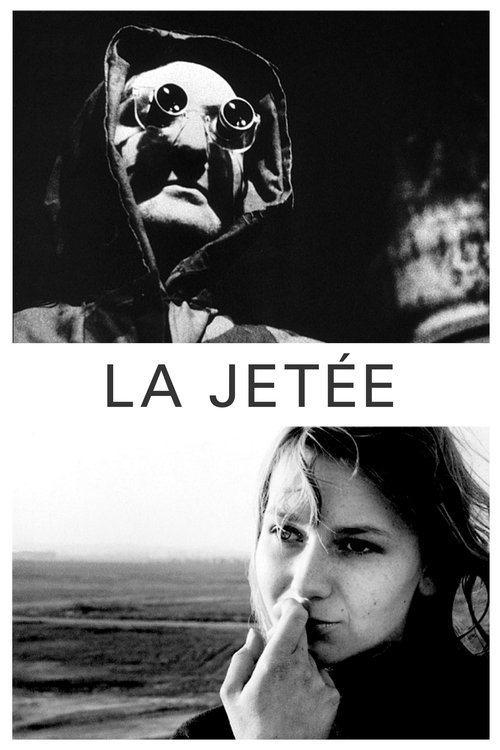
La Jetée
A haunting sci-fi photo-novel where fragmented memories become a haunting corridor through time, leading to a devastating and inescapable romantic destiny.
La Jetée

La Jetée

"A man's obsession with an image of his past"

16 February 1962 France 29 min ⭐ 7.9 (953)
Director: Chris Marker
Cast: Jean Négroni, Hélène Chatelain, Davos Hanich, Jacques Ledoux, André Heinrich
Drama Romance Science Fiction
Memory and Subjectivity Fate and Predestination Love and Loss in a Dystopian World The Nature of Cinema and the Image

Overview

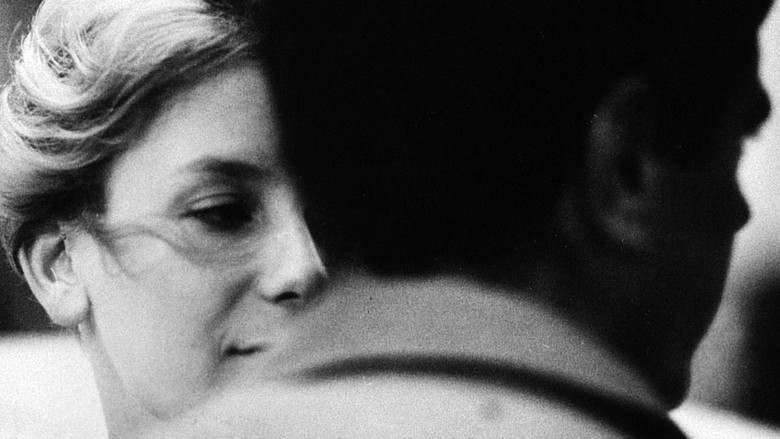
Set in a post-apocalyptic Paris ravaged by World War III, the survivors live in a subterranean society. Scientists, desperate to save the present, conduct time travel experiments. They select a male prisoner who is haunted by a single, powerful memory from his childhood: the face of a beautiful woman and a violent death he witnessed on the observation deck (the jetty) at Orly Airport.

Using this potent memory as an anchor, the scientists successfully send him back in time. In the pre-war past, he finds the woman from his memory, and they begin a tender, dreamlike romance, meeting in gardens, museums, and quiet Parisian streets. Their encounters are fleeting and surreal, as he appears and disappears without explanation. The scientists, however, have another goal. After mastering travel to the past, they propel him into the distant future to seek aid for their dying present.

He makes contact with a technologically advanced future civilization that provides him with a solution to save his time. But upon his return, he learns his captors plan to execute him. Given a final chance by the people of the future to escape with them, he makes a fateful choice, asking only to be returned to the past, to the woman and the time of his cherished memory.

Core Meaning

Chris Marker's "La Jetée" is a profound meditation on the nature of time, memory, and the human condition. The film posits that the past is not a place one can inhabit, but a collection of immutable images and scars that define our present and seal our future. The director suggests that our obsession with certain memories can become both a sanctuary and a prison. The protagonist's journey is not just through time, but through the landscape of his own mind, where a single, traumatic, yet beautiful image dictates his entire existence. Ultimately, the film delivers a fatalistic message: there is no escape from time's predetermined loop. The very memory that allows the protagonist to travel through time is the image of his own death, creating a perfect, unbreakable circle where the end is the beginning.

Thematic DNA

Memory and Subjectivity 35%
Fate and Predestination 30%
Love and Loss in a Dystopian World 20%
The Nature of Cinema and the Image 15%

Memory and Subjectivity

Memory is the central mechanism of the film, acting as the vehicle for time travel. The protagonist is chosen for the experiments precisely because he is 'marked by an image from his childhood.' The film explores how memories are not perfect records but subjective, fragmented, and emotionally charged images that shape our reality. The narrative itself, constructed from still photographs, mimics the way we recall the past—not as a continuous flow, but as a series of frozen moments. The narrator questions the reliability of memory, asking, “Had he invented that tender moment to prop up the madness to come?” suggesting our minds construct narratives to cope with trauma.

Fate and Predestination

"La Jetée" is built on the concept of a closed temporal loop, where the future is unchangeable because it has already happened. The protagonist's struggle is ultimately futile; he is a pawn of fate, unable to alter the course of events. The narrator explicitly states, “There is no way out of time.” The shocking climax reveals that the violent event he witnessed as a child was his own death, solidifying the theme that one cannot escape their destiny. His attempts to return to the past to find happiness only lead him to the very moment of his demise.

Love and Loss in a Dystopian World

Against the bleak, post-apocalyptic backdrop, the love story between the man and the woman serves as the film's emotional core. Their romance represents a lost era of peace, beauty, and humanity—a stark contrast to the sterile, underground existence of the present. Their time together is idyllic but ephemeral, punctuated by his sudden disappearances. This fleeting connection becomes the ultimate prize for the protagonist, who, when offered a chance to live in a pacified future, chooses instead to return to the past for a final moment with her, even though it leads to his death.

The Nature of Cinema and the Image

By using still photographs to tell its story, "La Jetée" deconstructs the medium of film itself. It reminds the viewer that cinema is an illusion of movement created by a rapid succession of static frames. The film's single moment of actual motion—the woman blinking—is profoundly impactful, breaking the established form and emphasizing the preciousness of a living, breathing present. Marker calls his work a 'photo-roman' (photo-novel), deliberately blurring the lines between photography, literature, and film, and forcing the audience to contemplate the power of a single, frozen image.

Character Analysis

The Man

Davos Hanich

Archetype: The Tragic Hero
Key Trait: Obsessed

Motivation

His primary motivation is his obsessive memory of the woman's face. This image is what allows him to travel through time and becomes his reason for living. His ultimate goal shifts from survival or saving the present to simply returning to her, the source of the only peace and love he has ever known, regardless of the consequences.

Character Arc

The Man begins as a prisoner, physically and mentally trapped by the past. His arc is not one of change, but of realization. He is sent on a journey through his own timeline, finding a brief period of happiness and love, only to discover that his path has always been a closed loop leading to his own death. He moves from being a haunted individual to understanding he is the ghost in his own story, fulfilling a destiny he can't escape.

The Woman

Hélène Chatelain

Archetype: The Anima / The Ideal
Key Trait: Enigmatic

Motivation

Her motivation appears to be simply to live in her present and to love the mysterious man who visits her. She acts as a receptive, gentle presence, providing the comfort and reality that the Man seeks in his journeys away from his grim existence.

Character Arc

The Woman does not have a traditional character arc; she exists more as a constant, an anchor in the past. She is the object of the Man's memory and desire. She seems to accept his mysterious appearances and disappearances without question, embodying a sense of timeless grace and acceptance. Her significance lies in what she represents to the Man: a peaceful, pre-war world and the possibility of love.

The Experimenter

Jacques Ledoux

Archetype: The Mentor / The Antagonist
Key Trait: Pragmatic

Motivation

His motivation is purely scientific and pragmatic: to save the present by any means necessary. He seeks to exploit the Man's powerful memory to retrieve resources or technology from the past or future, showing little regard for the human cost of his experiments.

Character Arc

The lead scientist is an ambiguous figure. He is the one who enables the Man's journey, acting as a guide into the past. However, he is also a jailer, a representative of the cold, utilitarian post-war regime that uses the Man for its own purposes and discards him once he is no longer useful. His character does not develop but serves as the detached, clinical force that controls the protagonist's fate.

Symbols & Motifs

The Museum

Meaning:

The museum, filled with taxidermied animals and ancient statues, symbolizes time that has been artificially frozen and preserved. It represents a past kept in stasis, much like the photographs that constitute the film and the memories that haunt the protagonist.

Context:

The Man and the Woman wander through a natural history museum. In these scenes, they themselves appear as static as the exhibits, captured in still frames. This visually reinforces the idea that in returning to the past, they are visiting a world that is, from the protagonist's perspective, already dead and preserved only in memory.

The Jetty (Observation Deck)

Meaning:

The jetty at Orly Airport is the film's central location, a literal and metaphorical platform for departures and arrivals, both physical and temporal. It is a point of intersection between past, present, and future, and the site where the protagonist's life and death are inextricably linked.

Context:

The film begins and ends on the jetty. It is the location of the protagonist's foundational childhood memory—the image of the woman and the man's death. His final return to the past brings him back to this same spot, where he fulfills his destiny by being killed in front of his younger self.

The Sequoia Tree Slice

Meaning:

The cross-section of a sequoia tree, with its rings marking historical dates, symbolizes the vast, linear, and recorded nature of history. It is a tangible map of time that the characters can observe from the outside.

Context:

In a direct homage to Alfred Hitchcock's Vertigo, the couple looks at a slice of a sequoia tree. The woman points to dates within the rings, but the man from the future points to a spot outside the trunk, telling her, "This is where I come from." This act signifies his existence outside of her known timeline and history.

Eyes and Blindfolds

Meaning:

Eyes and vision are central motifs representing perception, memory, and the subjective nature of reality. The blindfolds used during the experiments symbolize a forced inward journey into the landscape of the mind, blocking out the external present to access the internal past.

Context:

During the time-travel experiments, the protagonist's eyes are covered with padded devices. This sensory deprivation forces him to rely solely on his mental images. The one moment of true cinematic motion in the film is of the woman opening her eyes, a profound visual moment of life and consciousness breaking through the stasis of memory.

Memorable Quotes

Rien ne distingue les souvenirs des autres moments. Ce n'est que plus tard qu'ils se font reconnaître, à leurs cicatrices.

— Narrator

Context:

This line is spoken early in the film, setting the stage for the story of a man whose entire life is defined by a single, traumatic childhood memory that he only comes to fully understand at the moment of his death.

Meaning:

English Translation: "Nothing sorts out memories from ordinary moments. It is only later that they claim remembrance, when they show their scars." This quote encapsulates the film's core idea about memory and trauma. It suggests that the significance of an event is often not understood as it happens, but only in retrospect, through the lasting impact it leaves on our psyche.

Il comprit qu'on ne s'évadait pas du Temps.

— Narrator

Context:

This is part of the final narration, spoken as the Man realizes that the death he witnessed as a child was his own. He is shot by an agent from his own time, closing the circle of his life and memory.

Meaning:

English Translation: "He understood there was no way to escape Time." This quote delivers the film's fatalistic conclusion. It confirms that the protagonist's journey, which seemed like a potential escape, was merely the fulfillment of a predetermined loop.

Ceci est l'histoire d'un homme marqué par une image d'enfance.

— Narrator

Context:

These are the very first words of the film, immediately establishing the central theme of memory and its inescapable hold over the protagonist's life and destiny.

Meaning:

English Translation: "This is the story of a man, marked by an image from his childhood." This opening line frames the entire film not as a simple sci-fi adventure, but as a psychological study focused on the power of a single, formative memory.

Philosophical Questions

Is our identity defined more by our memories than our present reality?

The film's protagonist is chosen for the experiment solely based on the strength of a single memory. His entire existence, his actions, and his ultimate fate are dictated by this one image from his past. "La Jetée" forces us to consider whether we are the sum of our experiences or if we are shaped more powerfully by the few, potent memories that we cling to, which may or may not be accurate representations of the past.

If you could revisit the past, would it be possible to truly live in it, or would you forever be a ghost?

The protagonist is described as the woman's 'ghost' when he visits her in the past. He is an observer, an anomaly who doesn't truly belong. The film explores the paradox of time travel, suggesting that even if one could physically return to a past moment, they would be alienated from it by their knowledge of the future and their inability to change events. The past is presented as a static museum that can be visited but never inhabited.

Are we free to choose our destiny, or are our lives predetermined?

This is the central philosophical question of the film. The protagonist's journey ends where it began, with his own death on the jetty. His every choice, including his final, seemingly free decision to return to the woman he loves, leads him inexorably to this fate. The film presents a deterministic universe, a closed loop where free will is an illusion and the end is written in the beginning.

Alternative Interpretations

While the film's surface narrative is a tragic, fatalistic time loop, critics and viewers have proposed several alternative readings:

1. The entire experience is an internal dream or hallucination: One interpretation suggests that the time travel is not literal. Instead, the entire film could be the dying dream or mental projection of a prisoner in a post-war camp. His obsession with a pre-war memory causes his mind to construct this elaborate narrative as a way to cope with his grim reality. The 'experiments' are merely a psychological breakdown, and the love story is an invented fantasy to 'prop up the madness to come.'

2. A metaphor for filmmaking and spectatorship: This reading views "La Jetée" as an allegory for the experience of cinema itself. The protagonist, strapped into a device that feeds him images, is like the viewer in a movie theater. He is passively transported to another time and place through a sequence of still frames. The singular moment of movement (the woman blinking) represents the magical instant when the illusion of cinema becomes life, a moment of pure connection between the viewer and the image.

3. A Platonic Allegory: Some scholars interpret the film through the lens of Plato's Allegory of the Cave. The underground survivors are prisoners living in a world of shadows. The protagonist is the philosopher who is sent out of the cave into the 'real' world of the past (the realm of ideal forms, of sunlight, and 'real' things). He tries to bring back knowledge to save the others. His love for the woman represents a longing for this ideal reality, but he ultimately cannot remain there, and his death is a consequence of trying to bridge the world of shadows and the world of forms.

Cultural Impact

"La Jetée" is widely regarded as a masterpiece of the French New Wave's Left Bank movement and one of the most influential short films ever made. Created in the shadow of World War II and at the height of the Cold War, its post-apocalyptic narrative captured the pervasive anxieties of the era concerning nuclear annihilation and totalitarianism. Its most profound impact on cinema comes from its innovative form. By creating a compelling, emotional, and suspenseful narrative almost entirely from still photographs, Chris Marker challenged the conventions of filmmaking and explored the philosophical relationship between time, memory, and the moving image.

The film's influence is most famously seen in Terry Gilliam's 1995 feature film 12 Monkeys, which adapted its core plot of a time-traveling prisoner haunted by a childhood memory. However, its impact extends far beyond this direct remake, inspiring countless filmmakers and artists with its poetic treatment of science fiction themes and its minimalist aesthetic. It is frequently cited in academic circles for its philosophical depth, particularly its exploration of concepts from thinkers like Henri Bergson and Gilles Deleuze regarding time and perception. Despite its short runtime and unconventional format, "La Jetée" has earned a permanent place in film history as a powerful and thought-provoking work of art that continues to be studied and admired for its originality and profound emotional resonance.

Audience Reception

Audience reception for "La Jetée" has been overwhelmingly positive over the decades, with many viewers hailing it as a profound and unforgettable masterpiece. What audiences praise most is its powerful emotional impact, achieved with minimal means. The tragic love story and the devastating final twist resonate deeply, leaving a lasting impression. Its unique visual style, using still photos, is frequently cited as being hypnotic and poetic, effectively mimicking the nature of memory. Viewers often express astonishment at how a 28-minute film made of stills can be more compelling and thought-provoking than many feature-length blockbusters.

Criticism is rare and usually centers on the film's unconventional format. Some first-time viewers may find the photo-roman style difficult to engage with, accustomed as they are to continuous motion in cinema. However, even these critiques often concede that the artistic choice is integral to the film's themes. There are no major controversial moments, as the film is more philosophical and melancholic than provocative. The overall verdict from audiences is that "La Jetée" is a brilliant, haunting, and essential piece of science fiction cinema that rewards patient viewing with a rich and moving experience.

Interesting Facts

  • The film is composed almost entirely of still photographs. It contains only one brief shot of movement, where the woman opens her eyes and blinks. Director Chris Marker claimed he could only afford to rent a motion picture camera for a single afternoon.
  • Chris Marker referred to the film not as a movie, but as a "photo-roman" (photo-novel), emphasizing its hybrid nature between photography and narrative fiction.
  • The 1995 science fiction film "12 Monkeys," directed by Terry Gilliam and starring Bruce Willis and Brad Pitt, was directly inspired by "La Jetée" and acknowledges this in its opening credits.
  • The photographs for the film were taken with a Pentax Spotmatic still camera.
  • Chris Marker was a famously private and enigmatic figure who rarely gave interviews or allowed himself to be photographed. He said of making "La Jetée": "I photographed a story I didn't completely understand. It was in the editing that the pieces of the puzzle came together."
  • The film's historical context is rooted in post-WWII anxieties, including the fear of nuclear holocaust during the Cold War and the trauma of the Nazi concentration camps, which influenced the depiction of the underground society and its German-speaking scientists.

Easter Eggs

In one scene, the Man and Woman look at a cross-section of a large sequoia tree, with historical dates marked on its rings. The woman pronounces an English name the man doesn't understand.

This is a direct and explicit homage to Alfred Hitchcock's 1958 film Vertigo, which contains a nearly identical scene. In Vertigo, the characters discuss events from the past while looking at the tree's rings. The unspoken English name is almost certainly "Hitchcock." Both films share themes of obsession, memory, and a man's love for a mysterious woman he is destined to lose.

The protagonist wears a t-shirt with the words “Il Santos,” which translates to “The Saint.”

This could be a reference to the popular comic book and wrestling hero 'El Santo'. More symbolically, it positions the protagonist as a sacrificial figure or martyr, a 'saint' who endures suffering and gives his life in an attempt to save humanity and reclaim a moment of pure love.

The final shot of the protagonist falling as he is shot.

Some critics have noted that this final, frozen image of the falling man visually alludes to Robert Capa's famous 1936 photograph, "The Falling Soldier," one of the most iconic images of death in the 20th century. This reference ties the protagonist's personal death to a larger, historical iconography of conflict and sacrifice.

⚠️ Spoiler Analysis

Click to reveal detailed analysis with spoilers

Frequently Asked Questions

Explore More About This Movie

Dive deeper into specific aspects of the movie with our detailed analysis pages

Comments (0)

Leave a comment

No comments yet. Be the first to share your thoughts!