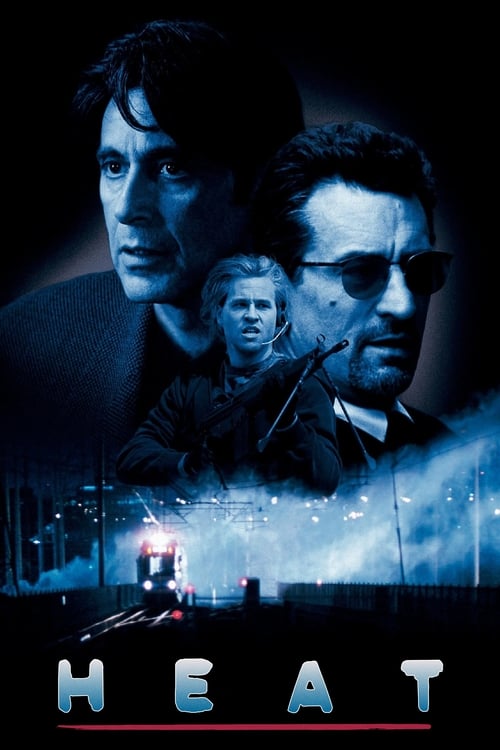
Heat
"A Los Angeles crime saga."
Overview
Michael Mann's Heat is a sprawling crime epic that charts the intense rivalry between two masters of their craft: Neil McCauley (Robert De Niro), a meticulous and isolated professional thief, and Lieutenant Vincent Hanna (Al Pacino), a relentless, obsessive detective in the LAPD's Robbery-Homicide Division. The film opens with McCauley and his crew executing a daring armored car robbery that turns violent, immediately putting them on Hanna's radar.
As Hanna's investigation intensifies, the film delves deep into the personal lives of both men, revealing the profound and often destructive impact their all-consuming professions have on their relationships. McCauley, who lives by the creed "Don't let yourself get attached to anything you are not willing to walk out on in 30 seconds flat if you feel the heat around the corner," finds his solitary existence challenged by a budding romance with a graphic designer, Eady (Amy Brenneman). Meanwhile, Hanna's third marriage to Justine (Diane Venora) is disintegrating under the weight of his devotion to his job, which also strains his relationship with his troubled stepdaughter, Lauren (Natalie Portman).
The narrative builds towards a final, high-stakes bank heist planned by McCauley's crew. The collision course between Hanna and McCauley is not just a professional one, but a deeply personal and philosophical duel between two men who, despite being on opposite sides of the law, are more alike than they would care to admit. Their parallel lives, marked by loneliness and dedication, culminate in a series of confrontations where they acknowledge a mutual respect, even as they are destined for a fatal showdown.
Core Meaning
The core meaning of Heat revolves around the concept of professional and personal duality, exploring the lives of men who are masters of their craft but failures in their private lives. Director Michael Mann examines the idea that extreme dedication to a profession, whether legal or criminal, necessitates a level of detachment that makes genuine human connection almost impossible. The film posits that Neil McCauley and Vincent Hanna are two sides of the same coin; both are defined by their work, which gives them purpose and meaning, but also isolates them and destroys their personal relationships. Ultimately, the film is a tragedy about the impossibility of escaping one's nature and the profound loneliness that comes from being consumed by an obsession, even when it's the one thing you do best. The final moments suggest a shared understanding and empathy between hunter and hunted, a recognition of their shared fate in a world where they are the only ones who truly comprehend each other.
Thematic DNA
Professionalism and Obsession
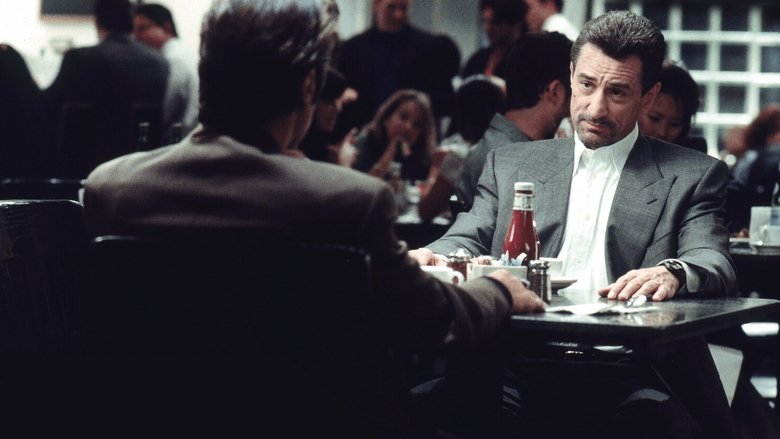
Both Neil McCauley and Vincent Hanna are depicted as the absolute best at what they do. McCauley's heists are planned with military precision, while Hanna's investigative skills are unparalleled. Their dedication borders on obsession, a single-minded focus that gives their lives structure and meaning but comes at a great personal cost. This theme is central to their famous coffee shop meeting, where they acknowledge their shared drive: "I don't know how to do anything else," Hanna admits, to which McCauley replies, "Neither do I." Their professionalism is their identity, trapping them in a cycle of action and consequence.
Duality and Sympathy for the Devil
The film masterfully creates a parallel between the protagonist and antagonist. Mann structures the narrative to show both men's lives, their personal struggles, and their professional triumphs, making them reflections of each other. The audience develops an understanding of, and even sympathy for, McCauley's crew, who are not just faceless criminals but men with families and personal codes. Hanna, the lawman, respects McCauley's discipline and intelligence, blurring the lines between hero and villain and presenting them as two masters on a collision course. This duality is the film's emotional core.
Loneliness and Failed Relationships
The hyper-masculine worlds of crime and law enforcement breed a profound sense of isolation. Both leads are emotionally detached, which leads to the ruin of their romantic relationships. McCauley's mantra is to be ready to abandon anyone in 30 seconds, a philosophy of non-attachment he ultimately violates. Hanna's obsession with his job has led to two divorces and the collapse of his third marriage, as his wife Justine laments, "You live among the remains of dead people." The film is populated with characters struggling with intimacy, showcasing the human cost of their chosen paths.
Fate and Inevitability
From their first meeting, there is a sense of an inescapable conclusion to Hanna and McCauley's story. They both acknowledge that if they meet again during a confrontation, one will not hesitate to kill the other. This fatalism hangs over the entire film. McCauley's decision to seek revenge on Waingro, breaking his own code, seals his fate and leads directly to the final showdown. The ending, where Hanna holds the dying McCauley's hand, feels less like a victory and more like the tragic, inevitable end of a shared journey.
Character Analysis
Lt. Vincent Hanna
Al Pacino
Motivation
Hanna's primary motivation is the thrill of the chase—"the action is the juice." He is driven by an obsessive need to hunt and stop criminals like McCauley, not out of a simple sense of justice, but because it is the only thing that makes him feel alive and gives his life purpose. His dedication is a form of addiction that provides clarity and focus, unlike the chaos of his personal life.
Character Arc
Vincent Hanna begins and ends as a man utterly consumed by his work. His arc is not one of significant change but of deepening self-awareness. Initially portrayed as a volatile, almost manic detective, his pursuit of McCauley forces him to confront the wreckage of his personal life. His coffee shop conversation reveals a man who understands his own failings but is powerless to change. By the end, after taking down his respected adversary, he isn't triumphant but melancholic, realizing he has killed the only person who truly understood him, leaving him more alone than ever.
Neil McCauley
Robert De Niro
Motivation
McCauley is motivated by a desire for absolute freedom and control, which for him means living outside the system and adhering to his own strict discipline. He takes scores not just for the money, but for the challenge and the execution of a perfect plan. His ultimate goal is to make one last big score and escape to a new life, but his deeper motivation is to live by his code, which is ultimately challenged by his own humanity.
Character Arc
Neil McCauley's arc is a tragic journey of a man whose meticulously constructed, detached life is undone by human connection. He lives by a strict code of non-attachment, but his relationship with Eady introduces a vulnerability he has long avoided. His arc is defined by his struggle between his code and his growing emotional attachments. In the end, he breaks his own cardinal rule twice: once for the heist, and fatally, for revenge against Waingro. This emotional decision leads to his death, making his arc a tragedy of a man who couldn't escape his nature but was briefly tempted by the possibility of a different life.
Chris Shiherlis
Val Kilmer
Motivation
Chris is motivated by the thrill of the score and the desire to provide for his family, though his actions often paradoxically destroy his home life. His loyalty to Neil is a driving force, but he is also propelled by his own addictions and volatile emotions, making him the crew's biggest liability and a foil to Neil's controlled demeanor.
Character Arc
Chris Shiherlis is a skilled but reckless member of McCauley's crew whose personal life is in constant turmoil. His arc is one of survival amidst chaos. He struggles with a gambling addiction and a tumultuous marriage to Charlene (Ashley Judd), which puts him and the crew at risk. Despite his volatility, he is fiercely loyal to Neil. His arc culminates in him being the only member of the core crew to escape, albeit wounded and having lost his family, forcing him into the same kind of isolated existence Neil had always lived.
Justine Hanna
Diane Venora
Motivation
Justine is motivated by a desire for a normal life and genuine emotional connection with her husband. She wants a partner who is present and shares a life with her, not just the shell of a man who lives for his job. Her actions are driven by a desperate need for intimacy and her frustration at Vincent's inability to provide it.
Character Arc
Justine's arc is one of painful realization and eventual departure. Initially, she tries to connect with her emotionally distant husband, Vincent, but grows increasingly frustrated with being the "leftovers" of his life. She represents the collateral damage of Vincent's obsession. Her arc is not about changing Vincent but about finding the strength to leave him after recognizing the irreparable damage his job has done to their relationship and her stepdaughter, culminating in her decision to leave him for a man who can be present.
Symbols & Motifs
The Ocean / Images of Water
The vast, empty ocean symbolizes the loneliness and emotional vacancy in the lives of the main characters, particularly Neil McCauley. His minimalist, high-rise apartment overlooks the Pacific, a constant visual reminder of his isolation.
The motif appears in McCauley's apartment, which is sparsely furnished and has a commanding view of the sea. It is also mentioned in the diner scene, where McCauley talks about a recurring dream of drowning, reinforcing his fear of being overwhelmed and losing control. Hanna, in turn, dreams of the dead victims of his cases.
The Color Blue
Director Michael Mann and cinematographer Dante Spinotti use a distinct blue and gray color palette to evoke a sense of melancholy, coolness, and emotional distance. The color pervades the night scenes and the sterile, modern architecture of Los Angeles, reflecting the inner state of the characters.
The blue filter is prominent in many of the film's most iconic scenes, including McCauley's apartment, the nighttime surveillance sequences, and the final confrontation at the airport. It gives the film its sleek, moody, and distinct visual identity.
The Diner Scene
More than a scene, the meeting over coffee is a symbol of the entire film's core duality. It represents a brief moment of truce and mutual understanding in a neutral space, where two adversaries can connect on a human level, acknowledging their similarities before returning to their fated roles.
Occurring in the middle of the film, Hanna pulls McCauley over and invites him for coffee. They sit across from each other and discuss their lives, dreams, and the codes they live by. The framing often keeps them in separate shots, emphasizing their isolation, until the end when they are briefly shown together, acknowledging their mutual respect and inevitable conflict.
Memorable Quotes
A guy told me one time, 'Don't let yourself get attached to anything you are not willing to walk out on in 30 seconds flat if you feel the heat around the corner.'
— Neil McCauley (quoting his mentor)
Context:
Neil explains this philosophy to Vincent Hanna during their iconic coffee shop meeting, as a way to explain how he operates and why a normal life, like marriage, is impossible for someone in his position.
Meaning:
This is the central philosophy of the film and Neil McCauley's personal code. It encapsulates the theme of non-attachment required for a life of crime and, as the film shows, for the life of the man hunting him. The entire narrative tests the limits of this discipline, and Neil's ultimate failure to adhere to it leads to his demise.
I do what I do best, I take scores. You do what you do best, try to stop guys like me.
— Neil McCauley
Context:
This is said during the coffee shop meeting with Vincent Hanna. It's a candid acknowledgment of their opposing roles and the path they are both set upon, recognizing their fundamental similarity in their dedication to their work.
Meaning:
This line succinctly establishes the professional respect and fatalistic worldview shared by the two main characters. It strips their conflict of any moral judgment and presents it as a battle between two masters of their respective crafts, each fulfilling their nature. It highlights the theme of professional identity defining one's existence.
Told you I'm never going back.
— Neil McCauley
Context:
Neil says this to Vincent after being shot in the chest during their final confrontation on the airport tarmac. As Hanna holds his hand, Neil reminds him of their conversation in the diner, bringing their relationship to a poignant and inevitable close.
Meaning:
These are Neil's final words, and they serve as a powerful, tragic fulfillment of his promise to Vincent. He would rather die than be captured and return to prison. It's a testament to his unwavering commitment to his code of freedom, even as he lies dying. It reinforces that, for him, death was a preferable alternative to incarceration.
You don't live with me, you live among the remains of dead people. You sift through the detritus, you read the terrain, you search for signs of passing, for the scent of your prey, and then you hunt them down. That's the only thing you're committed to. The rest is the mess you leave as you pass through.
— Justine Hanna
Context:
Justine delivers this powerful monologue to Vincent during a heated argument about their failing marriage. It is her final, clear-eyed assessment of who he is and why their relationship is impossible to sustain.
Meaning:
This quote is a devastatingly accurate and poetic summary of Vincent Hanna's character and the destructive impact of his obsession on his family. It articulates the central theme of loneliness and failed relationships, showing that Vincent is more a force of nature in pursuit of his prey than a husband or father.
For me, the action is the juice.
— Vincent Hanna
Context:
Hanna shouts this to an informant, explaining why he is so relentlessly driven in his pursuit of criminals. It's a moment of unguarded honesty about what truly drives him.
Meaning:
This line reveals the core of Vincent's motivation. It's not about justice or morality; it's about the adrenaline and the visceral thrill of the hunt. This single phrase explains his chaotic personal life and his manic energy on the job—he's an addict, and his drug is the action of his profession.
Philosophical Questions
Does absolute dedication to one's craft inevitably lead to personal ruin?
Heat relentlessly explores this question through its parallel protagonists. Both Hanna and McCauley have achieved the pinnacle of their professions, yet their personal lives are either non-existent or in complete shambles. The film suggests that the traits that make them exceptional—obsession, meticulousness, emotional detachment—are the very same traits that make them incapable of sustaining healthy human relationships. Justine's monologue to Hanna explicitly states this trade-off. McCauley's entire philosophy is built on avoiding attachments. The film doesn't offer a simple answer but presents a tragic portrait of what is lost when the professional self completely consumes the personal self.
What is the nature of the bond between adversaries?
The film delves into the complex relationship between Hanna and McCauley, suggesting a connection that transcends a simple cop-and-robber dynamic. It's a bond of mutual respect between two masters who see themselves in each other. They are the only two people in their world who truly understand the pressures and disciplines of their lives. This raises questions about empathy and understanding. Can you respect and even empathize with someone you are ethically bound to destroy? The film's final scene, where Hanna takes the dying McCauley's hand, suggests a profound, non-verbal acknowledgment of this unique and tragic bond.
Can a person ever truly escape their fundamental nature?
Neil McCauley's tragedy is his attempt, and ultimate failure, to escape his own nature. He is a disciplined, professional thief, yet his burgeoning love for Eady offers a glimpse of a different life. However, when faced with a choice between escaping with her and settling a score dictated by his criminal code, he reverts to his fundamental self. His need for revenge and adherence to his professional loyalties proves stronger than his desire for a new life. The film suggests that while people can dream of change, they are ultimately bound by the core tenets of their character, leading them down a path that is, in many ways, predetermined.
Alternative Interpretations
While the film is largely seen as a tragedy about two professionals on a collision course, some interpretations focus more on the idea of the film as a critique of contemporary masculinity. Both Hanna and McCauley represent a failing model of manhood, where emotional repression and an obsession with work lead to the destruction of personal relationships and any chance at happiness. Their brief moment of connection in the diner can be read as a yearning for an intimacy that their hyper-masculine codes otherwise forbid. Another perspective sees the ending not as tragic, but as the only possible 'happy ending' for these characters. In their final moments, they achieve a perfect, albeit fatal, understanding. Hanna doesn't just kill a criminal; he, in a sense, frees his counterpart from a life of running, and in holding his hand, validates the strange bond they shared. For men who lived in isolation, this final moment of connection could be interpreted as the most profound relationship either man ever had.
Cultural Impact
Heat is widely regarded as one of the most influential crime films ever made, redefining the genre in the 1990s and beyond. Its influence extends far beyond cinema, having been cited as an inspiration for real-life criminals and even serving as a tactical blueprint for robberies. The film's meticulous realism, particularly in its depiction of heists and the climactic downtown shootout, set a new standard for action sequences. Director Christopher Nolan has frequently cited Heat as a major influence on his film The Dark Knight, particularly in its portrayal of a sprawling city, the complex hero-villain dynamic, and the tone of the opening bank heist. The film's visual style, characterized by Dante Spinotti's cool, blue-hued cinematography, has been emulated by countless subsequent films and television shows, including The Town, Den of Thieves, and True Detective. Upon its release, Heat was met with positive reviews, with critics praising Mann's direction, the screenplay, and the powerhouse performances of Pacino and De Niro. Over time, its reputation has grown immensely, and it is now considered a modern classic. In pop culture, its iconography, from the coffee shop showdown to the intense gun battles, is frequently referenced and parodied, and the film has had a notable influence on video games like the Grand Theft Auto series.
Audience Reception
Audience reception for Heat has been overwhelmingly positive since its release, and it has cultivated a large and dedicated following, often cited as a masterpiece of the crime genre. Viewers consistently praise the film's realism, particularly the technically brilliant and intense shootout sequences, which are lauded for their sound design and authenticity. The iconic diner scene between Al Pacino and Robert De Niro is almost universally celebrated as a masterclass in acting and a cornerstone of cinematic history. The complex characters and the film's deep dive into their personal lives are also major points of praise, with many viewers appreciating that it's a character study as much as an action film. Criticisms, though less common, sometimes focus on the film's long runtime of nearly three hours. A minority of viewers find Al Pacino's performance to be overly loud and theatrical, contrasting sharply with De Niro's restrained portrayal. Some have also criticized the domestic subplots as being less compelling than the central cat-and-mouse game. Overall, however, the verdict is that Heat is a stylish, intelligent, and emotionally resonant crime epic.
Interesting Facts
- The film is based on the true story of Chicago detective Chuck Adamson and his pursuit of a real-life criminal named Neil McCauley in the 1960s. The iconic diner scene was inspired by a real-life meeting between Adamson and McCauley.
- This was the first film to feature Al Pacino and Robert De Niro sharing screen time together. They had both appeared in *The Godfather Part II* (1974) but in different timelines.
- Al Pacino revealed that he portrayed Vincent Hanna as being under the influence of cocaine to explain his volatile and energetic behavior, even though this is never shown or mentioned in the film.
- The famous diner scene was shot with minimal rehearsal at Robert De Niro's suggestion to maintain spontaneity and authenticity.
- The entire film was shot on location in Los Angeles, with director Michael Mann using over 65 different locations and no soundstages to enhance the film's realism.
- The downtown shootout sequence is so highly regarded for its realism that the footage of Val Kilmer performing a tactical reload has reportedly been used in training for U.S. Marines.
- The character of Nate, played by Jon Voight, is based on real-life ex-convict and author Edward Bunker, who served as a consultant on the film.
- The script for *Heat* was first used by Michael Mann for a 1989 TV movie called *L.A. Takedown* after a pilot for a series was not picked up.
- The actors underwent extensive firearms training with real-life British Special Air Service (SAS) commandos to prepare for the film's intense action sequences.
⚠️ Spoiler Analysis
Click to reveal detailed analysis with spoilers
Frequently Asked Questions
Explore More About This Movie
Dive deeper into specific aspects of the movie with our detailed analysis pages
Comments (0)
No comments yet. Be the first to share your thoughts!