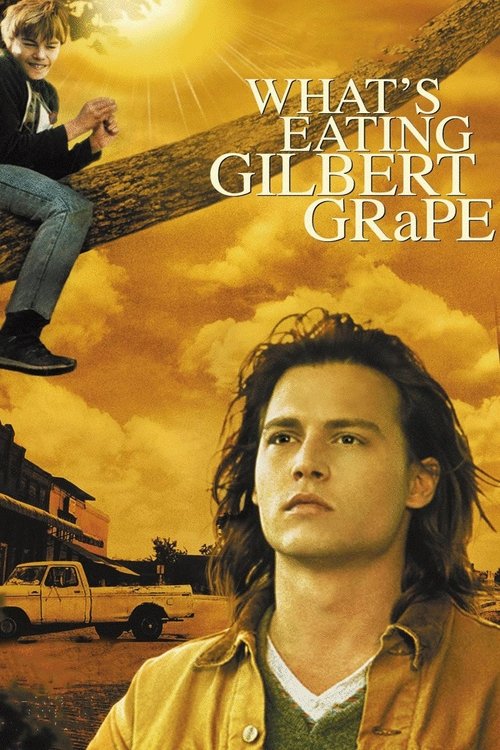
What's Eating Gilbert Grape
"Life is a terrible thing to sleep through."
Overview
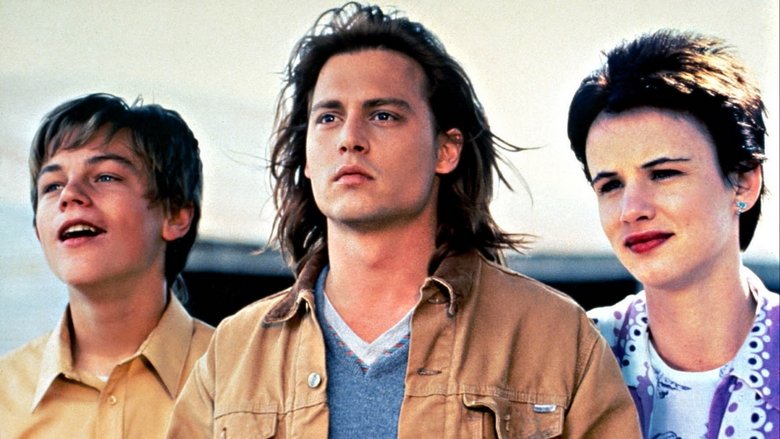
In the small, isolated town of Endora, Iowa, Gilbert Grape works as a clerk at Lamson's Grocery and serves as the primary caretaker for his deeply dysfunctional family. His father's suicide years prior has left his mother, Bonnie, suffering from severe depression and morbid obesity, leaving her entirely housebound. Meanwhile, Gilbert's younger brother, Arnie, who has a developmental disability, requires constant supervision and has a dangerous penchant for climbing the town's water tower. Gilbert's life is a suffocating loop of familial obligations, leaving him emotionally numb and trapped in an existence he desperately wishes to escape.
The monotonous rhythm of Gilbert's life is disrupted when a convoy of Airstream trailers passes through town, and a young, free-spirited woman named Becky becomes stranded with her grandmother. Becky's worldly perspective and genuine, non-judgmental acceptance of Gilbert's family begin to awaken his dormant desires for a life of his own. As Arnie's monumental 18th birthday approaches—a milestone doctors said he would never reach—the mounting pressures of loyalty, a stifling affair with a married woman, and the crumbling foundation of the Grape home force Gilbert to a breaking point. Ultimately, he must confront his paralyzing reality and make a profound choice about his own future.
Core Meaning
The film is a poignant exploration of the tension between familial responsibility and personal freedom. Director Lasse Hallström uses the suffocating environment of a stagnant Midwestern town and a decaying house to illustrate the immense emotional weight of inherited trauma. The core message suggests that while familial love and duty are profound and necessary, one cannot truly care for others without first allowing oneself the grace to live, heal, and establish personal boundaries. It ultimately argues that true love sometimes requires breaking the chains of the past to find renewal and self-actualization.
Thematic DNA
Familial Responsibility vs. Personal Freedom
This is the central conflict of the film, explored through Gilbert's role as the de facto head of the household [1.9]. He is inextricably bound to caring for his brother Arnie and his mother Bonnie, which completely restricts his ability to pursue his own desires, forcing a delicate balance between duty and the yearning to escape.
The Stagnation of Small-Town Life
The fictional town of Endora represents a trap. The new FoodLand supermarket threatens the traditional grocery where Gilbert works, symbolizing a shifting world that is leaving the town behind. The passing Airstream trailers symbolize a mobile, free outside world contrasting with the dreary decay of Endora.
Trauma and Grief
The lingering specter of the father's suicide deeply traumatizes the family. This grief physically manifests in Bonnie's morbid obesity and inability to leave the house, the rotting floorboards of the home, and the family's collective emotional paralysis.
The Healing Power of Acceptance and Love
Becky's arrival brings a non-judgmental, optimistic love that helps Gilbert see the value in himself and his deeply flawed family. Her acceptance teaches him that he is worthy of happiness and provides the emotional catalyst for his eventual liberation.
Character Analysis
Gilbert Grape
Johnny Depp
Motivation
To protect his family from becoming a joke to the outside world, while secretly yearning for a way to escape his responsibilities and be a good person.
Character Arc
Begins the narrative numb, overwhelmed, and silently resentful of his immense burdens [1.9]. He goes through a severe emotional breaking point, but ultimately learns to balance his profound love for his family with his own right to freedom.
Arnie Grape
Leonardo DiCaprio
Motivation
To find play, thrill, and joy in his mundane surroundings, often by climbing high structures like the water tower.
Character Arc
Approaches his 18th birthday—a milestone medical professionals believed he would never reach. He maintains his childlike innocence and joy while inadvertently pushing his siblings to their emotional breaking points.
Bonnie Grape
Darlene Cates
Motivation
To protect her children, particularly Arnie, while simultaneously hiding from the crushing reality of her grief and the town's judgment.
Character Arc
Having spent years bedridden by grief and obesity following her husband's suicide, she summons incredible courage to leave the house to protect Arnie. Later, she bravely climbs the stairs to her bedroom to pass away with dignity.
Becky
Juliette Lewis
Motivation
To experience life authentically, travel limitlessly, and appreciate the simple beauties in nature and people.
Character Arc
Arrives in Endora temporarily due to a broken-down vehicle, connects deeply with Gilbert, and opens his eyes to the vastness of the world before eventually continuing her journey with him by her side.
Symbols & Motifs
TheGrapeHouse
The house is literally rotting and sagging under Bonnie's weight, tying the family down. At the end of the film, the children burn it down to serve as a funeral pyre, beautifully symbolizing cleansing, rebirth, and liberation from their past.
The Water Tower
Arnie repeatedly scales it throughout the film, forcing Gilbert and the town's authorities to coax him down. This recurring action visually highlights the contrast between Arnie's upward mobility and Gilbert's grounded entrapment.
The Airstream Trailers
They pass through Endora annually, bringing Becky into Gilbert's life. They represent the escape Gilbert desperately yearns for, and eventually board at the end of the film.
Fire
It is chanted by Arnie as Match in the gas tank, boom boom!, seen in the smoking kitchen, and culminates in the deliberate burning of the Grape home.
Memorable Quotes
I wanna be a good person.
— Gilbert Grape
Context:
Said to Becky when she asks him what he wants for himself, highlighting how he rarely prioritizes or even considers his own needs.
Meaning:
Represents Gilbert's core desire and his profound internal struggle with feeling inadequate, despite his immense personal sacrifices for his family [1.1].
You're my knight in shimmering armor. Did you know that? ... You shimmer, and you glow.
— Bonnie Grape
Context:
Said to Gilbert after he bravely introduces Becky to his mother, resulting in a moment of profound maternal love and vulnerability.
Meaning:
Demonstrates Bonnie's deep appreciation for Gilbert's sacrifices, validating his tireless efforts to protect the family.
We don't really move. I mean, we'd like to, but... my mom is sort of attached to the house.
— Gilbert Grape
Context:
Gilbert explaining his complicated family situation to Becky with a wry, self-deprecating half-smile.
Meaning:
A poignant double entendre referring to both Bonnie's physical immobility due to her weight and her emotional inability to move past her husband's suicide.
I love the sky. It's so limitless.
— Becky
Context:
Becky and Gilbert talking together, which helps open Gilbert's mind to a larger perspective on freedom and existence.
Meaning:
Contrasts the vast possibilities of the outside world with the claustrophobic, limited, and stagnant life Gilbert leads in Endora.
Match in the gas tank, boom boom!
— Arnie Grape
Context:
A playful chant used by Gilbert and Arnie to coax Arnie down from the water tower.
Meaning:
A recurring motif of fire and destruction that subtly foreshadows the final burning of the Grape house.
Philosophical Questions
Does profound familial duty inherently require the sacrifice of personal freedom?
The film constantly weighs Gilbert's moral obligation to his vulnerable family against his own right to a fulfilling life [1.6]. It asks whether one can truly be a good person while deeply resenting the people they care for, exploring the fine line between noble self-sacrifice and tragic entrapment.
How does our environment shape our identity and potential?
Through the stagnation of Endora, the narrative explores determinism versus free will. Gilbert feels he is shrinking and rotting along with the town and his house, prompting the question of whether a person can ever truly grow if they remain rooted in the soil of their past trauma.
Alternative Interpretations
While the film is generally viewed as a straightforward coming-of-age drama, it has been analyzed through various critical lenses. Some viewers read the film through an existentialist perspective, viewing the town of Endora as a kind of purgatory where characters are trapped by their own refusal to make choices. In this reading, Becky represents the existentialist ideal of finding meaning through freedom and authentic action.
Another interpretation centers on the fiery conclusion. While burning the house is explicitly framed as an act of preserving Bonnie's dignity, psychoanalytical readings suggest it represents Gilbert violently severing his ties to inherited trauma by destroying the very place where his father committed suicide. Additionally, some argue that Gilbert's affair with the married Mrs. Carver is a manifestation of his subconscious desire to sabotage the traditional family-centric ideals that have ultimately trapped him.
Cultural Impact
What's Eating Gilbert Grape has left a lasting legacy primarily due to its deeply empathetic and unsentimental portrayal of mental illness, developmental disabilities, and the crushing reality of rural poverty. Upon release, the film gained immense critical acclaim, solidifying the careers of both Johnny Depp and Leonardo DiCaprio. DiCaprio's performance as Arnie is widely regarded as one of the most authentic and sensitive portrayals of a neurodivergent character in cinema history, earning him an Oscar nomination and signaling his arrival as a generational talent.
Culturally, the film resonated with audiences for its honest depiction of a non-traditional, dysfunctional family. Rather than relying on Hollywood clichés, director Lasse Hallström embraced a style that presented the Grape family's struggles—including Bonnie's severe depression and obesity—with raw humanity rather than turning them into a spectacle. Over the decades, the movie has become a cinematic staple in discussions about the quiet burdens placed on young caregivers and the insidious nature of grief, frequently studied for its masterful balance of melancholic drama and heartfelt optimism.
Audience Reception
Audiences and critics alike have overwhelmingly praised What's Eating Gilbert Grape for its touching, slice-of-life narrative and phenomenal ensemble acting. The most universally acclaimed aspect of the film is Leonardo DiCaprio's performance, which viewers frequently cite as entirely convincing, heartbreaking, and brilliant. Johnny Depp also received high praise for his understated, internalized portrayal of a young man suffocating under the weight of his duties.
Points of criticism often revolve around the film's pacing, which some viewers find slow, noting that it prioritizes atmospheric character studies over a fast-moving, plot-driven narrative. A highly controversial and difficult moment is Gilbert's physical outburst against Arnie, though it is widely acknowledged as a shockingly realistic breaking point for an overwhelmed caregiver. Ultimately, the verdict is that the film is a timeless, bittersweet masterpiece that handles delicate subject matter with extraordinary grace.
Interesting Facts
- Leonardo DiCaprio spent time in homes for mentally disabled children to prepare meticulously for the role of Arnie [1.11].
- Darlene Cates had no prior acting experience before playing Bonnie Grape; she was discovered on a talk show where she openly discussed her struggles with obesity.
- Leonardo DiCaprio was offered a highly lucrative role to play Max in Disney's 'Hocus Pocus', but he turned it down to hold out for 'What's Eating Gilbert Grape'—a film he hadn't even auditioned for yet.
- Leonardo DiCaprio's performance was so critically acclaimed that it earned him his first Academy Award nomination for Best Supporting Actor at the age of just 19.
- Johnny Depp described filming the movie as a challenging experience, noting that he was going through a personal rough patch at the time.
Easter Eggs
Thenameofthetown, Endora.
ThenameEndorasoundsremarkablylikethewordEndure, symbolicallyreflectingexactlywhatGilbert, hisfamily, andthetownspeoplemustdosimplytosurvivetheirstagnantanddecayinglives[1.4].
⚠️ Spoiler Analysis
Click to reveal detailed analysis with spoilers
Frequently Asked Questions
Explore More About This Movie
Dive deeper into specific aspects of the movie with our detailed analysis pages
Comments (0)
No comments yet. Be the first to share your thoughts!