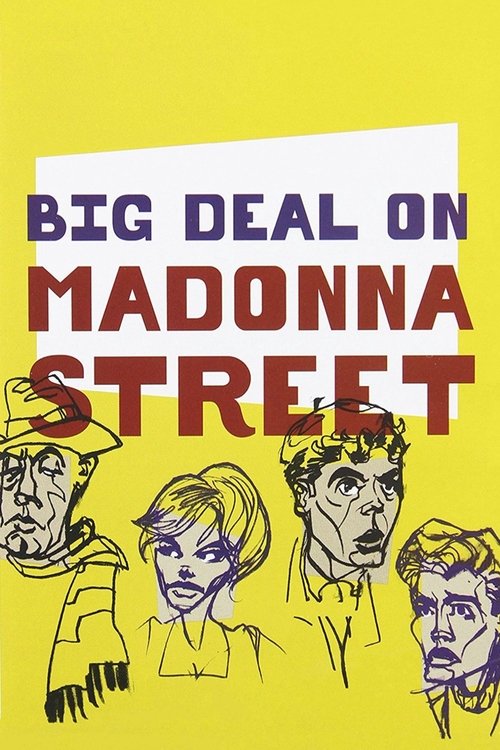
Big Deal on Madonna Street
I soliti ignoti
"The Story of a Perfect Crime ... Perfectly Hilarious!"
Overview
"Big Deal on Madonna Street" (I soliti ignoti) follows a band of small-time, inept Roman crooks who hatch a plan to rob a pawnshop. The scheme originates with Cosimo (Memmo Carotenuto), who gets arrested before he can execute it. He entrusts the plan to Peppe (Vittorio Gassman), a boastful but cowardly boxer who then assembles a motley crew of fellow amateurs: Tiberio (Marcello Mastroianni), a photographer with a baby to care for while his wife is in jail; Mario (Renato Salvatori), a young petty thief; Capannelle (Carlo Pisacane), an elderly, perpetually hungry pickpocket; and Michele (Tiberio Murgia), a Sicilian obsessed with his sister's honor.
Their grand ambition is to break through the wall of an adjacent vacant apartment to get to the pawnshop's safe. To do this, they enlist the expertise of Dante (played by the legendary Totò), a retired safecracker who gives them a crash course. The film humorously chronicles their series of blunders, personal distractions, and general incompetence as they attempt to prepare for and execute the "perfect heist." Their lack of skill, combined with a string of bad luck, turns their supposedly simple plan into a cascade of comedic disasters.
Core Meaning
The core meaning of "Big Deal on Madonna Street" lies in its satirical yet affectionate portrayal of the struggles of the working class in post-war Italy. Director Mario Monicelli uses the framework of a heist film not to celebrate criminal prowess, but to explore themes of poverty, friendship, and the absurdity of aspiring to a life of crime without the necessary skills or ruthlessness. The film serves as a parody of slick American and French crime dramas like "Rififi" and "The Asphalt Jungle," replacing their cool professionalism with heartfelt ineptitude. It suggests that for these characters, crime is not a path to glamour or riches, but a desperate, and ultimately futile, attempt to escape their circumstances. The true treasure they find isn't in the pawnshop safe, but in their shared camaraderie and the small, human moments amidst their chaotic failure.
Thematic DNA
The Comedy of Incompetence
The central theme is the complete and utter ineptitude of the would-be criminals. Unlike the suave professionals of typical heist films, this crew is a collection of bumblers. Every step of their plan, from scouting the location to the final break-in, is plagued by mistakes and unforeseen complications. This incompetence is the primary source of the film's humor, transforming a crime story into a comedy of errors. Their failure is not just a plot device; it's a statement on their nature as fundamentally ill-suited for a life of crime.
Poverty and Social Struggle
Beneath the comedy, the film is deeply rooted in the socio-economic realities of post-war Rome. The characters are driven to crime by desperation and the desire for a better life, not by greed. Monicelli portrays their poverty with a neorealist sensibility, showing their cramped living situations and the daily struggles they face. The heist represents a fantasy of escape, a single, decisive act that they believe will solve all their problems. The film's humor is tinged with the pathos of their situation, making them sympathetic figures rather than simple caricatures.
Parody of the Heist Genre
Monicelli deliberately subverts the conventions of the serious crime caper. Where films like "Rififi" feature meticulous planning and silent, tense break-ins, "Big Deal on Madonna Street" presents chaos, loud arguments, and constant setbacks. The character of Dante, the expert safecracker, provides a brief, almost instructional parody of the genre's tropes before the gang proceeds to ignore or bungle his advice. The film is often cited as the progenitor of the spoof heist film subgenre.
Friendship and Community
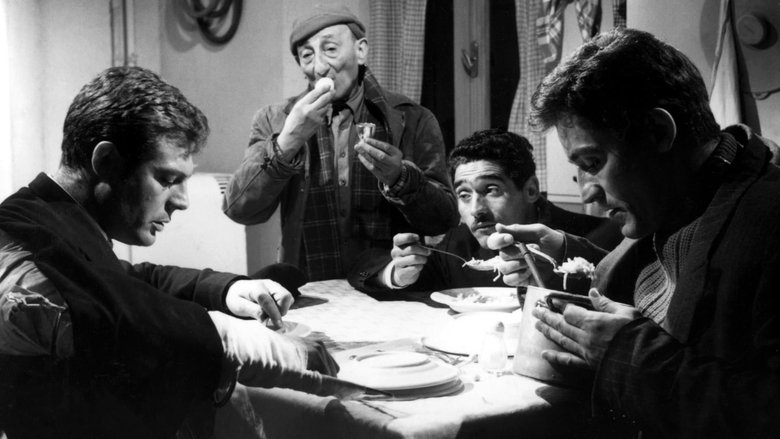
Despite their constant bickering and individual failings, a sense of camaraderie binds the group together. They are united by their shared social status and their foolish dream. The film's most memorable moments often arise from their interactions, whether it's their collective panic or their shared meal of pasta and chickpeas at the end of their failed heist. This theme suggests that even in failure, there is value in human connection and solidarity.
Character Analysis
Peppe "er pantera"
Vittorio Gassman
Motivation
Peppe is motivated by a desire to transcend his low-status life through what he perceives as a clever, easy score. He craves the respect and success that have eluded him in the boxing ring and on the streets, but lacks the discipline and intelligence to achieve it.
Character Arc
Peppe begins as a cocky, small-time boxer who lucks into the heist plan. He fashions himself the leader, constantly insisting on a "scientific" approach he is incapable of executing. His journey is one of gradual deflation, as his bravado is consistently undermined by his incompetence and bad luck. By the end, stripped of his criminal ambitions, he is seen heading off to find legitimate, manual labor, a humbling end to his grand scheme.
Tiberio
Marcello Mastroianni
Motivation
Tiberio's primary motivation is to support his family. He is not a natural criminal but is pushed into it by his desperate financial situation and the need to care for his baby son.
Character Arc
Tiberio is a photographer who has pawned his camera, leaving him unable to work. He is saddled with caring for his infant child while his wife is in jail for a petty offense. He joins the heist out of a sense of paternal responsibility, but his path is one of constant frustration. He fakes a broken arm to steal a camera, only to have his arm genuinely broken later, rendering him useless for the physical part of the heist. His arc highlights the tragicomic intersection of domestic life and criminal endeavor.
Dante Cruciani
Totò
Motivation
Dante is motivated by a professional pride in his old craft and the fee the gang offers him. He is past his life of active crime and treats the consultation as a simple teaching job, detached from the outcome.
Character Arc
Dante is a legendary, now-retired safecracker who acts as the gang's consultant. His role is brief but pivotal. He represents the old guard of professional crime, calmly and expertly explaining the craft of safecracking. He doesn't have a personal arc but serves as a comedic foil, highlighting the gang's amateurishness through his own professionalism. His lesson on the rooftop is a masterclass in both safecracking and comedy.
Cosimo
Memmo Carotenuto
Motivation
Cosimo is driven by a singular, obsessive need to execute his "perfect" heist plan, which he sees as his ticket to freedom and fortune. Unlike the others, his motivation is less about communal gain and more about personal ambition.
Character Arc
Cosimo is the originator of the heist plan, which he learns about in prison. His entire arc is a frantic and ultimately tragic attempt to get out of jail and reclaim his idea. He is the most traditionally criminal and self-serving of the group. After Peppe steals his plan, Cosimo's desperation leads him to a pathetic, fatal end during a clumsy purse-snatching, serving as a dark, moralistic counterpoint to the lighter tone of the main plot.
Symbols & Motifs
The Pawnshop Safe
The safe symbolizes the unattainable dream of wealth and a better life. It is the MacGuffin that drives the plot, representing a quick fix for the characters' deep-seated economic problems. Its ultimate impenetrability for the gang highlights the futility of their criminal aspirations.
The entire film revolves around the gang's plan to crack the safe in the Monte di Pietà pawnshop. They scout it, study it, and acquire an expert to teach them how to open it, but they never even manage to reach it, humorously underscoring the gap between their ambitions and their abilities.
The Wall
The wall they must break through represents the obstacles—both physical and personal—that stand between the characters and their goals. Their comical struggle to breach it, only to end up in the wrong room, symbolizes the misguided nature of their entire endeavor.
The climax of the film involves the gang laboriously breaking through a wall in the apartment they believe is adjacent to the pawnshop. After much effort, they break through into the apartment's own kitchen, a moment of supreme anticlimax and comedic failure.
Pasta e Ceci (Pasta and Chickpeas)
The simple meal of pasta and chickpeas symbolizes a return to reality and the small comforts of their actual lives. After the grand failure of their heist, they abandon their criminal ambitions and share a humble meal, finding solace not in stolen riches but in food and fellowship. It represents the grounding of their lofty, unrealistic dreams in the face of mundane reality.
Having broken into the wrong room and with dawn approaching, the defeated gang raids the apartment's refrigerator and cooks a pot of pasta and chickpeas. Their grand criminal enterprise ends not with a bang, but with a communal, slightly pathetic, supper.
Memorable Quotes
Lavorare stanca.
— Capannelle
Context:
This line is often cited as summing up the ethos of the film's protagonists. It's their resigned, half-joking response to the prospect of hard, legitimate work, which they view as a fruitless and exhausting endeavor compared to the dream of a big score.
Meaning:
Literally "Work is tiring." This simple phrase encapsulates the worldview of the characters. It's a humorous but poignant expression of their aversion to honest labor and their justification for seeking a criminal shortcut. It reflects the broader social fatigue and disillusionment of the era.
Rubare è un mestiere serio, ci vuole gente seria.
— Cosimo
Context:
Cosimo says this early on, trying to impress upon his associates the gravity and potential of his pawnshop heist plan. The rest of the film proceeds to hilariously prove just how far he and his crew are from being the "serious people" required for the job.
Meaning:
"Stealing is a serious profession. It requires serious people." This line is deeply ironic, as it's spoken by a character who is part of the most unserious and inept gang of thieves imaginable. It highlights the gap between the self-perception of criminals and the bumbling reality portrayed in the film, and it's a direct jab at the hyper-professional criminals in movies like "Rififi."
Philosophical Questions
Is failure more revealing of character than success?
The film argues a resounding "yes." The characters' grand plan to achieve success through crime completely unravels, but it's in this failure that their true natures are revealed. We see their loyalty (or lack thereof), their paternal instincts, their romantic longings, and their fundamental decency. The catastrophic end of the heist doesn't define them as losers so much as it strips away their pretensions, revealing the flawed but sympathetic humans underneath.
What is the relationship between comedy and tragedy?
Monicelli masterfully walks the line between comedy and tragedy. The characters' poverty and desperation are real and tragic, yet their attempts to overcome them are hilariously inept. The death of Cosimo is a stark, tragic moment in an otherwise lighthearted film. The film suggests that comedy is not the opposite of tragedy, but rather a different lens through which to view it. The laughter it provokes is deeply empathetic, born from the recognition of human folly in the face of hardship.
Alternative Interpretations
While primarily viewed as a comedy, some critics interpret "Big Deal on Madonna Street" through a darker, more cynical lens. In this view, the film is less a gentle parody and more a bleak commentary on the impossibility of social mobility for the underclass in post-war Italy. The characters' incompetence is not just funny; it's a symptom of a society that has left them with no viable skills or opportunities. Their failure is preordained, and the final scene, where they disperse back into their lives of petty struggle, can be read not as a return to charming normalcy but as a tragic confirmation of their inescapable circumstances.
Another interpretation focuses on the film's subtle moral structure. The only character who dies is Cosimo, the most selfish and traditionally "criminal" member of the group. The others, who are motivated more by family and friendship, are allowed to fail without severe consequences. This suggests a moral universe where genuine malice is punished, while well-intentioned foolishness is treated with a kind of gentle, comedic forgiveness. The failure of the heist, in this reading, is a form of redemption, pushing them away from a life of crime and back toward more honest, if difficult, lives.
Cultural Impact
"Big Deal on Madonna Street" had a profound cultural impact, effectively creating the comedic heist or caper-gone-wrong subgenre. It was a significant departure from the grim realities of Italian Neorealism, injecting comedy and satire into the depiction of post-war Italian society. By parodying serious American and French crime thrillers like "The Asphalt Jungle" and "Rififi," it offered a more human and relatable vision of criminals as hapless dreamers rather than hardened professionals. This approach influenced countless films, from Italian sequels and imitations to Hollywood productions like Woody Allen's "Small Time Crooks" and the films of the Coen Brothers.
The film was a huge success in Italy and also found critical and popular acclaim abroad, earning an Oscar nomination. It cemented the stardom of Marcello Mastroianni, launched the comedic career of Vittorio Gassman, and introduced Claudia Cardinale to a wider audience. As a cornerstone of the Commedia all'italiana movement, it demonstrated that comedy could be a powerful vehicle for sharp social commentary, exploring themes of poverty, class, and the struggle to survive in a changing society. Its legacy is that of a film that not only made audiences laugh but also redefined a genre and captured the bittersweet spirit of an era.
Audience Reception
Upon its release, "Big Deal on Madonna Street" was a major success with both critics and audiences in Italy and internationally. It was praised for its clever script, brilliant ensemble cast, and its innovative blend of neorealist settings with sharp comedy. American critics celebrated it as one of the most irresistible Italian comedies in years, highlighting its humor, humanity, and clever plotting. Over the decades, its reputation has only grown, and it is now widely regarded as a masterpiece of Italian cinema and the quintessential example of Commedia all'italiana. Audiences consistently praise the film's lovable, sad-sack characters and the hilarious, perfectly constructed final heist sequence. While some contemporary viewers might find its pacing slightly slower than modern comedies, the overwhelming consensus is that it remains a timeless, funny, and deeply human film.
Interesting Facts
- The film's original Italian title, "I soliti ignoti," translates to "The Usual Unknowns," a phrase commonly used in Italian police reports, akin to "the usual suspects."
- "Big Deal on Madonna Street" is considered a seminal film in the "Commedia all'italiana" (Italian-style comedy) genre, which blended humor with social commentary.
- The film was a major breakthrough for Vittorio Gassman, who until then was primarily known for dramatic roles. His comedic performance as Peppe redefined his career.
- Director Mario Monicelli stated that the film was intended as a parody of neorealism and, more specifically, of Jules Dassin's famous French heist film "Rififi" (1955).
- Despite being a major star, the legendary comedian Totò has a relatively small but highly memorable role as the safecracking expert Dante. The producers featured him prominently on the original posters to attract a larger audience.
- A young Claudia Cardinale appears in a minor but notable role as Carmelina, the sheltered sister of one of the gang members. This film helped launch her international career.
- The film's distinctive jazz score by Piero Umiliani was influential and helped popularize the use of jazz in European film soundtracks of the 1960s and 70s.
- The film received an Academy Award nomination for Best Foreign Language Film in 1959.
Easter Eggs
In one scene, a movie poster is visible for the 1957 film "Kean: Genius or Scoundrel" ("Kean - Genio e sregolatezza"). The star of that film, prominently featured on the poster, is Vittorio Gassman, who plays Peppe in "Big Deal on Madonna Street."
This is a self-referential, fourth-wall-breaking joke. It winks at the audience by featuring the film's own star in a poster within the movie's world, adding a layer of meta-humor about Gassman's status as a famous actor playing a down-on-his-luck character.
⚠️ Spoiler Analysis
Click to reveal detailed analysis with spoilers
Frequently Asked Questions
Explore More About This Movie
Dive deeper into specific aspects of the movie with our detailed analysis pages
Comments (0)
No comments yet. Be the first to share your thoughts!