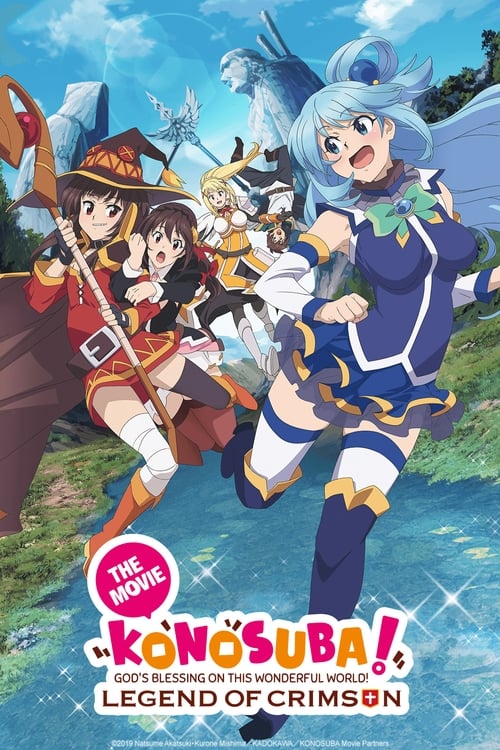
KONOSUBA – God's blessing on this wonderful world! Legend of Crimson
映画 この素晴らしい世界に祝福を!紅伝説
"We will definitely return alive. Go back to that place."
Overview
Following the events of the second anime season, the film sees Kazuma's party journeying to Megumin's hometown, the Crimson Demon Village. They are spurred into action by a letter from Yunyun suggesting a grave threat to the village. Upon arrival, they discover a community as eccentric and prone to dramatic flair as Megumin herself. The group becomes embroiled in the village's defense against Sylvia, a formidable general of the Demon King's army. The film focuses heavily on Megumin's backstory, her relationship with her rival Yunyun, and her unwavering dedication to Explosion magic, all while maintaining the series' signature blend of slapstick humor, witty banter, and parody of fantasy and isekai tropes.
While the central conflict involves protecting the village from Sylvia's forces, the story also delves into the personal dynamics of the main cast, particularly the burgeoning romantic tension between Kazuma and Megumin. The party must utilize their chaotic and often unreliable abilities to confront their most powerful enemy yet, leading to a large-scale, explosive climax that tests their bonds and their bizarre skills.

Core Meaning
At its heart, KONOSUBA – Legend of Crimson is a celebration of embracing one's own eccentricities and finding strength in unconventional places. It champions the idea that perceived flaws and seemingly useless quirks can become powerful assets when combined with unwavering passion and the support of friends, however dysfunctional they may be. The film uses its comedic, genre-parody framework to explore the genuine emotional core of its characters, suggesting that true strength lies not in conforming to expectations, but in an unapologetic commitment to one's own unique path, as exemplified by Megumin's devotion to her singular, powerful spell.
Thematic DNA
Embracing Individuality and Non-Conformity
The central theme revolves around Megumin's unwavering dedication to Explosion magic, which is considered a 'joke' or impractical specialty by her highly capable Crimson Demon peers. Her arc in the film is an identity crisis where she questions if she should conform and learn more versatile advanced magic. The film ultimately validates her choice, showing that her hyper-specialization, born of passion, is what allows the group to overcome their greatest threat. Kazuma's final act of using her skill points to further enhance her Explosion magic, rather than diversifying her skills, cements this theme. It champions the idea that sticking to one's dreams, even if they seem foolish to others, is a source of true power.
The Dysfunctional Found Family
The film reinforces the core concept of the series: a group of deeply flawed, often selfish individuals who, despite constant bickering and incompetence, function as a bizarre but effective family unit. Their journey to Megumin's village is not born of pure altruism but a mix of obligation, misunderstanding, and Kazuma's selfish desires. However, in the face of a real threat, they (mostly) pull together. Kazuma's ultimate sacrifice and Megumin and Yunyun's combined final attack highlight that their strength comes from their begrudging reliance on one another's unique, albeit ridiculous, talents.
Parody of Isekai and Fantasy Tropes
Legend of Crimson continues the series' sharp satire of the isekai ('another world') genre. It subverts expectations at every turn. The all-powerful Crimson Demon Clan is revealed to be a village of chuunibyou (dramatically delusional teens/adults). The epic quest is kicked off by a prank letter. The main villain, Sylvia, is initially intimidating but also becomes the subject of the film's signature lewd and awkward humor. The film consistently pokes fun at RPG mechanics, over-the-top special moves, and the wish-fulfillment nature of typical isekai stories.
Character Analysis
Kazuma Satou
Jun Fukushima
Motivation
Primarily motivated by self-interest, avoiding trouble, and seeking creature comforts and romantic encounters. However, a deeper motivation is a grudging loyalty to his party members, especially Megumin, which he tries to hide under layers of cynicism and complaints.
Character Arc
Kazuma's arc in the film sees him continue to be a cynical, perverted, and reluctant hero. However, his bond with Megumin deepens significantly. While initially driven by his 'popular phase' and lecherous thoughts, he ultimately shows genuine care for her. His decision to use his skill points to upgrade her Explosion magic, rather than force her to learn something more practical, demonstrates his acceptance of her for who she is. He remains a scoundrel but proves he can be relied upon when his friends are in trouble.
Megumin
Rie Takahashi
Motivation
Her singular motivation is to master and use Explosion magic, the most powerful spell in existence. In the film, this motivation is tested as she also develops a desire to be seen as useful and valuable to her friends, particularly Kazuma.
Character Arc
The film is centered on Megumin's journey of self-acceptance. Returning home forces her to confront the perception of her beloved Explosion magic as a useless joke by her peers. She faces a crisis of confidence, even offering to learn advanced magic to be more useful to Kazuma. Her arc culminates in her reaffirming her path, unleashing the most powerful Explosion yet with Yunyun, and solidifying her identity as the party's one-trick-pony powerhouse. Her relationship with Kazuma also evolves from camaraderie to explicit romantic feelings.
Aqua
Sora Amamiya
Motivation
Motivated by a desire for praise, worship, and an easy life. She wants to be recognized as the great goddess she believes herself to be, despite her actions often proving the contrary. She is also motivated by a genuine, though often unhelpful, desire to fight against the Demon King's forces.
Character Arc
Aqua serves primarily as a source of comic relief and deus ex machina. Her role in the film is less central compared to Kazuma and Megumin. She spends much of the time being useless, crying, or demanding praise. However, her divine powers, such as providing blessings to enhance Kazuma's luck, become crucial in the final battle. Her arc is static; she remains a powerful yet comically inept and narcissistic goddess throughout.
Darkness (Lalatina Dustiness Ford)
Ai Kayano
Motivation
Her motivations are twofold: to protect her comrades as a noble crusader and, more prominently, to place herself in situations where she will experience physical and emotional torment, which she finds intensely pleasurable.
Character Arc
Darkness has a significantly reduced role in the film, a point of criticism for some viewers. Her primary function is to serve as the party's unshakeable shield and provide masochistic comic relief. She eagerly throws herself in front of danger, deriving pleasure from the abuse. Her arc is largely non-existent in this installment, with her character traits being played for laughs rather than developed further.
Symbols & Motifs
Explosion Magic
Symbolizes pure, unapologetic passion and the pursuit of a singular, unconventional dream. It represents Megumin's entire identity and her refusal to conform to the expectations of her clan, who view it as impractical 'joke magic'.
It is the central focus of Megumin's character arc. The entire plot is driven by her return to a village of powerful mages where her specialization is looked down upon. The climax of the film is a massive, combined explosion spell, validating her life's purpose. The final explosion, shaped like a heart, can be interpreted as her love for both her craft and for Kazuma.
Crimson Demon Poses
These elaborate, dramatic poses and introductions symbolize the clan's 'chuunibyou' nature—a shared, culturally ingrained delusion of grandeur and power. It represents a collective embrace of eccentricity and a rejection of subtlety, highlighting that Megumin's personality isn't an anomaly but a product of her environment.
Nearly every member of the Crimson Demon Village introduces themselves with a dramatic pose and over-the-top speech. Yunyun's inability to comfortably perform these poses is a source of her social awkwardness and alienation from her peers. The film uses these moments for comedic effect, contrasting the supposedly powerful mages with their nerdy and theatrical behavior.
Memorable Quotes
我が名はめぐみん!紅魔族随一の魔法の使い手にして、爆裂魔法を操りし者! (Waga na wa Megumin! Kouma-zoku随一の魔法の使い手にして、爆裂魔法を操りし者!)
— Megumin
Context:
She uses variations of this introduction throughout the series and film, often before casting her Explosion spell. It's a recurring gag that establishes her character and the over-the-top culture of the Crimson Demon Village.
Meaning:
This is Megumin's standard, dramatic self-introduction, meaning 'My name is Megumin! The foremost and greatest mage of the Crimson Demons, and the one who wields Explosion magic!' It perfectly encapsulates the 'chuunibyou' nature of her entire clan and her immense pride in her specialized magic.
エクスプロージョン! (EKUSUPURŌJON!)
— Megumin
Context:
This is her incantation, shouted at the climax of her spell-casting chant. It's used multiple times in the film, with the final, climactic 'Explosion!' being a combined effort with Yunyun to defeat the final villain.
Meaning:
'Explosion!' This single word is Megumin's signature line and the name of her only offensive spell. It represents the culmination of her power and passion, a moment of ultimate destruction followed by complete helplessness. It's the punchline and the climax of her character all in one.
俺は男女平等主義者だ。 (Ore wa danjo byōdō shugisha da.)
— Kazuma Satou
Context:
While not originating in the movie, this line defines his character's philosophy. It's the justification for his often-perverted actions, reframing them as a principled stand for equality, which serves as a recurring source of humor throughout the franchise.
Meaning:
'I yearn for true gender equality.' This is Kazuma's infamous catchphrase, which he uses to justify using his more underhanded tactics, like 'Steal,' on female opponents without hesitation. It's a comedic line that highlights his shameless and pragmatic nature, subverting typical heroic chivalry.
Philosophical Questions
Is it selfish to pursue a dream that inconveniences others?
The film explores this question through Megumin's devotion to Explosion magic. Her dream makes her a 'burden,' as she is completely incapacitated after one spell and must be carried by Kazuma. In the Crimson Demon Village, she could be a more versatile and consistently 'useful' member of society if she abandoned her niche passion. The film presents the sacrifices others make for her dream (like Kazuma carrying her, or Yunyun helping her) but ultimately concludes that pursuing one's passion is a valid and powerful choice, suggesting that the support of friends makes such a 'selfish' dream worthwhile.
What defines true strength and usefulness?
The Crimson Demon Clan values power and combat effectiveness, and by their standards, Megumin's one-shot ability is a novelty rather than a practical strength. The film challenges this narrow definition. While the other mages are powerful, it is Megumin's 'useless' specialty, honed to an extreme degree, that provides the necessary power to defeat Sylvia. The film argues that true strength isn't about being well-rounded or conforming to a standard, but about the passionate mastery of one's own unique abilities, no matter how strange they seem.
Alternative Interpretations
The character of Sylvia, the main antagonist, has been the subject of significant debate and varied interpretations. One perspective is that the humor surrounding Sylvia is deeply transphobic. In this reading, Kazuma's initial attraction followed by repulsion upon discovering she has male anatomy is played for laughs in a way that mocks and dehumanizes transgender identities. His negative reaction is framed as the 'correct' one, shared by his party, which punches down and relies on harmful stereotypes.
An alternative interpretation views the situation through the lens of Kazuma's established character as a heterosexual, panicky teenager. This perspective argues that Kazuma's reaction is not a condemnation of Sylvia's identity, but a personal, comically exaggerated moment of sexual confusion and panic from a character who is consistently portrayed as flawed and selfish. It is seen as a reflection of his own hangups rather than a statement on gender identity itself. Some also point out that Sylvia is a 'chimera' who has modified her own body, which complicates a direct one-to-one comparison with human transgender experiences and places the character firmly in a fantasy context where the humor is derived from the absurd situation rather than targeted malice.
Cultural Impact
KONOSUBA – Legend of Crimson solidified the franchise's status as a premier parody of the increasingly saturated isekai genre. While the TV series laid the groundwork, the film's success brought this satirical take to a wider audience, demonstrating the commercial viability of subverting genre tropes rather than simply adhering to them. It was praised by fans and many critics for retaining the show's comedic essence while providing a more focused character arc and higher production values.
The film's humor, particularly its handling of the antagonist Sylvia, also sparked considerable online discussion and controversy regarding its portrayal of a character who could be interpreted as transgender, with some viewers and critics labeling the jokes as transphobic. This debate highlights a cultural friction point in anime comedy and its reception by Western audiences, contributing to ongoing conversations about representation and humor in the medium. Ultimately, the film's popularity bolstered the Konosuba brand and is seen as a key reason for the continuation of the anime, ensuring its place as an influential and much-discussed staple of modern isekai anime.
Audience Reception
Audience reception for Legend of Crimson was overwhelmingly positive, especially among existing fans of the series. Viewers praised it for successfully capturing the spirit and humor of the TV show, essentially feeling like a high-budget, feature-length episode. The focus on Megumin's character development and her relationship with Kazuma was a highlight for many. The improved animation quality from J.C.Staff was also frequently noted, with the final battle's explosion effects receiving particular acclaim. The comedy was lauded as being as sharp and hilarious as ever.
Points of criticism were often directed at the reduced roles for Darkness and Aqua, who were sidelined for much of the movie in favor of Megumin and Kazuma. Some viewers unfamiliar with the series found it difficult to get into due to the lack of exposition. The most significant point of criticism and controversy stemmed from the film's humor surrounding the villain Sylvia, which many audience members and critics found to be transphobic and offensive. Despite this, the overall verdict from the target audience was that it was a fun, hilarious, and satisfying continuation of the Konosuba story.
Interesting Facts
- The animation for the film was handled by J.C.Staff, a change from the television series' Studio Deen. This resulted in a noticeable change in visual quality, particularly for the action and explosion sequences.
- The movie adapts Volume 5 of the original light novel series, 'Let's Go, Crimson Magic of Explosion!'.
- The film was a box office success, earning over $1.13 million in its limited U.S. screening alone and significantly more in Japan.
- Some plot points and character interactions from the light novel were cut or altered for the film's runtime. Notably, a few scenes deepening the relationship between Kazuma and Megumin were removed, and the final battle was extended with anime-original content.
- The success of the film is cited as a major factor in the greenlighting of a third season of the anime series.
Easter Eggs
During the final battle, Wiz gathers magical energy from the Crimson Demons in a manner visually similar to the 'Spirit Bomb' from Dragon Ball Z.
This is a direct visual homage to one of the most iconic attacks in anime history, used for comedic and epic effect to show the combined power of the villagers.
As Megumin and Yunyun charge their final joint spell, their power-up stances are a reference to the classic 'charging up' poses frequently seen in the Dragon Ball franchise.
This is another playful nod to Dragon Ball, parodying the shonen trope of characters gathering immense power before unleashing a final attack.
The final combined blast from Megumin and Yunyun, which Kazuma is caught in along with Sylvia, visually resembles the 'Special Beam Cannon' from Dragon Ball Z.
This completes a trifecta of Dragon Ball references in the climax, paying homage to another famous attack and reinforcing the film's satirical but loving relationship with anime tropes.
⚠️ Spoiler Analysis
Click to reveal detailed analysis with spoilers
Frequently Asked Questions
Explore More About This Movie
Dive deeper into specific aspects of the movie with our detailed analysis pages
Comments (0)
No comments yet. Be the first to share your thoughts!