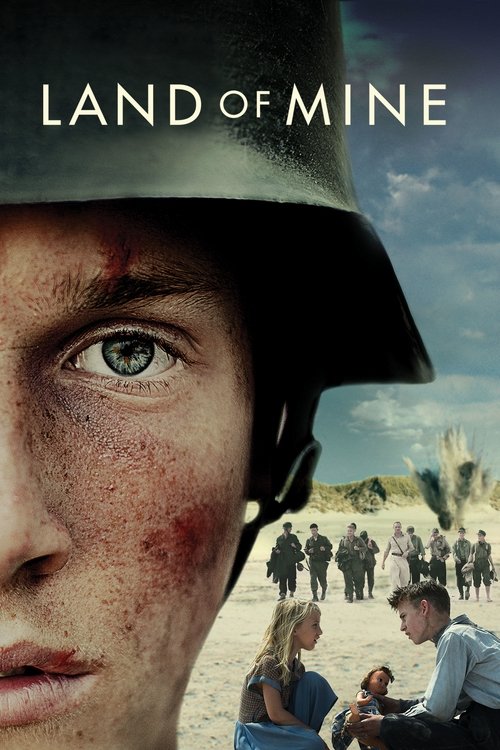
Land of Mine
Under sandet
"They survived the second World War, now they must survive the cleanup"
Overview
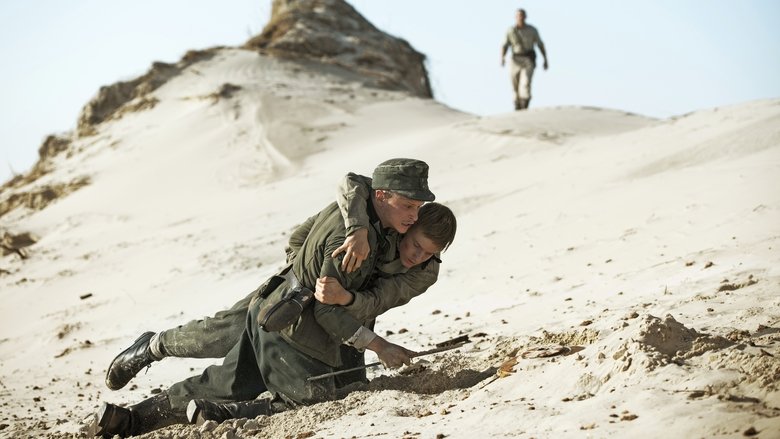
Set in the immediate aftermath of World War II in May 1945, Land of Mine (Under sandet) reveals a harrowing, often forgotten chapter of European history. Following the German surrender, thousands of young German Prisoners of War, many still in their teens, were sent to the west coast of Denmark to clear the beaches of more than two million landmines planted by the Nazi occupiers. Under the command of the battle-hardened and vengeful Danish Sergeant Carl Rasmussen, a small group of boys is assigned to clear a single beach using little more than their bare hands and metal rods.
The film focuses on the psychological tension of the task and the shifting relationship between the boys and their captor. As the body count rises and the sheer inhumanity of the mission becomes undeniable, Rasmussen's initial desire for retribution is tested by the vulnerability of the boys he is ordered to exploit. The story avoids traditional combat to explore the silent, nail-biting terror of the minefields and the moral cost of victory in a world struggling to find its soul again.

Core Meaning
The core of the film is an exploration of the transition from collective hatred to individual empathy. Director Martin Zandvliet uses this historical war crime—the forced labor of POWs in violation of the 1929 Geneva Convention—to question whether a nation can maintain its moral superiority while seeking vengeance. It suggests that the "sins of the fathers" should not be paid for by their children and that true peace requires the difficult, active choice of forgiveness over the cycle of retribution. The film serves as a mirror to Denmark's own national narrative, challenging the simplistic image of the country as a purely innocent victim of occupation.
Thematic DNA
Vengeance vs. Forgiveness
The film tracks the moral arc of Sergeant Rasmussen as he moves from brutalizing German soldiers to acting as a surrogate father. It highlights the difficulty of seeing the 'human' in the 'enemy' after years of trauma and occupation.
The Sins of the Fathers
Revealed through the youth of the POWs, many of whom were conscripted into the Volkssturm at the war's end. They are literally and figuratively digging up the dangerous legacy left by the generation before them.
Ethics and War Crimes
The narrative exposes the legal loophole used by British and Danish commands to reclassify POWs as "voluntarily surrendered personnel" to bypass international laws against forced dangerous labor.
Innocence Lost
The boys dream of simple futures—building houses or seeing their mothers—while performing a task that demands they age instantly or die. Their innocence acts as a stark contrast to the cynicism of the adult military officers.
Character Analysis
Sgt. Carl Leopold Rasmussen
Roland Møller
Motivation
Initially motivated by nationalistic revenge, his drive shifts to personal redemption and a desire to be more than a murderer of children.
Character Arc
Starts as a man fueled by five years of repressed rage against German occupiers, initially beating and starving the boys. Through Sebastian's leadership and the boys' suffering, he gradually rediscovers his empathy, eventually risking his own career to save the survivors.
Sebastian Schumann
Louis Hofmann
Motivation
To keep his comrades alive and return home to help rebuild Germany.
Character Arc
Remains the emotional and pragmatic leader of the group. He brokers the first peace with Rasmussen and maintains hope for the future, surviving the ordeal as the primary witness to the tragedy.
Helmut Morbach
Joel Basman
Motivation
Surviving through defiance and maintaining a sense of soldierly pride in a dehumanizing situation.
Character Arc
Acts as the skeptical counter-voice to Sebastian's optimism. He is aggressive and protective of his identity as a soldier, but his shell cracks as he sees his friends die one by one.
Captain Ebbe Jensen
Mikkel Boe Følsgaard
Motivation
Absolute punishment of the Germans at any cost, showing no regard for their age or humanity.
Character Arc
Remains a static character representing the unyielding cruelty of the state. He serves as a foil to Rasmussen, showing what happens when hatred remains unchecked by personal interaction.
Symbols & Motifs
The Sand
Symbolizes repressed history and hidden danger. On the surface, the beaches are beautiful and serene, but beneath lies a lethal truth that must be painstakingly uncovered.
Used as the primary setting; the title Under sandet (Under the Sand) highlights that the past is buried but never truly gone until it is confronted.
The Twins (Ernst and Werner)
Represent the duality of hope and despair. Their bond is the emotional anchor for the group's humanity.
When Werner is killed, Ernst's subsequent loss of the will to live symbolizes the total destruction of the spirit caused by the war's aftermath.
Otto the Dog
Symbolizes Rasmussen's internal empathy and the fragile nature of trust.
Otto's death in a "cleared" zone causes Rasmussen to momentarily regress into his old hatred, showing how easily peace can be shattered by a single spark of tragedy.
The Beetle / The Mouse
Small, fragile life amidst vast destruction; they represent the boys' own vulnerability and desire for gentleness.
The boys are shown tenderly playing with or protecting these small creatures during moments of rest.
Memorable Quotes
No one wants to see Germans here. This is not your country.
— Captain Ebbe Jensen
Context:
Spoken to the boys upon their arrival, setting the stage for their dehumanization.
Meaning:
Establishes the hostile atmosphere and the collective Danish sentiment of the time.
These mines are not dummies.
— Sgt. Carl Rasmussen
Context:
During a training exercise where the boys must prove they can defuse a live mine with their bare hands.
Meaning:
A literal warning that doubles as a metaphor for the deadly reality of the boys' situation.
When we get home, we'll build the first house.
— Sebastian Schumann
Context:
Sebastian says this to the twins while they are resting in the bunker, imagining their life after the war.
Meaning:
Represents the fragile hope that keeps the boys working; a dream of creation in a landscape of destruction.
Philosophical Questions
Can an individual be held responsible for the crimes of their collective?
The film explores this by showing young boys, who likely saw no combat, being punished for the atrocities of the Nazi regime. It asks if 'justice' is served by subjecting children to the same cruelty their nation once inflicted.
What is the distinction between justice and revenge in the aftermath of trauma?
The film examines this through the Danish officers' treatment of the POWs. It questions whether the state's 'eye for an eye' policy is an act of cleansing or simply the continuation of war by other means.
Is empathy a choice or an inevitable consequence of proximity?
Through Rasmussen, the film suggests that hatred requires distance. Once he is forced to live and work with the boys, their shared humanity becomes an undeniable force that overrides his military indoctrination.
Alternative Interpretations
Critics have debated the film's ending, which some interpret as an earned redemption and others as a sentimental fantasy. One reading suggests that the ending, where Rasmussen lets the survivors run for the border, is a rejection of the state's authority in favor of human morality. However, an alternative, more cynical interpretation posits that this 'happy' ending is a narrative device to alleviate the audience's guilt, potentially downplaying the fact that historically, nearly half of these boys died or were maimed. Some viewers also see the film as a metaphor for modern refugee crises, where youth are forced to 'clean up' the messes of global powers they have no control over.
Cultural Impact
Land of Mine had a profound impact on Danish national discourse, as it brought a largely "repressed" and uncomfortable chapter of history into the public eye. For decades, Denmark's post-war narrative was one of heroic resistance and victimhood; Zandvliet’s film forced a reckoning with the fact that Danish authorities had participated in what many historians now classify as a war crime. The film was critically acclaimed globally, earning an Academy Award nomination for Best Foreign Language Film. It has been cited as a benchmark for modern 'anti-war' cinema because it focuses on the psychological debris of conflict rather than the combat itself. It challenged the prevailing trope in cinema of Germans as monolithic monsters, contributing to a more nuanced, humanist approach to WWII storytelling.
Audience Reception
The film was overwhelmingly praised by audiences and critics for its unbearable tension and emotional depth. Audiences frequently noted that the 'mine defusing' scenes were among the most suspenseful ever put to film. The performances of Roland Møller and Louis Hofmann were singled out for their chemistry and subtlety. Some points of criticism focused on the film's occasionally 'manipulative' score and its leaning into sentimental tropes (like the rescue of the little girl), which some felt simplified a complex historical tragedy. However, the overall verdict remains that it is an essential, high-stakes drama that succeeds in humanizing the 'enemy' without excusing the ideology they represented.
Interesting Facts
- The film was shot on location at the Skallingen Peninsula in Denmark, where the real-life demining operations took place.
- During production, the crew discovered a real, undetonated landmine buried in the sand, emphasizing the lingering danger of the site.
- The explosions in the film were created using real powder charges rather than CGI to maintain a visceral, practical feel.
- Director Martin Zandvliet cast his own daughter, Zoe Zandvliet, as Elizabeth, the young girl who lives near the beach.
- To prepare for the roles, the young German actors spent time in a military camp to simulate the physical exhaustion and discipline of POW life.
- Roland Møller had never played a leading role before this film; he was previously a professional musician and had served time in prison, which he said helped him understand the character's bottled-up rage.
Easter Eggs
Historical Location Accuracy
The bunker and beach settings are not sets but historically authentic locations. Filming on the exact beaches where these boys died 70 years prior was intended to ground the performances in a sense of somber reality.
Director's Cameo-style casting
The casting of the director's daughter as the symbol of innocent life (Elizabeth) heightens the stakes for the audience, as she becomes the bridge that proves the Germans' humanity when they save her from the minefield.
⚠️ Spoiler Analysis
Click to reveal detailed analysis with spoilers
Frequently Asked Questions
Explore More About This Movie
Dive deeper into specific aspects of the movie with our detailed analysis pages
Comments (0)
No comments yet. Be the first to share your thoughts!