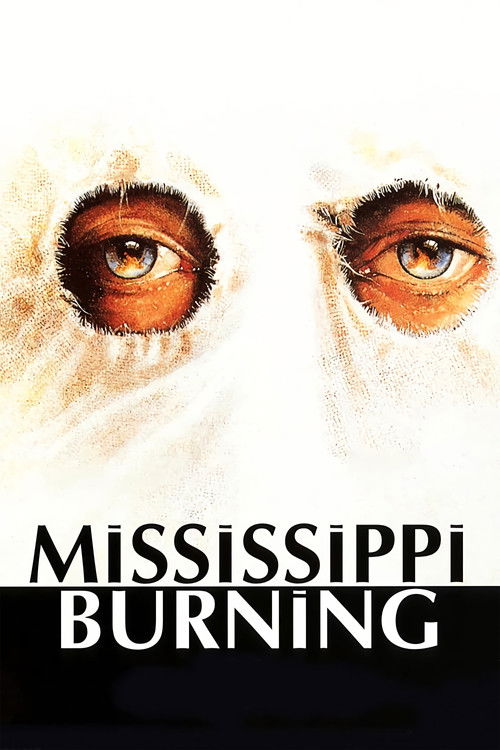
Mississippi Burning
A visceral Southern Gothic thriller where the sweltering heat of 1964 Mississippi mirrors the incendiary racial hatred consuming a small town. Fire, blood, and swamp water visually define this harrowing procedural about the cost of justice.
Mississippi Burning

Mississippi Burning

"1964. When America was at war with itself."

08 December 1988 United States of America 128 min ⭐ 7.7 (1,862)
Director: Alan Parker
Cast: Gene Hackman, Willem Dafoe, Frances McDormand, Brad Dourif, R. Lee Ermey
Drama Crime Thriller Mystery
The White Savior Complex Ends vs. Means Complicity of Silence Institutional Racism
Budget: $15,000,000
Box Office: $34,604,000

Overview

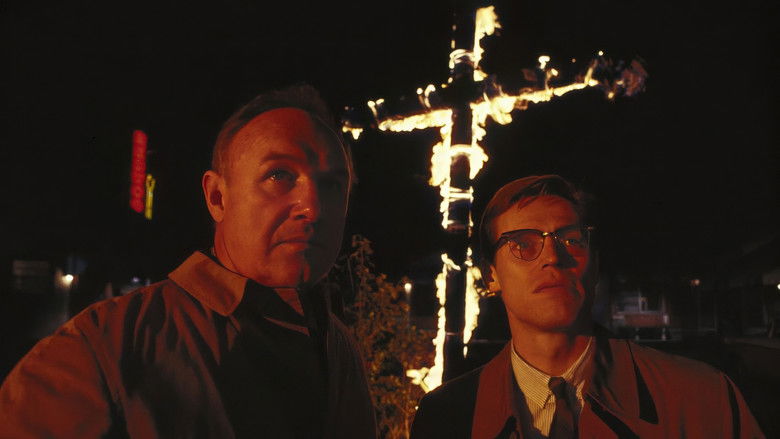
In 1964, three civil rights activists go missing on a dark Mississippi road, sparking a massive FBI investigation. Two agents with diametrically opposed methods arrive to lead the case: Alan Ward, a young, idealistic northerner who strictly follows the book, and Rupert Anderson, a cynical former Mississippi sheriff who understands the violent language of the South. As they dig deeper, they encounter a wall of silence, intimidation, and burning crosses erected by the local Ku Klux Klan, who have infiltrated the local law enforcement.

The investigation turns into a war of attrition. While Ward attempts to use massive manpower and federal procedure, Anderson realizes that in a town ruled by terror, legal niceties won't yield results. The dynamic shifts when Anderson takes the lead, employing intimidation, deception, and aggressive tactics to break the Klan's code of silence. The film builds to a volatile climax as the agents turn the town's hatred against itself to uncover the truth buried in an earthen dam.
Core Meaning

At its heart, Mississippi Burning is a study of pragmatism versus idealism in the face of absolute evil. Director Alan Parker argues that when confronting a system as deeply retrenched and violent as the institutionalized racism of the 1960s South, the moral high ground of the law may be insufficient. The film suggests that fighting fire with fire—using the enemy's own brutal tactics—might be the only way to achieve justice, raising the uncomfortable question of whether the ends truly justify the means.

Thematic DNA

The White Savior Complex 30%
Ends vs. Means 25%
Complicity of Silence 25%
Institutional Racism 20%

The White Savior Complex

The film is frequently analyzed (and criticized) for centering the narrative of the Civil Rights movement on two white FBI agents rather than the Black community. The agency and struggle of Black characters are often sidelined to focus on the heroism and moral dilemmas of Ward and Anderson.

Ends vs. Means

The central conflict between Anderson and Ward. Ward believes in the sanctity of the procedure and civil rights, while Anderson believes that catching monsters requires becoming one. The film ultimately seems to side with Anderson, suggesting that illegal intimidation is necessary to crack the case.

Complicity of Silence

The town's silence is a weapon. It's not just the violent Klansmen who are guilty, but the ordinary citizens, officials, and wives who look the other way. Mrs. Pell's arc represents the breaking of this complicity, showing the courage required to speak the truth in a culture of fear.

Institutional Racism

Racism isn't shown merely as the act of bad individuals but as a systemic rot involving the police, the mayor, and the courts. The law enforcement is the Klan, making standard justice impossible.

Character Analysis

Rupert Anderson

Gene Hackman

Archetype: The Pragmatic Anti-Hero / The Cowboy Cop
Key Trait: Street-smart intimidation

Motivation

To solve the case and punish the bullies, driven by a personal understanding of the poverty and hate that breeds such men.

Character Arc

Starts as a cynical observer following orders but evolves into a ruthless enforcer who uses his knowledge of the South to dismantle the Klan. He teaches Ward that high-minded ideals fail against raw hatred.

Alan Ward

Willem Dafoe

Archetype: The Idealist / The By-the-Book Bureaucrat
Key Trait: Moral rigidity

Motivation

To uphold the law and civil rights through proper federal procedure.

Character Arc

Begins as a rigid superior officer who looks down on Anderson's methods. Over time, he is humbled by the brutality he witnesses and eventually sanctions Anderson's illegal tactics to get results.

Mrs. Pell

Frances McDormand

Archetype: The Tragic Whistleblower
Key Trait: Quiet courage

Motivation

Guilt and a desire to wash away the hatred she married into.

Character Arc

Moves from a passive, fearful housewife to the key witness who breaks the case. She suffers physical abuse for her bravery but ultimately chooses to stay and rebuild her life.

Deputy Clinton Pell

Brad Dourif

Archetype: The Banality of Evil
Key Trait: Smug cruelty

Motivation

Racial supremacy and maintaining his local power structure.

Character Arc

remains unrepentant throughout, transitioning from a smug lawman to a fearful suspect as the FBI closes in.

Symbols & Motifs

Fire

Meaning:

Destruction, hatred, and cleansing. It represents the Klan's terror (burning crosses, churches) but also the 'burning' pressure the FBI applies to the town.

Context:

Used in the burning cross scenes, the burning of the church, and the title itself.

The Swamp

Meaning:

The murky, concealing nature of the South's secrets. It physically hides the bodies and metaphorically represents the depth of the corruption.

Context:

The bodies are buried in an earthen dam; the agents are constantly wading through mud and water.

Segregated Water Fountains

Meaning:

The visceral reality of 'Separate but Equal'. One is clean and modern, the other dirty and broken.

Context:

Shown early in the film to visually establish the apartheid-like conditions of the setting.

Broken Tombstone

Meaning:

The incompleteness of justice and the erasure of Black identity in history.

Context:

The final shot focuses on a tombstone reading '1964 Not Forgotten', with the name broken off.

Memorable Quotes

It was a war long before we got here.

— Alan Ward

Context:

Ward says this to Anderson after realizing the depth of the hostility they are facing.

Meaning:

Acknowledges that the racial conflict in the South is deep-rooted and systemic, not just a temporary crime scene the FBI can fix.

With an old man so full of hate that he didn't know that being poor was what was killing him.

— Rupert Anderson

Context:

Anderson tells Ward a story about his father to explain why these men are the way they are.

Meaning:

A profound analysis of the socio-economic roots of racism. Anderson explains how poor whites are manipulated into hating Black people to distract them from their own poverty.

Hatred isn't something you're born with. It gets taught. At school they said segregation was what it said in the Bible... At 9 years of age, you get told enough times, you believe it.

— Mrs. Pell

Context:

Mrs. Pell speaking to Anderson in her home, explaining the mindset of her husband and the town.

Meaning:

highlights the indoctrination of racism and how it is passed down through generations and institutions.

You'll leave me with nothing... I'll have to live with that.

— Mrs. Pell

Context:

Her confession scene where she decides to reveal the truth to Anderson.

Meaning:

She accepts that doing the right thing will cost her her marriage and safety, but realizes her conscience is more important.

Philosophical Questions

Do the ends justify the means?

The film posits that in an unjust society, legal methods are insufficient. Anderson's use of kidnapping, coercion, and threats (illegal acts) achieves the justice that Ward's warrants cannot. It asks the audience if they are comfortable with law enforcement breaking the law to catch the bad guys.

Is neutrality possible in the face of oppression?

Through the townspeople and the Mayor, the film explores how silence and 'staying out of it' act as active support for the oppressors. It argues that there are no innocent bystanders in a system of terror.

Alternative Interpretations

The Western in Disguise: Some critics view the film not as a historical drama but as a classic Western. Anderson is the gunslinger who rides into a lawless town to clean it up, while Ward is the ineffective eastern lawyer. The Klan represents the outlaws.
The FBI as Myth: Another reading suggests the film is a pro-FBI fantasy that reimagines the Bureau—which historically surveilled and harassed civil rights leaders like MLK—as the heroic champions of the movement.

Cultural Impact

Mississippi Burning was a critical and commercial success that ignited a firestorm of controversy. While it was nominated for seven Academy Awards (winning Best Cinematography) and praised as a gripping thriller, it was heavily criticized by historians and civil rights veterans for its 'White Savior' narrative. Critics argued it turned a Black struggle for freedom into a white FBI procedural, effectively 'hijacking' history. despite this, the film is credited with renewing public interest in the Civil Rights movement and remains a touchstone for discussions about historical accuracy in Hollywood.

Audience Reception

Audiences generally rate the film highly (CinemaScore 'A') for its intense performances, particularly Gene Hackman's, and its palpable atmosphere of dread. It is often praised as a taut, well-made thriller. However, modern audiences and critics frequently deduct points for its dated racial politics and the sidelining of Black agency, viewing it as a product of its time that prioritized white perspective over historical truth.

Interesting Facts

  • The film is based on the real 'Mississippi Burning' (MIBURN) FBI investigation into the murders of civil rights workers Chaney, Goodman, and Schwerner.
  • Gene Hackman convinced director Alan Parker to remove a planned sex scene between Anderson and Mrs. Pell, arguing it would be out of character and disrespectful.
  • The scene where a cameraman is beaten by a local redneck is based on actual news footage from the era.
  • The character of Mrs. Pell (Frances McDormand) is fictional; in real life, the informant was a man (likely a highway patrolman or Klan member), not the deputy's wife.
  • Director Alan Parker received heavy criticism from civil rights leaders, including Coretta Scott King, for marginalizing Black characters and fictionalizing history.
  • Willem Dafoe was cast because Parker wanted a 'Kennedy-esque' face to represent the idealism of the Justice Department.
  • The 'barbershop' scene involving the razor blade was a pure invention for the film to show Anderson's intimidation tactics.

Easter Eggs

Producer Cameos

Producers Frederick Zollo and Robert F. Colesberry appear in the film. Zollo plays a news reporter, and Colesberry plays the cameraman who gets beaten up.

1964 Not Forgotten Tombstone

The final shot shows a tombstone with the name broken off, reading only '1964 Not Forgotten'. This was a prop, but it symbolizes the anonymous victims of racial violence and the film's fictionalization of the specific real-life victims (Chaney, Goodman, Schwerner).

Sheriff Ray Stuckey / Sheriff Rainey

The character of Sheriff Stuckey is physically and behaviorally modeled closely after the real-life Sheriff Lawrence Rainey, who was known for his chewing tobacco and dismissive attitude during the trial.

⚠️ Spoiler Analysis

Click to reveal detailed analysis with spoilers

Frequently Asked Questions

Explore More About This Movie

Dive deeper into specific aspects of the movie with our detailed analysis pages

Comments (0)

Leave a comment

No comments yet. Be the first to share your thoughts!