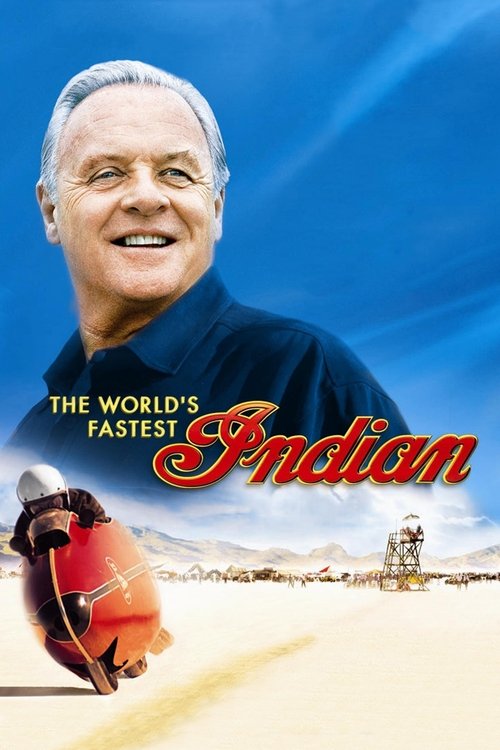
The World's Fastest Indian
"Based on one hell of a true story."
Overview
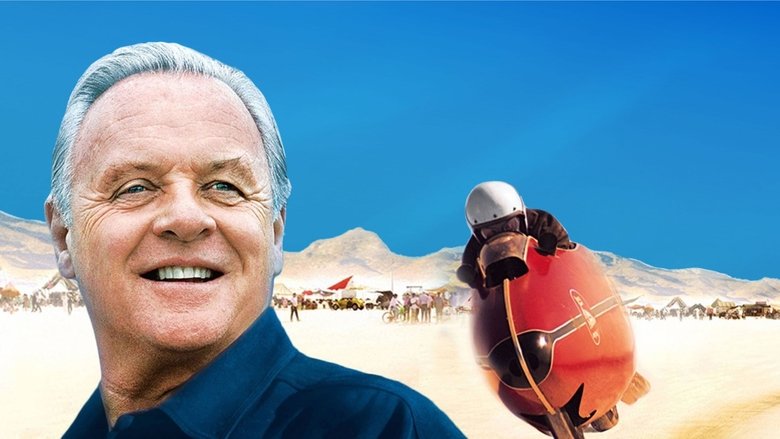
The World's Fastest Indian tells the heartwarming true story of Burt Munro (Anthony Hopkins), a 68-year-old New Zealander who refuses to let age or convention slow him down. Living in a cinder-block shed in Invercargill, Burt has spent decades modifying his beloved 1920 Indian Scout motorcycle with makeshift parts and sheer ingenuity. Despite a heart condition and a lack of funds, he embarks on an arduous journey across the globe to the Bonneville Salt Flats in Utah, the holy grail for speed demons.
The film chronicles his odyssey from the bottom of the world to the American West, painting a portrait of a man who charms everyone he meets—from a transvestite motel clerk in Los Angeles to a used car salesman and a lonely widow. Upon arriving at Bonneville, Burt faces a bureaucratic wall of racing officials who deem his ancient machine a death trap. Through his infectious spirit and the support of new friends, he is granted a chance to run.
In a climactic test of will and engineering, Burt pushes his fragile machine to the breaking point. The story is less about the record itself and more about the journey of a man who believes that "if you don't follow through on your dreams, you might as well be a vegetable." It is a celebration of eccentricity, kindness, and the refusal to fade away quietly.
Core Meaning
At its heart, the film is a meditation on the vitality of the human spirit and the refusal to accept the limitations of age. Director Roger Donaldson uses Burt Munro's story to argue that passion is the antidote to death. The film suggests that "growing old" is a choice to stop dreaming, not just a biological process. By contrasting Burt's vibrant, risky life with the safety of a "vegetable" existence, the movie champions the idea that a life lived fully, even for five minutes at high speed, is worth more than a lifetime of safe stagnation.
Thematic DNA
The Defiance of Age
Burt is constantly reminded of his age—by his doctor, his neighbors, and the racing officials. The film flips the script on the "fragile senior" trope, showing Burt as more alive than characters half his age. His physical ailments (angina) are treated as mere mechanical annoyances, similar to a sputtering engine, rather than reasons to stop.
Passion vs. Convention
Burt lives outside societal norms—sleeping in his workshop, peeing on his lemon tree, and melting metal on a stove. The film juxtaposes his unconventional genius against the rigid rules of the Bonneville bureaucrats. His success proves that passion and intuition often outstrip rigid adherence to the rulebook.
The Kindness of Strangers
Unlike many road movies that focus on danger, this film posits that the world is inherently good. From Fernando to Tina and Ada, Burt succeeds because a community of disparate strangers decides to help him. It highlights how genuine authenticity attracts kindness.
Ingenuity and Self-Reliance
Burt's bike is a testament to "Number 8 wire" mentality (a Kiwi term for ingenuity). Casting pistons in sand, carving tires with a kitchen knife—the film celebrates the analog, tactile joy of creating something with one's own hands in an increasingly polished, corporate world.
Character Analysis
Burt Munro
Anthony Hopkins
Motivation
To find out how fast his bike can go. He isn't seeking fame, but validation of his life's work. He fears dying without ever knowing the true potential of his creation.
Character Arc
Burt begins as a local eccentric in a small town, dismissed by many as a nuisance. His journey transforms him from a "mad old coot" into a legend. He doesn't change his nature; rather, the world changes its perception of him as he proves the validity of his obsession.
Tom
Aaron Murphy
Motivation
To help his hero succeed; he sees the magic in Burt that the adults miss.
Character Arc
Tom is Burt's anchor to home and his primary believer. He represents the next generation who learns that being "normal" is overrated. He helps Burt prepare and protects his legacy while he is away.
Ada
Diane Ladd
Motivation
Connection and companionship; helping a wandering soul.
Character Arc
A brief but significant encounter. She is a lonely widow who sees the man inside the mechanic. She offers Burt a chance to settle down, which he gently refuses, reinforcing his commitment to his mission.
Symbols & Motifs
The 1920 Indian Scout
The motorcycle is an extension of Burt himself—an antique chassis modified to perform beyond its original design. It symbolizes potential hidden within the old and the idea that with enough care (and obsession), even something "obsolete" can set the world on fire.
The bike is treated like a living companion; Burt talks to it, touches it tenderly, and risks his life on its reliability. The visual of the "shell" covering the old frame mirrors Burt's own aging body housing a youthful spirit.
The Lemon Tree
A symbol of unconventional growth and pragmatism. Burt urinates on it to water it, shocking his neighbors. It represents his rejection of social niceties in favor of what works, and his connection to the natural cycle of life.
Early in the film, Burt instructs his young neighbor Tom on the benefits of this "natural fertilizer," establishing his disregard for suburban norms and his practical philosophy.
The White Salt Flats
A place of purity, infinity, and danger. The stark white landscape represents the threshold between life and death, a blank canvas where Burt can finally write his own destiny without the noise of society.
The visual shift from the green, cluttered spaces of New Zealand to the blinding, expansive white of Utah marks the transition from the mundane world to the spiritual realm of speed.
Memorable Quotes
If you don't follow through on your dreams, you might as well be a vegetable.
— Burt Munro
Context:
Burt says this to young Tom in his workshop, explaining why he pushes himself despite the dangers and his age.
Meaning:
The film's thesis statement. It equates the abandonment of passion with a spiritual death. It justifies Burt's recklessness—he would rather risk death than live without purpose.
You live more in five minutes on a bike like this than some people live in a lifetime.
— Burt Munro
Context:
Spoken during a quiet moment, reflecting on the thrill of speed that non-racers cannot understand.
Meaning:
A justification for the extreme risk of land speed racing. It suggests that intensity of experience is more valuable than longevity of existence.
I think when you're dead, you're dead. I'm a devout atheist, thank God.
— Burt Munro
Context:
A humorous paradox delivered during a conversation about the afterlife and beliefs.
Meaning:
Highlights Burt's pragmatic, grounded worldview. He focuses entirely on the here and now, driven by the belief that this life is the only chance he gets.
Danger is the spice of life. You've got to take a risk now and again... that's what makes life worthwhile.
— Burt Munro
Context:
Burt offering advice, reinforcing his archetype as the wise thrill-seeker.
Meaning:
Reflects his philosophy that safety breeds boredom. Risk is necessary to feel truly alive.
Philosophical Questions
Does the pursuit of a dream justify the risk of life?
The film asks whether a long, safe life is superior to a short, glorious one. Burt explicitly states he would rather die attempting the record than live as a "vegetable." The film validates this existential wager, presenting the quality of life as dependent on the pursuit of one's highest passion, regardless of the danger.
Is success defined by the result or the attempt?
While Burt does get the record, the film spends 90% of its runtime on the journey and the struggle. Even if he hadn't set the record, the friends he made and the barriers he broke (age, class, geography) suggest that the "win" was in arriving at the starting line, not just crossing the finish line.
Alternative Interpretations
While primarily an inspirational sports drama, the film can be interpreted as a spiritual allegory. Burt is a pilgrim traveling to a "sacred" land (the Salt Flats), facing trials (financial, mechanical, bureaucratic) and temptations (Ada, the easy life) along the way. His "God of Speed" is a literal deity he worships through the ritual of mechanics. Alternatively, the ending can be read with a touch of melancholy: Burt achieves his dream, but the film implies he has "completed" his life's purpose, leaving nothing else for him but the inevitable decline he fought so hard to outrun—making the record his final, defiant act against mortality.
Cultural Impact
The World's Fastest Indian is considered a crown jewel of New Zealand cinema, solidifying Burt Munro's status as a national folk hero. Upon release, it became the highest-grossing local film in New Zealand history. Culturally, it revived interest in the "Kiwi can-do" attitude—the idea that ingenuity can triumph over budget. For the motorcycling community worldwide, the film (and the bike) became an icon, leading to a surge of pilgrims visiting the E Hayes & Sons hardware store in Invercargill where the real bike is displayed. It also marked a significant shift in Anthony Hopkins' career, allowing audiences to see him in a warm, vulnerable, and comedic light, distinct from his Hannibal Lecter persona.
Audience Reception
The film received overwhelmingly positive reviews from both critics and audiences, holding a high score on Rotten Tomatoes. Viewers universally praised Anthony Hopkins' performance, calling it one of his most subtle and endearing. The film is frequently described as "feel-good," "inspiring," and "unpretentious." Criticism was minor, mostly directed at the formulaic nature of the plot and some historical inaccuracies (like the compression of timelines). However, audiences largely forgave these "Hollywood" adjustments because the emotional core of the character felt so authentic. It remains a beloved favorite among motorcycle enthusiasts and general audiences alike.
Interesting Facts
- Director Roger Donaldson wrote, produced, and directed a documentary about the real Burt Munro in 1971 titled 'Offerings to the God of Speed' before making this feature film over 30 years later.
- Anthony Hopkins claimed this was one of his favorite roles because Burt was so different from the psychopaths and uptight characters he was famous for playing.
- The real Burt Munro was actually married and had four children, unlike the film's portrayal of him as a lifelong bachelor/divorcé living alone.
- Burt's record run in the film (201 mph) is a dramatization; his official record in 1967 was 183.58 mph (corrected later to 184.087 mph), though he did have an unofficial one-way run of 190.07 mph.
- The scene where Burt pees on the lemon tree was added by Roger Donaldson as a tribute to his own father, who used to do the same thing, though it fits Burt's eccentric character perfectly.
- Many of the props in Burt's shed, including the piston molds and the ball of offerings, were actual items owned by the real Burt Munro, borrowed from the Southland Museum.
- The film compresses Burt's multiple trips to Bonneville (spanning from 1956 to 1967) into a single narrative journey for dramatic effect.
- Tim Shadbolt, the actual Mayor of Invercargill at the time of filming, has a cameo as Frank, a friend of Burt's.
Easter Eggs
Tim Shadbolt Cameo
The man playing Frank, who helps organize the fundraiser for Burt in Invercargill, is Tim Shadbolt, the real-life, long-serving Mayor of Invercargill. He is a local legend in New Zealand, known for his own colorful personality.
Offerings to the God of Speed
The shelf labeled "Offerings to the God of Speed" where Burt keeps his broken pistons is a direct reference to the title of Roger Donaldson's 1971 documentary about Burt Munro.
Antarctic Angels
The biker gang Burt encounters in New Zealand are the Antarctic Angels. This is a real motorcycle club in Invercargill, and some real members were used as extras in the scene.
⚠️ Spoiler Analysis
Click to reveal detailed analysis with spoilers
Frequently Asked Questions
Explore More About This Movie
Dive deeper into specific aspects of the movie with our detailed analysis pages
Comments (0)
No comments yet. Be the first to share your thoughts!