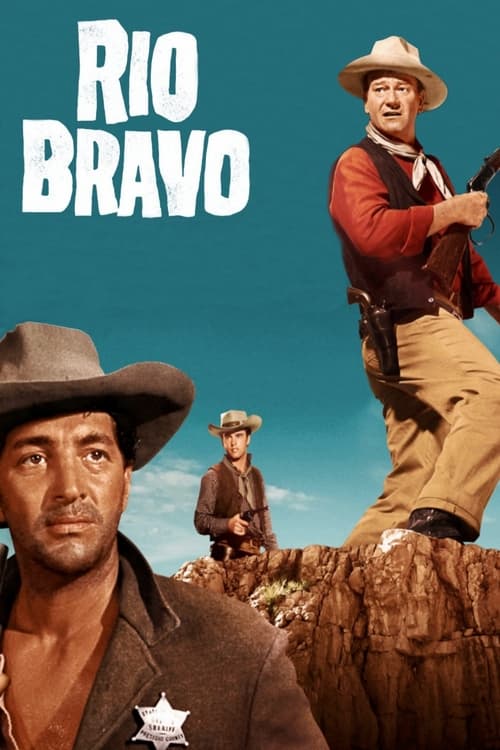
Rio Bravo
"They fought back to back... No quarter given... No quarter asked... No way in... No way out... of Rio Bravo!"
Overview
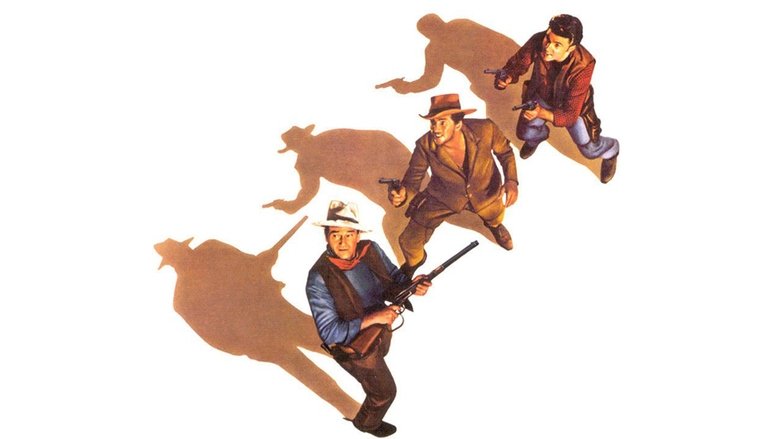
Set in the small town of Rio Bravo, Texas, the story follows Sheriff John T. Chance as he arrests Joe Burdette for murder. Joe's brother, Nathan, a powerful and wealthy land baron, effectively lays siege to the town, hiring a small army of gunmen to prevent the sheriff from transferring Joe to a U.S. Marshal. Facing overwhelming odds, Chance is forced to defend the jail and maintain the law with a skeleton crew of social misfits.
The narrative unfolds at a leisurely pace, prioritizing the interactions between the lawmen and their allies over typical action sequences. As the 'No Quarter' music of the Deguello plays repeatedly from the local saloon, the film builds a palpable sense of dread and community. The plot centers not just on the external threat of the Burdette gang, but on the internal struggle of men trying to prove their worth to themselves and each other.
Core Meaning
At its heart, Rio Bravo is a celebration of professionalism and the Hawksian group. Director Howard Hawks created the film as a direct ideological rebuttal to High Noon (1952), which he felt depicted a lawman as an 'amateur' for begging his community for help. In Rio Bravo, the sheriff only accepts help from those who are 'good enough,' suggesting that true dignity comes from competence and self-reliance within a trusted circle of peers.
The film carries a message about the power of redemption through discipline. It argues that a man's past—be it alcoholism, physical disability, or youth—does not define him as much as his willingness to stand his ground and perform his duty with excellence.
Thematic DNA
Professionalism
The film emphasizes the 'Hawksian' ideal of the professional. Sheriff Chance repeatedly turns down help from 'well-meaning amateurs,' believing that only those with the necessary skills and emotional fortitude should face the dangers of the badge.
Redemption
Primarily explored through the character of Dude, this theme focuses on the arduous journey of reclaiming one's self-respect. Dude’s battle with the bottle is a mirror to the town's battle with the Burdette gang, representing a struggle for internal and external order.
Male Camaraderie
The core of the film is the 'hangout' chemistry between the main characters. Their bond is built through shared labor, mutual ribbing, and silent understanding, forming a makeshift family that replaces the traditional community that has failed them.
The Nature of Courage
Courage is depicted not as the absence of fear, but as the adherence to a moral code despite it. Whether it is Stumpy's stubborn loyalty or Colorado's quiet competence, the film explores different facets of what it means to be brave.
Character Analysis
John T. Chance
John Wayne
Motivation
To uphold the law and protect his town from the corruption of the Burdette family without sacrificing 'amateur' lives.
Character Arc
Chance begins as a rigidly self-reliant lawman who refuses any help that might get someone killed. Through his interactions with Feathers and his posse, he learns to accept vulnerability and the necessity of communal support, softening his stoic exterior.
Dude (Borrachón)
Dean Martin
Motivation
To overcome his addiction and prove to Chance (and himself) that he is still the man he used to be before his heartbreak.
Character Arc
Dude undergoes a harrowing transformation from a broken alcoholic seeking a drink in a spittoon to a fully restored deputy. His arc is the emotional core of the film, culminating in him regaining his steady hand and self-respect.
Stumpy
Walter Brennan
Motivation
Unwavering loyalty to Chance and a desire to prove he is still 'in the game' despite his age and infirmity.
Character Arc
While largely static, Stumpy provides the moral and strategic anchor for the group. He proves that physical disability (his 'game leg') does not diminish a person's utility or bravery in a crisis.
Feathers
Angie Dickinson
Motivation
To find a place where she is respected and loved for who she is, rather than being judged for her past associations.
Character Arc
A wanderer with a questionable reputation who finds a reason to stay. She challenges Chance’s authority and force-feeds him the emotional intimacy he tries to avoid.
Colorado Ryan
Ricky Nelson
Motivation
To do his job well and protect the people he respects, while maintaining a sense of professional detachment until it's no longer an option.
Character Arc
A young gunfighter who initially 'minds his own business' but eventually chooses to commit to a cause. He represents the next generation of 'Hawksian' professionals—competent, cool-headed, and respectful of the older guard.
Symbols & Motifs
The Spittoon
Symbolizes humiliation and the loss of dignity. The act of Joe Burdette throwing a coin into the spittoon for Dude to retrieve establishes the power dynamic of the town and provides the visual marker for Dude's eventual redemption when he finally refuses to grovel.
Introduced in the opening scene and revisited later when Dude's sobriety is tested; it marks the beginning and end of his psychological journey.
El Deguello
A song meaning 'No Quarter' (the cutthroat). It symbolizes impending doom and the ruthless nature of the antagonist, Nathan Burdette, signaling that no mercy will be shown to the lawmen.
Burdette hires a band to play the song continuously in the saloon across from the jail to wear down the nerves of the Sheriff's posse.
Feathers' Wardrobe
Represents the conflict between identity and societal judgment. Her flashy, feathered clothing and black tights symbolize her independence and 'shady' past, while her willingness to change for Chance represents her vulnerability and desire for a new life.
Feathers' clothing is a constant point of contention between her and Chance, culminating in the final scene where she wears her 'working' outfit just for him.
Memorable Quotes
Sorry don't get it done, Dude.
— John T. Chance
Context:
Said early in the film after Dude hits Chance while trying to get a drink, emphasizing that Dude must earn back his place through action, not words.
Meaning:
Encapsulates the theme of professionalism. In Chance's world, intentions and apologies matter less than results and discipline.
A game-legged old man and a drunk. That's all you got? ... That's what I got.
— Pat Wheeler and John T. Chance
Context:
A conversation between Chance and his old friend Wheeler, who is skeptical of the posse's ability to hold off Burdette's army.
Meaning:
Highlights the underdog nature of the group and Chance's acceptance of his flawed but loyal team over 'well-meaning amateurs.'
If I ever saw a man holding a bull by the tail, you're it.
— Pat Wheeler
Context:
Wheeler describing Chance's impossible situation of holding Joe Burdette in a town surrounded by his brother's hired killers.
Meaning:
A metaphor for a man in a precarious and dangerous situation where letting go is just as dangerous as holding on.
Hey sheriff, you forgot your pants.
— Feathers
Context:
Said to Chance as he leaves her room after a night of tension and implied intimacy.
Meaning:
A playful line that humanizes the stoic hero and signals the romantic and comedic subversion of the traditional tough-guy Western lead.
Philosophical Questions
What is the true measure of a man's worth?
The film explores whether worth is inherent or earned through professional conduct. Dude's struggle suggests that dignity is a daily choice made through discipline, while Stumpy's role argues that utility is not limited by physical capability.
Does professionalism require the sacrifice of emotional connection?
Chance tries to maintain a wall of stoicism to protect others and himself, but his eventual surrender to Feathers' charms suggests that isolation is a weakness, and true strength comes from integrating duty with human connection.
Alternative Interpretations
While traditionally viewed as a conservative defense of rugged individualism and the rejection of collective civilian aid, some modern critics interpret the film as a humanist study of disability and failure. By placing a 'drunk' and a 'cripple' at the center of the town's salvation, Hawks subverts the typical Hollywood image of the flawless hero, suggesting that the 'professional' is someone who manages their flaws rather than one who lacks them. Another reading sees the film as a proto-feminist Western, as Feathers is portrayed with an agency and sexual confidence that was rare for female characters in the 1950s Western landscape.
Cultural Impact
Rio Bravo is considered the definitive 'hangout movie,' a term coined by Quentin Tarantino to describe films where the audience feels they are simply spending time with characters they love. It redefined the Western by shifting the focus from landscape and action to the internal dynamics of a small group. Its 'under siege' narrative structure became a blueprint for the modern action genre, influencing everything from Die Hard to Assault on Precinct 13. In 2014, the film was selected for preservation in the National Film Registry for being 'culturally, historically, or aesthetically significant.'
Audience Reception
Upon its release, Rio Bravo was a commercial smash, becoming one of the top-grossing films of 1959. While some contemporary critics found its 141-minute runtime excessive and its plot formulaic, audience and critical sentiment shifted dramatically over the decades. It is now widely regarded by cinephiles as one of the top Westerns ever made, praised for its warmth, its seamless blend of humor and tension, and the legendary chemistry of its star-studded cast.
Interesting Facts
- The film was made as a direct response to 'High Noon' (1952), which Howard Hawks and John Wayne famously despised for its depiction of a lawman seeking help from civilians.
- Ricky Nelson was cast specifically to appeal to the teenage market; his character was even given a musical segment with Dean Martin to capitalize on their singing careers.
- John Wayne wears his famous 'Red River D' belt buckle in the film, a personal lucky charm from his 1948 collaboration with Hawks.
- Director John Carpenter has cited Rio Bravo as one of his favorite films, using it as the primary inspiration for his 1976 classic 'Assault on Precinct 13.'
- The song 'My Rifle, My Pony, and Me' used the same melody as the title theme from Hawks' earlier masterpiece 'Red River.'
- Quentin Tarantino famously considers Rio Bravo his 'ultimate hangout movie' and uses it as a litmus test for his personal relationships.
Easter Eggs
The Red River D Buckle
The belt buckle worn by John Wayne features a 'D' for Dunson, his character's name in Red River. It serves as a meta-reference to the legendary partnership between Hawks and Wayne.
Tiomkin's Self-Reference
Composer Dimitri Tiomkin scored both High Noon and Rio Bravo. In Rio Bravo, he repurposed the Deguello (the 'no-quarter' bugle call from the Alamo) as a haunting psychological weapon, adding an extra layer of irony given Hawks' dislike of Tiomkin's previous Western work.
⚠️ Spoiler Analysis
Click to reveal detailed analysis with spoilers
Frequently Asked Questions
Explore More About This Movie
Dive deeper into specific aspects of the movie with our detailed analysis pages
Comments (0)
No comments yet. Be the first to share your thoughts!