Skip to content
Nameless Gangster
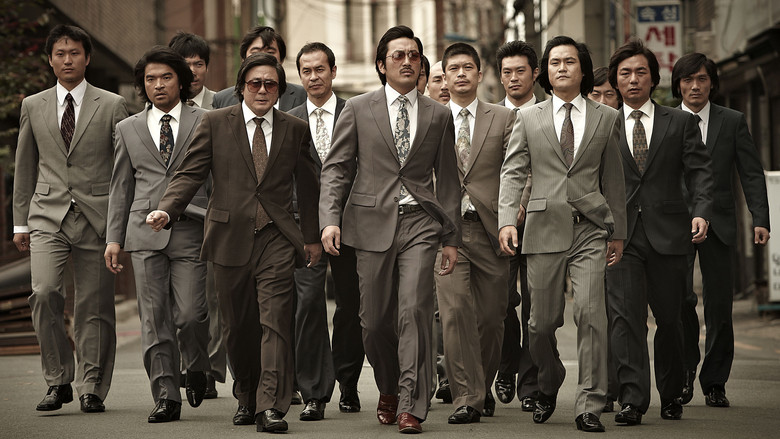
A venomous, sun-baked neo-noir steeped in pathetic desperation and brassy bravado, where opportunistic survivalists navigate shifting tides like predatory chameleons feasting upon the blood-slicked corridors of rapid industrialization.
Nameless Gangster

Nameless Gangster

범죄와의 전쟁

"Power can not be taken alone."

02 February 2012 South Korea 133 min 6.9 (195)

Director: Yoon Jong-bin

Cast: Choi Min-sik, Ha Jung-woo, Kwak Do-won, Don Lee, Kim Sung-kyun

Crime Thriller Bloodline, Clan Networks, and Social Collusion Opportunism and the Nature of the 'Bandal' The Interdependence of State and Underworld Power Paternal Duty as a Moral Shield
Budget: $125,000

Overview

Set against the rapid economic transformation and political turbulence of 1980s South Korea, Nameless Gangster: Rules of the Time traces the meteoric rise and moral descent of Choi Ik-hyun (Choi Min-sik). Originally an unremarkable, mildly corrupt customs official operating at the port of Busan, Ik-hyun finds himself singled out as the sacrificial lamb during an internal department inspection. While attempting to liquidate a confiscated cache of high-grade heroin on his way out, he brokers a fateful partnership with Choi Hyung-bae (Ha Jung-woo), a ruthless, charismatic young mob boss dominating the Busan underworld.

Upon discovering they are distant kin from the respected Gyeongju Choi clan, Ik-hyun leverages Confucian clan loyalty and patriarchal hierarchy to ingratiate himself into Hyung-bae's criminal empire. Combining Hyung-bae's brutal physical muscle with Ik-hyun's relentless talent for political lobbying, bureaucratic bribery, and social networking, the mismatched duo rapidly wrests control of gambling dens, slot machine parlors, and illicit port smuggling across the city, rising to the zenith of regional power.

However, their unstable alliance frays as Ik-hyun's inflated ego and insatiable ambition clash with the disciplined brutality of underworld codes. When South Korean President Roh Tae-woo officially decrees a nationwide "War on Organized Crime" in the autumn of 1990, law enforcement launches an unprecedented dragnet led by an unyielding, ambitious prosecutor. As loyalties crumble and associates turn on one another, Ik-hyun must deploy every shred of deceit to preserve his skin and ensure his family's future.


Core Meaning

At its core, Nameless Gangster: Rules of the Time is director Yoon Jong-bin's caustic critique of modern South Korean socio-political evolution, examining how corruption, cronyism, and traditional kinship networks (yeongo) formed the foundational bedrock of modern success. By charting the trajectory of a man who is neither an authentic gangster nor an honest civilian—a creature known colloquially as a bandal ("half-gangster")—the film strips romantic mythology away from organized crime and reveals it as an organic byproduct of state authoritarianism and unrestrained capitalism.

Yoon Jong-bin frames Ik-hyun as an emblem of the Korean paternal generation of the 1980s: men driven by ruthless survival instincts who justified bribery, betrayal, and violence under the sacred banner of family duty. The film's ultimate message is deeply ironic and unsettling: in a rigged social hierarchy, it is not the stoic, honorable fighter who endures, but the shameless, slippery opportunist who co-opts the mechanisms of authority to pass down institutional legitimacy to the next generation.

Thematic DNA

Bloodline, Clan Networks, and Social Collusion 30%
Opportunism and the Nature of the 'Bandal' 25%
The Interdependence of State and Underworld Power 25%
Paternal Duty as a Moral Shield 20%

Bloodline, Clan Networks, and Social Collusion

The narrative continuously underscores how traditional Confucian structures, particularly ancestral lineage (the Gyeongju Choi clan), are weaponized as instruments of manipulation and social capital. Ik-hyun repeatedly uses family ties and generational seniority to dismantle legal roadblocks, disarm hostile mobsters, and charm corrupt bureaucrats.

Opportunism and the Nature of the 'Bandal'

Ik-hyun occupies the morally ambiguous gray zone of the bandal—half civilian, half crook. Unable to fight with fists, he wields a rolodex of connections and institutional loopholes. The film demonstrates how modern institutions frequently elevate unscrupulous mediators who operate between legitimate power and illicit violence.

The Interdependence of State and Underworld Power

Rather than portraying criminals and authorities as natural adversaries, the film exposes how politicians, prosecutors, police officers, and crime syndicates feed off each other in the same ecosystem. The state's 1990 "War on Crime" is depicted less as an ideological crusade for moral justice and more as an aggressive reorganization of power and political optics.

Paternal Duty as a Moral Shield

Throughout his criminal maneuvers, Ik-hyun endlessly repeats that all his humiliations and deceits are suffered purely for the sake of his children's prosperity. The film deconstructs the self-serving narrative of patriarchal sacrifice, showing how parental ambition often serves as an excuse to excuse personal greed and cowardice.

Character Analysis

Choi Ik-hyun

Choi Min-sik

Archetype: Antihero / Corrupt Opportunist Key Trait: Chameleonic adaptability, relentless sycophancy, and unyielding self-preservation

Motivation

Driven by an insatiable dread of social obscurity, a thirst for public dignity, and the imperative to secure aristocratic elevation for his children.

Character Arc

Begins as an insecure, corrupt customs inspector facing termination. By embedding himself in Busan's underworld, he amasses immense influence as an indispensable fixer, survives the government crackdown through treacherous betrayal, and retires as a respected patriarch whose lineage successfully enters the elite judicial class.

Choi Hyung-bae

Ha Jung-woo

Archetype: Underworld Boss / Tragic Outlaw Key Trait: Steely composure, magnetic authority, and lethal decisive violence

Motivation

To build an unchallenged criminal empire founded upon strict martial loyalty, respect, and street dominance.

Character Arc

Rises swiftly as the most feared, composed kingpin of Busan's syndicate. Despite his sharp tactical instincts, his reluctant deference to Confucian clan loyalty binds him to Ik-hyun, ultimately leading to his complete downfall and betrayal when the state crackdowns tighten.

All 5 characters and cast

Symbols & Motifs

The Gyeongju Choi Clan Jokbo (Genealogy Book)

Meaning:

Represents the feudal, hierarchical survival mechanism of Korean society. It symbolizes how ancestral traditions and Confucian lineage are reduced to opportunistic tools used to bypass legal standards and demand unearned loyalty.

Context:

Ik-hyun consults and recites his clan lineage when confronting Hyung-bae's father, turning an impending violent beating into a forced formal bow of filial respect.

The Empty, Unloaded Revolver

Meaning:

A symbol of false bravado, superficial power, and performative masculinity. It encapsulates Ik-hyun's essence: a man who projects lethal authority while completely lacking the true violence or inner discipline required to back it up.

Context:

Ik-hyun receives the ornamental handgun as a gift from a Yakuza associate and flaunts it openly in an attempt to intimidate adversaries, despite the cylinder carrying no live ammunition.

The 'One-Billion-Won' Address Book

Meaning:

Symbolizes the intangible yet devastating weapon of bureaucratic connection, bribery, and institutional leverage (inmaek). It stands as a modern weapon more destructive and durable than Hyung-bae's baseball bats and blades.

Context:

Ik-hyun defiantly taps his notebook while interacting with associates and authorities, boastfully declaring that the telephone numbers inscribed inside are worth a billion won.

The Shared Banquet Table and Sobaek Feasts

Meaning:

Symbolizes the backroom diplomacy where Korean economic, legal, and criminal alliances are forged over food and alcohol, blurring the line between civil administration and mafia collusions.

Context:

Numerous pivotal shifts in power—from initial gang alliances to prosecutorial compromises—occur in private dining rooms over heavy dishes, toasts, and subtle exchanges of cash gifts.

Memorable Quotes

살아있네.
— Choi Hyung-bae

Context

Spoken smoothly during moments of triumphant indulgence, savoring high-class food, luxury liquor, and romantic conquests.

Meaning

Literally translating to 'It's alive!' or 'Still got it,' the phrase serves as an arrogant celebration of vitality, swagger, and sensual indulgence, becoming an indelible emblem of the bad guys' golden age.

학생은 공부를 해야 학생이고, 건달은 싸워야 할 때 싸워야 건달입니다.
— Choi Hyung-bae

Context

Delivered firmly to Ik-hyun to rebuke his non-violent, cowardly hesitations regarding syndicate warfare.

Meaning

Draws a stark line of professional ethos, arguing that a gangster's identity and legitimacy are validated exclusively through physical readiness and decisive violent commitment.

All 5 quotes

Philosophical Questions

Can survival achieved through systematic betrayal and humiliation ever be considered an authentic victory?

The film contrasts Hyung-bae's violent yet principled adherence to underworld brotherhood against Ik-hyun's shameless willingness to endure public degradation, crawl on hands and knees, and sell out allies. While Ik-hyun survives and thrives into wealthy old age, his lingering paranoia highlights the psychological rot of a life constructed entirely upon opportunism.

Does society inherently reward the moral conformist, the open rebel, or the parasitical mediator?

By detailing the concept of the bandal ('half-gangster'), the story demonstrates how binary concepts of legality and crime fail to reflect real-world dynamics. The pure gangster is imprisoned and the strict moralist is sidelined, whereas the parasitic mediator who navigates both systems reaps institutional rewards.

How It Ends

Alternative Interpretations

While widely viewed as a gritty crime drama, many critics interpret Nameless Gangster primarily as a sharp generational satire and an allegorical critique of South Korea's rapid capitalist modernization. Under this reading, Ik-hyun's trajectory represents the opportunistic middle-class civilian who, lacking physical strength or technological expertise, leveraged corrupt bureaucratic nepotism and family ties to secure prosperity during the country's boom years.

Full ending explanation

Cultural Impact

Upon its debut in 2012, Nameless Gangster: Rules of the Time became a pivotal touchstone in South Korean cinema, dominating the box office and revitalizing the country's gangster noir genre. Unlike the stylized heroic bloodshed or hyper-stylized action films of previous decades, Yoon Jong-bin introduced a hyper-realistic, sociologically grounded lens that examined the historical collusion between criminal gangs and the authoritarian Fifth Republic.

The film permanently altered Korean comedy and television culture, inspiring countless parody sketches across variety television programs like SNL Korea and Infinite Challenge. The idiom "Sal-a-it-ne" embedded itself into daily conversation as a widespread cultural catchphrase. Internationally, critics praised the film's intricate sociopolitical scope, solidifying Choi Min-sik and Ha Jung-woo as powerhouse leading actors on the global stage.

Audience Reception

The film earned widespread acclaim from both critics and general audiences, drawing praise for its incisive script, authentic period atmosphere, and black comedy. Critics lauded Choi Min-sik's multi-layered performance, successfully rendering an unprincipled, deceitful scoundrel into a strangely empathetic and magnetic figure. Ha Jung-woo's cool, restrained charisma received equal adulation, creating one of the most memorable character pairings in modern Korean cinema.

Minor criticisms noted that the middle act occasionally slows down due to the intricate web of shifting secondary factions and business partnerships. Nevertheless, the overall consensus hailed the film as a definitive masterpiece of Korean neo-noir that rivals classic American crime sagas in psychological depth and social commentary.

Interesting Facts

  • Director Yoon Jong-bin conceived the script by reflecting upon the lifestyle and moral compromises of his late father's generation during South Korea's high-growth 1980s era.
  • Choi Min-sik gained substantial weight and altered his posture to portray the corpulent, desperate, and comically pathetic physical presence of Ik-hyun.
  • The film was a massive domestic commercial blockbuster, capturing over four million admissions at the South Korean box office within its first month of release.
  • Ha Jung-woo's dialogue delivery of 'Sal-a-it-ne' exploded into one of the most famous viral pop culture catchphrases and commercial parodies in South Korea.
  • The film served as the breakout cinematic debut for stage actor Kim Sung-kyun, who earned major acclaim and awards for his chilling portrayal of henchman Park Chang-woo.
  • Western critics frequently likened the film's kinetic narrative rhythm, voiceover, and period soundtrack to Martin Scorsese's mob masterpiece Goodfellas.

Easter Eggs

The English title 'Nameless Gangster' and the 'Daebu' opening title card

Director Yoon Jong-bin intentionally subverts the Italian-American mob tradition; while Coppola's The Godfather celebrates patrician nobility, the Korean term Daebu ('Godfather' / elder of one's grandfather's generation) is assigned to a groveling, cowardly cheat who has no genuine criminal honor.

The 1990 real-world speech by President Roh Tae-woo

The movie incorporates genuine archival aesthetics and political rhetoric surrounding the historical October 13, 1990 declaration of the 'War on Crime,' rooting Ik-hyun's fictional misadventures directly into factual modern history.

Frequently Asked Questions

Explore More About This Movie

Dive deeper into specific aspects of the movie with our detailed analysis pages

Comments (0)

Leave a comment

No comments yet. Be the first to share your thoughts!

Similar Movies