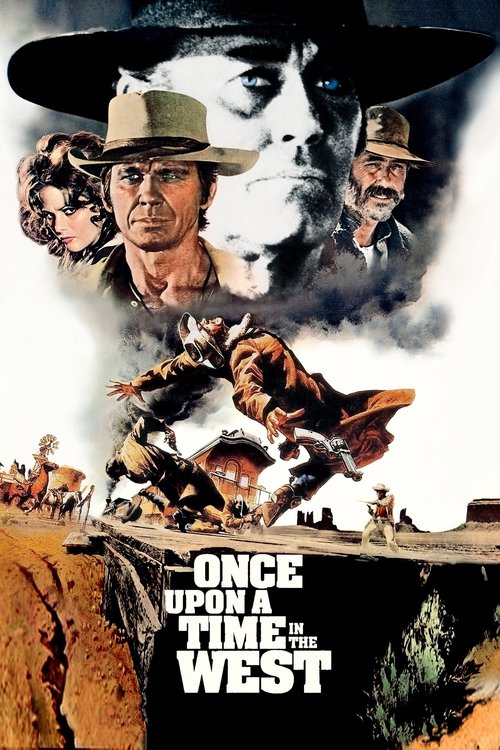
Once Upon a Time in the West
C'era una volta il West
"There were three men in her life. One to take her… one to love her —and one to kill her."
Overview
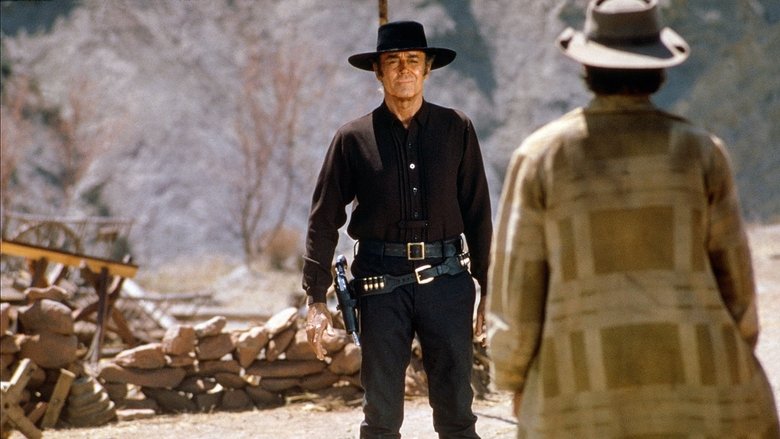
Sergio Leone's epic masterpiece, "Once Upon a Time in the West," unfolds in the fictional Arizona town of Flagstone, where the relentless construction of a railroad signals the end of an era. Jill McBain (Claudia Cardinale), a former prostitute from New Orleans, arrives to start a new life with her husband, Brett McBain, only to discover that he and his children have been brutally murdered. The massacre was orchestrated by the ruthless hired gun, Frank (Henry Fonda), who works for the crippled railroad tycoon, Morton (Gabriele Ferzetti). Morton desires McBain's land, "Sweetwater," which contains the only water source in the region and is crucial for the advancing railroad.
Into this volatile situation ride two enigmatic figures: the mysterious, harmonica-playing stranger known only as "Harmonica" (Charles Bronson), who has a personal vendetta against Frank, and the notorious outlaw Cheyenne (Jason Robards), who has been framed for the McBain murders. Jill, now the owner of the valuable land, finds herself caught in a web of greed, violence, and revenge. She must navigate the treacherous landscape of the changing West, forming uneasy alliances with Harmonica and Cheyenne to protect her inheritance and survive the brutal ambitions of Frank and Morton.
Core Meaning
"Once Upon a Time in the West" serves as an elegy for the American West, exploring the death of the romanticized frontier and the violent birth of modern civilization. Director Sergio Leone deconstructs the myths of the West, portraying it not as a land of heroes and villains, but as a harsh reality where progress, symbolized by the railroad, is achieved through brutality and corruption. The film laments the end of an "ancient race" of gunslingers and outlaws, who are ultimately displaced by the forces of capitalism and industry. It's a meditation on the transition from a world governed by a personal code of honor and violence to one dictated by money and corporate power, suggesting that while the methods may change, the inherent cruelty of human ambition remains.
Thematic DNA
The End of an Era
The film's central theme is the demise of the Old West. This is powerfully symbolized by the relentless advance of the railroad, which represents the encroachment of civilization, technology, and corporate capitalism. The traditional figures of the West—the gunslinger, the outlaw—are portrayed as a dying breed. Characters like Harmonica and Cheyenne are remnants of a bygone era, their skills and codes of honor becoming obsolete in a world increasingly dominated by businessmen like Morton. Frank's desire to transition from a mere gunman to a businessman encapsulates this struggle, though he ultimately cannot escape his violent nature. The film's Italian title, "C'era una volta il West" ("Once upon a time, there was the West"), explicitly frames the story as a look back at something that is gone forever.
Revenge
Revenge is a primary motivator for the film's protagonist, Harmonica. His relentless pursuit of Frank is driven by a traumatic event from his childhood, revealed in a powerful flashback during the final duel. Frank, in a moment of extreme cruelty, forced a young Harmonica to play the harmonica while his own brother was being hanged, the instrument becoming a permanent symbol of his quest for vengeance. This deeply personal vendetta contrasts with the more impersonal, economic motives of characters like Morton and Frank, highlighting the clash between the old world of personal honor and the new world of cold, calculated business.
The Nature of Progress
The film critically examines the idea of progress. The railroad, the ultimate symbol of American expansion and modernity, is built on a foundation of violence, murder, and corruption. The character of Morton, a crippled tycoon obsessed with reaching the Pacific Ocean, embodies the relentless and often destructive force of manifest destiny. He believes in the power of money over the gun, yet relies on the brutality of men like Frank to achieve his goals. Leone suggests that "progress" is not a clean or noble endeavor, but a brutal and often amoral process that destroys one way of life to make way for another.
The Role of Women in the West
Jill McBain represents a departure from the typical female character in Westerns. She is not a damsel in distress but a resilient survivor who adapts to her brutal new reality. A former prostitute, she uses her wits and strength to navigate a world dominated by violent men. Ultimately, she is the one who inherits the future, transforming from a victim into the matriarch of the new town of Sweetwater. While Harmonica and Cheyenne represent the departing spirit of the Old West, Jill embodies the foundation of the new civilization, bringing water to the railroad workers and establishing a community. Her journey symbolizes the often-overlooked role of women in the taming and building of the frontier.
Character Analysis
Harmonica
Charles Bronson
Motivation
To avenge the murder of his brother at the hands of Frank. This singular, all-consuming goal has defined his entire life since the traumatic childhood event.
Character Arc
Harmonica is a static character in the sense that his goal is fixed from the beginning: revenge against Frank. He is an almost supernatural force of destiny, an avenging angel whose entire identity is consumed by his past trauma. He acts as a catalyst, disrupting Frank's plans and aiding Jill, but his actions are always subordinate to his primary mission. After fulfilling his vengeance, he has no place in the new world that is being built. He cannot stay with Jill, as he is a relic of the violent past. His arc concludes with him riding away, his purpose fulfilled and his identity effectively erased along with the man he was hunting.
Jill McBain
Claudia Cardinale
Motivation
Initially, her motivation is to start a new life and find domestic happiness with her husband. After his murder, her motivation shifts to survival and, eventually, to fulfilling the potential of the land she has inherited, thereby securing her own independence and future.
Character Arc
Jill undergoes the most significant transformation in the film. She arrives as a naive bride from New Orleans, hoping for a domestic life, only to be thrust into a brutal world of violence and greed. Initially a victim, she quickly learns to adapt and survive. She evolves from a pawn in the games of men into a powerful figure in her own right. By the end, she embraces her late husband's dream, not out of sentimentality, but as a means of securing her own future. She becomes the symbolic mother of the new community, providing the life-giving water that allows civilization to flourish.
Frank
Henry Fonda
Motivation
Frank is motivated by greed and a desire for power. He no longer wants to be a subordinate but a man of wealth and influence, aiming to control the valuable Sweetwater land and become a businessman.
Character Arc
Frank is a ruthless killer who is caught between two worlds: the dying Old West of the gunslinger and the emerging new West of the businessman. His arc is a failed attempt at evolution. He wants to transition from a hired gun to a legitimate tycoon like Morton, but his inherent violence and adherence to the gunslinger's code ultimately prevent this. He is intelligent enough to understand the power of money, but he cannot suppress his nature. His decision to face Harmonica in a final duel, an old-world tradition, rather than simply escaping, seals his fate and proves he is, as he admits, "just a man"—a man of the past.
Cheyenne
Jason Robards
Motivation
Initially, Cheyenne seeks to find and punish the person who framed him for the McBain murders. This evolves into a desire to protect Jill and help her succeed, driven by a chivalrous code and a soft spot for her resilience.
Character Arc
Cheyenne is a notorious bandit who is wrongfully accused of the McBain massacre. His arc involves revealing the honorable man beneath the fearsome reputation. Initially motivated by clearing his name, he develops a protective, almost paternal affection for Jill. He represents a more romanticized version of the outlaw, one with a moral code. Like Harmonica, he is a figure of the Old West who has no place in the coming civilization. His death from a mortal wound inflicted by Morton signifies the end of his way of life. He dies realizing he is not the right man for Jill or the future she represents.
Symbols & Motifs
The Railroad
The railroad is the central symbol of the film, representing the unstoppable march of progress, modernity, and capitalism. It is a destructive force that carves its way through the landscape, displacing the old ways of the West and bringing a new, more corporate form of power and corruption.
The entire plot revolves around the construction of the railroad and the fight for the land and water needed to complete it. Morton, the railroad baron, is physically confined to his train, which serves as his moving seat of power. The final shot of the film shows the railroad tracks being laid at Sweetwater, with Jill providing water to the workers, signifying that the new era has definitively arrived.
The Harmonica
The harmonica is a deeply personal symbol of memory, trauma, and vengeance. It is inextricably linked to Harmonica's past and his singular motivation to kill Frank. Its haunting melody serves as his calling card and a constant reminder of the injustice he suffered.
Harmonica plays the instrument before confronting his enemies. In the film's climax, a flashback reveals that Frank shoved the harmonica into a young Harmonica's mouth as he struggled to support his hanging brother. In their final duel, Harmonica shoves the instrument into Frank's mouth just before killing him, bringing his quest for revenge full circle.
Water
Water symbolizes life, the future, and the foundation of civilization. In the arid landscape of the West, control over water means control over the future. Brett McBain's dream was not just to own land, but to control the water that would give life to a new town.
The McBain ranch, "Sweetwater," is valuable precisely because it has the only reliable water source in the area, which is essential for the steam-powered locomotives. The film ends with Jill, the new owner of Sweetwater, bringing water to the thirsty railroad workers, symbolizing her role as a life-giver and the matriarch of the burgeoning community.
Duster Coats
The long duster coats worn by Frank's gang and by Cheyenne are iconic signifiers of the gunslinger and the outlaw, representing the rugged, dangerous, and transient nature of the figures of the Old West.
Frank's gang is introduced wearing these coats during the McBain massacre. When Frank's men leave behind a piece of a duster to frame Cheyenne, it links the garment directly to the world of outlaws. Harmonica's later comment to Cheyenne, "I saw three of these dusters a short time ago. Inside the dusters, there were three men. Inside the men, there were three bullets," solidifies the duster as the uniform of this "ancient race" of gunmen.
Memorable Quotes
You brought two too many.
— Harmonica
Context:
In the opening sequence, after a long, tense wait, three of Frank's gunmen confront Harmonica at a remote train station. When they point out they have three horses and he has none, one gunman remarks, "Looks like we're shy one horse." Harmonica, knowing a gunfight is inevitable, delivers this cold reply before killing them all.
Meaning:
This iconic line establishes Harmonica's deadly competence and laconic nature in the film's opening scene. It demonstrates his supreme confidence and foreshadows the violent encounter that is about to unfold, where he will single-handedly kill the three gunmen sent to ambush him.
People scare better when they're dying.
— Frank
Context:
Spoken to his employer, Morton, after the massacre of the McBain family. Morton had only instructed Frank to "scare" Brett McBain off his land, not to murder him and his children. Frank's reply is a cold justification for his extreme actions, highlighting the deep rift between Morton's business-oriented approach and Frank's purely violent one.
Meaning:
This chilling line encapsulates Frank's brutal and sadistic philosophy. It reveals his profound understanding of fear and his utter lack of morality. For Frank, violence is not just a tool but the most effective means of communication and control.
How can you trust a man who wears both a belt and suspenders? The man can't even trust his own pants.
— Frank
Context:
Frank says this to Wobbles, an informant, just before deciding to cut ties with him. It's a clever, dismissive insult that demonstrates Frank's attention to detail and his belief that a person's external choices reflect their internal nature.
Meaning:
A darkly humorous and insightful line that reveals Frank's sharp, cynical judgment of character. He sees the combination of belt and suspenders as a sign of profound distrust and unreliability, applying this sartorial observation to the man's moral character.
You know, Jill, you remind me of my mother. She was the biggest whore in Alameda and the finest woman that ever lived.
— Cheyenne
Context:
Cheyenne says this to Jill at the Sweetwater ranch. After initially treating her with suspicion, he comes to admire her strength. This line marks a turning point in their relationship, establishing his protective feelings toward her.
Meaning:
This quote reveals the core of Cheyenne's character: a man who operates by his own moral code, separate from society's judgments. He sees the inherent goodness in Jill despite her past as a prostitute, equating her with his beloved mother. It's a moment of vulnerability that shows his capacity for warmth and respect.
Keep your lovin' brother happy.
— Frank
Context:
In the flashback during the final duel, a younger Frank places a harmonica in a young boy's mouth while the boy struggles to support his older brother, who has a noose around his neck and is standing on the boy's shoulders. Frank utters this line as a final, cruel taunt before the boy collapses, causing his brother's death.
Meaning:
These are the haunting words spoken by Frank that are revealed in the film's climactic flashback. They are the epitome of his sadism, a taunt delivered during an act of unimaginable cruelty that forged Harmonica's entire existence and single-minded quest for revenge.
Philosophical Questions
Is 'progress' inherently violent and destructive?
The film explores this question through the symbolism of the railroad. Its construction, a celebrated icon of American progress and manifest destiny, is shown to be driven by greed, corruption, and murder. The railroad tycoon Morton is a visionary, but his dream is realized through the brutal actions of his hired gun, Frank. Leone presents progress not as a clean, linear advancement but as a chaotic and bloody process that necessitates the destruction of a previous way of life. The film leaves the audience to ponder whether the benefits of civilization can ever be truly separated from the violent means used to achieve it.
Can one escape their fundamental nature?
This question is central to the character of Frank. He aspires to become a businessman, to wield power through wealth rather than just a gun. He sees that the world is changing and tries to adapt. However, his inherent brutality and his identity as a gunslinger constantly undermine his ambitions. He can't resist killing the McBains when simply scaring them would have sufficed, and in the end, he chooses an honorable, old-world duel with Harmonica over the pragmatic, business-like decision to flee. The film suggests that one's core identity is inescapable, and attempts to suppress it are ultimately futile.
What is the role of memory and the past in shaping the present?
Harmonica's character is the living embodiment of the past's inescapable influence. His entire existence is defined by a single, traumatic memory that fuels his quest for revenge. The haunting notes of his harmonica are a constant echo of this past trauma. The film demonstrates that the present is built upon the events of the past, both personally and historically. The final duel is not just a confrontation between two men, but a reckoning with a past crime that has shaped the lives of both. Frank, who has likely killed many, is finally forced to confront the specific consequences of one long-forgotten act of cruelty.
Alternative Interpretations
While the central narrative is straightforward, some elements invite alternative readings. One interpretation posits Harmonica as a supernatural figure, an avenging ghost or an embodiment of destiny rather than just a man seeking revenge. His sudden appearances, minimal dialogue, and singular focus lend him an otherworldly quality. He is less a character and more a force of nature, an agent of karma sent to correct a past wrong. In this reading, his departure at the end is not just him leaving a world where he doesn't belong, but a spirit fading away once its earthly business is concluded.
Another area of discussion is the film's portrayal of Jill McBain. While many see her as a symbol of resilience and the future, some critics have viewed her treatment as misogynistic, arguing that she is repeatedly objectified and subjected to sexual violence or the threat of it by the male protagonists. From this perspective, her ultimate success in building the town is less a feminist triumph and more a survival story within a deeply patriarchal and violent world that Leone, despite her strength, does not fundamentally challenge.
Cultural Impact
"Once Upon a Time in the West" is widely regarded as a cinematic masterpiece and one of the greatest Westerns ever made. Released in 1968, a year of significant social and political upheaval, the film captured a sense of disillusionment and the end of an old order. It fundamentally redefined the Spaghetti Western genre, moving beyond the more cynical but straightforward action of the "Dollars Trilogy" into a more operatic, elegiac, and meditative style. Leone's deliberate pacing, use of extreme close-ups, and the seamless integration of Ennio Morricone's powerful score created a unique, immersive experience.
The film's influence on cinema has been profound and long-lasting. Its deconstruction of Western myths and its morally ambiguous characters paved the way for future revisionist Westerns. Filmmakers such as Quentin Tarantino, Martin Scorsese, and George Lucas have cited Leone and this film as a major influence on their work. The casting of Henry Fonda, a beloved American hero, as a cold-blooded child killer was a shocking and revolutionary move that shattered genre conventions and audience expectations. Though initially a financial failure in the U.S. due to studio cuts, the restored version is now celebrated for its epic scope and artistic ambition, securing its place as a cornerstone of world cinema.
Audience Reception
Upon its initial release, audience reception for "Once Upon a Time in the West" was sharply divided, largely due to the different versions of the film shown. In Europe, the full, uncut version was a massive critical and commercial success, celebrated for its operatic scope and artistic depth. In the United States, however, Paramount Pictures cut approximately 20 minutes from the film, disrupting its deliberate pace and removing key character development, such as Cheyenne's entire introduction. This truncated version was a box office flop and was met with confusion and disappointment by many American viewers and critics who found it slow and baffling. Over time, with the restoration and release of Leone's original cut, the film's reputation has grown immensely. Modern audiences and critics almost universally regard it as a masterpiece, praising its stunning cinematography, Ennio Morricone's iconic score, the complex characters, and the profound thematic depth. It is now considered by many to be Leone's greatest work and one of the best films ever made.
Interesting Facts
- Henry Fonda, known for playing heroic characters, initially turned down the role of the villainous Frank. Director Sergio Leone flew to meet him and convinced him by saying, "Picture this: the camera shows a gunman from the waist down pulling his gun and shooting a running child. The camera tilts up to the gunman's face and... it's Henry Fonda."
- Leone originally wanted to reunite the three stars of "The Good, the Bad and the Ugly" (Clint Eastwood, Lee Van Cleef, and Eli Wallach) for cameo roles as the three gunmen in the opening scene. When Eastwood was unavailable, the idea was scrapped.
- Ennio Morricone composed the film's iconic score before filming began, based on the screenplay. Leone would then play the music on set to help the actors get into character and set the mood for the scenes.
- The first draft of the screenplay, written by Leone, Dario Argento, and Bernardo Bertolucci, was 436 pages long.
- The film was a box office disappointment in the United States, where Paramount cut it down significantly. However, it was a massive success in Europe, particularly in France, where one Paris theater reportedly showed it for two years straight.
- Al Mulock, the actor who played one of the three gunmen in the opening sequence, committed suicide by jumping from his hotel window while still in costume.
- The film was the first Spaghetti Western to be partially shot in the United States, with Leone filming in the iconic Monument Valley, a location famous from John Ford's Westerns.
- The long, dialogue-free opening scene was used by Vince Gilligan as a stylistic reference for directors working on the acclaimed TV series "Breaking Bad".
- Leone was initially reluctant to include a female lead, only agreeing after much convincing from co-writer Bernardo Bertolucci.
Easter Eggs
Numerous visual and thematic references to classic American Westerns.
Leone, a great admirer of the genre, filled the film with homages to the movies that inspired him. For example, the McBain massacre is reminiscent of a similar scene in "The Searchers." The choice to film in Monument Valley is a direct nod to the work of director John Ford. The opening scene with three men waiting for a train is a reference to "High Noon." The film acts as both a tribute to and a deconstruction of the classic Hollywood Western.
The character of the Sheriff, played by Keenan Wynn, is named Sam.
This is likely a reference to director Sam Peckinpah, another master of the Western genre known for his revisionist take on its classic tropes. Robert Ryan was originally offered the role but turned it down for a part in Peckinpah's "The Wild Bunch."
Woody Strode's character uses a sawed-off Winchester rifle.
This is a subtle tribute to the TV series "Wanted: Dead or Alive," where Steve McQueen's character carried a similar signature weapon known as a "Mare's Leg."
⚠️ Spoiler Analysis
Click to reveal detailed analysis with spoilers
Frequently Asked Questions
Explore More About This Movie
Dive deeper into specific aspects of the movie with our detailed analysis pages
Comments (0)
No comments yet. Be the first to share your thoughts!