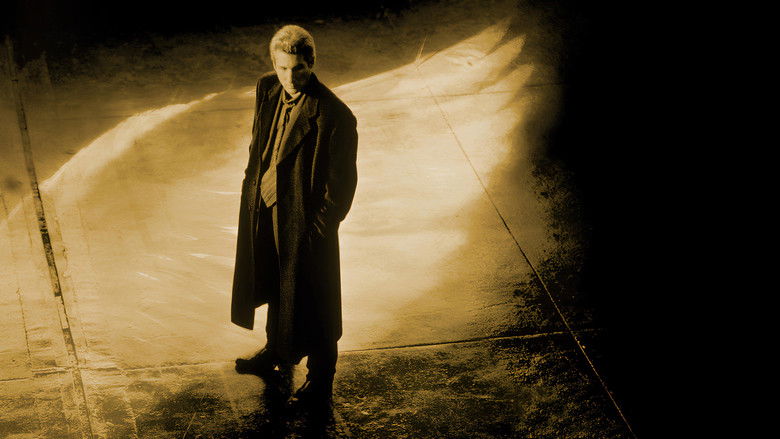
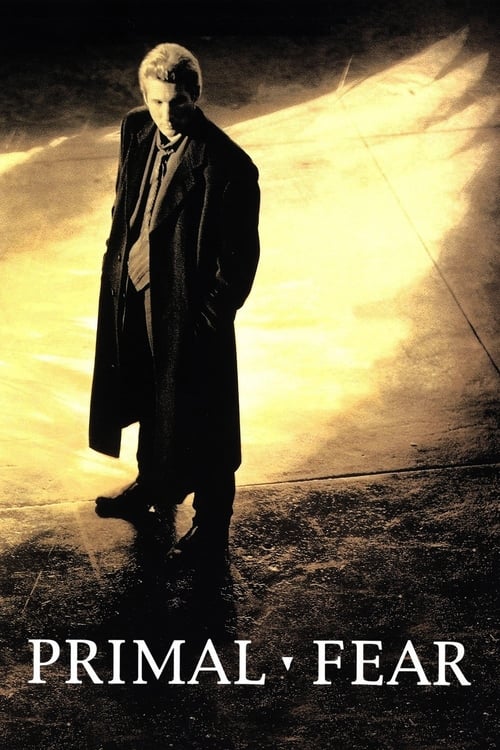
Primal Fear
"Sooner or later, a man who wears two faces forgets which one is real."
Overview
Primal Fear follows Martin Vail, a slick, arrogant, and highly successful Chicago defense attorney who thrives on media attention and legal loopholes. When a beloved and powerful Catholic archbishop is brutally murdered in his residence, the police apprehend a young, blood-soaked altar boy named Aaron Stampler fleeing the scene. Seeing a chance for a high-profile victory, Vail eagerly takes on the case pro bono, determined to prove the seemingly innocent and heavily stuttering teenager's innocence.
As Vail digs deeper into the investigation, he uncovers a shocking underbelly of corruption, dark secrets, and abuse hidden behind the sacred walls of the church. The case takes a profound psychological turn when Aaron's behavior becomes increasingly erratic, leading Vail and a forensic neuropsychologist to suspect the young man might be suffering from severe trauma-induced psychological conditions. What begins as a straightforward pursuit of legal glory transforms into a tense exploration of truth, forcing Vail to question his own cynical beliefs and the very nature of the justice system.
Core Meaning
The core meaning of Primal Fear lies in its cynical deconstruction of truth, justice, and human nature. Director Gregory Hoblit, adapting William Diehl's novel, suggests that the legal system is less about discovering the truth and more about who can spin the most convincing narrative. It acts as a cautionary tale about the blinding nature of arrogance; Martin Vail's unshakeable belief in his own intellect and ability to manipulate the system ultimately makes him the perfect victim of a much darker manipulation. Furthermore, the film explores the terrifying concept that absolute evil can seamlessly hide behind the mask of absolute innocence, challenging the comforting illusion that we can truly know what lies within another person's mind.
Thematic DNA
The Illusion of Justice
The film portrays the American justice system not as a sacred institution of truth, but as a high-stakes game where lawyers gamble with people's lives. Martin Vail explicitly treats the courtroom as a stage for his ego, emphasizing performance and technicalities over objective guilt or innocence, only to have this worldview violently dismantled.
Duality and the Fractured Self
Through the character of Aaron and his aggressive alter-ego Roy, the film deeply explores the duality of human nature. This theme of a split self—the innocent, stuttering victim versus the ruthless, sociopathic survivor—anchors the narrative and forces the audience to confront the psychological masks people wear to navigate trauma and society.
Arrogance and Hubris
Martin Vail's tragic flaw is his unchecked hubris. He operates with a god-complex, believing he is always the smartest person in the room and entirely in control of his clients and the court. His eventual downfall is entirely psychological and moral, brought about by his own blinding ego and desperate need to be the savior.
The Corruption of the Sacred
The film sharply contrasts the holy veneer of the Catholic Church with the horrific, predatory actions of Archbishop Rushman. By exposing the sexual abuses perpetrated by a supposedly righteous figure, the narrative highlights the deep betrayal of trust and the devastating ripple effects of institutional corruption.
Character Analysis
Martin Vail
Richard Gere
Motivation
Initially motivated by ego, media attention, and the thrill of winning unbeatable cases. Later, he is driven by a genuine, albeit misguided, desire to protect a traumatized victim from the death penalty.
Character Arc
Vail begins as a cynical, media-hungry defense attorney who views clients merely as stepping stones for his own fame. Over the course of the trial, he genuinely comes to care for Aaron and believes in his innocence, shedding his detached persona. Ultimately, his arc ends in profound disillusionment and moral defeat when he realizes his newfound empathy was weaponized against him.
Aaron Stampler / Roy
Edward Norton
Motivation
Survival, revenge against his abuser (the Archbishop), and successfully manipulating the legal system to escape imprisonment and the death penalty by faking an insanity plea.
Character Arc
Aaron is introduced as a timid, stuttering, and deeply traumatized altar boy facing the death penalty. As the trial progresses, he seemingly fractures into 'Roy,' a violent, protective sociopathic alter-ego. In the final, chilling twist, his arc completes by shedding the 'Aaron' persona entirely, revealing that the innocent victim never existed and 'Roy' was the true, singular mastermind all along.
Janet Venable
Laura Linney
Motivation
To uphold the law, secure justice for the murdered Archbishop, and prove her professional superiority, especially against her arrogant ex-lover Martin Vail.
Character Arc
As the aggressive prosecuting attorney and Vail's former lover, Janet serves as the voice of the state, determined to secure a death penalty conviction. She remains steadfast in her belief of Aaron's guilt. While she ultimately loses the case due to 'Roy's' courtroom outburst, her initial instincts about Aaron's cold-blooded guilt are proven correct, though she remains unaware of the final twist.
Symbols & Motifs
The Hawthorne Book / B32.156
The catalog code B32.156 references page 156 of Nathaniel Hawthorne's The Scarlet Letter, specifically an underlined quote about wearing one face to himself and another to the multitude. It symbolizes the central theme of duality, hidden sins, and the masks people wear to deceive both the world and themselves.
The quote is discovered in the Archbishop's private reading room, serving as a crucial clue that hints at both the Archbishop's hypocritical, predatory double life and Aaron's ultimate psychological deception.
The Videotape
The sex tape represents the undeniable, ugly truth that cannot be argued away by legal technicalities. It stands as a symbol of ultimate exploitation, the loss of innocence, and the tangible proof of the systemic abuse hidden behind closed doors.
Vail discovers the tape hidden in the Archbishop's residence, which shifts his perspective on the case, providing a motive for the murder and exposing the horrific reality of what Aaron and the other altar boys endured.
Blood-Soaked Altar Boy Clothes
The visual of Aaron in his blood-stained clerical garments juxtaposes the sacred with the profane. It acts as a powerful metaphor for the loss of innocence and how religious sanctuaries can become sites of absolute horror and violence.
This is the initial image presented to the audience and the police as Aaron is chased down and captured immediately following the brutal murder of the Archbishop.
Memorable Quotes
Why gamble with money when you can gamble with people's lives? That was a joke.
— Martin Vail
Context:
Vail says this during a cynical interview with a reporter early in the film, establishing his arrogant and detached persona before the Stampler case breaks him.
Meaning:
This encapsulates Vail's initial, cynical worldview. It highlights the arrogance with which he approaches the justice system, treating the courtroom as his personal playground rather than a place of profound consequence.
So there never... there never was a Roy? ... There never was an Aaron, counselor!
— Martin Vail and Aaron Stampler
Context:
In the final scene in the holding cell, Vail figures out the lie, and Aaron drops the stutter, revealing his true sociopathic nature to a stunned Martin Vail.
Meaning:
This is the devastating climax of the film. It shatters the entire reality of the narrative, revealing the absolute depths of the deception and the complete triumph of the villain over the protagonist.
Do you know what I would do if someone did that to me? I would kill him, I wouldn't hesitate. I would stab him 78 times. I would chop off his fingers, slash his throat open, carve numbers in his chest, gouge out his eyes, I swear to God!... But that's me.
— Janet Venable
Context:
Janet says this to Martin while discussing the horrific sex tape of the Archbishop, temporarily dropping her prosecutor persona to react with raw, human disgust.
Meaning:
This quote serves to underscore the horrific nature of the abuse Aaron suffered, suggesting that a brutal murder is almost a logical, human response to such profound violation, blurring the lines between justice and vengeance.
Philosophical Questions
Is the justice system inherently flawed by its reliance on performance over truth?
The film aggressively questions the adversarial legal system, portraying it as a theater where the most compelling narrative, rather than objective reality, determines the verdict. Vail's manipulation of the jury and Aaron's manipulation of Vail demonstrate how easily justice can be subverted by skilled performers.
Can victims of horrific abuse be held entirely morally responsible for their violent retribution?
Even after the twist reveals Aaron as a calculating killer, the film leaves the audience grappling with the undeniable fact that he was subjected to monstrous sexual abuse by the Archbishop. It asks whether survival instincts and extreme trauma can contextualize, if not entirely justify, absolute brutal violence.
Can we ever truly know the inner mind of another human being?
The terrifying core of the film is the realization that absolute evil can perfectly mimic absolute innocence. It challenges the philosophical assumption that empathy and psychological evaluation can accurately map a person's soul, suggesting some darkness is completely impenetrable and unknowable.
Alternative Interpretations
While the film's twist explicitly states that 'Aaron' never existed and 'Roy' was the true persona all along, some viewers and critics offer a psychological counter-reading. This alternative interpretation posits that Aaron may have initially been a genuinely innocent and frightened boy whose prolonged, horrific abuse at the hands of the Archbishop caused his psyche to permanently fracture as a survival mechanism. In this reading, the cold, calculating 'Roy' completely consumed and destroyed the original 'Aaron' long before the events of the film, meaning the final confession isn't just a sociopath bragging, but the tragic result of a victim who had to become a monster to survive.
Another interpretation focuses on Martin Vail's complicity. Some argue that Vail unconsciously guided Aaron/Roy into forming the Dissociative Identity Disorder defense. Because Vail desperately needed a narrative to save his client, he telegraphed to the manipulative Roy exactly what the psychiatric experts and the court needed to see to grant an insanity plea, making Vail the unwitting architect of his own defeat.
Cultural Impact
Primal Fear stands as a definitive courtroom thriller of the 1990s, a decade renowned for the genre. Its most significant cultural legacy is the launch of Edward Norton's career; his astonishing debut performance as Aaron Stampler earned him an Academy Award nomination, a Golden Globe win, and instantly established him as one of the premier actors of his generation. The film's shocking twist ending has become culturally iconic, frequently cited in discussions of the best cinematic plot twists of all time, alongside The Usual Suspects and The Sixth Sense.
Critically, the film was praised for its tight pacing, Gregory Hoblit's atmospheric direction, and the intense psychological cat-and-mouse game at its center. It effectively tapped into contemporary societal anxieties surrounding institutional corruption, specifically foreshadowing the massive real-world scandals involving sexual abuse within the Catholic Church that would become widely public in the years following the film's release. By blending the legal thriller format with deep psychological horror, Primal Fear left a lasting impact on how Hollywood approaches the unreliable narrator and villain protagonist tropes.
Audience Reception
Audiences and critics alike highly praised Primal Fear, primarily directing their acclaim toward Edward Norton's masterful, chameleon-like performance, which is universally regarded as one of the greatest cinematic debuts in history. Viewers were captivated by the tightly wound plot, the palpable suspense, and the dynamic chemistry between Richard Gere's arrogant lawyer and Norton's seemingly helpless client.
The film's twist ending is frequently highlighted as a major positive, praised for being genuinely surprising yet perfectly set up by earlier clues, leaving viewers with a haunting sense of unease rather than a neat, happy resolution. The main points of criticism generally centered on the film's adherence to certain 90s courtroom tropes and a few predictable subplots, such as the romantic history between Vail and the prosecuting attorney. However, the overwhelming verdict is that Primal Fear is an elite, top-tier psychological thriller that transcends its genre limitations through extraordinary acting and a deeply cynical, unforgettable climax.
Interesting Facts
- Edward Norton was a complete newcomer when he auditioned for the role of Aaron Stampler, beating out 2,100 other actors. He sent in a tape doing both Aaron's and Roy's voices, instantly winning the role.
- The stutter was not originally written for the character of Aaron in William Diehl's novel. Edward Norton decided to add the stutter during his audition to make the character seem more innocent and sympathetic, which won him the part.
- Leonardo DiCaprio was initially offered and strongly considered for the role of Aaron Stampler, but he turned the part down.
- Edward Norton improvised parts of the final conversation, adding spontaneous menace to his performance, and was paid only $25,000 for his debut role, which ultimately earned him an Oscar nomination.
- Richard Gere later remarked that the final scene between Vail and Aaron was one of the most chilling moments he had ever filmed.
Easter Eggs
Nathaniel Hawthorne's 'The Scarlet Letter' Quote
The catalog number B32.156 leads to an underlined passage on page 156 of Hawthorne's classic novel: No man, for any considerable period, can wear one face to himself and another to the multitude without finally getting bewildered as to which may be the true... This directly foreshadows the film's climactic twist regarding Aaron's dual identities and his ultimate deception.
⚠️ Spoiler Analysis
Click to reveal detailed analysis with spoilers
Frequently Asked Questions
Explore More About This Movie
Dive deeper into specific aspects of the movie with our detailed analysis pages
Comments (0)
No comments yet. Be the first to share your thoughts!