Skip to content
Revenger
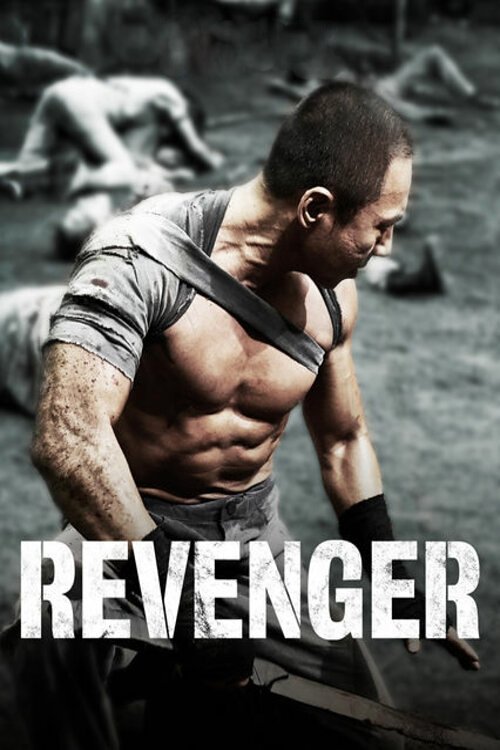
A brutal island-prison revenge thriller where grief hardens into muscle and bone — a silent man walking through a lawless rock in the sea, trading every ounce of his humanity for one last, exhausted act of vengeance.
Revenger

Revenger

리벤져

"Everyone has a plan until they've been hit."

06 December 2018 South Korea 102 min 5.6 (177)

Director: Lee Seung-Won

Cast: Bruce Khan, Park Hee-soon, Yoon Jin-seo, Kim In-kwon, Kim Na-yeon

Crime Action Thriller Vengeance as an emptying-out A world without law Protection versus retribution The body as the last language Complicity and the jailer's guilt

Overview

Revenger (리벤져, 2018) is a South Korean action thriller directed by Lee Seung-won, written by Bruce Khan and Ahn Seung-hwan, and released in Korea on 6 December 2018 before reaching a much wider international audience on Netflix. Its premise is lean to the point of austerity: Kim Yool, a former police detective, has lost his wife and daughter to the reckless violence of gangster Carlos Kuhn. Having hunted down everyone else involved, he has only one name left — and that name belongs to a man now beyond the reach of ordinary law.

Kuhn is serving time on a remote island penitentiary, a dumping ground for criminals so dangerous that the outside world has effectively stopped governing it. Inside, Kuhn has not merely survived; he has taken the place over, ruling it as a private kingdom. To reach him, Yool has to get himself sent there too — walking willingly into a closed system with no guards to appeal to, no exit, and no rules but the ones the strongest inmate writes.

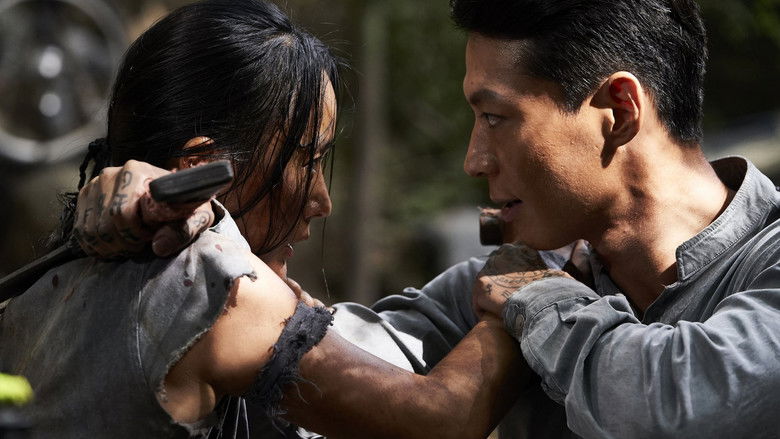
On the island Yool finds that the population is not only predators. There are people simply trying to endure: a fiercely capable woman named Maly, a child under her protection, and a scavenger band led by the unpredictable Bao. What begins as a single-minded errand of vengeance becomes entangled with the question of whether a man emptied out by loss can still be of use to anyone living. The film is built around Khan's own fight choreography, and it moves at the pace of a fist — short scenes, long fights, very little talk.

Core Meaning

At its heart Revenger argues that revenge is not a resolution but a form of self-erasure. Kim Yool has already done the arithmetic of vengeance — everyone responsible is dead except one — and what the film shows us is the man left over after that arithmetic is finished: nearly wordless, functionally already a prisoner before he is sentenced, alive only in the moments he is hitting someone.

The island is the idea made literal. It is what a world looks like when every person in it has decided that force is the only legitimate argument. Kuhn's reign is not an aberration on that rock; it is its logical government. By placing his avenger inside that system, the director asks whether Yool is the cure or simply the most disciplined symptom — whether a man who solves everything with violence can be told apart from the men he is there to punish.

The counterweight is the child and their protector. The film's quiet proposition is that the only thing that actually redeems the capacity for violence is using it for someone who cannot use it themselves. Yool's real arc is not from grief to satisfaction — vengeance gives him no satisfaction — but from a man avenging a dead family to a man briefly, dangerously useful to a living one.

Thematic DNA

Vengeance as an emptying-out 30%
A world without law 22%
Protection versus retribution 20%
The body as the last language 16%
Complicity and the jailer's guilt 12%

Vengeance as an emptying-out

Yool arrives at the story already at the end of a revenge narrative — he has killed everyone else — which lets the film skip the seduction of vengeance and show only its residue. He barely speaks, owns nothing, and has arranged his own imprisonment as a delivery mechanism for a single act. The film repeatedly frames his violence not as catharsis but as labour: exhausting, repetitive, and never quite finished, since each body clears the way to another body.

A world without law

The island penitentiary is a state of nature with a fence around it. Because society has exiled its worst and then stopped looking, Carlos Kuhn is able to convert a prison into a fiefdom — proof that removing law does not remove government, it just hands government to whoever is most willing to hurt people. The scavenger bands, the tribute economy, and the casual disposability of the weak all extend the idea: this is what remains when punishment replaces justice.

Protection versus retribution

Maly and the child she guards represent the film's alternative use for a body trained to fight. Her hostility toward Yool — he is implicated in her being on the island at all — only softens when his violence is spent on saving the child rather than on satisfying himself. The film draws a hard line between the man who kills for the dead and the man who kills for the living, and locates whatever grace it has on the second side of that line.

The body as the last language

Khan's near-silent performance makes martial arts the film's primary dialogue. Character is expressed through fighting style: Yool's economical, short, powerful strikes against Kuhn's henchmen's swarming brutality. Where a conventional thriller would give a grieving father monologues, Revenger gives him choreography, and every exchange of blows functions as an argument about who these people are.

Complicity and the jailer's guilt

Yool is not an innocent visitor to this hell — as a detective he helped populate it, and Maly's resentment makes that explicit. The film quietly implicates the enforcer in the system he enforced, suggesting that the man who sends people to the island and the man sentenced to it are separated by paperwork rather than by nature.

Character Analysis

Kim Yool

Bruce Khan

Archetype: Antihero / avenging wanderer Key Trait: Near-total silence backed by devastating, economical physical skill

Motivation

To kill Carlos Kuhn, the gangster responsible for the deaths of his wife and daughter; later, to keep a living child from becoming another body on the island.

Character Arc

Begins as a former detective who has already methodically killed everyone connected to his family's murder except its author, and who engineers his own imprisonment to reach the last one. Across the film he is drawn out of pure instrumentality by Maly and the child, shifting from a man executing a plan to a man defending people — without ever quite being redeemed or made whole. He ends the story alive but unplaced, still outside any ordinary world.

Carlos Kuhn

Park Hee-soon

Archetype: Tyrant / dark mirror Key Trait: Burn-scarred and bandaged, ruling through implied violence rather than exertion

Motivation

Absolute dominion over the only territory left to him, and the preservation of a power built entirely on the fear of those around him.

Character Arc

A reckless gangster whose crimes killed Yool's family, imprisoned on the island and, instead of being broken by it, seizing control of it. He does not develop so much as consolidate: each act of the film reveals how completely the prison has become his instrument, until the confrontation he has been waiting for arrives.

All 5 characters and cast

Symbols & Motifs

The island prison itself

Meaning:

An externalised image of Yool's inner state: a closed space he cannot leave, populated entirely by violence, where the only activity available is fighting. It also stands for a society's willingness to discard rather than reform — the problem shipped somewhere it cannot be seen.

Context:

The film's entire second and third acts unfold on the rock. Its isolation is emphasised by the sea on every side and by the total absence of functioning authority; the only way in is to be condemned, and Yool condemns himself deliberately.

Carlos Kuhn's bandages and burn scars

Meaning:

Damage worn as a uniform. The wrappings make the villain look half-mummified — a man already partly dead who has turned his ruin into an emblem of power, and a mirror for Yool, who is also visibly a survivor of something that should have killed him.

Context:

Park Hee-soon plays Kuhn with all-over body burns and wrappings, a look critics singled out as one of the film's most striking images. The bandages hide his face, so his authority is conveyed entirely through posture and stillness.

Maly's bow

Meaning:

Precision and restraint set against the film's dominant mode of close-quarters mauling. A weapon that requires choosing a target at a distance, it marks her as someone who fights for something rather than out of appetite — a guardian's weapon rather than a predator's.

Context:

Yoon Jin-seo's character is defined by her archery, a skill reviewers repeatedly compared to Katniss Everdeen; it is her means of keeping the child alive in a place where everyone else negotiates with their fists.

The child

Meaning:

The future, and the film's only argument against nihilism. Where Yool's daughter is a memory that drives killing, this child is a life that can still be defended — a chance to spend violence forward instead of backward.

Context:

The child's endangerment by Kuhn's men is the hinge that converts Yool from an intruder into an ally and earns Maly's forgiveness.

Silence

Meaning:

Grief that has outlasted its vocabulary. Yool's refusal or inability to speak marks a man who has subtracted everything from himself that is not the mission.

Context:

Khan's protagonist is famously taciturn throughout; exposition is handed to other characters, leaving the hero to communicate almost exclusively through action.

The sea

Meaning:

An impassable boundary between the world of law and the world of appetite — and, in the film's final image, an ambiguous promise of somewhere else.

Context:

The ocean frames the island in wide shots and governs everything about the story's logic: no one escapes, ships arrive on someone else's schedule, and the water is the reason the island's tyranny can exist unobserved.

Philosophical Questions

Can justice exist where law has been withdrawn?

The island is a place society created by removing itself. What fills the vacuum is not anarchy but Carlos Kuhn's rule — a government of pure force. The film lets Yool act as an unlicensed court, and then quietly notes that his verdicts are enforced the same way Kuhn's are. The question it leaves open is whether what Yool delivers is justice or merely a preferable tyranny.

What is left of a person after revenge has consumed everything else?

Yool enters the story with his revenge nearly complete: everyone but one man is already dead. The film therefore studies the aftermath rather than the appetite. His silence, his indifference to imprisonment, his lack of any plan beyond the last killing all suggest that vengeance does not restore a self — it is the thing that spent the self.

Is the man who punishes monsters different in kind from the monsters?

Kuhn is scarred, bandaged, and remade by damage; Yool is hollowed out by it. The film sets them as mirror images and gives Maly the job of testing the difference. Her answer is not philosophical but practical: the distinction shows up only in who the violence is spent on.

Does the one who enforced an unjust system deserve mercy from its victims?

Maly resents Yool because his police work put her where she is. The film does not excuse him; it makes him earn forgiveness through an act that costs him, and even then the forgiveness is specific and conditional rather than absolving. It suggests that complicity is discharged by service to the harmed, not by suffering.

Can violence ever be a form of care?

Every character on the island fights, but the film sorts them by purpose. Maly's bow protects a child; Bao's marauding feeds a band; Kuhn's brutality feeds only itself. Yool's arc moves him from the last category toward the first, and the film's only glimpse of grace occurs when his skill is finally aimed at keeping someone alive.

Alternative Interpretations

The post-credits scene is the film's genuine interpretive battleground. Yool appears in a robe in a dusty, windswept place with structures that are difficult to make out, and reviewers have openly asked whether this is the world beyond the island, his home, or somewhere the ships have carried him. Three readings circulate. The literal one: he escaped, and this is simply life afterwards — a sequel hook. The metaphysical one: the indeterminate, barely legible landscape is not a place at all but an afterlife or purgatory, the destination of a man who died in everything but body long before the final fight. The cyclical one: he has arrived somewhere new that looks a great deal like the last place, implying that a man built for vengeance simply relocates his war.

Full ending explanation

Cultural Impact

Revenger arrived at a specific moment in Korean cinema's relationship with the world. Released theatrically in December 2018 to little fanfare, it found its real audience on Netflix from 15 January, becoming one of the clearer early examples of a modest Korean genre picture reaching a global action-fan constituency it could never have reached in cinemas. Its reputation was built almost entirely by word of mouth among martial arts enthusiasts rather than by critics or festival programmers.

Its significance within Korean film is that it attempts something Korea rarely makes. Korean cinema's international brand in the 2010s was the revenge thriller and the crime drama — psychologically dense, socially angry, and built on suspense rather than on sustained physical combat. A pure martial arts vehicle, driven by a choreographer-star, is closer to Hong Kong or Indonesian tradition. Bruce Khan explicitly framed the project as an attempt to prove that a Korean martial arts film could compete internationally, describing his aim as work that is 'both realistic and pragmatic', and the production's use of both Korean (Apex) and Indonesian (Pirahna) stunt teams makes that ambition structural rather than rhetorical.

The film's lineage is easy to read: Bruce Lee's philosophy of short, fast, powerful striking as filtered through Khan's choreography; the island-arena survival narrative that runs from Battle Royale through The Hunger Games; and the Korean revenge tradition that gave the world Oldboy, though Revenger trades that tradition's moral complexity for velocity. Reception was split rather than dismissive — reviewers consistently praised the fight scenes as excellent and the cinematography as capable while criticising the script, and the film's IMDb user score settled at a middling 5.7. Its most durable cultural effect has been on Khan's own career: at 51 he was established as a late-arriving martial arts titan, and the film became the calling card that carried him into subsequent projects.

Audience Reception

Reception was genuinely divided, and the split falls along a consistent fault line: audiences admired the fighting and dismissed the story. The most widely shared praise went to Bruce Khan's choreography and physical performance — reviewers noted that the fights 'come thick and fast,' hardly pausing for breath, and that Khan's power and technique were the reason to watch. That he was 51 at the time and moving like a man in his twenties became part of the film's word-of-mouth appeal among martial arts fans. Cinematography was also generally credited as competent to good, and Park Hee-soon's bandaged, burn-scarred villain was singled out as a memorable design even by unimpressed critics.

The criticism was blunt. Writers described the screenplay as riddled with holes — one review memorably said you would sink through its plot problems 'faster than a rock thrown off A-101 into the ocean' — and characterised the film as best enjoyed as background entertainment for 'mindless kicking, punching and killing.' The near-silent protagonist frustrated viewers expecting the emotional density of the Korean revenge tradition, and secondary characters, including Bao's marauders, were felt to be sketched rather than developed. The Hunger Games-adjacent island-survival framing struck some as derivative.

The most contested elements were the post-credits scene, which viewers still argue over because it explains nothing and is not clearly located, and the question of what the film was even trying to be. Audiences arriving from Korean thrillers tended to rate it harshly; audiences arriving from Hong Kong and Indonesian action cinema tended to rate it as a solid genre entry. The aggregate result is a middling 5.7 user score on IMDb — a number that conceals two fairly confident and opposite verdicts rather than describing a consensus of mild indifference.

Interesting Facts

  • Bruce Khan, the film's star, co-wrote the story and screenplay with Ahn Seung-hwan and also served as the film's fight choreographer — making the action his authorial signature as much as the director's.
  • Khan was 51 years old when Revenger became his international breakthrough, and reviewers repeatedly noted that he moved on screen like a fighter decades younger.
  • The film was released theatrically in South Korea on 6 December 2018 and then arrived on Netflix on 15 January, which is where the vast majority of its international audience discovered it.
  • The action was executed by a mix of Korean and Indonesian stunt talent, drawing on the Apex Stunt Team and Pirahna Stunts — a cross-border collaboration that reflects the Indonesian influence on modern Asian screen fighting.
  • Khan has cited Bruce Lee as his childhood idol, and Lee's philosophy directly informs his choreography: fast, short, powerful kicks and an emphasis on close-range economy.
  • Khan has articulated a specific aesthetic position on screen combat, saying that 'realism is important in martial arts, but realism can involve artistic elements' and that movement itself can be beautiful.
  • Khan stated his ambition was to make a Korean martial arts film that would be recognised internationally, describing his goal as a martial arts movie that is 'both realistic and pragmatic' — a genre Korea produces far less often than its crime and revenge thrillers.
  • Park Hee-soon's villain was created with extensive all-over burn makeup and bandaging that left him looking almost mummified, a design choice critics singled out even in otherwise negative reviews.
  • The film carries a post-credits scene, which is unusual for a mid-budget Korean action picture and has fuelled ongoing viewer debate about whether a sequel was intended.
  • Critical opinion split sharply along a single line: the fight choreography was widely praised as genuinely excellent, while the screenplay was criticised for plot holes — the film holds a modest 5.7 user rating on IMDb.

Easter Eggs

The post-credits scene showing Yool in a robe in a dusty, windswept landscape

The film's most discussed hidden detail. Viewers cannot place the location — is it the mainland, his home, somewhere the ships took him, or something more metaphorical? — and its sheer ambiguity turns the ending from a closed revenge story into an open question about whether Yool has a life after vengeance, or a sequel hook that was never followed up.

Bruce Khan's fighting style as an homage to Bruce Lee

Khan has openly named Bruce Lee as his childhood idol and built his choreography around Lee's principles of fast, short, powerful kicks. For genre-literate viewers the entire action design reads as a sustained tribute, connecting a 2018 Korean Netflix film back to the foundational figure of martial arts cinema — right down to the performer's chosen professional name.

Maly's bow and the Katniss Everdeen parallel

Multiple reviewers noted that the archer-guardian of a child on a lawless island plays as a deliberate echo of The Hunger Games, situating Revenger within the 2010s wave of survival-arena fiction and signalling that the island is meant to be read as an arena rather than merely a prison.

Indonesian stunt performers in a Korean production

The involvement of Pirahna Stunts alongside Korea's Apex Stunt Team is an in-joke for action fans: it imports the personnel and sensibility of the Indonesian school that produced The Raid, which explains why the island's close-quarters brawls feel closer to Jakarta than to the typical Korean gangster thriller.

Frequently Asked Questions

Explore More About This Movie

Dive deeper into specific aspects of the movie with our detailed analysis pages

Comments (0)

Leave a comment

No comments yet. Be the first to share your thoughts!

Similar Movies