The Great Escape
A thrilling wartime saga of defiance where the human spirit tunnels toward freedom, painted against the grim canvas of captivity.
The Great Escape

The Great Escape

"Put a fence in front of these men... and they'll climb it!"

03 July 1963 United States of America 173 min ⭐ 7.9 (2,692)
Director: John Sturges
Cast: Steve McQueen, James Garner, Richard Attenborough, James Donald, Charles Bronson
Drama War Adventure
Perseverance and Ingenuity The Spirit of Defiance Brotherhood and Sacrifice The Brutal Reality of War
Budget: $4,000,000
Box Office: $11,700,000

Overview

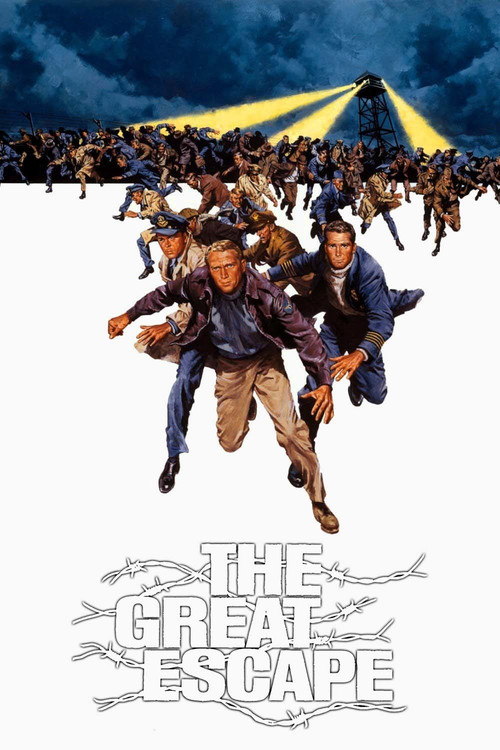
Based on a true story, "The Great Escape" chronicles the ambitious plot of Allied prisoners of war to orchestrate a mass breakout from a supposedly escape-proof German POW camp, Stalag Luft III, during World War II. The camp is specially designed to hold the most persistent and troublesome escapees, bringing together a diverse group of skilled individuals.

Under the leadership of RAF Squadron Leader Roger Bartlett, also known as "Big X," the prisoners pool their talents to execute an audacious plan: digging three tunnels, codenamed "Tom," "Dick," and "Harry," with the goal of freeing 250 men. The film meticulously details their ingenious methods of digging, disposing of dirt, forging documents, and creating civilian disguises, all while under the watchful eyes of their German captors. The narrative builds suspense as they face numerous setbacks and the constant threat of discovery.
Core Meaning

"The Great Escape" is a testament to the indomitable nature of the human spirit and the relentless pursuit of freedom. The director, John Sturges, portrays the prisoners' unwavering determination not just as a desire for personal liberty, but as a continued act of war and defiance against their captors. The film emphasizes that their duty as officers is to escape and, in doing so, divert significant enemy resources to their recapture, thereby aiding the larger war effort. It celebrates ingenuity, camaraderie, and the extraordinary resilience of individuals who, even in the face of overwhelming odds and brutal consequences, refuse to surrender their hope or their dignity.

Thematic DNA

Perseverance and Ingenuity 35%
The Spirit of Defiance 30%
Brotherhood and Sacrifice 25%
The Brutal Reality of War 10%

Perseverance and Ingenuity

The film is a masterclass in showcasing human ingenuity under duress. The prisoners devise brilliant solutions for every obstacle, from creating a ventilation system for the tunnels to forging complex identity papers and tailoring civilian clothing. Their perseverance is relentless; even after one tunnel is discovered, they immediately shift their focus to the next, demonstrating an unbreakable resolve to succeed.

The Spirit of Defiance

More than just an escape plan, the entire operation is an act of psychological warfare. Led by Bartlett, the prisoners' primary goal is to disrupt the German war machine by forcing the enemy to divert massive manpower to hunt them down. This theme of constant harassment and refusal to accept their situation as prisoners underscores a profound spirit of defiance.

Brotherhood and Sacrifice

The escape is a massive collaborative effort, requiring immense trust and teamwork among the prisoners of different nationalities and backgrounds. Each man has a specific role, and their success depends on their ability to work together seamlessly. The theme of sacrifice is poignant, as many men understand they may not make it out, but they contribute to the effort for the greater good of the mission and their fellow soldiers.

The Brutal Reality of War

Despite its adventurous tone, the film does not shy away from the grim realities of war. The lighthearted moments of camaraderie are starkly contrasted with the constant danger and the tragic fates of many escapees. The execution of 50 recaptured prisoners by the Gestapo serves as a brutal reminder of the enemy's cruelty and the high cost of their fight for freedom.

Character Analysis

Captain Virgil Hilts, 'The Cooler King'

Steve McQueen

Archetype: Antihero / Rebel
Key Trait: Incorrigible

Motivation

His primary motivation is an innate, almost compulsive need for freedom and a refusal to be confined. He is driven by a restless, rebellious spirit and a desire to challenge authority at every turn.

Character Arc

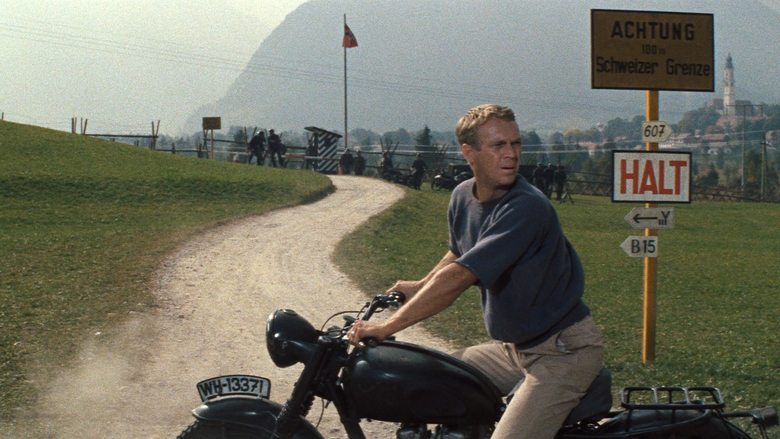
Hilts begins as a lone wolf, constantly attempting individual escapes and showing little interest in organized efforts. His journey is one of reluctant integration into the group. He eventually channels his rebellious energy into a crucial role for the collective escape, undertaking dangerous reconnaissance missions. Though he is ultimately recaptured, his final act of defiance—the iconic motorcycle jump—solidifies his legendary status, and his return to the cooler is not a defeat but a symbol of his unbroken spirit.

Squadron Leader Roger Bartlett, 'Big X'

Richard Attenborough

Archetype: Leader / Mastermind
Key Trait: Strategic

Motivation

As the mastermind, his motivation is strategic and ideological. He aims to cause maximum disruption to the German war effort by forcing them to divert resources to recapture 250 escaped prisoners, viewing the escape as a direct continuation of the war.

Character Arc

Bartlett's arc is defined by his singular, unwavering focus on masterminding the largest escape in military history. He arrives at the camp with a formidable reputation and immediately takes charge. His character remains steadfast and determined throughout, shouldering the immense responsibility for the lives of his men. His arc concludes tragically with his capture and execution, making him a martyr for the cause of defiance he championed.

Flight Lieutenant Robert Hendley, 'The Scrounger'

James Garner

Archetype: The Charmer / Fixer
Key Trait: Resourceful

Motivation

Hendley is motivated by a desire to contribute his unique skills to the cause and to help his comrades. His practical, resourceful nature drives him to solve problems and acquire necessary materials, making the impossible possible for the escape committee.

Character Arc

Hendley is the charming operator who can procure anything the escape effort needs. His arc becomes more personal and compassionate through his friendship with the forger, Colin Blythe. Initially focused on the practicalities of "scrounging," he takes on the profound responsibility of being Colin's eyes when he goes blind. The tragic death of Colin during their escape attempt deeply affects Hendley, marking a shift from a suave operator to a man who has experienced profound loss.

Flight Lieutenant Danny Velinski, 'The Tunnel King'

Charles Bronson

Archetype: The Specialist / The Stoic
Key Trait: Resilient

Motivation

Danny is motivated by a deep-seated sense of duty and a desire to utilize his expertise for the escape. Despite his crippling claustrophobia, his determination to contribute and see the tunnel through to completion is his driving force.

Character Arc

Danny is the expert tunneler, having dug 17 tunnels in previous camps. His primary struggle is with severe claustrophobia, a condition he must constantly fight to perform his crucial role. His arc is one of quiet, internal struggle and immense fortitude. He successfully escapes, one of the very few to do so, representing the triumph of endurance and specialized skill over deep-seated fear.

Flight Lieutenant Colin Blythe, 'The Forger'

Donald Pleasence

Archetype: The Artisan / The Gentle Soul
Key Trait: Meticulous

Motivation

Colin is motivated by a meticulous dedication to his craft and a desire to play his part in the escape. He finds purpose and pride in using his artistic skills to aid his fellow prisoners in their quest for freedom.

Character Arc

Colin is the master forger, responsible for creating the essential documents for the escapees. A mild-mannered bird enthusiast, his arc is one of the most tragic. He gradually loses his eyesight due to the intense, detailed work of forging, rendering him dependent on Hendley. His journey ends in his death shortly after their escape, symbolizing the immense personal sacrifices made by the men for the sake of the mission.

Symbols & Motifs

The Tunnels (Tom, Dick, and Harry)

Meaning:

The tunnels are the most powerful symbol of hope, perseverance, and the prisoners' unyielding desire for freedom. They represent a tangible link to the outside world and the possibility of escape from oppression.

Context:

The meticulous planning, digging, and concealment of the three tunnels form the central plot of the film. Each tunnel's name gives it a distinct personality, and their progress marks the progression of the prisoners' hopes. The discovery of "Tom" is a major setback, while the completion of "Harry" marks the climax of their efforts.

Hilts' Baseball and Glove

Meaning:

Hilts' baseball and glove symbolize his American identity, his individuality, and his persistent, almost casual defiance. His repeated act of throwing the ball against the cooler wall is a solitary act of rebellion, showing that even in isolation, his spirit cannot be broken.

Context:

Throughout the film, especially during his numerous stints in solitary confinement ('the cooler'), Hilts is seen with his baseball and glove. It's a constant companion that underscores his restless energy and his refusal to be mentally imprisoned.

The Cooler

Meaning:

The solitary confinement cell, known as "the cooler," symbolizes the enemy's attempt to break the prisoners' spirits. However, for characters like Hilts, who becomes known as "The Cooler King," it paradoxically becomes a symbol of honor and unbreakable defiance.

Context:

Characters, most notably Hilts, are repeatedly sent to the cooler for their escape attempts and insubordination. Instead of deterring them, it reinforces their status as heroes among the other prisoners and strengthens their resolve.

Memorable Quotes

Colonel Von Luger, it is the sworn duty of all officers to try to escape. If they can't, it is their sworn duty to cause the enemy to use an inordinate number of troops to guard them, and their sworn duty to harass the enemy to the best of their ability.

— Group Captain Ramsey, 'The SBO'

Context:

Spoken by the senior British officer, Ramsey, to the camp Commandant, Colonel von Luger, at the beginning of the film, setting the stage for the conflict and the prisoners' unyielding mindset.

Meaning:

This quote succinctly outlines the prisoners' philosophy and the film's central theme. It establishes that their escape attempts are not just about personal freedom but are a strategic act of war, a duty to continue fighting even while captive.

We have in effect put all our rotten eggs in one basket. And we intend to watch this basket very carefully.

— Colonel von Luger

Context:

Von Luger says this to Ramsey upon the prisoners' arrival, explaining the purpose of Stalag Luft III and expressing his belief that he can contain them.

Meaning:

This line from the Commandant establishes the premise of the film: the Germans have gathered the most notorious Allied escape artists into one high-security camp. It's a statement of confidence that ironically foreshadows the massive, organized escape they will soon face.

Are all American officers so ill-mannered? / Yeah, about 99 percent.

— Colonel von Luger and Captain Hilts

Context:

This conversation takes place during Hilts' first meeting with Von Luger, after Hilts has already made it clear he intends to escape. His cheeky response earns him his first trip to the cooler.

Meaning:

This witty exchange perfectly captures Hilts' rebellious and defiant American character. It highlights the cultural clash between the German sense of order and the American's casual insubordination, establishing Hilts as a key antagonist to the camp authorities.

Philosophical Questions

What is the nature of duty in captivity?

The film explores the idea that for a soldier, the war does not end upon capture. Through Group Captain Ramsey's opening declaration, it posits that it is an officer's sworn duty to not only attempt escape but to actively be a nuisance to the enemy. This raises questions about whether a prisoner's primary duty is to survive or to continue the fight through other means, even at great personal risk. The entire escape is framed not as a bid for personal freedom, but as a strategic military operation designed to disrupt the enemy.

Does the success of a defiance lie in the outcome or the act itself?

The escape is ultimately a tactical failure: of the 76 who escape, 73 are recaptured and 50 of them are executed. Only three make it to freedom. This tragic outcome forces the audience to question the meaning of their efforts. The film suggests that the true victory was not in the number who reached safety, but in the audacious act of defiance itself. By proving that even the most secure facility was vulnerable and by forcing the German High Command to divert vast resources, the prisoners achieved their primary objective. The final shot of Hilts returning to the cooler, undaunted, reinforces the idea that the spirit of resistance is a victory in itself.

Alternative Interpretations

While on the surface "The Great Escape" is a straightforward war adventure, some critics have offered alternative readings. One interpretation views the film less as a historical document and more as a celebration of a particular brand of masculinity, emphasizing camaraderie, stoicism, and rebellious individualism, embodied by stars like McQueen and Bronson. The almost complete absence of women focuses the narrative squarely on the dynamics of male bonding and heroism in a high-stakes environment.

Another perspective, noted by critics like Bosley Crowther in 1963, is that the film presents a romanticized and 'Rover Boyish' version of POW life, glossing over the true horrors of war. The tone is often light and adventurous, which could be interpreted as trivializing the grim reality of the prisoners' situation. This interpretation suggests the film functions more as an escapist fantasy than a gritty war drama, choosing entertainment value over a stark depiction of the inhumanity of the conflict.

Cultural Impact

"The Great Escape" became one of the highest-grossing films of 1963 and has since achieved iconic status, celebrated for its thrilling narrative, memorable score by Elmer Bernstein, and an all-star cast that solidified Steve McQueen as a superstar. It has become a cultural touchstone, particularly in the United Kingdom, where it is a traditional holiday television staple. The film's depiction of Allied defiance and ingenuity captured the public imagination and has influenced countless other prison break and adventure films.

While based on the real escape from Stalag Luft III, the film is a heavily fictionalized account. Most notably, it amplified the role of American prisoners to appeal to US audiences; the actual escape was primarily carried out by British and other Commonwealth airmen. This creative license caused some resentment among British war veterans. Despite these inaccuracies, veterans have acknowledged that the film authentically portrayed many details of camp life and has been instrumental in keeping the memory of the 50 executed airmen alive for a global audience. The iconic motorcycle chase, added at McQueen's request, is considered one of the greatest movie stunts of all time and has been frequently parodied and paid homage to in popular culture.

Audience Reception

Audiences have overwhelmingly praised "The Great Escape" since its release, cementing it as a beloved classic. Viewers consistently laud the film for its thrilling and suspenseful narrative, the spectacular performances from its ensemble cast, and Elmer Bernstein's iconic, rousing musical score. The camaraderie and chemistry among the characters are frequently highlighted as a major strength, making audiences invest deeply in their fates. Steve McQueen's portrayal of the rebellious Hilts and the legendary motorcycle chase are universally celebrated as standout elements.

Criticism from audiences is minimal but occasionally points to the film's lengthy runtime of nearly three hours, which some find to be slow in the first half as the escape is meticulously planned. Some viewers, particularly those with a deeper knowledge of the historical event, criticize the film's historical inaccuracies, especially the exaggerated role of American prisoners. However, for most, the sheer entertainment value and the powerful themes of defiance and perseverance far outweigh these critiques, securing its place as a timeless adventure film.

Interesting Facts

  • Steve McQueen, a keen motorcyclist, performed most of his own riding stunts, but the famous 60-foot barbed-wire fence jump was performed by his friend and stuntman Bud Ekins.
  • Through clever editing, Steve McQueen is actually chasing himself in some parts of the motorcycle sequence. He would dress as a German soldier for some shots pursuing his own character, Hilts.
  • Donald Pleasence, who played the forger Colin Blythe, was a real-life Royal Air Force pilot who was shot down and held in a German POW camp (Stalag Luft I).
  • Charles Bronson, who played the "Tunnel King," suffered from claustrophobia in real life, just like his character, due to his past work in a coal mine.
  • The film is based on a real mass escape from Stalag Luft III, but the significant involvement of American POWs was a fictional addition for the movie. In reality, most Americans had been transferred to another compound months before the escape.
  • James Garner, who played the "Scrounger," drew on his own experiences as a soldier in the Korean War, where he had to be resourceful to get by.
  • The film was shot entirely in Germany, with a life-sized replica of the camp built in a forest clearing near Munich.
  • The barbed wire in the film was made of rubber. The entire cast and crew spent their downtime tying small rubber strings together to create the vast amounts of wire needed for the fences.

⚠️ Spoiler Analysis

Click to reveal detailed analysis with spoilers

Frequently Asked Questions

Explore More About This Movie

Dive deeper into specific aspects of the movie with our detailed analysis pages

Comments (0)

Leave a comment

No comments yet. Be the first to share your thoughts!