Scooby-Doo! Camp Scare
"Back-to-nature chills and thrills!"
Overview
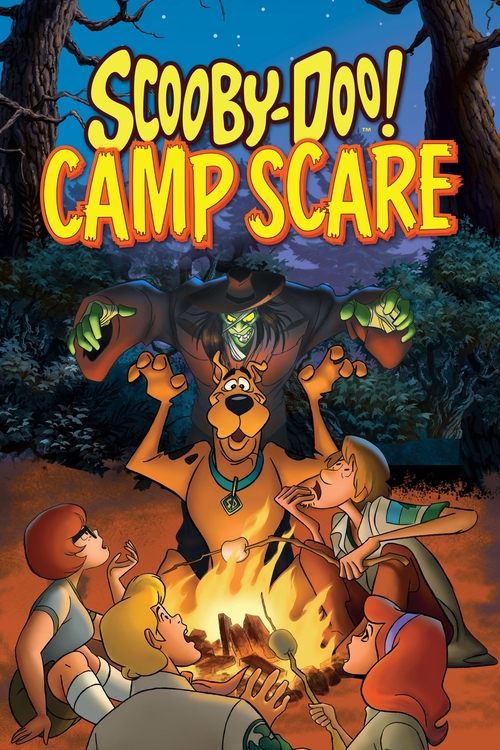
Mystery Inc. travels to Camp Little Moose, Fred's beloved childhood summer camp, so the gang can serve as camp counselors. They arrive to find the camp nearly deserted, except for the head counselor, Burt, and Forest Ranger Knudsen. They learn that a terrifying figure from local campfire legends, the Woodsman, has seemingly come to life, scaring all the original campers away. Despite the danger, Fred convinces Burt to keep the camp open for three new arrivals: Luke, Trudy, and Deacon. The gang's attempt at a normal summer camp experience is quickly thwarted by attacks from not only the Woodsman but also two other local legends: the Fishman at the rival Camp Big Moose Lake, and the Spectre of Shadow Canyon.
As the monsters' attacks intensify and grow more destructive, including the complete demolition of Camp Little Moose, the gang must unravel a complex mystery tied to a submerged town at the bottom of the lake and the hidden treasure of a notorious gangster named Baby Face Boretti. They must work together with the new campers and the head counselor of the rival camp, Jessica, to discover who is behind the masks and why they are so desperate to empty the campgrounds before it's too late.
Core Meaning
Scooby-Doo! Camp Scare explores the theme that greed can drive people to desecrate cherished traditions and endanger innocent lives. The villains are motivated by a hidden treasure, and in their pursuit, they manufacture terror by co-opting local legends, turning places of joy and nostalgia into zones of fear. The film champions the preservation of tradition and community, as exemplified by Fred's passionate efforts to save his childhood camp. It ultimately suggests that the real monsters are not the ghouls from campfire stories but rather humans corrupted by avarice, and that teamwork and a connection to the past are powerful forces to combat such modern-day evils.
Thematic DNA
Greed vs. Tradition
The central conflict is driven by the villains' greed for a hidden treasure, which directly threatens the existence of Camp Little Moose, a place of cherished memories and tradition for Fred. The antagonists exploit local legends, twisting cultural heritage into tools of fear for personal gain. This theme is embodied in the contrast between the rustic, tradition-rich Camp Little Moose and the modern, luxurious Camp Big Moose, highlighting a tension between preserving the past and exploiting resources for profit.
Facing Fear
The film uses the classic summer camp setting, a place synonymous with ghost stories, to explore how characters confront fear. The monsters—The Woodsman, The Fishman, and The Spectre—are designed to be genuinely intimidating for a younger audience, representing tangible threats. The gang and the young campers must repeatedly overcome their terror to investigate the mystery, demonstrating that courage isn't the absence of fear, but acting in spite of it. Velma also helps the camper Trudy, who is initially scared of the outdoors, to find her own courage.
Teamwork and Mentorship
Assuming the roles of camp counselors, the Mystery Inc. gang acts as mentors to the three young campers. Fred is passionate about passing on camp traditions, and Velma bonds with the tech-savvy but shy Trudy, encouraging her to step out of her comfort zone. The resolution of the mystery relies on the entire group, including the rival camp counselor Jessica, working together, splitting up to cover more ground, and combining their clues to solve the case.
Deception and Disguise
A core element of the Scooby-Doo formula, this theme is particularly layered in Camp Scare. The villains employ multiple monster disguises to create a widespread supernatural threat. More significantly, one of the main villains is himself in disguise, posing as a timid young camper named Deacon to act as an inside man and manipulate the gang. This twist emphasizes that threats can come from where they are least expected, hidden in plain sight.
Character Analysis
Fred Jones
Frank Welker
Motivation
To relive his fondest summer camp memories and pass on the traditions of Camp Little Moose to a new generation of campers, ensuring its legacy continues.
Character Arc
Fred's arc is driven by nostalgia and a desire to preserve tradition. He brings the gang to Camp Little Moose, his childhood haven, and is fiercely protective of it. Initially blinded by his idealized memories, he insists on keeping the camp open despite clear danger. His journey involves moving beyond simple nostalgia to active leadership, mentoring the new campers and devising plans to confront the very real threats to his beloved camp.
Velma Dinkley
Mindy Cohn
Motivation
To logically deconstruct the seemingly supernatural events, uncover the historical truth behind the legends, and solve the complex criminal plot.
Character Arc
Velma serves as the primary investigator, piecing together the historical clues about the sunken town of Moose Creek and the gangster's treasure. Her personal arc involves a brief, and unwanted, romantic subplot with Ranger Knudsen. More importantly, she acts as a mentor to Trudy, a fellow tech-savvy introvert, encouraging her to embrace the camp experience and build confidence.
Daphne Blake
Grey DeLisle
Motivation
To support her friends, protect the young campers, and ensure the group's safety while applying her own skills to solve the mystery.
Character Arc
Daphne displays her resourcefulness and quiet bravery. While initially hesitant about the rustic camp, she quickly adapts. Her arc shows her moving from being 'danger-prone' to actively competent and confrontational, particularly during the underwater fight with the Fishman where she helps Fred. She also shows a brief spark of jealousy towards Jessica, adding a small layer of personal complexity.
Shaggy Rogers
Matthew Lillard
Motivation
To avoid danger at all costs and find the next meal, a motivation that is consistently challenged by the terrifying monsters haunting the camp.
Character Arc
Shaggy follows his classic arc of being driven by fear and hunger. However, Camp Scare allows both him and Scooby moments of genuine bravery, often spurred by the need to protect others or when their own fear is momentarily overcome by adrenaline. Their arc is less about change and more about reinforcing the idea that even the most cowardly can be heroic when the situation demands it.
Deacon / Babyface Boretti
Mark Hamill
Motivation
To find the long-lost treasure of his former cellmate, gangster Ricky LaRue, which is hidden in the sunken town of Moose Creek. He posed as a camper to get the gang to leave so he and his partner could search for it unimpeded.
Character Arc
Deacon's entire character is an act. He presents as a nerdy, timid camper who is afraid of everything, making him seem like an unlikely threat. His arc is the gradual reveal of his true identity as the ruthless gangster Babyface Boretti. The unmasking of his personality, not just a monster costume, is the film's biggest twist, showing a calculated and deceptive villain who exploited the innocence of the camp setting.
Symbols & Motifs
Campfire Stories
The campfire stories represent the power of narrative and tradition. Initially, they are a source of communal fun and spooky entertainment. The villains corrupt this by bringing the legends to life, transforming shared cultural tales into instruments of terror. This symbolizes how stories and traditions can be manipulated for nefarious purposes.
The film opens with a camp counselor telling the legend of the Woodsman. Later, Fred tells the story of the Fishman, and the legend of the Spectre is also recounted. Each of these stories precedes the appearance of the actual monster, forming the basis of the mystery.
The Sunken Town of Moose Creek
The submerged town symbolizes a hidden past and buried secrets. Its discovery is the turning point in the mystery, revealing that the land holds a history far deeper and darker than the camp legends suggest. It is the literal location of the treasure, representing the forgotten source of the villains' greed.
Scooby-Doo first discovers a building at the bottom of Big Moose Lake during an attack by the Fishman. The gang later learns it was a mining town that was flooded to create the dam and lake, and it's where gangster Ricky LaRue's treasure is hidden. The film's climax takes place in the town after the dam is destroyed.
The Woodsman's Axe
The axe is a symbol of tangible and genuine danger. Unlike many Scooby-Doo villains whose tools are theatrical, the Woodsman's axe is presented as a real, sharp weapon. Its repeated use in destructive acts—destroying property and being thrown directly at the characters— elevates the threat level beyond a typical haunting, symbolizing that the stakes in this mystery are potentially lethal.
The Woodsman is seen wielding the axe from his first appearance, where he throws it at a fleeing counselor. He uses it to destroy the camp boathouse and repeatedly throws it near the gang during chases, reinforcing the sense of immediate physical danger.
Memorable Quotes
Burt, if you have any more campfire stories, I'd appreciate it if you keep them to yourself!
— Shaggy Rogers
Context:
Said after one of the early encounters with the Woodsman, as the gang processes the reality that the legends they've been told are now actively trying to harm them.
Meaning:
This line perfectly encapsulates Shaggy's terror and frustration. It's a comedic moment that highlights the core premise of the film: the campfire stories are becoming terrifyingly real, and Shaggy has had enough of the source material.
Wait a minute. How can a lake be haunted?
— Velma Dinkley
Context:
Velma says this in response to Fred telling the spooky legend of the Fishman to try and dissuade the group from going to the rival camp's lake, which he considers a betrayal of Camp Little Moose.
Meaning:
This quote is classic Velma, applying skepticism and logic to a seemingly supernatural claim. It contrasts Fred's dramatic storytelling with her need for a rational explanation, setting up the investigation into the mystery of Big Moose Lake.
The name ain't Deacon, chumps. It's Babyface Boretti.
— Deacon / Babyface Boretti
Context:
After trapping part of the gang in the old jailhouse in the sunken town of Moose Creek, Deacon drops his facade and reveals he is the gangster they've been reading about.
Meaning:
This is the film's major reveal, where the seemingly harmless and nerdy camper exposes his true identity as a hardened criminal. It's a pivotal moment that unmasks the true nature of the conspiracy.
Philosophical Questions
Are manufactured fears based on legends as powerful as tangible, real-world dangers?
The film explores this by presenting both types of threats. The monsters are manufactured fears, costumes and special effects designed to evoke terror based on campfire stories. However, the villains back up these illusions with real danger: a sharp axe, explosions, and the destruction of a dam. This demonstrates that the most effective way to manipulate people is to blend the psychological power of legendary fears with the immediate threat of physical harm, blurring the line between what is a story and what is a genuine danger.
What is the value of preserving tradition in the face of modernization and greed?
Fred's character is the embodiment of this question. His motivation is almost entirely based on the preservation of his nostalgic, positive experiences at Camp Little Moose. The plot's central conflict is a direct assault on this tradition by villains who see the land only for its monetary value. The film's resolution, where the two rival camps merge to create 'Camp Little Big Moose,' suggests a compromise: that tradition can survive and adapt by integrating new elements, rather than being completely erased by modernity.
Alternative Interpretations
While the film's plot is straightforward, some alternative readings are possible. One interpretation views the conflict between Camp Little Moose and Camp Big Moose as a commentary on gentrification and corporate takeover of local traditions. The rustic, community-focused Little Moose is literally being destroyed by a plot motivated by greed, while the sterile, high-tech Big Moose represents a soulless modernization. Fred's passionate defense of Little Moose can be seen as a fight to preserve authentic, local culture against encroaching corporate interests. Another, more subtle interpretation could explore the film's take on fear itself. The villains don't just scare people away; they appropriate and weaponize local folklore. This can be read as a metaphor for how media or powerful interests can twist cultural narratives to manipulate public fear for their own agenda. The post-credits reveal of the real Spectre also suggests a philosophical layer: while human greed is the primary antagonist, the film leaves room for the existence of genuine, unexplained phenomena, implying that the world is more mysterious than even Velma's logic can fully explain.
Cultural Impact
Released in 2010, Scooby-Doo! Camp Scare arrived during a renaissance for the franchise's direct-to-video movies, which were adopting a slightly more mature and cinematic tone. The film is frequently cited by fans as one of the best modern Scooby-Doo movies, often ranked alongside classics like Scooby-Doo on Zombie Island for its effective balance of genuine scares, engaging mystery, and classic humor. It successfully tapped into the cultural nostalgia for 1980s summer camp slasher films, making it enjoyable for adults who grew up with that genre, while remaining appropriate for its core younger audience. The monster designs, particularly the Woodsman, are considered some of the most genuinely frightening in the franchise's history, contributing to the film's reputation for having a higher threat level. Critics and audiences praised its well-constructed plot, high-quality animation, and the clever twist villain voiced by Mark Hamill. Within the Scooby-Doo canon, Camp Scare stands as a prime example of how the classic formula can be adapted to a specific film genre—in this case, the camp slasher—to create a fresh and compelling narrative that respects the franchise's roots.
Audience Reception
Scooby-Doo! Camp Scare is overwhelmingly well-regarded by audiences and is considered a standout among the direct-to-video film series. Fans consistently praise its darker, scarier tone, which pays homage to 80s slasher films while remaining family-friendly. The monster designs, especially the Woodsman, are frequently highlighted as being genuinely creepy and effective. The mystery plot is often described as clever and well-constructed, with the twist revealing Deacon as the gangster Babyface Boretti being a particular point of praise for its surprising nature. The animation quality and voice acting, particularly Mark Hamill's performance, also receive high marks. Criticisms are minor and infrequent but sometimes point out that the plot can feel slightly over-complicated with its three separate monster legends and intricate backstory. Overall, the verdict from audiences is that Camp Scare is a thrilling, fun, and satisfying entry that successfully modernizes the classic Scooby-Doo formula.
Interesting Facts
- The film pays homage to 1980s summer camp slasher films, most notably the 'Friday the 13th' series. A calendar in one of the cabins is even shown to be on Friday the 13th.
- The character of Deacon/Babyface Boretti is voiced by legendary actor Mark Hamill, who is also well-known for voicing The Joker in 'Batman: The Animated Series'.
- The Woodsman monster may have been inspired by the real-life campfire legend of 'Cropsy,' a story that also inspired the 1981 slasher film 'The Burning'.
- This is one of the direct-to-video films considered by fans to have a darker, more serious tone, with villains who pose a credible physical threat, similar to 'Scooby-Doo on Zombie Island'.
- The film features original songs with a 'Beach Boys' feel, which contrasts with the darker, horror-influenced tone of the mystery itself.
- The animation style is consistent with the look of the 'Scooby-Doo! Mystery Incorporated' TV series, which was airing around the same time and shared some of the same producers, like Spike Brandt and Tony Cervone.
- A post-credits scene reveals that the Spectre of Shadow Canyon, unlike the other monsters, is actually a real ghost, leaving a lingering supernatural element after the main mystery is solved.
Easter Eggs
Homage to 'Friday the 13th'
The entire setting and the nature of the Woodsman villain are a direct homage to the classic slasher film series 'Friday the 13th', which features the killer Jason Voorhees haunting a summer camp. The film adopts many horror tropes from the genre, such as chase scenes through the woods and a seemingly unstoppable masked antagonist.
Mystery Incorporated Musical Cue
During the final explanation of the mystery, the musical score briefly incorporates a theme from the 'Scooby-Doo! Mystery Incorporated' television series. This is a nod from composer Robert J. Kral and producers Spike Brandt and Tony Cervone, who worked on both projects.
Dynamite Mistaken for a Candle
The classic cartoon trope of a character mistaking a stick of dynamite for a candle is used in the film. This is a common gag in animation history and a nod to the genre's slapstick roots.
⚠️ Spoiler Analysis
Click to reveal detailed analysis with spoilers
Frequently Asked Questions
Explore More About This Movie
Dive deeper into specific aspects of the movie with our detailed analysis pages
Comments (0)
No comments yet. Be the first to share your thoughts!