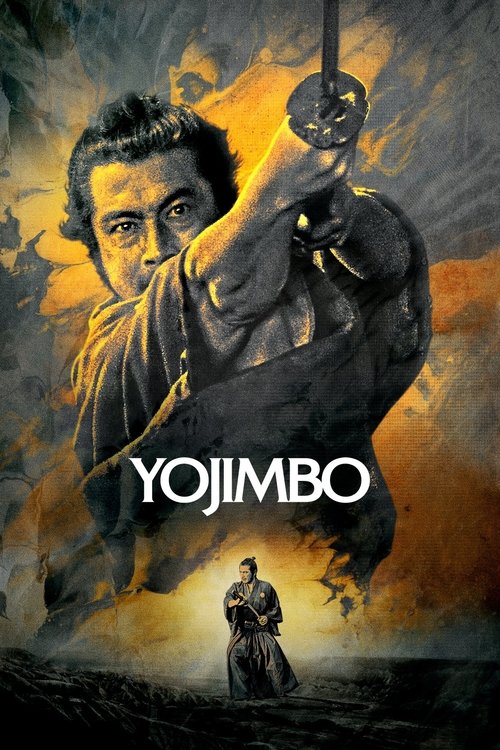
Yojimbo
A ronin's quiet storm of cunning descends upon a dust-choked town, orchestrating a symphony of greed and violence with the sharp edge of his wit and sword.
Yojimbo

Yojimbo

用心棒

"Kill one or a hundred... you only hang once"

25 April 1961 Japan 110 min ⭐ 8.1 (1,582)
Director: Akira Kurosawa
Cast: Toshirō Mifune, Tatsuya Nakadai, Yōko Tsukasa, Isuzu Yamada, Daisuke Katō
Drama Thriller
Corruption and Greed Individualism vs. Society The Anti-Hero and Moral Ambiguity Tradition vs. Modernity

Overview

In 19th-century Japan, a masterless samurai, or ronin, wanders into a desolate town torn apart by two warring gangs. The town's silk merchant, Tazaemon, backs Seibei's gang, while the sake brewer, Tokuemon, supports Ushitora's faction. Introducing himself as Sanjuro Kuwabatake, the ronin decides to profit from the conflict by playing the two sides against each other.

He first demonstrates his formidable skill by effortlessly dispatching some of Ushitora's men, prompting the weaker Seibei to hire him as a bodyguard, or 'yojimbo'. However, Sanjuro's allegiance is fluid. He manipulates both gangs, instigating confrontations and chipping away at their numbers, all while observing the chaos with a cynical amusement from a watchtower. His plans become complicated with the arrival of Unosuke, Ushitora's younger brother, who wields a modern pistol, a significant threat to Sanjuro's traditional swordsmanship.

Core Meaning

At its heart, "Yojimbo" is a cynical yet darkly comedic critique of corruption, greed, and the senselessness of violence. Director Akira Kurosawa uses the lone anti-hero, Sanjuro, as a force of nature to cleanse a town consumed by its own depravity. The film explores themes of individualism versus conformity and the decline of traditional samurai honor in a changing world where money and power have become the new masters. Sanjuro's actions, while morally ambiguous, ultimately bring a brutal form of justice and peace, suggesting that in a world overrun by evil, sometimes the only solution is to let the corrupt destroy each other.

Thematic DNA

Corruption and Greed 35%
Individualism vs. Society 25%
The Anti-Hero and Moral Ambiguity 20%
Tradition vs. Modernity 20%

Corruption and Greed

The film portrays a town entirely consumed by greed. The two rival gangs, led by Seibei and Ushitora, are motivated solely by the desire to control the town's businesses, particularly the gambling trade. The town's officials, the silk merchant and the sake brewer, are complicit, aligning with the gangs to protect their own commercial interests. Sanjuro himself is initially motivated by money, demanding payment for his services as a bodyguard. The only thriving business is the coffin maker, a grim testament to the town's moral decay. Kurosawa presents this corruption as a pervasive sickness, leading to a state of near-total societal breakdown where violence is the only language spoken.

Individualism vs. Society

Sanjuro is the ultimate individualist, a masterless ronin who follows his own code. He stands in stark contrast to the town's inhabitants, who are either part of the mindless, violent gangs or are too cowardly to act. He is a force of chaos, but one guided by his own cunning and a hidden sense of morality. His detachment allows him to manipulate the social structure of the town from the outside, exposing its rotten core. He is a commentary on the power of a single, decisive individual in a corrupt and stagnant society.

The Anti-Hero and Moral Ambiguity

Sanjuro is far from a traditional hero. He is cynical, manipulative, and kills for money. However, he possesses a deeper sense of honor that emerges at crucial moments, such as when he risks his life to save a family that has been wronged by the gangs. He is an anti-hero who uses questionable methods to achieve a greater good, cleaning up the town by exterminating the criminals. This moral ambiguity challenges the clear-cut good-versus-evil narrative often found in the Westerns that influenced the film, making for a more complex and compelling protagonist.

Tradition vs. Modernity

The film is set in 1860, a period of transition in Japan as the age of the samurai was ending and Western influences were beginning to appear. This theme is most powerfully symbolized by the conflict between Sanjuro's sword and Unosuke's pistol. The gun represents a new, impersonal form of violence that threatens the traditional skill and honor of the samurai. Sanjuro's initial fear and eventual outsmarting of the gunman represents a complex commentary on this societal shift, suggesting that intelligence and strategy can overcome technological superiority.

Character Analysis

Sanjuro Kuwabatake

Toshirō Mifune

Archetype: Anti-hero, Trickster
Key Trait: Cunning

Motivation

Initially, Sanjuro's motivation appears to be purely financial gain. He states, 'I'll get paid for killing, and this town is full of people who deserve to die.' However, his actions are also driven by a deep-seated contempt for pathetic people and senseless cruelty, as well as an intellectual pleasure in manipulating the foolish and corrupt gangsters. Ultimately, he is motivated by a personal, unspoken code of honor.

Character Arc

Sanjuro begins as a detached, cynical ronin seemingly motivated only by self-interest and money. As he becomes entangled in the town's affairs, a deeper, albeit rough, sense of justice emerges. He orchestrates the destruction of the gangs, not just for profit, but to eliminate the pervasive evil. His decision to rescue a captive family at great personal risk marks a turning point, revealing the core of honor beneath his hardened exterior. By the end, he has acted as a cleansing force, restoring a brutal kind of peace before wandering off, unchanged in his solitary nature but having affirmed his own hidden moral code.

Unosuke

Tatsuya Nakadai

Archetype: The Shadow, The Modern Villain
Key Trait: Ruthless

Motivation

Unosuke is motivated by a desire for power and control within the gang hierarchy. He enjoys the advantage his pistol gives him, feeling 'naked' without it, and seems to relish the fear and chaos he can create. His primary motivation is to eliminate any threats to his family's dominance, making him Sanjuro's direct antagonist.

Character Arc

Unosuke arrives as a formidable and intelligent threat to Sanjuro's plans. As the younger brother of the gang leader Ushitora, he is shrewder and more dangerous than the other thugs, primarily due to his possession of a pistol. He is the first to suspect Sanjuro's deception. His arc is one of escalating confrontation with Sanjuro, representing a modern, dishonorable form of combat against the samurai's traditional prowess. He remains a cunning and ruthless antagonist until his defeat in the final showdown, where Sanjuro must use his wits to overcome the technological advantage of the gun.

Gonji

Eijirō Tōno

Archetype: The Ally, The Everyman
Key Trait: Moral

Motivation

Gonji is motivated by a desire to see his town freed from the tyranny of the two gangs. He is weary of the violence and longs for a return to peace. His initial advice to Sanjuro is driven by self-preservation, but his conscience and admiration for Sanjuro's actions compel him to help, despite the immense danger.

Character Arc

Gonji, the tavern owner, is one of the few decent people left in the town. Initially, he is cautious and advises Sanjuro to leave for his own safety. As he witnesses Sanjuro's skill and complex motivations, he becomes a reluctant ally and confidant. His arc shows a progression from fearful observer to active participant in resisting the town's corruption. He risks his life to help Sanjuro escape after he is captured and beaten, demonstrating his courage and loyalty. He represents the conscience of the town and serves as a moral anchor for Sanjuro.

Ushitora

Kyū Sazanka

Archetype: The Brute, Rival Villain
Key Trait: Ambitious

Motivation

Ushitora is driven by a simple and direct lust for power. He wants to be the sole ruler of the town's criminal underworld, supplanting his former boss, Seibei. He is aligned with the sake brewer, Tokuemon, to solidify his control over the town's lucrative enterprises. His motivation is pure, uncomplicated greed and ambition.

Character Arc

Ushitora begins as Seibei's former right-hand man who has broken away to form his own rival gang. He is brutish, ambitious, and relies on force. His arc is intertwined with his rival Seibei, as both are manipulated by Sanjuro. Ushitora's power grows when his gun-wielding brother Unosuke arrives, but his reliance on brute force and his failure to see Sanjuro's larger scheme ultimately lead to his downfall. He successfully eliminates Seibei's gang but is then wiped out himself by the returning Sanjuro, demonstrating the futility of his violent ambitions.

Symbols & Motifs

The Wind

Meaning:

The persistent, dust-kicking wind symbolizes the moral emptiness, chaos, and social decay that plague the town. It creates a sense of unease and desolation, reflecting the barren moral landscape.

Context:

The wind is a near-constant presence from the opening shots, blowing dust through the empty main street. It underscores the tension before confrontations and visually represents the turmoil that Sanjuro enters and ultimately stirs up further before cleansing the town.

The Dog with a Human Hand

Meaning:

This gruesome opening image immediately establishes the town's depravity and the complete breakdown of social order. It signifies that life has become cheap and humanity has been discarded.

Context:

As Sanjuro first approaches the town, he sees a dog trotting down the street with a severed human hand in its mouth. This shocking sight informs both Sanjuro and the audience of the extreme level of violence and inhumanity that has become commonplace.

Unosuke's Pistol

Meaning:

The pistol represents the encroachment of modernity and Western influence, a force that threatens the traditional martial honor of the samurai. It is a disruptive technology that changes the rules of combat, making skill and discipline potentially obsolete against a 'cocky idiot with a gun'.

Context:

Unosuke, one of the main antagonists, is the only character with a firearm. His pistol gives him a significant advantage and is the one weapon that visibly gives Sanjuro pause, forcing him to rely on strategy rather than pure swordsmanship to win their final duel.

The Watchtower

Meaning:

The central watchtower symbolizes a position of detachment, observation, and strategic superiority. It is a place from which one can see the bigger picture and manipulate events from above the fray.

Context:

Sanjuro frequently climbs the town's central watchtower to observe the two gangs as they prepare to fight. From this vantage point, he can watch his plans unfold with an amused, god-like perspective, highlighting his intellectual and strategic dominance over the town's foolish inhabitants.

Memorable Quotes

Cooper. Two coffins... No, maybe three.

— Sanjuro Kuwabatake

Context:

After initially being mocked by a group of Seibei's gangsters, Sanjuro demonstrates his skill by killing two of them and severing the arm of a third. He then turns to the stunned coffin maker and places his grimly comic order, cementing his reputation in the town.

Meaning:

This iconic line, delivered calmly after Sanjuro swiftly cuts down several gangsters, perfectly encapsulates his cool detachment, confidence, and the dark humor that pervades the film. It establishes his deadly efficiency and his cynical acceptance of the violence that defines the town.

I'll get paid for killing, and this town is full of people who deserve to die.

— Sanjuro Kuwabatake

Context:

Sanjuro says this to the tavern keeper Gonji, explaining his decision to get involved in the town's gang war. It reveals his cynical worldview and sets up his morally ambiguous plan to pit the two factions against each other.

Meaning:

This quote bluntly states Sanjuro's initial, mercenary justification for staying in the corrupt town. It highlights his anti-hero status; he is not a noble hero on a quest for justice, but a pragmatist who sees an opportunity to profit from cleansing a town of its evil.

Kill one or a hundred. You only hang once.

— Orin

Context:

Orin says this to her husband Seibei while they are plotting, urging him to be decisive and ruthless in his actions against Ushitora. It shows that she is one of the driving forces behind the conflict.

Meaning:

Spoken by Seibei's ambitious and ruthless wife, this line reveals the absolute moral bankruptcy of the town's leaders. It's a pragmatic and chilling expression of the idea that once a line has been crossed, the scale of the crime becomes irrelevant.

Now we'll have some peace and quiet in this town.

— Sanjuro Kuwabatake

Context:

After the final showdown where he eliminates Ushitora, Unosuke, and the rest of their gang, Sanjuro surveys the carnage. Before departing, he utters this line to the terrified but surviving townspeople, leaving them with a brutally clean slate.

Meaning:

This is Sanjuro's final assessment of his handiwork, delivered with heavy irony as he stands in a street littered with the corpses of the gangsters he has just killed. It underscores the film's cynical take on peace, suggesting that sometimes the only way to achieve it is through total annihilation of the corrupt elements.

Philosophical Questions

In a world consumed by corruption, is it necessary to become a monster to fight monsters?

The film explores this question through its protagonist, Sanjuro. He is not a righteous hero; he is a cynical, violent, and manipulative man who adopts the avarice of the gangsters to defeat them. Kurosawa seems to suggest that in a society where evil is irrational and all-encompassing, conventional morality is ineffective. Sanjuro's success comes from his ability to be more cunning and ruthless than his enemies, fighting fire with fire. The film leaves the audience to ponder whether his methods are justified by the outcome—a peaceful town, albeit one paved with corpses.

What is the nature of honor in a lawless world?

Sanjuro is a ronin, a masterless samurai, representing a break from the traditional bushido code of loyalty. He operates on his own terms, creating a personal and situational code of honor. He is willing to kill for money but also risks everything to save an innocent family, an act that brings him no material gain. The film questions whether honor is an external code to be followed or an internal moral compass that guides action even amidst chaos and moral decay. Sanjuro's honor is not about loyalty to a lord, but about a personal intolerance for cruelty and exploitation.

Does the end justify the means?

Sanjuro's entire plan is built on deception, manipulation, and inciting violence, leading to the deaths of dozens of people. The end result is the liberation of the town from tyrannical gangs. The film doesn't offer a simple answer. It presents the brutal calculus of the situation: the town was already destroying itself, and Sanjuro simply accelerated the process to bring about a conclusion. The final shot of him walking away from the 'peaceful' town forces the viewer to confront whether the complete annihilation of evil can be considered a truly positive outcome, especially given the methods employed.

Alternative Interpretations

While often seen as a straightforward, if cynical, action film, "Yojimbo" invites several alternative readings. One prominent interpretation views the film as an allegory for the destructive nature of capitalism. In this reading, the two gangs represent competing commercial interests whose rivalry destroys the town (the market), with Sanjuro acting as a disruptive outside force that brings about the collapse of the corrupt system. The town's conflict originates from a dispute between a silk merchant and a sake brewer, grounding the violence in commerce.

Another interpretation views Sanjuro not as a human character but as a supernatural entity or a personification of fate. Stephen Prince suggests he can be seen as a "marebito," a wandering spirit from Japanese folklore who brings blessings if treated well and destruction if not. This reading is supported by his mysterious appearance, his almost superhuman abilities, and the way he seems to act as a force of nature, cleansing the town before vanishing as enigmatically as he arrived. His name is an alias, he has no past, and he functions less as a person and more as a catalyst for the town's self-destruction.

Cultural Impact

"Yojimbo" had a profound and lasting impact on global cinema, reshaping both the samurai genre and influencing the creation of new ones. Released in 1961, it arrived as the Japanese studio system was changing and Kurosawa himself was feeling 'fed up with the world of Yakuza.' He channeled this frustration into creating a new kind of samurai film, one that was cynical, darkly humorous, and featured a morally ambiguous anti-hero rather than a noble warrior. This departure from traditional jidaigeki (period dramas) was a sensation in Japan and resonated internationally.

Its most significant influence was on the Western. Kurosawa, himself an admirer of John Ford's Westerns, created a film that was in turn remade as Sergio Leone's "A Fistful of Dollars" (1964). This unauthorized remake directly lifted "Yojimbo's" plot and established the 'Spaghetti Western' genre, launching Clint Eastwood's 'Man with No Name' persona, a character directly descended from Toshiro Mifune's Sanjuro. This cross-pollination of genres, from American Western to Japanese samurai film and back to the Italian Western, is a unique moment in film history. The film's blend of high-art visual composition and accessible, entertaining action set a new standard and demonstrated the universal appeal of its core narrative, which has been imitated and paid homage to in countless films, television shows, and video games since.

Audience Reception

Upon its release, "Yojimbo" was a major commercial success in Japan and received highly positive reviews from critics. Audiences were drawn to its exciting blend of action, dark comedy, and satire, as well as Toshiro Mifune's iconic performance as the gruff, witty anti-hero Sanjuro. It is often cited as one of Kurosawa's most accessible and entertaining films. Critics praised its masterful direction, innovative widescreen cinematography, and its clever subversion of samurai and Western film tropes. While some noted its cynical tone and violence, the overall reception was that it was a brilliantly crafted piece of entertainment with surprising thematic depth. Its popularity has endured, and it is widely regarded today as a masterpiece and one of the greatest films ever made.

Interesting Facts

  • The name Sanjuro Kuwabatake, which the ronin gives himself, is an invention. He glances at a mulberry field ('Kuwabatake') and states his age is around thirty ('Sanjuro').
  • Director Akira Kurosawa was heavily influenced by American Westerns, particularly those of John Ford. The film, in turn, became a major inspiration for the Spaghetti Western genre.
  • The film is an uncredited adaptation of Dashiell Hammett's 1929 novel "Red Harvest," with some scenes also borrowed from his 1931 novel "The Glass Key."
  • Kurosawa instructed actor Toshiro Mifune to model his character's physicality on that of a wolf or a dog, while Tatsuya Nakadai (Unosuke) was told to act like a snake.
  • The massive amount of dust seen swirling through the town was not natural; it was imported by the truckload from a firing range to enhance the desolate, Western-like atmosphere.
  • The film's composer, Masaru Sato, was reportedly given only one week to write the entire musical score.
  • The sequel, "Sanjuro" (1962), was originally a different story but was altered after the success of "Yojimbo" to feature the same iconic ronin character.

Easter Eggs

The film was famously and unofficially remade by Sergio Leone as the 1964 Spaghetti Western "A Fistful of Dollars," starring Clint Eastwood as 'The Man with No Name.'

Leone's film copies "Yojimbo"'s plot and characters so closely—in some cases, almost shot-for-shot—that Kurosawa's production company, Toho, successfully sued Leone. Kurosawa reportedly wrote to Leone, saying, "It is a very fine film, but it is my film." The lawsuit settlement gave Kurosawa and Toho 15% of the worldwide gross of "A Fistful of Dollars" and exclusive distribution rights in Japan, Taiwan, and South Korea, which ironically made Kurosawa more money from Leone's remake than he did from his own original film.

An inside joke regarding Kurosawa's casting history is present in the film.

The actor Susumu Fujita plays Homma, the cowardly fencing instructor who is quickly dismissed and replaced by Sanjuro. Fujita was Kurosawa's first major leading man in the 1940s, before being supplanted by Toshiro Mifune. The scene where Homma is cast aside by Sanjuro is a meta-commentary on this real-life shift in Kurosawa's go-to leading actors.

The film's plot and archetypes have influenced numerous other works.

Beyond its direct remake, "Yojimbo"'s story of a lone warrior playing two factions against each other has been reused in films like "Last Man Standing" (1996) with Bruce Willis and has influenced stories in various media, from the TV series "Star Wars: The Clone Wars" to video games like "Final Fantasy X," which features a summonable character (Aeon) named Yojimbo who must be paid to fight.

⚠️ Spoiler Analysis

Click to reveal detailed analysis with spoilers

Frequently Asked Questions

Explore More About This Movie

Dive deeper into specific aspects of the movie with our detailed analysis pages

Comments (0)

Leave a comment

No comments yet. Be the first to share your thoughts!