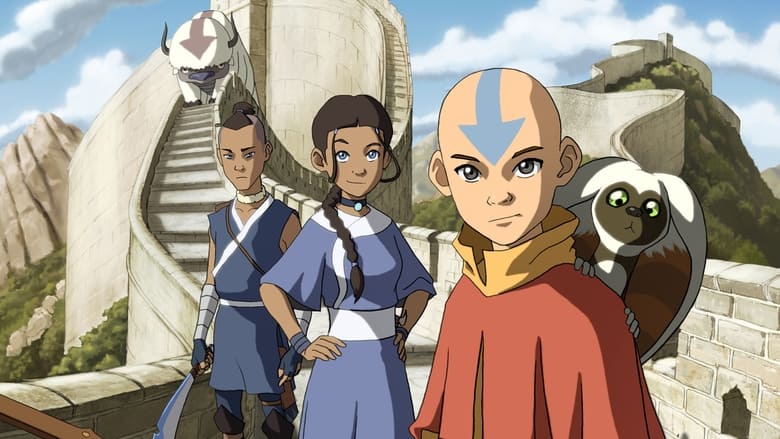
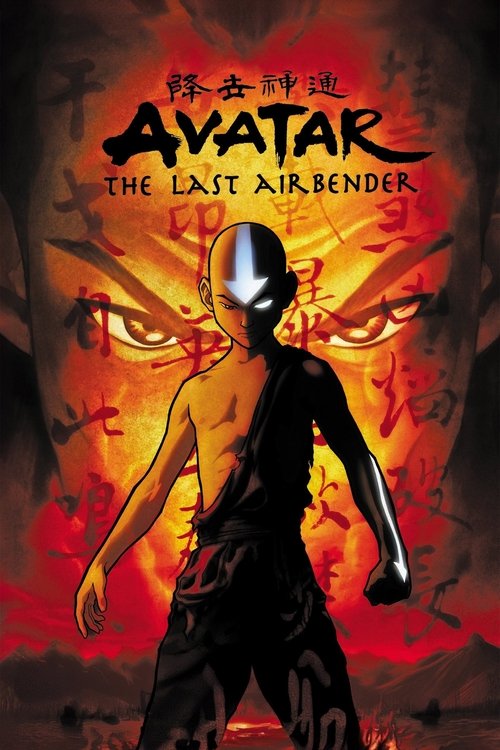
Avatar: The Last Airbender
"Fire. Air. Water. Earth"
Overview
Avatar: The Last Airbender is set in a world divided into four nations, each corresponding to one of the four elements: the Water Tribes, the Earth Kingdom, the Fire Nation, and the Air Nomads. Within each nation, certain individuals known as "benders" can manipulate their native element. The Avatar is the only being capable of bending all four elements, serving as the bridge between the physical and spirit worlds and maintaining harmony among the nations.
The series begins when two siblings from the Southern Water Tribe, Katara and Sokka, discover a twelve-year-old boy named Aang frozen in an iceberg. They soon learn that Aang is the new Avatar and the last of the Air Nomads, who were wiped out a century ago by the Fire Nation at the start of a global war. Now, with his new friends, Aang must embark on a perilous journey to master the remaining three elements—Water, Earth, and Fire—to fulfill his destiny and defeat the tyrannical Fire Lord Ozai, ending the hundred-year war and restoring balance to the world.
Their journey is fraught with challenges, including being relentlessly pursued by the banished and honor-obsessed Prince Zuko of the Fire Nation, who believes capturing the Avatar is his only path to redemption. Along the way, Team Avatar grows, encountering powerful allies and confronting the deep scars the war has left on the world's people and landscapes, forcing Aang to mature from a carefree child into a global leader.
Core Meaning
The core meaning of Avatar: The Last Airbender is a profound exploration of hope, change, and the power of choice in the face of overwhelming adversity. The creators intended to convey that one's destiny is not predetermined by birth or societal expectations, but is instead forged through personal decisions, empathy, and the willingness to change. The series champions the idea that true balance, both internally and externally, comes from understanding and embracing different perspectives. It delves into the complexities of war, showing that there is no inherent evil in any one group of people, but rather that corruption, indoctrination, and the thirst for power can lead anyone astray. Ultimately, the show's message is one of redemptive power, emphasizing that compassion, forgiveness, and the bonds of a found family are the most powerful forces for healing a broken world.
Thematic DNA
War, Imperialism, and Genocide
The series confronts the grim realities of a century-long war initiated by the Fire Nation. It explores themes of imperialism, colonialism, and totalitarianism without shying away from their consequences. The narrative shows the devastating impact of conflict on ordinary people, refugees, and the environment. The genocide of the Air Nomads is a foundational element of the story, forcing the protagonist, Aang, to grapple with immense loss and his role as the last of his kind. The show critically examines propaganda and indoctrination within the Fire Nation, illustrating how a nation can be led into believing in its own supremacy to justify conquest.
Destiny vs. Free Will
A central philosophical question in the series is the conflict between destiny and free will. This is most prominently explored through the character arcs of Aang and Zuko. Aang initially rejects his destiny as the Avatar, preferring the freedom of childhood, but must learn to accept his responsibilities. Conversely, Prince Zuko is obsessed with what he believes is his destiny: capturing the Avatar to restore his honor. His journey is about realizing he has the free will to choose his own path, reject his father's tyrannical ideology, and define his own sense of honor. The series ultimately argues that while people may have predetermined roles, their choices and moral compass define who they truly are.
Redemption and Forgiveness
The possibility of redemption is a cornerstone of the series, embodied by Prince Zuko's character arc, which is often cited as one of the best in television history. His internal struggle between good and evil, and his eventual decision to defy his father and join the Avatar, showcases the message that no one is beyond redemption if they are willing to change. The theme also extends to other characters, like Iroh, who seeks to atone for his past as a Fire Nation general. Forgiveness is portrayed as a difficult but necessary process, seen when Aang struggles with his anger towards the Fire Nation and Katara confronts the man who killed her mother.
Balance and Harmony
The concept of balance is central to the show's mythology and philosophy, drawing from Eastern spiritual traditions. The Avatar's primary role is to maintain balance among the four nations, the four elements, and between the physical and spirit worlds. This theme is explored on multiple levels: the geopolitical balance disrupted by the Fire Nation, the elemental balance Aang must achieve within himself, and the internal, moral balance characters like Zuko strive for. The show suggests that harmony is achieved not through homogeneity, but through the respectful coexistence and interplay of different cultures, philosophies, and even opposing forces.
Character Analysis
Aang
Zach Tyler Eisen
Motivation
Initially, Aang is motivated by a desire for fun, friendship, and a return to the life he lost. As the series progresses, his motivation shifts to protecting his new friends and fulfilling his duty as the Avatar to restore balance to the world. A core, unwavering motivation throughout is his adherence to Air Nomad philosophy, which values all life, forcing him to seek a non-lethal solution to the conflict with Fire Lord Ozai.
Character Arc
Aang begins the series as a fun-loving, carefree 12-year-old boy burdened by a destiny he never wanted. His initial arc is defined by his flight from responsibility, which inadvertently leads to his 100-year preservation in an iceberg. Across the three seasons, he is forced to mature at an accelerated rate, grappling with the genocide of his people, the immense pressures of mastering the elements, and the moral weight of ending a war. He evolves from a playful child who avoids conflict to a fully realized Avatar who faces the Fire Lord, yet holds onto his core pacifist values, ultimately finding a way to defeat his enemy without compromising his spirit.
Zuko
Dante Basco
Motivation
Zuko's initial motivation is singular: restore his honor by capturing the Avatar. This motivation is rooted in a desperate need for his abusive father's acceptance. Over time, this evolves into a complex search for his own identity and purpose. He is eventually motivated by a genuine desire to end the suffering his nation has caused and to forge his own destiny, separate from the legacy of his father.
Character Arc
Zuko's arc is arguably the most complex and celebrated in the series. He starts as the primary antagonist, a bitter and exiled prince obsessed with capturing the Avatar to regain his father's love and his honor. His journey is a tumultuous internal war between his indoctrinated desire for his father's approval and the quiet wisdom of his uncle, Iroh. Through failure, introspection, and witnessing the effects of the war firsthand, he slowly deconstructs the toxic definition of honor he was raised with. His transformation culminates in him rejecting his father, joining Team Avatar, and helping to end the war, finding his true honor in restoring peace and becoming a worthy leader for his nation.
Katara
Mae Whitman
Motivation
Katara's primary motivation is to protect her loved ones and heal the wounds of the world. She is driven by the memory of her mother and a powerful sense of justice. She is also deeply motivated to help Aang fulfill his destiny as the Avatar, often acting as his most steadfast supporter and moral guide. As her powers grow, she is motivated to become a master waterbender to change the course of the war.
Character Arc
Katara begins as a capable but inexperienced waterbender, thrust into a maternal role for her tribe and family after her mother's death. She is the emotional core of the group, driven by immense hope and compassion. Her arc involves honing her powerful bending abilities to become a true master, while also grappling with her deep-seated anger and desire for revenge against the man who killed her mother. She learns to balance her nurturing instincts with her fierce warrior spirit, becoming a moral compass for the team and a force of unwavering strength and hope. Her journey explores the complexities of forgiveness and processing trauma.
Sokka
Jack De Sena
Motivation
Sokka is motivated by a deep desire to protect his tribe, his sister, and his friends. He feels a great responsibility as the oldest male from his village left after the warriors went to war. He is driven to prove his worth as a non-bender in a world of extraordinary abilities, constantly seeking to contribute through his intellect and courage. His love for his friends and his desire to see a peaceful world are his ultimate drivers.
Character Arc
Sokka starts the series as the comic relief, a non-bender who overcompensates with sarcasm and an inflated sense of his abilities as a warrior. His arc is one of maturation and overcoming insecurity. Initially holding sexist views, he is quickly humbled by powerful female warriors like Suki and learns to respect women as equals. Lacking bending, he finds his value in ingenuity, strategy, and leadership, becoming the team's primary tactician. He evolves from a goofy, self-doubting boy into a confident and brilliant leader who can stand proudly alongside the world's most powerful benders.
Iroh
Mako, Greg Baldwin
Motivation
Iroh's primary motivation is to help his nephew, Zuko, find the right path and escape the cycle of anger and pain that defines their family. He sees the good in Zuko and is determined to nurture it. More broadly, he is motivated by a desire for peace and balance in the world, having seen the ultimate futility and sorrow of war. He finds joy and meaning in simple pleasures like tea and Pai Sho, sharing his wisdom with anyone who will listen.
Character Arc
Iroh is introduced as Prince Zuko's lazy, tea-loving uncle, but is quickly revealed to be a wise and powerful firebending master with a tragic past. His arc is one of quiet redemption and guidance. Once a celebrated general known as the "Dragon of the West," he abandoned his conquest of Ba Sing Se after the death of his son, Lu Ten. This loss transformed him, leading him to value peace, spirituality, and inner balance over power and conquest. Throughout the series, he serves as Zuko's moral compass, patiently guiding his nephew towards the light and eventually taking an active role in the war's conclusion as a leader of the White Lotus.
Symbols & Motifs
The Avatar State
The Avatar State symbolizes immense power, spiritual connection, and the weight of history. It represents the ultimate fusion of the current Avatar with the collective knowledge and power of all their past lives. It is a visual metaphor for the immense responsibility on the Avatar's shoulders and the delicate balance between control and destruction.
The Avatar State is activated in moments of extreme emotional distress or mortal danger for Aang. When his eyes and tattoos glow, he can perform incredible feats of bending but is also at his most vulnerable. A major part of Aang's journey is learning to control this state, moving from it being a reactive defense mechanism to a tool he can consciously access, symbolizing his maturation and acceptance of his role.
The White Lotus
The Order of the White Lotus symbolizes wisdom, philosophy, and the unity of different cultures beyond national allegiances. It represents the idea that knowledge, beauty, and a shared commitment to peace and balance can connect people from all four nations, even during a time of global conflict.
Initially appearing as a simple Pai Sho tile, the White Lotus is revealed to be the symbol of a secret, ancient society of which Uncle Iroh is a Grand Master. Members include masters and sages from across the world (King Bumi, Pakku, Jeong Jeong, Piandao). They operate in secret throughout the series, finally revealing themselves in the finale to liberate the city of Ba Sing Se, demonstrating their collective power and vision for a unified world.
Zuko's Scar
Zuko's facial scar is a physical manifestation of his internal pain, shame, and the trauma inflicted by his abusive father, Fire Lord Ozai. It symbolizes his banishment, his obsessive quest for honor, and the internal conflict that defines his character arc.
Received in an Agni Kai (a firebending duel) after he spoke out of turn against a general's plan, the scar is a constant reminder of his perceived dishonor. His journey throughout the series is one of healing this internal wound. As he begins to choose his own path and redefine his honor, the scar, while remaining, no longer defines him. It becomes a symbol of his past suffering and his ultimate resilience.
Appa and Momo
Aang's animal companions, Appa the sky bison and Momo the winged lemur, symbolize the lost Air Nomad culture and the natural world. They are the last known living examples of their species, mirroring Aang's status as the last airbender. They represent innocence, loyalty, and Aang's connection to his past and to all living things.
Appa and Momo are constant companions to Team Avatar, providing transport, comic relief, and emotional support. The episode "Appa's Lost Days" is a powerful exploration of this symbolism, highlighting the cruelty of animal trafficking and the deep emotional bond between Aang and Appa. Their survival is a beacon of hope for the restoration of the world.
Memorable Quotes
Pride is not the opposite of shame, but its source. True humility is the only antidote to shame.
— Iroh
Context:
This line is spoken in Season 2, Episode 9, "Bitter Work." Iroh says this to Zuko while teaching him how to redirect lightning, a technique that requires inner peace and humility. Zuko is struggling with his inner turmoil and shame, and Iroh uses this lesson to guide him spiritually as well as martially.
Meaning:
This quote encapsulates much of Iroh's philosophy and is a direct lesson for Zuko. It argues that arrogance and pride lead to actions one will later be ashamed of. The path to overcoming shame isn't to build oneself up with more pride, but to practice humility, accept one's imperfections, and learn from them.
My first girlfriend turned into the moon.
— Sokka
Context:
Spoken in Season 3, Episode 14, "The Boiling Rock, Part 1." After Zuko shares his own romantic troubles, Sokka offers this line as a strangely comforting, if unrelatable, point of comparison, bringing a moment of levity to a tense situation.
Meaning:
While seemingly a throwaway joke, this quote is a perfect summary of Sokka's character: it's simultaneously hilarious, tragic, and utterly bizarre. It acknowledges the deep personal loss he experienced (Princess Yue sacrificing herself to become the Moon Spirit) while framing it in his signature deadpan, slightly awkward humor.
Sometimes life is like this dark tunnel. You can’t always see the light at the end of the tunnel, but if you just keep moving, you will come to a better place.
— Iroh
Context:
This is said in Season 2, Episode 20, "The Crossroads of Destiny." Iroh and Zuko are fugitives hiding in the catacombs of Ba Sing Se. Aang and Katara find them, and Iroh offers this wisdom to Aang, who is feeling lost and unsure of his path.
Meaning:
A quintessential Iroh quote that offers profound wisdom on perseverance and hope in the face of despair. It's a message that acknowledges hardship and uncertainty but champions the simple, powerful act of moving forward as the key to eventually finding peace and happiness.
The past can be a great teacher.
— Aang
Context:
Aang says this to Zuko in Season 3, Episode 13, "The Firebending Masters." They are about to learn the original source of firebending from the Sun Warriors' civilization, delving into the distant past to correct the corrupt, rage-fueled firebending of the present day.
Meaning:
This quote reflects Aang's journey of accepting his past—including the 100 years he was frozen and the genocide of his people—and learning from it rather than being defined by it. It speaks to the series' broader theme of learning from history, both personal and global, to build a better future.
When we hit our lowest point, we are open to the greatest change.
— Aang
Context:
While this specific line is from The Legend of Korra, the sentiment is demonstrated throughout The Last Airbender. Aang experiences it after learning of the Air Nomad genocide, and Zuko lives it through his banishment and internal struggles. It is a core philosophical tenet of the Avatar universe learned through Aang's experiences in the original series.
Meaning:
This quote, spoken by Aang to Korra in the sequel series but reflective of his own journey, encapsulates the idea that profound transformation often arises from moments of complete despair. It suggests that hitting rock bottom can be a catalyst for rebuilding oneself in a stronger, more enlightened way.
Episode Highlights
The Storm
This episode is a critical turning point for the series, elevating its narrative depth. It masterfully parallels the backstories of Aang and Zuko, revealing why Aang ran away from his destiny and how Zuko received his scar and banishment. It transforms Zuko from a simple villain into a tragic, sympathetic figure and grounds Aang's journey in personal trauma and guilt.
"The Storm" established that the show was not just a children's cartoon but a complex character drama. It laid the emotional groundwork for the intertwined destinies of the hero and the anti-hero, making their eventual convergence more meaningful and highlighting the immense burdens both young boys carry.
The Siege of the North, Part 2
The spectacular finale of the first season showcases a massive battle at the Northern Water Tribe. Key moments include Admiral Zhao killing the Moon Spirit, plunging the world into darkness, and Aang merging with the Ocean Spirit to create a gigantic, vengeful water monster to decimate the Fire Nation fleet. It also features Princess Yue's ultimate sacrifice to restore the Moon Spirit.
This episode demonstrated the epic scale of the series and the immense spiritual power of the Avatar. It was a stunning conclusion to Aang's waterbending training, established the high stakes of the war, and showed that victory often comes at a great personal cost, setting a mature tone for the seasons to follow.
Zuko Alone
In this standalone episode, Zuko, now separated from his uncle, wanders the Earth Kingdom as a refugee. He befriends a young boy and his family, and for the first time, finds a measure of peace. The episode delves into his painful childhood and his complicated relationship with his mother and his cruel sister, Azula. It culminates in him revealing his identity as the Fire Prince to defend the family, only to be rejected by them.
Considered one of the series' best episodes, "Zuko Alone" is a masterclass in character study. It provides crucial insight into Zuko's psyche and motivations, showing that his internal struggle is not just about honor, but about a deep-seated desire for love and acceptance that was denied to him by his family. It powerfully illustrates that his identity is a source of both pride and shame.
The Tales of Ba Sing Se
An anthology episode featuring a series of short vignettes about the main characters' lives within the massive city of Ba Sing Se. The most famous and poignant segment is "The Tale of Iroh," which follows him as he helps various city residents before building a memorial for his deceased son, Lu Ten, on his birthday, tearfully singing "Leaves from the Vine."
This episode provides a beautiful, quiet moment for character development amidst the epic plot. Iroh's segment, in particular, adds incredible emotional depth to his character and is famous for its heart-wrenching tribute to his original voice actor, Mako, who had recently passed away.
The Crossroads of Destiny
The dark and shocking finale of the second season sees all the storylines converge in Ba Sing Se. Aang is mortally wounded by Azula while in the Avatar State, Zuko betrays his uncle to side with his sister, and the seemingly impenetrable city of Ba Sing Se falls to the Fire Nation.
This episode marks the lowest point for the heroes and is a stunning subversion of expectations. It demonstrates Zuko's continued internal conflict and his inability to break free from his past, while also showing the terrifying efficiency of Azula. The fall of Ba Sing Se and Aang's near-death experience completely upend the balance of power, setting a grim stage for the final season.
The Avatar and the Fire Lord
The episode explores the parallel histories of Avatar Roku and Fire Lord Sozin, who began as best friends. Through Aang and Zuko experiencing visions of their respective predecessors' memories, it is revealed how Sozin's ambition and Roku's hesitation led to the start of the Hundred Year War. It also reveals a shocking secret: Zuko is Roku's great-grandson.
This episode is a pivotal moment in the series' mythology and for Zuko's character arc. It reframes the war not just as a conflict between good and evil, but as the result of a broken friendship. The revelation of Zuko's heritage solidifies his internal conflict as a literal battle between the legacies of the Avatar and the Fire Lord raging within him.
Sozin's Comet (Parts 1-4)
The four-part series finale is an epic conclusion to the entire saga. It features multiple climactic battles: Zuko and Katara versus Azula, Sokka, Toph, and Suki against the Fire Nation airship fleet, the Order of the White Lotus liberating Ba Sing Se, and Aang's final confrontation with the super-powered Fire Lord Ozai. Aang struggles with the moral dilemma of killing Ozai, ultimately using a newly-learned ability, energybending, to take away Ozai's firebending powers permanently.
Widely regarded as one of the best series finales of all time, "Sozin's Comet" provides a deeply satisfying resolution to every major character arc and plotline. Aang's final solution is a perfect culmination of his journey, honoring his pacifist beliefs while still finding a way to defeat evil. The episode is a masterwork of animation, storytelling, and emotional payoff, cementing the series' legacy.
Philosophical Questions
Is violence ever justified to achieve peace?
This is the central moral dilemma Aang faces in the finale. Raised as a pacifist Air Nomad who believes all life is sacred, he is told by his past lives and his friends that he must kill Fire Lord Ozai to end the war. The series spends significant time exploring this conflict. Aang seeks alternatives, consulting past Avatars who advocate for decisive, lethal action, and even a giant Lion Turtle who offers a third option. The series presents compelling arguments on both sides: the pragmatic necessity of eliminating a tyrant versus the spiritual cost of taking a life. Aang's ultimate solution—energybending—is a powerful narrative choice that suggests it's possible to defeat evil without compromising one's core principles, though the series acknowledges this is an extraordinary power not available to everyone, leaving the broader question open.
Can one escape the legacy of one's family and nation?
This question is the foundation of Zuko's entire character arc. He is born into a legacy of tyranny and raised to believe his sole purpose is to serve the Fire Nation's imperialist ambitions and earn the approval of his abusive father. His journey is a constant struggle against this indoctrination. The revelation that he is also the great-grandson of Avatar Roku complicates this, showing he has a dual legacy of both great good and great evil. The series explores how Zuko must actively unlearn the toxic lessons of his upbringing and choose to forge a new legacy for himself and his nation, ultimately arguing that while the past is a powerful influence, it does not have to be a prison.
What is the nature of balance in a world of conflict?
The series explores the concept of balance on micro and macro levels. For the Avatar, it's about mastering the four elements, which are often in opposition. For the world, it's about harmony between the four nations. The Fire Nation's war creates a global imbalance by asserting one element's superiority. The show suggests that true balance isn't about the absence of conflict or emotion, but about acknowledging and integrating different forces. Iroh teaches Zuko that firebending's power comes from breath and life, not just rage. Aang must learn to be decisive and powerful (Earth and Fire) to balance his naturally evasive and peaceful nature (Air and Water). The series posits that harmony comes from respecting the distinct but interconnected parts of a whole.
Alternative Interpretations
While the series' primary themes are quite clear, some interpretations offer different lenses through which to view the narrative. One common interpretation reads the story as a spiritual allegory for achieving enlightenment. In this view, Aang represents the divine self, and his journey to master the four elements is a metaphor for mastering the four lower chakras to achieve balance and save the world (the self) from the Fire Nation (the ego). The Fire Nation's aggression, stemming from the solar plexus chakra (seat of the ego), seeks to dominate, while the Avatar's goal is to restore harmony among all centers of being.
Another perspective focuses heavily on the political commentary, viewing the Fire Nation's actions not just as a generic evil but as a direct critique of historical and modern imperialism, drawing parallels to Imperial Japan's actions in World War II. This interpretation sees the series as a powerful anti-colonial and anti-militarist text, examining how propaganda, nationalism, and the suppression of history can fuel generations of conflict. The finale, where Aang removes Ozai's bending rather than killing him, can be interpreted not just as a personal moral victory but as a political statement on the nature of justice, suggesting that restorative justice (disarming the oppressor) is a more enlightened path than retributive justice (execution).
Cultural Impact
Avatar: The Last Airbender premiered in 2005 and is widely regarded as one of the greatest animated series of all time, leaving a significant and lasting cultural footprint. Created during a time when American cartoons were largely episodic comedies, Avatar introduced a generation of young viewers to long-form, serialized storytelling with a definitive ending. Its fusion of American animation with the artistic style and storytelling sensibilities of Japanese anime created a unique and influential visual language.
The series was groundbreaking for its deep and respectful integration of East Asian and Indigenous cultures, philosophies, and aesthetics. From martial arts to spirituality (drawing on Buddhism, Taoism, and Hinduism), architecture, and clothing, the show's world-building was meticulously researched, offering a level of cultural representation rarely seen in Western media. This approach resonated strongly with audiences and set a new standard for fantasy world creation.
Critically acclaimed from its debut, the series was lauded for tackling mature and complex themes—such as war, genocide, imperialism, propaganda, destiny, and redemption—with nuance and sincerity, making them accessible to a younger audience without sacrificing depth. This thematic complexity has given the show enduring relevance, with its popularity surging again upon its arrival on Netflix in 2020, where it found a massive new audience and captivated the original fans, now young adults. Its legacy includes a successful sequel series, The Legend of Korra, an ongoing series of graphic novels, and multiple live-action adaptations, demonstrating its power as a beloved and enduring franchise that has influenced a generation of creators and fans.
Audience Reception
Avatar: The Last Airbender received universal acclaim from audiences upon its release and has maintained a remarkably positive reception over the years, solidifying its status as a beloved classic. It was a ratings success for Nickelodeon, attracting millions of viewers per episode, far beyond its target demographic of 6-to-11-year-olds. Audiences praised the series for its compelling and mature storytelling, deep character development (particularly Zuko's redemption arc), sophisticated world-building, and high-quality animation. The show's ability to balance humor, action, and genuine emotional weight was a consistent point of praise.
The series finale, "Sozin's Comet," was a major television event, earning some of the highest ratings in the network's history and receiving widespread praise for providing a satisfying conclusion to all its storylines. The show's popularity experienced a massive resurgence when it was added to Netflix in 2020, becoming one of the most-watched shows on the platform and proving its timeless appeal to a new generation of viewers. While there is near-universal praise, minor criticisms are sometimes directed at the pacing of certain early episodes in Season 1 before the plot gains momentum. However, the overwhelming audience verdict is that Avatar: The Last Airbender is a masterpiece of animated television.
Interesting Facts
- The character of Toph Beifong was originally conceived as a large, athletic teenage boy. Her character was changed to a small, 12-year-old blind girl to subvert expectations and create a more interesting dynamic.
- M. Night Shyamalan was later hired to write and direct a live-action film adaptation, *The Last Airbender* (2010), which was widely condemned by critics and fans.
- The creators, Michael Dante DiMartino and Bryan Konietzko, first met at the Rhode Island School of Design. The idea for the show reportedly began with a sketch by Konietzko of a middle-aged bald man who evolved into a child with an arrow on his head.
- Each style of bending is based on a different real-world Chinese martial art. Waterbending is based on Tai Chi, Earthbending on Hung Gar Kung Fu, Firebending on Northern Shaolin Kung Fu, and Airbending on Ba Gua Zhang.
- The iconic "Cabbage Merchant," a recurring gag character whose cabbages are constantly being destroyed, became a massive fan favorite.
- The segment "The Tale of Iroh" in the episode "The Tales of Ba Sing Se" was dedicated to Iroh's original voice actor, Mako, who passed away before the episode aired.
- Creators DiMartino and Konietzko were initially involved as showrunners for the Netflix live-action remake but left the project in 2020, citing creative differences.
Easter Eggs
In the episode "The Desert," a character mentions a location called the Wan Shi Tong's library, which is described as a vast repository of knowledge. Wan Shi Tong, the spirit owl who guards it, says he has collected information for his library by having foxes bring him knowledge.
This is a clever reference to Japanese folklore. The name Wan Shi Tong can be loosely translated to "He Who Knows Ten Thousand Things." In Japanese culture, foxes (kitsune) are often depicted as intelligent beings and messengers, sometimes associated with spirits and knowledge.
The written script used throughout the series, particularly for maps and official documents, is a stylized form of classical Chinese calligraphy.
The creators employed a cultural consultant and a Chinese calligrapher, Siu-Leung Lee, to ensure authenticity. This deepens the world-building and pays homage to the primary cultural influence on the Earth Kingdom and the series as a whole.
In the episode "The Ember Island Players," the main characters watch a play that satirically recaps their entire journey.
This episode is a giant, meta-textual Easter egg that cleverly serves as a recap episode while also poking fun at the show's own tropes and fan perceptions. It addresses common fan complaints (like the pronunciation of Aang's name), parodies the characters' personalities, and even foreshadows Zuko's eventual turn to good in a humorous way.
⚠️ Spoiler Analysis
Click to reveal detailed analysis with spoilers
Frequently Asked Questions
Explore More About This Movie
Dive deeper into specific aspects of the movie with our detailed analysis pages
Comments (0)
No comments yet. Be the first to share your thoughts!