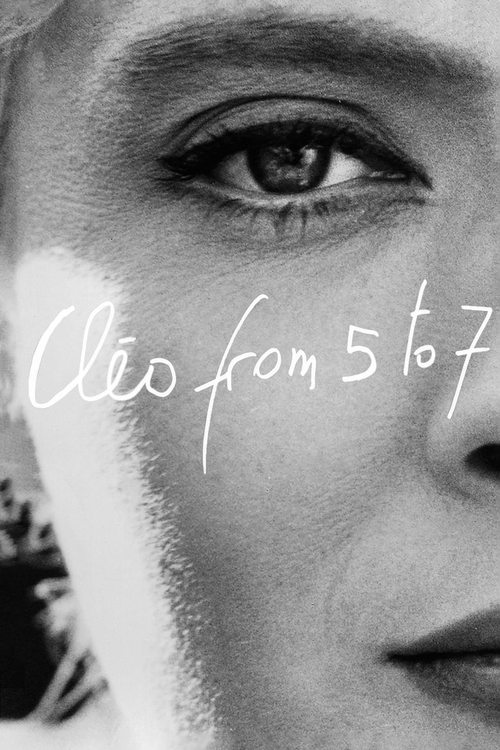
Cléo from 5 to 7
A poignant, real-time French New Wave drama. A young singer navigates the sunlit yet shadow-haunted streets of Paris, peeling away the glamorous masks of her existence while a ticking clock echoes her quiet dread of mortality.
Cléo from 5 to 7

Cléo from 5 to 7

Cléo de 5 à 7

"The whole world... has made an appointment with..."

11 April 1962 France 90 min ⭐ 7.7 (758)
Director: Agnès Varda
Cast: Corinne Marchand, Antoine Bourseiller, Dominique Davray, Dorothée Blanck, Michel Legrand
Drama
Mortality and Existential Dread The Female Gaze and Objectification Authenticity vs. Performance Objective vs. Subjective Time

Overview

Cléo from 5 to 7 unfolds in near real-time, intimately following Florence "Cléo" Victoire, a beautiful and somewhat vain Parisian pop singer. The narrative kicks off at 5:00 PM as Cléo receives a grim tarot card reading, heightening her profound anxiety over a pending medical test that might confirm a diagnosis of stomach cancer. Surrounded by a bustling city, she must wait until 6:30 PM to learn her fate.

Over the course of these ninety minutes, Cléo wanders the streets of Paris, interacting with her superstitious maid, her dismissive lover, her self-absorbed musical collaborators, and an old friend who models nude. Despite being surrounded by people, she feels deeply isolated, realizing that those around her view her merely as a beautiful doll or a melodramatic child.

As the clock ticks closer to her appointment, Cléo undergoes a poignant internal transformation. She sheds her superficial persona, removes her wig, and begins to observe the world around her rather than just seeking its validation. A chance encounter in a park with a grounded soldier about to ship off to the Algerian War provides her with the genuine human connection she desperately needs to face whatever lies ahead.


Core Meaning

Agnès Varda's masterpiece is a profound exploration of existentialism, mortality, and the female identity. At its core, the film critiques the objectification of women in a patriarchal society, illustrating how a woman is conditioned to view herself exclusively through the male gaze. Varda uses Cléo's health crisis as a catalyst for an existential awakening, forcing her to confront the superficiality of her life.

The director intended to show the journey from being an "object" to becoming a "subject." Initially, Cléo defines her existence entirely by her beauty and how others perceive her. By the film's conclusion, she breaks free from this performative femininity. The underlying message is that an authentic life requires shedding societal masks, embracing vulnerability, and finding true meaning through genuine human connections rather than superficial admiration.

Thematic DNA

Mortality and Existential Dread 35%
The Female Gaze and Objectification 35%
Authenticity vs. Performance 15%
Objective vs. Subjective Time 15%

Mortality and Existential Dread

The ticking clock of the film serves as a constant reminder of death. Cléo's fear of cancer forces her to question the meaning of her life, realizing that her fame and beauty are ultimately fragile and transient.

The Female Gaze and Objectification

Cléo begins the film defining herself entirely by how others look at her, embodying the "brainless beauty" stereotype imposed by the men in her life. As the film progresses, the camera shifts to her perspective, allowing her to look out at the world and reclaim her agency.

Authenticity vs. Performance

Cléo's life is initially highly theatrical, filled with wigs, dramatic outbursts, and sycophantic friends. Her journey involves shedding these physical and emotional layers to find her true, unadorned self beneath the pop-star persona.

Objective vs. Subjective Time

Varda explores how time feels relative depending on one's emotional state. While the film tracks 90 minutes of objective time, the agonizing wait for life-altering news stretches these moments into an eternity of subjective psychological turmoil for Cléo.

Character Analysis

Florence "Cléo" Victoire

Corinne Marchand

Archetype: Protagonist
Key Trait: Performative yet deeply vulnerable

Motivation

To find comfort, distraction, and meaning while awaiting a potentially fatal medical diagnosis.

Character Arc

She transitions from a vain, dependent, and self-absorbed pop star into a grounded, self-aware woman who bravely accepts her mortality.

Antoine

Antoine Bourseiller

Archetype: Ally / Mentor
Key Trait: Earnest and philosophical

Motivation

To connect genuinely with another human being on his final day of leave before returning to a deadly conflict.

Character Arc

He serves as a narrative anchor in the final act, bringing Cléo out of her isolation by sharing his own existential fears about the Algerian War.

Dorothée

Dorothée Blanck

Archetype: Foil
Key Trait: Unashamed and grounded

Motivation

To live freely, appreciating her body as a natural vessel rather than a commodity.

Character Arc

She remains a steady, uninhibited presence, providing a stark contrast to Cléo's anxieties about physical perfection.

Angèle

Dominique Davray

Archetype: Caretaker
Key Trait: Superstitious and dismissive

Motivation

To manage Cléo's life and coddle her, treating her more like a fragile child than an adult.

Character Arc

She remains static, representing the stifling, superficial environment Cléo must eventually escape.

Symbols & Motifs

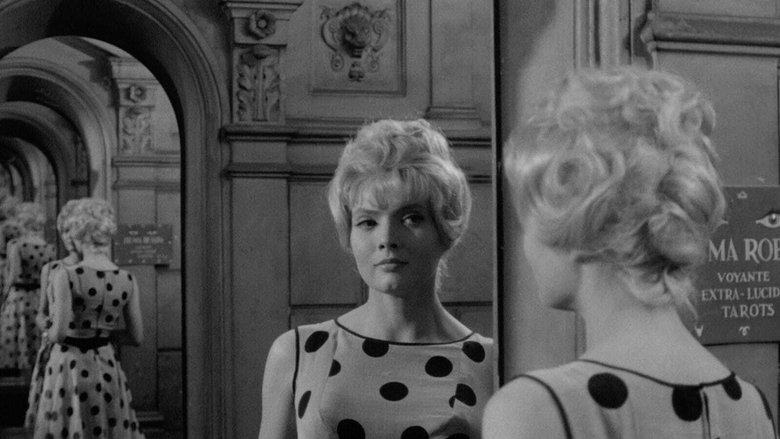
Mirrors and Reflections

Meaning:

Mirrors represent Cléo's vanity, her reliance on external validation, and her fragmented sense of self under the male gaze.

Context:

They appear constantly in the first half of the film. When a mirror shatters later on, it acts as an omen of death but also symbolizes the breaking of Cléo's superficial, image-obsessed persona.

The Tarot Cards

Meaning:

They symbolize fate, impending doom, and ultimately, a necessary metamorphosis.

Context:

Shown in the very first scene. The "Death" card terrifies Cléo, but the fortune teller secretly notes it signifies a profound transformation of her whole being.

Wigs and Clothing

Meaning:

These items represent the artificial masks and performative femininity Cléo uses to shield herself from reality.

Context:

Midway through the film, after an emotional rehearsal, Cléo strips off her glamorous wig and dons a simple black dress, marking her transition toward authenticity.

Clocks and Watches

Meaning:

They are manifestations of objective time and the unstoppable approach of Cléo's diagnosis.

Context:

Clocks are seen in cafes, streets, and apartments, relentlessly reminding Cléo and the audience of the impending 6:30 PM deadline.

Memorable Quotes

Tant que je suis belle, je suis vivante.

— Cléo

Context:

Spoken in voiceover as Cléo looks into a mirror on the street, seeking reassurance immediately after her grim tarot reading.

Meaning:

This line encapsulates Cléo's initial tragic worldview, where physical beauty and the male gaze are equated with existence itself.

Mon corps me rend heureuse, pas fière.

— Dorothée

Context:

Spoken to Cléo when discussing how she can comfortably pose nude for artists without feeling exposed or judged.

Meaning:

A profound feminist statement that contrasts with Cléo's vanity. It highlights a healthy, un-objectified relationship with one's own physical form.

Tout le monde me gâte, personne ne m'aime.

— Cléo

Context:

Spoken in frustration after her musical collaborators treat her profound fear of illness as a dramatic joke.

Meaning:

A moment of stark self-awareness where Cléo realizes that the people catering to her fame do not genuinely care for her soul or well-being.

Il me semble que je n'ai plus peur. Il me semble que je suis heureuse.

— Cléo

Context:

Spoken in the final moments of the film after the doctor confirms her cancer diagnosis and she walks away with Antoine.

Meaning:

The resolution of Cléo's internal conflict. She finds peace not in a clean bill of health, but in letting go of her anxiety and embracing reality.

Philosophical Questions

Does the awareness of death give life its meaning?

The film explores how the looming threat of cancer strips away Cléo's superficial concerns. It posits that only by acknowledging our mortality can we stop performing and start genuinely living.

What is the difference between being looked at and truly being seen?

Cléo spends her life being stared at as an object of beauty. The film questions the value of the 'gaze' by showing that Cléo only finds comfort when Antoine truly listens to her and sees her humanity, rather than just her physical form.

Can true authenticity exist in a society obsessed with image?

Varda uses mirrors, wigs, and pop-culture fame to explore how society traps individuals (especially women) in roles. Cléo's journey suggests that authenticity requires a deliberate, often painful severing of these societal expectations.

Alternative Interpretations

The Algerian War Allegory: Many critics interpret Cléo's journey as an allegory for France itself during the Algerian War. Cléo's initial vanity, self-absorption, and willful ignorance of anything ugly represent the French public's detachment from the brutal realities of the conflict. Her eventual awakening and connection with Antoine (a soldier returning to the war) symbolizes the nation being forced to confront the grim realities it had been ignoring.

The Meaning of the Ending: The film's ending has sparked debate. The doctor nonchalantly confirms Cléo has cancer but insists she will be fine with two months of radiation. Some view this as a tragic ending where Cléo is doomed, with the doctor exhibiting the very male dismissiveness she has suffered from all day. Conversely, the more accepted feminist and existential reading suggests the exact medical prognosis is irrelevant. Cléo's declaration that she is "happy" means she has conquered her fear of the unknown; by accepting her mortality, she is finally free to live authentically.

Cultural Impact

Cléo from 5 to 7 is widely celebrated as one of the crowning achievements of the French New Wave, specifically the Left Bank (Rive Gauche) cinematic movement. Agnès Varda, often dubbed the "grandmother" of the New Wave, broke through the male-dominated ranks of her contemporaries like Godard and Truffaut to deliver a film with a distinctly female gaze. At the time of its release, the film was revolutionary for its real-time narrative structure and its documentary-like "verité" aesthetic, capturing the authentic, bustling streets of 1960s Paris.

Historically, the film is praised for its subtle yet poignant commentary on the Algerian War, intertwining France's socio-political anxieties with Cléo's personal dread. Philosophically, it draws heavily on existentialism, portraying a protagonist who must peel away the "bad faith" of performative femininity to confront the void of mortality. Over the decades, its reputation has only grown; in a 2019 BBC poll of international film experts, it was voted the second-greatest film directed by a woman. It remains a foundational text in feminist film theory, lauded for transforming its heroine from a passive object to be looked at into an active subject observing the world.

Audience Reception

Audiences and critics alike have overwhelmingly praised Cléo from 5 to 7 for its emotional resonance, technical innovation, and profound feminist undertones. Viewers frequently highlight Corinne Marchand's mesmerizing performance, noting how seamlessly she transitions from a melodramatic, flighty starlet to an emotionally grounded woman. The film's real-time pacing is often lauded for creating an immersive, anxiety-inducing atmosphere that mirrors Cléo's internal state.

While contemporary reviews in the early 1960s sometimes missed the point—with some male critics dismissing Cléo as merely a "spoiled" or "brainless" character—modern audiences recognize this as Varda's deliberate setup to critique patriarchal objectification. A minor point of contention among some viewers is the abruptness of the ending, but the consensus holds that the climax is a brilliant subversion of traditional dramatic resolutions. Overall, it is regarded as a flawless masterpiece that feels startlingly modern in its exploration of female agency and existential dread.

Interesting Facts

  • The film's narrative runs in nearly real-time, with the 90-minute runtime closely matching the diegetic chronological events from 5:00 to 6:30 PM.
  • Agnès Varda interviewed over a hundred cancer patients to ensure she authentically captured the psychological dread and anxiety of awaiting a terminal diagnosis.
  • The opening tarot card reading is the only scene in the film shot in color; the abrupt switch to black and white plunges the viewer into Cléo's stark, subjective reality.
  • Composer Michel Legrand, who wrote the film's magnificent score, actually acts in the movie as 'Bob the pianist,' Cléo's eccentric songwriter.
  • The film was initially criticized by some male critics of the era who failed to see past Cléo's vanity, missing Varda's nuanced critique of how society forces women to be superficial.

Easter Eggs

A silent film cameo by Jean-Luc Godard and Anna Karina

Cléo watches a short silent comedy titled Les Fiancés du pont Mac Donald. The short features prominent French New Wave figures, including Godard, who famously removes his trademark dark sunglasses for the scene, and his then-wife Anna Karina. It acts as a playful homage to Varda's cinematic peers.

Appearances by Eddie Constantine and Jean-Claude Brialy

These actors also make brief, humorous appearances in the same silent film-within-a-film, further embedding the movie in the collaborative spirit of the French New Wave.

A poster for Un Chien Andalou

A movie poster for Luis Buñuel's surrealist masterpiece is visible in the background of a scene, paying homage to the avant-garde cinema that paved the way for the Left Bank filmmakers.

⚠️ Spoiler Analysis

Click to reveal detailed analysis with spoilers

Frequently Asked Questions

Explore More About This Movie

Dive deeper into specific aspects of the movie with our detailed analysis pages

Comments (0)

Leave a comment

No comments yet. Be the first to share your thoughts!