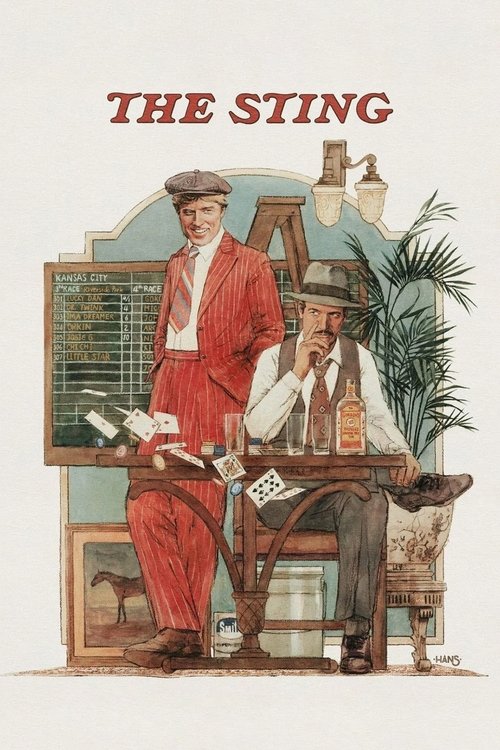
The Sting
A jazz-infused caper where deception pirouettes with revenge, painting a Depression-era cityscape in hues of cunning and camaraderie.
The Sting

The Sting

"...all it takes is a little confidence."

25 December 1973 United States of America 129 min ⭐ 8.0 (2,778)
Director: George Roy Hill
Cast: Paul Newman, Robert Redford, Robert Shaw, Charles Durning, Ray Walston
Drama Crime Comedy
Revenge and Justice Deception and Illusion Friendship and Mentorship Professionalism and Craft
Budget: $5,500,000
Box Office: $159,616,327

Overview

Set in the grimy, Depression-era Chicago of 1936, "The Sting" follows the story of Johnny Hooker (Robert Redford), a fledgling grifter whose partner, Luther Coleman, is murdered on the orders of the ruthless and powerful racketeer Doyle Lonnegan (Robert Shaw). Seeking vengeance, Hooker teams up with Henry Gondorff (Paul Newman), a seasoned master of the "big con."

Together, they assemble a motley crew of con artists to execute an elaborate and intricate scheme against Lonnegan. Their plan, known as "the wire," involves creating a fake off-track betting parlor to swindle Lonnegan out of a substantial sum of money. As they meticulously set their trap, the film unfolds in a series of carefully orchestrated steps, each one drawing their dangerous mark deeper into the deception. The narrative is punctuated by stylized title cards that divide the film into sections like "The Set-Up," "The Hook," and "The Wire," mirroring the stages of a classic confidence game.
Core Meaning

"The Sting" is a masterclass in cinematic deception, exploring the idea that the art of the con is a form of storytelling where perception is reality. The director, George Roy Hill, crafts a narrative that not only cons its central antagonist but also the audience, leading them through a maze of misdirection and false assumptions. At its heart, the film is a celebration of cleverness and ingenuity over brute force. It posits that in a corrupt world of powerful criminals and compromised law enforcement, the meticulously planned con can serve as a form of poetic justice. The film ultimately conveys a message about the power of collaboration and trust, as the success of the elaborate sting hinges on the flawless execution and loyalty of a diverse team of grifters.

Thematic DNA

Revenge and Justice 35%
Deception and Illusion 30%
Friendship and Mentorship 25%
Professionalism and Craft 10%

Revenge and Justice

The primary driver of the plot is Johnny Hooker's quest for revenge for the murder of his friend and mentor, Luther. However, the film subverts the typical revenge narrative by opting for a non-violent, intellectual form of retribution. Justice is achieved not through bloodshed, but through the complete financial and psychological humiliation of the villain, Doyle Lonnegan. This theme explores the idea of a more satisfying and elegant form of justice, where the punishment is tailored to the antagonist's own greed and arrogance.

Deception and Illusion

"The Sting" is fundamentally a story about the art of deception. The film meticulously details the mechanics of the "big con," showcasing the layers of illusion and performance required to pull it off. Every character is, in essence, an actor playing a role. This theme is mirrored in the filmmaking itself, which employs its own tricks to mislead the audience, culminating in a final twist that reveals we've been the ultimate marks. The narrative structure, with its chapter-like title cards, further emphasizes the constructed nature of the con, presenting it as a carefully crafted story.

Friendship and Mentorship

The relationship between the young, impulsive Johnny Hooker and the experienced, world-weary Henry Gondorff forms the emotional core of the film. Gondorff becomes a mentor and father figure to Hooker, guiding him through the complexities of the high-stakes con game. Their bond, built on trust in a world of lies, provides the heart of the story and elevates it beyond a simple crime caper. The theme of camaraderie extends to the entire team of con artists, who work together with Swiss-watch precision, highlighting the importance of community and loyalty.

Professionalism and Craft

The film portrays the con artists not just as criminals, but as skilled professionals who take immense pride in their craft. The execution of "the wire" is presented with the precision and dedication of a masterpiece being created. Every detail is meticulously planned and flawlessly executed by a team of specialists. This theme celebrates the intelligence, discipline, and artistry involved in their elaborate deception, contrasting their methodical approach with Lonnegan's thuggish brutality.

Character Analysis

Henry Gondorff

Paul Newman

Archetype: The Mentor / The Mastermind
Key Trait: Masterful

Motivation

Initially reluctant, Gondorff's primary motivation is to help Hooker get revenge for Luther's death, a mutual friend. He is also driven by the professional challenge and the artistry of pulling off the ultimate con against a seemingly untouchable mark. While he states it's about the money, his meticulous planning and enjoyment of the craft suggest a deeper motivation rooted in professional pride.

Character Arc

Gondorff begins the film as a once-great con man who has gone into hiding, seemingly a washed-up alcoholic. Lured back into the game by Hooker's plea for revenge, he rediscovers his purpose and genius. He transforms from a reluctant, semi-retired grifter into the confident and brilliant architect of the big con. His arc is one of resurgence, as he meticulously plans and executes the sting, all while mentoring the younger, more impulsive Hooker.

Johnny Hooker

Robert Redford

Archetype: The Protagonist / The Apprentice
Key Trait: Ambitious

Motivation

His driving motivation is pure revenge for the murder of his mentor and friend, Luther Coleman. This singular focus makes him willing to take on the immense risk of conning a dangerous mob boss like Doyle Lonnegan.

Character Arc

Hooker starts as a skilled but cocky and reckless small-time grifter. The murder of his partner, Luther, forces him to mature and seek a greater purpose beyond quick cash. Under Gondorff's tutelage, he learns discipline and the intricacies of the "big con." His arc is a journey from impulsive apprentice to a key player in a masterful scheme. By the end, he has learned the value of the con itself over the money, refusing his share because he knows he'd just blow it.

Doyle Lonnegan

Robert Shaw

Archetype: The Antagonist
Key Trait: Arrogant

Motivation

Lonnegan is motivated by power and money. He is fiercely protective of his reputation and his criminal enterprise. He does not tolerate being cheated or crossed, which is why he has Luther killed. His motivation within the con is pure greed; he believes he is using Hooker to ruin a rival bookie and make a fortune in the process.

Character Arc

Lonnegan is a static character, remaining a ruthless, arrogant, and intelligent crime boss throughout the film. His arc is not one of development but of downfall. He is systematically dismantled by the con artists who exploit his own defining traits: his greed, his pride, and his insistence on being the smartest man in the room. His confidence in his own ability to cheat and control situations ultimately becomes his undoing.

Lt. William Snyder

Charles Durning

Archetype: The Corrupt Official
Key Trait: Persistent

Motivation

Snyder's motivation is a combination of greed and a petty desire for revenge. Hooker not only evades him but humiliates him by paying him off with counterfeit money. This personal slight fuels his dogged pursuit of Hooker throughout the film.

Character Arc

Snyder is a relentless and corrupt Joliet police lieutenant who serves as a persistent thorn in Hooker's side. His arc sees him being continually outsmarted and manipulated. He starts off pursuing Hooker for a cut of the initial con but ends up being a pawn in the larger scheme, ultimately used by the con men to escort Lonnegan away from the scene of the final sting, ensuring the villain never realizes he was duped.

Symbols & Motifs

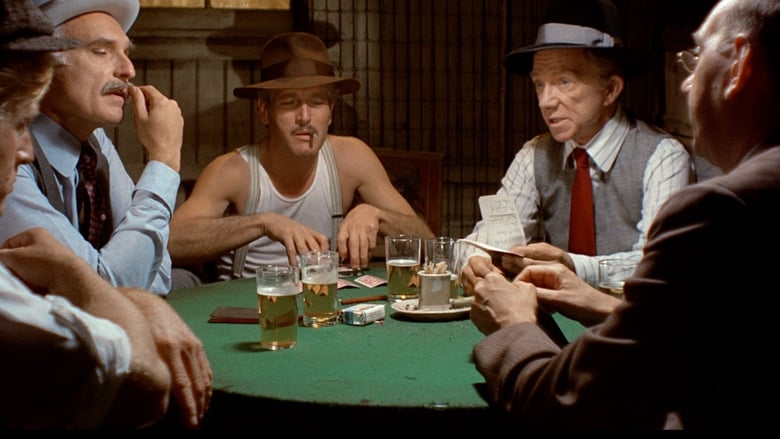
Poker Games

Meaning:

The recurring poker games symbolize the broader themes of deception, strategy, and bluffing that define the world of con artists. They are a microcosm of the larger con, where success depends on reading your opponent, maintaining a calm exterior, and knowing when to raise the stakes.

Context:

A key sequence takes place on a train where Gondorff, pretending to be a boorish, drunken bookie, cheats the notorious cardsharp Lonnegan. This scene not only establishes Gondorff's mastery of deception but also serves as "the hook" that lures Lonnegan into the main con. The game highlights the idea of out-cheating a cheater, a central tenet of the film's form of justice.

The Carousel

Meaning:

The carousel, which serves as a front for a brothel and Gondorff's initial hiding place, symbolizes the cyclical and deceptive nature of the con game. Its constant motion and cheerful facade hide a more complex and illicit reality, much like the cons themselves.

Context:

When Hooker first seeks out the legendary Gondorff, he finds him drunk and operating a carousel. This initial presentation is itself a small con, a facade of a man past his prime, which Gondorff quickly sheds. The location serves as the initial meeting point where the plan to sting Lonnegan is hatched.

Inter-title Cards

Meaning:

The stylized inter-title cards, designed to look like illustrations from The Saturday Evening Post, serve as a structural and symbolic device. They break the film into distinct chapters of the con ("The Set-Up," "The Hook," etc.), symbolizing the methodical, story-like nature of the grifters' plan. They also reinforce the film's nostalgic, storybook quality.

Context:

These cards appear throughout the film, introducing each new phase of the elaborate scheme. This narrative framing device draws the audience into the mechanics of the con, making them feel like insiders, even as the film prepares its final twist to deceive them as well.

Memorable Quotes

What was I supposed to do - call him for cheating better than me, in front of the others?

— Doyle Lonnegan

Context:

Spoken to his bodyguard, Floyd, after the high-stakes poker game on the train. Floyd is certain that Gondorff cheated to win, but Lonnegan explains with frustration why he couldn't expose him, setting the stage for his desire for revenge against the man he knows as "Shaw."

Meaning:

This line perfectly encapsulates Lonnegan's arrogance and the nature of the criminal world they inhabit. He acknowledges he was out-cheated but is more concerned with his reputation than the loss of money. It also highlights the brilliance of Gondorff's strategy: to cheat so skillfully that the victim cannot call it out without incriminating himself.

He's not as tough as he thinks.

— Johnny Hooker

Context:

Hooker says this while observing Lonnegan from a distance, trying to build up his confidence. Gondorff's immediate, sobering reply grounds him, emphasizing the high-stakes and danger of the con they are about to undertake.

Meaning:

This quote, followed by Gondorff's reply, "Neither are we," establishes the central dynamic of the film. It's not about being tough in a physical sense, but about being smart. It's a reminder of their vulnerability and the need for meticulous planning over brute force, defining their entire approach to getting revenge.

You gotta keep his con even after you take his money. He can't know you took him.

— Henry Gondorff

Context:

Gondorff explains this core tenet of confidence games to Hooker early in their planning. It foreshadows the elaborate finale, where the faked deaths are designed specifically to sell the con to Lonnegan permanently and ensure he walks away without suspicion.

Meaning:

This line articulates the highest principle of the "big con." It's not enough to simply steal the money; the true art lies in ensuring the mark never realizes they were deceived. This philosophy is crucial to their survival, as Lonnegan's retaliation would be lethal if he ever discovered the truth.

You're right, it's not enough. But it's close!

— Johnny Hooker

Context:

This poignant exchange occurs after Hooker has decided to go after Lonnegan. It reveals the depth of his grief and his singular, all-consuming motivation for embarking on the dangerous con.

Meaning:

This line is a response to Luther telling him that revenge won't bring him back. It encapsulates Hooker's raw, emotional state. While he understands that revenge won't fix his loss, it's the only thing driving him and the closest he can get to a sense of justice or closure.

Philosophical Questions

What is the nature of justice when the system is corrupt?

The film explores a world where the lines between right and wrong are blurred. The protagonist, Johnny Hooker, seeks justice for his friend's murder, but he operates outside the law. The police are portrayed as either corrupt (like Lt. Snyder) or ineffective against a powerful figure like Lonnegan. In this context, the film poses the question of whether an illegal act—an elaborate con—can be a justifiable means to achieve a moral end. The "sting" becomes a form of extralegal justice, a carefully orchestrated plan to punish a villain who is otherwise untouchable. It suggests that in a flawed system, justice may need to be crafted with the same cunning and deception used by the criminals themselves.

Is there honor among thieves?

"The Sting" deeply explores the concept of a moral code within a criminal community. The entire plot is predicated on loyalty and trust. Hooker's quest is to avenge a fallen comrade. Gondorff and his extensive network of grifters come together, risking their freedom to help, bound by a shared sense of community and professionalism. The success of their incredibly complex con depends entirely on each person playing their part with unwavering trust in the others. This contrasts sharply with the antagonist, Lonnegan, who operates through fear and betrayal. The film suggests that a strong sense of honor and loyalty can exist and even thrive in the most unlikely of subcultures.

Alternative Interpretations

While "The Sting" is largely seen as a straightforward and cleverly plotted caper, some interpretations delve deeper into its structure and themes. One perspective views the entire film as a metanarrative about the art of filmmaking itself. The con artists are akin to a director (Gondorff), screenwriter, and actors, who create a believable world (the fake betting parlor) with sets, costumes, and props to manipulate their "audience" (Lonnegan). The film's self-aware structure, with its chapter-like title cards, supports this reading, suggesting that the audience is being let in on the craft of creating a compelling illusion, both as a con and as a movie.

Another interpretation focuses on the film as a form of social commentary. Set during the Great Depression, the story of clever individuals triumphing over a powerful, corrupt figure through wit rather than violence could be seen as an allegory for the common person's struggle against oppressive systems. The con men operate outside the law, but their target is a far greater and more brutal criminal, making them anti-heroes in a world where official channels of justice are ineffective. They represent a form of subversive, populist justice against the wealthy and ruthless.

Cultural Impact

"The Sting," released in 1973, was a massive critical and commercial success, providing a dose of nostalgic escapism for audiences weary of the Vietnam War and the Watergate scandal. It was one of the highest-grossing films of its time and won seven Academy Awards, including Best Picture. The film revitalized the caper and heist genres, setting a new standard with its intricate plotting, witty screenplay, and charismatic leads. Its influence can be seen in countless subsequent films that blend crime with comedy and feature elaborate twists, such as the "Ocean's Eleven" series.

The most significant cultural impact was the popularization of Scott Joplin's ragtime music. Marvin Hamlisch's adaptation of Joplin's 1902 tune "The Entertainer" became a top-ten hit and sparked a global revival of the ragtime genre. The film's visual style, with its muted color palette and Edith Head's period-perfect costumes, also had a lasting influence on cinematic depictions of the 1930s. In 2005, "The Sting" was selected for preservation in the United States National Film Registry by the Library of Congress as being "culturally, historically, or aesthetically significant," cementing its status as an enduring American classic.

Audience Reception

Upon its release, "The Sting" was met with widespread acclaim from audiences and critics alike, becoming a box office phenomenon. Audiences were captivated by the on-screen chemistry between Paul Newman and Robert Redford, their second collaboration with director George Roy Hill after the success of "Butch Cassidy and the Sundance Kid." The film was praised for its clever, intricate plot filled with satisfying twists and turns, which kept viewers guessing until the very end. The playful tone, witty dialogue, and stylish re-creation of the 1930s, enhanced by the popular ragtime score, were also major points of praise. The overall verdict was that it was a supremely entertaining and masterfully crafted piece of pure entertainment, a "feel-good" film that was both intelligent and charming. There was very little criticism, with most reviewers and viewers embracing it as a near-perfect example of the caper genre.

Interesting Facts

  • The screenplay by David S. Ward was inspired by the real-life cons of brothers Fred and Charley Gondorff, documented in David Maurer's 1940 book "The Big Con".
  • Robert Shaw, who played the villain Doyle Lonnegan, injured his ankle shortly before filming. Instead of delaying production, he incorporated the limp into his character's performance.
  • The film's distinctive chapter-like title cards were created by artist Jaroslav Gebr and were designed to evoke the style of The Saturday Evening Post illustrations from the 1930s.
  • Although set in the 1930s, the film's iconic score is composed of ragtime music by Scott Joplin, whose popularity had actually peaked two decades earlier. The film's success led to a major revival of interest in Joplin's music.
  • Director George Roy Hill deliberately limited the use of extras in street scenes to emulate the style of gangster films from the 1930s, where streets would often be empty during dramatic moments.
  • Julia Phillips became the first female producer to win an Academy Award for Best Picture for her work on this film.
  • Robert Redford was nominated for a Best Actor Oscar for his role but, according to a 2004 interview, he didn't actually see the finished film until decades after its release.
  • Jack Nicholson was reportedly offered the role of Johnny Hooker but turned it down.
  • The diner where Hooker meets Lonnegan was a set on the Universal Studios backlot, the same interior later used in "Back to the Future" (1985).
  • The final twist was a closely guarded secret. To prevent leaks, director George Roy Hill only provided the full script to key department heads, and some supporting actors didn't know the true ending until they saw the premiere.

⚠️ Spoiler Analysis

Click to reveal detailed analysis with spoilers

Frequently Asked Questions

Explore More About This Movie

Dive deeper into specific aspects of the movie with our detailed analysis pages

Comments (0)

Leave a comment

No comments yet. Be the first to share your thoughts!