Tokyo Godfathers
A heartfelt tragicomedy painted across a snowy Tokyo, where a chance discovery of life in the trash becomes a miraculous quest for redemption for three souls discarded by society.
Tokyo Godfathers

Tokyo Godfathers

東京ゴッドファーザーズ

"Meet the ultimate dysfunctional family."

05 December 2003 Japan 92 min ⭐ 7.9 (1,405)
Director: Satoshi Kon
Cast: Aya Okamoto, Yoshiaki Umegaki, Tohru Emori, Satomi Korogi, Mamiko Noto
Drama Animation Comedy
The Nature of Family Coincidence and Miracles Redemption and Forgiveness Social Commentary on Homelessness
Box Office: $607,735

Overview

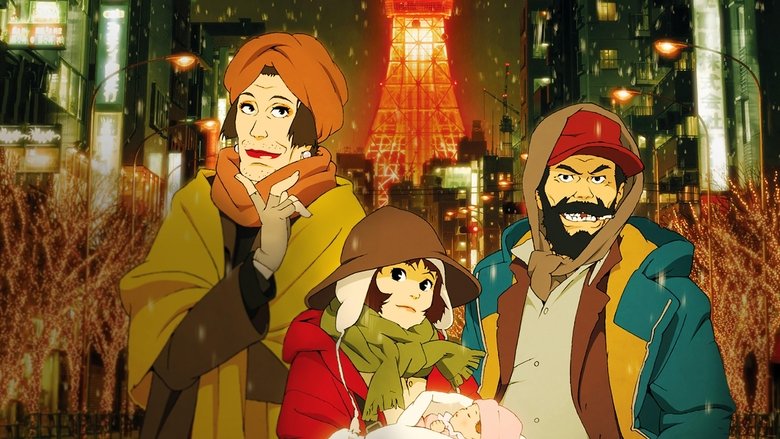
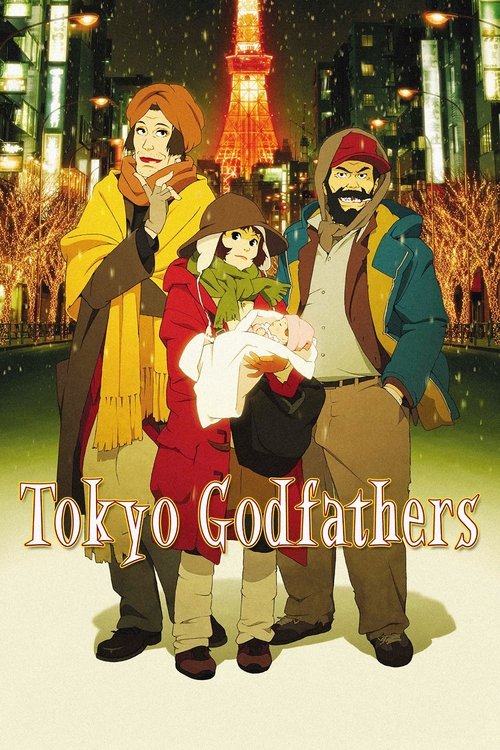
On Christmas Eve in Tokyo, three homeless companions—Gin, a gruff alcoholic; Hana, a sentimental former drag queen; and Miyuki, a cynical teenage runaway—discover an abandoned newborn baby while rummaging through a garbage dump. Naming her Kiyoko, which means "pure child," the trio embarks on a chaotic and poignant journey through the city to find her parents.

Their quest is punctuated by a series of extraordinary coincidences and encounters that force each of them to confront the pasts they ran away from. As they navigate encounters with yakuza, well-meaning strangers, and figures from their own histories, their makeshift family bond is tested and strengthened, turning their search for the baby's home into a quest to find their own place in the world.

Core Meaning

At its core, Tokyo Godfathers is a profound exploration of family, forgiveness, and redemption. Director Satoshi Kon shifts from his usual themes of blurred reality to tell what he called a "twisted sentimental story" grounded in realism. The film posits that family is not defined by blood, but by love, choice, and shared experience, as demonstrated by the powerful bond formed between Gin, Hana, and Miyuki.

The central message is one of hope, suggesting that even those on the lowest rungs of society—the "invisible" and "discarded"—possess an inherent goodness and capacity to bring about positive change. Through a series of events that blur the line between coincidence and divine intervention, the film argues for the possibility of miracles in everyday life and the idea that confronting one's past, no matter how painful, is the only path to salvation and reconnecting with society.

Thematic DNA

The Nature of Family 35%
Coincidence and Miracles 30%
Redemption and Forgiveness 25%
Social Commentary on Homelessness 10%

The Nature of Family

The film's central theme is the redefinition of family. Gin, Hana, and Miyuki, all estranged from their biological families, form a powerful, albeit dysfunctional, 'pseudo-family'. Their shared responsibility for Kiyoko solidifies their bond, suggesting that family is forged through love, loyalty, and mutual support rather than blood ties. This chosen family provides the emotional anchor each character needs to eventually seek reconciliation with their original families.

Coincidence and Miracles

Tokyo Godfathers is driven by a chain of improbable coincidences that the characters, particularly the devout Hana, interpret as miracles or divine intervention. From finding the baby on Christmas Eve (a parallel to the nativity story) to repeatedly encountering people connected to their quest, these events act as a guiding force. Director Satoshi Kon intentionally crafts an "unbelievable story" to seem believable, suggesting that the city of Tokyo itself, with its mix of cruelty and affluence, facilitates these moments of grace, acting as a silent protagonist watching over them.

Redemption and Forgiveness

Each of the three protagonists is a runaway, haunted by past sins and shame: Gin by his gambling debts, Hana by a violent incident at her club, and Miyuki by stabbing her father. They chose a life of homelessness as a form of self-penance. The journey with Kiyoko forces them to confront these pasts, giving them a renewed sense of purpose and the courage to seek forgiveness, ultimately leading to their own redemption.

Social Commentary on Homelessness

The film offers a humanizing portrayal of homelessness in Japan, a topic particularly relevant at the time of its 2003 release. Kon highlights the cruelty and indifference of a society that treats people as disposable. The protagonists face harassment, violence from vigilante youths, and systemic neglect. However, the film avoids being a bleak documentary, instead focusing on the resilience, dignity, and kindness of those living on the margins.

Character Analysis

Gin

Tohru Emori

Archetype: The Cynic / Reluctant Father
Key Trait: Gruff but secretly caring

Motivation

Initially motivated by self-preservation and a desire to be rid of the baby, his core motivation is revealed to be a deep-seated guilt and a buried love for the family he left behind. Protecting Kiyoko becomes a way for him to atone for his failures as a father.

Character Arc

Gin begins as a belligerent, cynical alcoholic who lies about his past, claiming his wife and daughter are dead. His journey with Kiyoko forces him to drop his hardened exterior and embrace a paternal, protective role. He confronts his shame over his gambling debts and abandonment of his family, ultimately culminating in a tearful reunion with his own daughter, who works as a nurse.

Hana

Yoshiaki Umegaki

Archetype: The Heart / Devout Mother
Key Trait: Dramatically compassionate

Motivation

Driven by a powerful maternal instinct and a deep-seated desire to have a family, Hana wants to find Kiyoko's parents to understand why a mother would abandon her child, hoping it will help her forgive her own mother. Her faith in miracles fuels her optimism throughout their ordeal.

Character Arc

Hana, a transgender woman and former drag queen, is the emotional core of the group. She immediately sees Kiyoko as a gift from God and embraces the role of a mother she always dreamed of. Her unwavering faith and compassion drive the quest forward. Her arc involves confronting her feelings of abandonment by her own mother and proving to herself that she is capable of profound love and maternal care, finding her miracle not in biology, but in action.

Miyuki

Aya Okamoto

Archetype: The Runaway / Rebellious Daughter
Key Trait: Stubborn and resentful

Motivation

Miyuki's primary motivation is survival and maintaining her independence. She is trapped by guilt and the belief that she can never be forgiven by her family. The quest to return Kiyoko parallels her own need to return to her family, forcing her to confront her fear of rejection.

Character Arc

Miyuki starts as a sullen, sharp-tongued teenager who is annoyed by the baby and constantly bickers with Gin. She ran away after stabbing her policeman father in a dispute over her missing cat. Through caring for Kiyoko and witnessing Hana's selflessness, she matures from a selfish child into a caring 'older sister.' Her journey is about learning to communicate and overcoming the stubborn pride that prevents her from going home, leading to a reconciliation with her father.

Symbols & Motifs

Kiyoko (The Baby)

Meaning:

Kiyoko, whose name means "pure child," is a symbol of hope, innocence, and divine grace. She acts as a catalyst for change, a "Christmas present from God" that forces the protagonists to confront their pasts and find their better selves. Her presence initiates the series of miracles that guide the trio toward redemption, representing a chance for a new beginning not just for her, but for her godparents as well.

Context:

Found in a pile of trash on Christmas Eve, her discovery parallels the birth of Jesus in the nativity story, a theme established in the film's opening scene at a church. Throughout the film, her uncanny ability to survive and bring about fortunate coincidences reinforces her symbolic role as a miracle worker.

Tokyo Cityscape

Meaning:

The city of Tokyo is portrayed as a character in itself, a dual-natured entity that is both cruel and nurturing. Its dark alleys and garbage dumps represent societal decay and indifference, where people are discarded like trash. However, the city also provides the means for survival and is the backdrop for all the film's miracles, suggesting it has a soul that watches over the protagonists.

Context:

The film contrasts the glittering neon lights of affluent districts with the squalid shelters of the homeless. Key locations like Shinjuku and its backstreets are rendered with gritty realism, grounding the fantastical events in a tangible, complex urban environment.

The Key

Meaning:

The locker key found with Kiyoko symbolizes the unlocking of the past and the path to the future. It is the first tangible clue that sets the entire quest in motion. It represents the potential for discovery and the hope that answers can be found, motivating the trio to move forward instead of remaining stagnant in their despair.

Context:

The key is found with the baby in the garbage dump. It leads them to a coin locker containing photos and information about Kiyoko's supposed parents, launching their detective-like journey across Tokyo. The key physically opens a lock, but metaphorically it opens the door for each character to begin addressing their own locked-away pasts.

Memorable Quotes

こいつは神様のくれたクリスマス・プレゼントだよ

— Hana

Context:

Spoken shortly after the trio discovers the abandoned baby Kiyoko in the trash on Christmas Eve. While Gin and Miyuki are pragmatic and worried, Hana immediately frames the event in spiritual, miraculous terms, setting the tone for their journey.

Meaning:

Translated as "This is a Christmas present from God." This line encapsulates Hana's unwavering faith and the film's central theme of miracles. It establishes Kiyoko not as a burden, but as a divine gift meant to bring about change and salvation for the trio.

あたしは神様が創った失敗作なの

— Hana

Context:

Hana says this during a conversation early in the film, reflecting on her identity and her inability to have children biologically. She then playfully wonders if a "miracle like the Virgin Mary" could happen to her, moments before they find Kiyoko, adding a layer of dramatic irony.

Meaning:

Translated as "I am a mistake made by God." This poignant line reveals Hana's deep-seated vulnerability beneath her flamboyant exterior. It speaks to her feelings of being an outcast due to her transgender identity but is also juxtaposed with her strong faith, highlighting the complexity of her character.

Philosophical Questions

What constitutes a 'family'?

The film deconstructs the traditional definition of family. The central trio, unrelated by blood and from vastly different backgrounds, form a more loving and functional family unit than the biological ones they fled. Through their shared struggles and unwavering loyalty to each other and Kiyoko, the film powerfully argues that the bonds of love, choice, and shared experience are more significant than bloodlines in creating a true family.

Is redemption possible for those who have abandoned their responsibilities?

All three protagonists are running from past mistakes where they hurt their loved ones and shirked responsibility. Their journey is a path of atonement. By taking on the ultimate responsibility—caring for a helpless infant—they are forced to become selfless. This act of grace allows them to find the courage to face their pasts and seek forgiveness, suggesting that redemption is not only possible but is earned through selfless action and confronting one's personal demons.

Do we live by chance or by design?

The narrative is built on a series of incredible coincidences that stretch believability. This central mechanic forces the audience to question whether life is a series of random events or if there is a guiding force—be it God, fate, or the 'soul' of the city—that connects everything. Hana believes it's God's plan, while Gin is more cynical. The film never explicitly answers, leaving the viewer to ponder the mysterious interplay of luck, choice, and potential destiny in shaping our lives.

Alternative Interpretations

The central point of debate in interpreting Tokyo Godfathers is the nature of the film's many coincidences. One perspective is that these events are genuine miracles—divine interventions orchestrated by a higher power, fitting the Christmas theme and Hana's devout perspective. The film is filled with Christian allegory, from the nativity parallels to themes of salvation, supporting this reading.

A more secular interpretation suggests that the events are simply a highly improbable, but not impossible, chain of coincidences. In this view, the film is not about divine fate, but about the interconnectedness of human lives in a vast metropolis like Tokyo. It's a celebration of luck and the idea that by putting good out into the world, good things will eventually come back around. Satoshi Kon himself referred to the city of Tokyo as a character, suggesting an almost animistic force at play—the city itself creating these connections. Ultimately, the film leaves it ambiguous, allowing the viewer to decide whether the events are guided by God, fate, or sheer, extraordinary luck.

Cultural Impact

Released in 2003, Tokyo Godfathers stands as a unique entry in Satoshi Kon's acclaimed filmography and in the broader landscape of anime. Unlike his other psychological thrillers, this film's accessibility and heartwarming, comedic tone broadened his audience. It received critical acclaim, winning the Best Animation Film at the 58th Mainichi Film Awards and an Excellence Award at the 2003 Japan Media Arts Festival.

The film's most significant impact lies in its compassionate and nuanced portrayal of homelessness and marginalized communities in Japan. It challenged societal prejudices by presenting its homeless protagonists not as pitiable figures, but as complex, flawed, and deeply human characters capable of immense kindness and heroism. Hana's character was also a noteworthy and positive depiction of a transgender woman in anime at the time.

While not a massive box-office success, Tokyo Godfathers has become a beloved cult classic and is frequently cited as one of the best Christmas movies ever made, praised for its celebration of found family, hope, and the human spirit in the face of adversity.

Audience Reception

Audience reception for Tokyo Godfathers has been overwhelmingly positive, with many viewers considering it a masterpiece and a unique Christmas classic. It holds a high rating of 91% on Rotten Tomatoes. Viewers praise its perfect blend of humor, drama, and heartfelt emotion, finding the story incredibly moving and uplifting despite the grim subject matter. The three main characters are consistently highlighted as being memorable, flawed, and deeply lovable.

The main points of praise focus on the film's powerful theme of 'found family' and its hopeful message of redemption. Criticism is minor but sometimes points to the sheer improbability of the plot's coincidences feeling overly convenient. Some also note that the depiction of Hana, while largely positive, involves some dated humor and language that can be uncomfortable. Overall, audiences regard it as one of Satoshi Kon's most emotionally resonant and accessible films.

Interesting Facts

  • The film was inspired by the 1948 John Ford western "3 Godfathers," which also features three outlaws who find and care for an abandoned baby.
  • Director Satoshi Kon intentionally made "Tokyo Godfathers" more realistic and linear compared to his other mind-bending, surrealist films like "Perfect Blue" and "Paprika" to challenge himself with a different kind of storytelling.
  • The film was released in 2003, coinciding with a peak in Japan's recorded homeless population after the economic collapse of the 1990s, making its social commentary particularly timely.
  • Satoshi Kon chose homeless people as protagonists because he was interested in their lives and wanted to explore how those separated from mainstream society could, in their own way, rejuvenate it.
  • The name given to the baby, Kiyoko (清子), is a reference to the Japanese title for the carol "Silent Night" (きよしこの夜, Kiyoshi Kono Yoru) and can be translated as "pure child".

Easter Eggs

A magazine cover featuring the pop idol group CHAM!

In one scene, a magazine in an apartment features the pop group CHAM! on its cover. This is a direct reference to Satoshi Kon's debut film, Perfect Blue (1997), where the protagonist, Mima Kirigoe, was a member of that very group.

Posters for other Satoshi Kon films.

Throughout the city, attentive viewers can spot posters and advertisements that subtly reference Kon's other works, including Millennium Actress. This self-referential detail is a common trait in Kon's films, creating a shared universe among his projects.

⚠️ Spoiler Analysis

Click to reveal detailed analysis with spoilers

Frequently Asked Questions

Explore More About This Movie

Dive deeper into specific aspects of the movie with our detailed analysis pages

Comments (0)

Leave a comment

No comments yet. Be the first to share your thoughts!