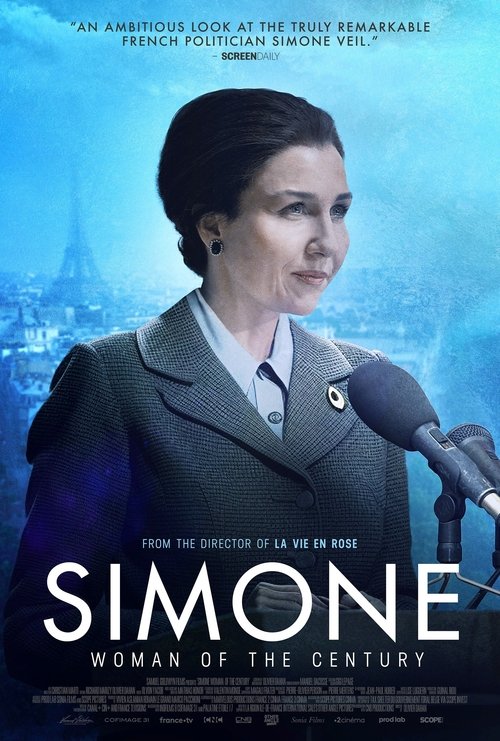
Simone: Woman of the Century
Simone, le voyage du siècle
"We are responsible for what will unite us tomorrow"
Overview
"Simone: Woman of the Century" chronicles the extraordinary life of Simone Veil, an iconic French political figure. The film eschews a traditional linear narrative, instead weaving through the pivotal moments of her existence in a non-chronological fashion, driven by memory and emotional resonance. It depicts her idyllic childhood abruptly shattered by her deportation to the Auschwitz-Birkenau concentration camp during the Holocaust, a traumatic experience that would fundamentally shape her unwavering commitment to human rights.
The film follows her journey after the war as she becomes a magistrate, her marriage to Antoine Veil, and her rise in the male-dominated world of French politics. It highlights her key political battles, most notably her fierce and controversial fight to legalize abortion in France, a law that would come to be known as the "Loi Veil." We also see her tireless efforts to improve prison conditions and her significant role as the first elected president of the European Parliament. Throughout, the narrative flashes back to the horrors of the camps, illustrating how the memory of the Shoah fueled her lifelong fight against injustice.

Core Meaning
The core meaning of "Simone: Woman of the Century" lies in the indomitable power of resilience and the profound connection between personal trauma and public service. Director Olivier Dahan posits that Simone Veil's entire life's work—her fight for women's rights, her advocacy for prisoners, and her dedication to a unified Europe—was a direct response to the dehumanization she experienced during the Holocaust. The film's central message is that memory, however painful, must be transmitted to future generations as a bulwark against hatred and injustice. It's a testament to how one individual, forged in the crucible of immense suffering, can dedicate their life to ensuring such atrocities never happen again, transforming personal tragedy into a universal message of hope and human dignity.
Thematic DNA
Memory and Trauma
The film is structured around the concept of memory, using a non-linear narrative to show how Simone Veil's experiences in the concentration camps are a constant, intrusive presence throughout her life. The horrors of the Shoah are not just a past event but a foundational trauma that informs all her subsequent actions and political convictions. The narrative's jumps in time reflect how a single memory can be triggered at any moment, illustrating the lasting psychological scars of surviving such atrocity. Director Olivier Dahan emphasizes that the film is fundamentally about the Holocaust and its lifelong impact.
Resilience and the Fight for Justice
Simone's life is portrayed as an unrelenting battle against injustice in its various forms. Having survived the ultimate injustice of the Holocaust, she dedicates her career to defending the dignity of the marginalized, from female prisoners to women seeking abortions. Her story is one of extraordinary resilience, showing her channeling her personal suffering into a formidable public strength. The film highlights her tenacity in overwhelmingly male-dominated environments, where she fought fiercely for her convictions.
Feminism and Women's Rights
A significant portion of the film is dedicated to Veil's political struggle to legalize abortion in France in 1974. These scenes depict the intense, often vicious, opposition she faced in the National Assembly. Her fight is contextualized as a cornerstone of women's emancipation in 20th-century France. The film portrays her as a pioneering feminist icon who broke barriers and championed women's equality and control over their own bodies, even though she didn't always align herself with specific feminist movements.
The Construction of Europe
The film presents Simone Veil's commitment to a unified Europe as a direct consequence of her wartime experience. Having witnessed the depths of nationalist hatred, she saw European integration as the only path to lasting peace and a way to prevent such barbarism from recurring. Her election as the first president of the European Parliament is depicted as a climactic achievement in her lifelong mission to overcome the hatred that tore the continent apart.
Character Analysis
Simone Veil
Elsa Zylberstein / Rebecca Marder
Motivation
Her primary motivation is to fight against injustice and ensure that the barbarity she witnessed is never forgotten or repeated. Fueled by the memory of her mother, who died in the camps, and the loss of her father and brother, she dedicates her life to creating a more humane and just world. This manifests in her specific political battles for abortion rights, prison reform, and the unification of Europe.
Character Arc
The film portrays Simone's arc not as a transformation but as a lifelong embodiment of convictions forged in her youth and solidified in the crucible of the Holocaust. As a young woman (Rebecca Marder), she is shown as intelligent and resilient, surviving unimaginable horror. This experience doesn't break her but rather instills in her an unshakeable resolve. As an adult (Elsa Zylberstein), she channels this resolve into her public life, fighting for the rights of others. Her journey is one of applying the harsh lessons of her past to the challenges of the present, never wavering in her core principles of human dignity and justice.
Antoine Veil
Olivier Gourmet / Mathieu Spinosi
Motivation
His motivation is his love and admiration for Simone. He is driven by a desire to see her succeed and supports her ambitions, even when they challenge societal norms. He provides the stable home life and intellectual partnership that allows her to pursue her demanding public career.
Character Arc
Antoine is portrayed as a supportive, though at times traditional, husband who recognizes and ultimately champions his wife's extraordinary capabilities. Initially, he might have expected a more conventional wife and mother, but he evolves to become her steadfast partner. He is her confidant and intellectual equal, and the film suggests that Simone could not have achieved what she did without his support.
Yvonne Jacob
Élodie Bouchez
Motivation
Her motivation is the survival and well-being of her children. Even in the direst circumstances of the camp, she is driven by a profound love and a desire to maintain their humanity and dignity. This maternal strength becomes Simone's lifelong inspiration.
Character Arc
Yvonne, Simone's mother, is presented as a foundational figure whose influence guides Simone long after her death. Before the war, she is shown as a progressive and loving mother. In the concentration camp, she is a pillar of strength and dignity. Her death from typhus in Bergen-Belsen is a pivotal tragedy that becomes a driving force for Simone's life. Her arc is completed through Simone's lifelong fight to uphold the values her mother instilled in her.
Symbols & Motifs
The Chanel Suit
Simone Veil's signature Chanel suits symbolize her strength, professionalism, and unyielding dignity in the face of adversity. It represents her armor in the political arena, a conscious choice of attire that commands respect in a world dominated by men. It also signifies her return to and embrace of life and culture after the dehumanization of the camps.
Throughout the latter half of the film, Elsa Zylberstein's Simone is almost always seen in one of her elegant tweed suits. The costume designer worked closely with the House of Chanel to faithfully recreate the specific outfits Veil wore during key moments, such as her powerful speech defending the abortion bill in Parliament. This visual consistency underscores the suit as an essential part of her public identity and her fight for freedom and tolerance.
Laying the First Stone
This act symbolizes the bridging of Simone's past trauma and her present public duty. By openly stating that her masonry skill comes from her time in the camps, she breaks a long-held public silence, reclaiming a traumatic memory and transforming it into a moment of defiant truth-telling. It represents the "double penalty" of survivors who were expected to remain silent upon their return.
In a scene set in 1975, Simone, as Minister of Health, is at a ceremony to lay the first stone for a children's hospital. When an official compliments her technique with the trowel, she calmly replies, "I did this... when I was deported... It's been my profession." This moment, based on a real event, is depicted with a quiet intensity, followed by a stunned silence from those around her, powerfully illustrating the weight of her past.
The Non-Linear timeline
The fragmented, non-chronological structure of the film is itself a symbol of how memory and trauma function. It rejects a simple, linear progression of a life, suggesting instead that the past, particularly the trauma of the Holocaust, is always present and can resurface at any moment, influencing and defining the present.
The film constantly jumps between different periods of Simone's life—her idyllic childhood, the horror of Auschwitz, her political battles in the 1970s, and her later years. Director Olivier Dahan uses this "emotional chronology" rather than a factual one, where scenes are linked by thematic or emotional echoes rather than by date, to create a sensory narrative that reflects the inner world of a trauma survivor.
Memorable Quotes
Vous ne me faites pas peur. J'ai survécu à pire que vous. Vous n'êtes que des SS aux petits pieds.
— Simone Veil
Context:
During a heated meeting for the 1979 European elections, Simone Veil is disrupted and threatened by Front National activists. Unflinching, she steps to the microphone and delivers this powerful rebuke, silencing her opponents and demonstrating that no political intimidation can compare to what she has already endured.
Meaning:
This quote encapsulates Simone Veil's immense courage and resilience. By directly confronting neo-fascist hecklers with the memory of her survival, she diminishes their power and asserts the strength she gained from overcoming the ultimate evil. It's a defiant affirmation of her entire life's trajectory.
Comment définir la mémoire? [...] Pendant deux ou trois générations, la mémoire et l'histoire sont étroitement liées. Cette mémoire n'est pas seulement contemplative ou composée de souvenirs. Elle est enracinée dans l'expérience.
— Simone Veil (voiceover)
Context:
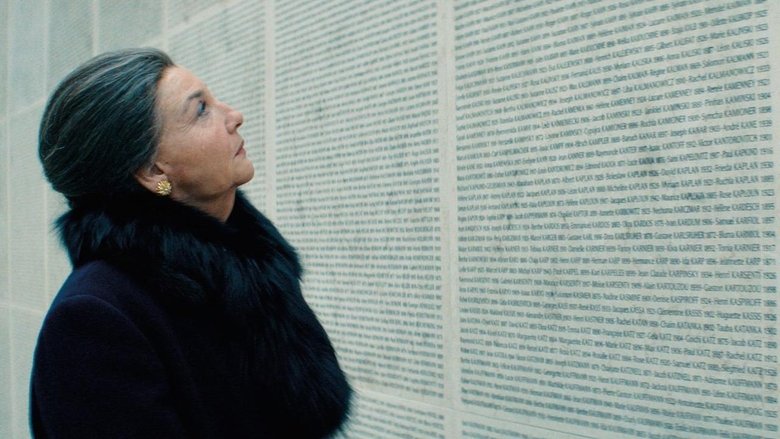
This is part of a voiceover from Simone near the end of the film as she reflects on her life and the nature of memory. It plays over images of her looking at the Wall of Names at the Shoah Memorial in Paris, directly linking her personal experience to the collective, historical record.
Meaning:
This quote serves as the philosophical backbone of the film. It explains the narrative's structure and its urgency. Veil articulates the idea that memory is a living, experiential force, not a passive recollection of history. The film itself is an act of transmitting this experiential memory before it fades from living history.
Quand on banalise la Shoah en la mettant en perspective, je me demande si notre civilisation ne perd pas ses repères... On conduit la jeunesse d'aujourd'hui sur les chemins de la haine, du racisme, de l'antisémitisme et de la xénophobie. Il y a beaucoup de faux prophètes en France, en Europe et dans le monde aujourd'hui.
— Simone Veil
Context:
This stirring speech is delivered by an older Simone Veil towards the end of the film, highlighting her lifelong role as a guardian of Holocaust memory and a voice of conscience for Europe.
Meaning:
This is a powerful warning that connects the lessons of the Holocaust directly to contemporary society. It encapsulates her fear that the horrors of the past could be repeated if society forgets its moral compass. The quote underlines the film's political relevance and its message about the dangers of historical revisionism and rising intolerance.
Philosophical Questions
What is the relationship between memory and history?
The film explores this question through its very structure. Simone's voiceover near the end explicitly states that for a few generations, memory and history are intertwined, but that this connection is fragile. The film posits that history without the visceral, personal component of memory becomes a sterile set of facts, easily ignored or manipulated. It argues for the vital importance of transmitting first-hand or second-hand memory (the "voyage of the century") to keep the ethical lessons of history alive and prevent the repetition of past atrocities.
Can personal trauma be a catalyst for societal good?
The film presents a resounding 'yes' to this question. It frames Simone Veil's immense suffering not as a debilitating force, but as the very source of her strength and empathy. Her fight for the dignity of prisoners, women, and all of Europe is depicted as a direct result of being stripped of her own dignity. The film explores the profound psychological alchemy through which the experience of absolute evil can forge an unbreakable commitment to justice and humanism, suggesting that the deepest understanding of what is right can come from experiencing the deepest wrong.
How does a society choose what to remember and what to forget?
The film touches on France's post-war silence regarding the Holocaust. One scene highlights the "double penalty" for survivors who were expected not to speak of their experiences upon their return. Simone's decision to break this silence, and later to dedicate herself to the memory of the Shoah, is a central theme. The film asks viewers to consider the political and social mechanisms that lead to collective amnesia and highlights the courage required to force a society to confront the uncomfortable truths of its past.
Alternative Interpretations
While the film is largely a celebratory biopic, its unconventional structure invites alternative interpretations. The non-linear, fragmented narrative can be seen not just as a reflection of trauma, but as a deliberate critique of the traditional biopic genre. Olivier Dahan avoids a simple, chronological 'greatest hits' account of Veil's life. Instead, by constantly juxtaposing her political triumphs with the primal horror of the camps, he suggests that her life cannot be neatly compartmentalized or understood without constantly acknowledging its traumatic origins. This interpretation posits the film as an argument that a person is not simply the sum of their achievements, but a complex tapestry of past and present experiences that are perpetually in dialogue.
Another interpretation focuses on the film's deliberate omissions. For instance, some critics noted that the film smooths over some of Veil's more conservative stances later in life, such as her opposition to marriage for all. From this perspective, the film is less an objective biography and more of a curated myth-making exercise. It chooses to focus almost exclusively on the aspects of her legacy that align with contemporary progressive values, creating an inspirational but ultimately incomplete icon. This reading sees the film not as a comprehensive portrait, but as a political act designed to inspire activism in the present by presenting a purified version of a historical hero.
Cultural Impact
"Simone: Woman of the Century" was met with significant success in France, selling over 2.4 million tickets and becoming one of the top-performing French films of the year. Its release was timely, resonating with contemporary political debates, including the overturning of abortion rights in the United States and the rise of far-right politics in Europe, making Veil's historical battles feel urgently relevant.
The film served as an important educational tool, introducing the life and legacy of Simone Veil to a new generation. Actress Elsa Zylberstein and director Olivier Dahan both expressed that a key goal was to transmit Veil's story to young people who might not be familiar with her or with films like "Schindler's List" or "Shoah". This was successful to a notable degree, with young viewers sharing quotes from the film on social media platforms like TikTok.
Critically, the reception was mixed. Many praised the powerful performances of Elsa Zylberstein and Rebecca Marder and the undeniable importance of the story. However, some critics found the non-linear structure chaotic and the film's tone overly hagiographic, likening it to a dramatized Wikipedia page that covers many events without achieving deep emotional insight. Despite these criticisms, the film's emotional weight and historical significance were widely acknowledged, solidifying Veil's status as a national icon and a symbol of resilience and humanism.
Audience Reception
Audiences in France responded very positively to "Simone: Woman of the Century," making it a major box office success. Viewers were deeply moved by the film's powerful portrayal of Veil's life, her resilience, and her monumental struggles. The performances of Elsa Zylberstein and Rebecca Marder were widely praised as passionate and convincing. Many viewers found the film to be an important and necessary history lesson, particularly for younger generations, and appreciated its inspirational message. Following screenings, it was not uncommon for audiences to remain in their seats in stunned silence, with some breaking into applause at the end credits.
Points of criticism from audiences often mirrored those of professional critics. Some found the non-linear, fragmented timeline confusing or felt that it kept them at an emotional distance. Others thought the film tried to cover too much of Veil's life, resulting in a series of key moments being surveyed rather than deeply explored. A recurring critique was the perceived heavy-handedness of the direction and the omnipresent musical score, which some felt pushed the film into excessive pathos. Despite these criticisms, the overwhelming audience verdict was that it was a powerful and essential tribute to one of France's most revered figures.
Interesting Facts
- The film was a long-term passion project for lead actress Elsa Zylberstein, who initiated the project after meeting Simone Veil and was personally endorsed by Veil to portray her.
- Elsa Zylberstein spent a full year preparing for the role, not taking any other acting jobs, and studying Veil's speeches, body language, and even wearing her shoes to perfect the portrayal.
- Zylberstein endured between four and seven hours of prosthetic makeup application each day to transform into the older Simone Veil.
- Director Olivier Dahan considers this film the final installment of his trilogy of biopics about iconic 20th-century women, following "La Vie en Rose" (Edith Piaf) and "Grace of Monaco" (Grace Kelly).
- The film's sets for the Auschwitz and Bergen-Belsen concentration camps were entirely reconstructed in studios in Budapest with a high degree of historical accuracy, an experience the cast and crew found deeply moving and emotionally charged.
- Simone Veil's sons, Jean and Pierre-François Veil, reviewed the script and were reportedly deeply moved by the final film.
- To achieve the film's visual style, cinematographer Manu Dacosse used anamorphic lenses and worked with a colorist to create a LUT (Look-Up Table) that emulated the look of analog film stock.
- Quotes from the film, which were often real words spoken by Simone Veil, became trending sounds on TikTok among French youth following the movie's release.
⚠️ Spoiler Analysis
Click to reveal detailed analysis with spoilers
Frequently Asked Questions
Explore More About This Movie
Dive deeper into specific aspects of the movie with our detailed analysis pages
Comments (0)
No comments yet. Be the first to share your thoughts!