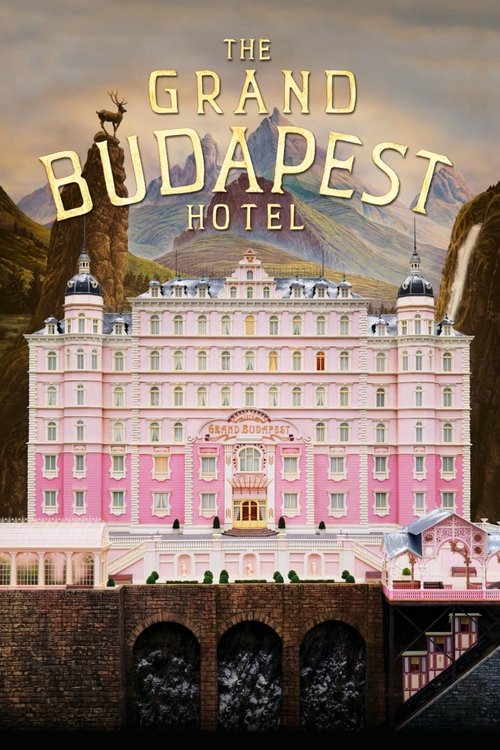
The Grand Budapest Hotel
"A murder case of Madam D. with enormous wealth and the most outrageous events surrounding her sudden death!"
Overview
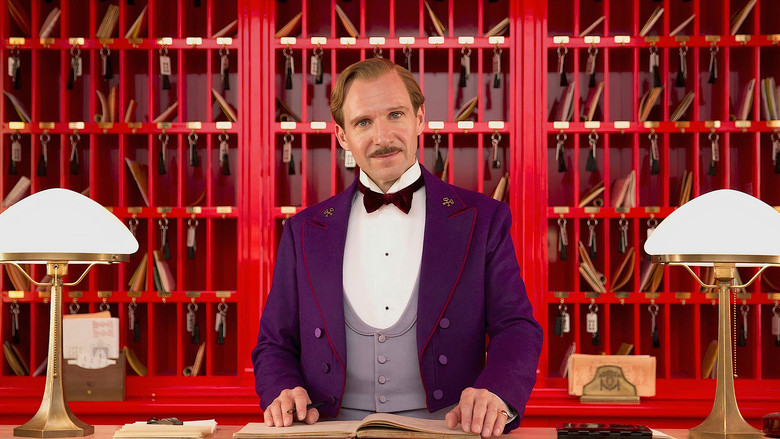
"The Grand Budapest Hotel" recounts the adventures of Gustave H. (Ralph Fiennes), a legendary concierge at a famous hotel in the fictional Republic of Zubrowka between the first and second World Wars. He is assisted by his trusted lobby boy and protégé, Zero Moustafa (Tony Revolori). The story is primarily told in flashback by an older Zero (F. Murray Abraham) to a young author (Jude Law) in the now-dilapidated hotel in the 1960s.
The central plot kicks off when one of Gustave's elderly, wealthy lovers, Madame D. (Tilda Swinton), mysteriously dies and bequeaths him a priceless Renaissance painting, "Boy with Apple." This enrages her villainous son, Dmitri (Adrien Brody), who frames Gustave for murder. Gustave and Zero are forced to go on the run, embarking on a frantic journey to prove Gustave's innocence. Along the way, they must outwit Dmitri's ruthless henchman, J.G. Jopling (Willem Dafoe), and navigate a continent on the brink of war, relying on a secret network of fellow concierges known as the Society of the Crossed Keys.

Core Meaning
The core meaning of "The Grand Budapest Hotel" is a lament for a lost past—a world of elegance, civility, and principle that has been irrevocably destroyed by the barbarism of war and fascism. Inspired by the writings of Austrian author Stefan Zweig, the film explores themes of nostalgia, not as a simple longing for "the good old days," but as a complex and often tragic act of memory. M. Gustave represents this bygone era, a man who, as the elder Zero notes, "sustained the illusion of his world with marvelous grace" long after it had already vanished. The film suggests that storytelling and memory are the only ways to preserve these ideals, even if the recollection is tinged with sadness and loss, creating a fragile bulwark against the darkness of history.
Thematic DNA
Nostalgia and the Lost Past
The film is steeped in nostalgia, framed as a story told by an old man reminiscing about his youth. This isn't a simple, rosy-eyed view of the past; it's a bittersweet acknowledgment of a world of elegance and order that has been destroyed by war. The contrast between the vibrant, pastel-colored 1930s hotel and its drab, dilapidated state in the 1960s visually represents this theme. The elder Zero Moustafa keeps the hotel not for profit, but as a connection to his memories of Gustave and his beloved Agatha, embodying the idea that the past is a place we inhabit through memory.
Civilization vs. Barbarism
M. Gustave is the embodiment of civilization, with his dedication to poetry, etiquette, and impeccable service. He believes there are still "faint glimmers of civilization left in this barbaric slaughterhouse that was once known as humanity." This civility is constantly threatened by the encroaching forces of fascism, represented by the brutal "ZZ" military forces and the thuggish Dmitri and Jopling. Gustave's ultimate fate—executed by soldiers for defending Zero—shows the tragic defeat of his ideals in the face of brute force.
Friendship and Loyalty
At its heart, the film is about the profound bond that develops between M. Gustave and Zero. What begins as a mentor-protégé relationship evolves into a deep, loyal friendship. Zero risks everything to help Gustave prove his innocence, and Gustave, in turn, defends Zero, a stateless refugee, to the point of sacrificing his own life. This theme is also exemplified by the Society of the Crossed Keys, a fraternity of concierges who demonstrate unwavering loyalty and assistance to one another, representing a network of decency in a collapsing world.
The Power of Storytelling
The film's nested narrative structure—a girl reads a book by an author who recounts a story told to him by Zero—emphasizes that history and personal legacy survive through the act of storytelling. Zero tells his story to the Author to keep the memory of Gustave and Agatha alive. The Author states that writers don't invent stories but receive them from the world. This suggests that these memories, once passed on, become part of a larger cultural narrative, preserving a world that would otherwise be forgotten.
Character Analysis
M. Gustave H.
Ralph Fiennes
Motivation
His primary motivation is to uphold the highest standards of service and civility, which he sees as the very purpose of the Grand Budapest and, by extension, his own life. He is also motivated by a love for poetry, beauty, and the company of wealthy, elderly blondes.
Character Arc
Gustave begins as a fastidious, vain, and charming concierge who embodies the ideals of the hotel. While he initially seems superficial, his journey as a fugitive reveals his deep loyalty, bravery, and a paternal love for Zero. He doesn't change his core principles but applies them with greater depth and sacrifice. His arc is ultimately tragic; he maintains his civility to the very end, which leads to his death when he confronts fascist soldiers, proving his ideals cannot survive in the brutal new world.
Zero Moustafa
Tony Revolori / F. Murray Abraham
Motivation
Initially, his motivation is simply to be a good lobby boy and earn his place. This quickly evolves into an unwavering loyalty to M. Gustave, who becomes the father figure he never had. His love for Agatha is also a central motivation, and as an older man, his sole motivation is to preserve the memory of his past happiness.
Character Arc
Young Zero starts as a penniless, stateless refugee with no family, literally a 'zero'. Under Gustave's tutelage, he becomes a competent and fiercely loyal friend. His arc is one of finding a new family and purpose. He gains a fortune and the hotel but loses both his mentor and his great love, Agatha. The older Zero is a lonely, melancholic figure who lives in the past, preserving the hotel as a monument to his memories, showing that his immense wealth could not protect him from profound loss.
Dmitri Desgoffe-und-Taxis
Adrien Brody
Motivation
His motivation is pure greed. He believes he is entitled to his family's entire fortune, particularly the 'Boy with Apple' painting, and is willing to kill anyone who stands in his way.
Character Arc
Dmitri is a static character who serves as the primary antagonist. He begins as a greedy, entitled aristocrat furious at being snubbed in his mother's will, and he remains ruthless and villainous throughout. His character represents the decay of the aristocracy into brutishness and a precursor to the fascist violence to come. His arc is simply a descent into criminality as he resorts to murder and intimidation to get what he wants.
Agatha
Saoirse Ronan
Motivation
Her motivation is her love for and loyalty to Zero. She unhesitatingly helps him and M. Gustave, even when it puts her in mortal danger, such as sneaking into the Nazi-occupied hotel to retrieve the painting.
Character Arc
Agatha is a brave, kind, and capable young baker who remains a steadfast beacon of goodness throughout the film. Her arc is defined by her relationship with Zero; she falls in love, becomes his courageous partner in the caper, and marries him. Her character doesn't undergo a significant transformation but rather demonstrates her inherent strength and loyalty. Her tragic, early death from the "Prussian Grippe" underscores the film's theme that innocence and happiness are fragile and fleeting.
Symbols & Motifs
The Grand Budapest Hotel
The hotel itself symbolizes a lost, pre-war Europe—a bastion of culture, refinement, and civility. Its physical state directly reflects the era: vibrant and grand in the 1930s, stark and impersonal in the communist-era 1960s. Its decline mirrors the decay of the civilized values Gustave champions.
The hotel is the central setting for the main story in 1932. Later, in 1968, the Author meets the owner, Mr. Moustafa, in its faded, nearly empty dining hall. The changing architecture and color palette of the hotel signify the passage of time and the erosion of its former glory.
Boy with Apple Painting
This priceless Renaissance painting is the film's MacGuffin, driving the plot. It symbolizes immense wealth and the greed it inspires in the Desgoffe-und-Taxis family. For Gustave, it represents Madame D.'s affection and a link to the world of aristocratic luxury he aspires to. Ultimately, it becomes the key to his exoneration and inheritance. The painting itself, a fictional creation for the film, represents a piece of timeless art caught in the crossfire of modern brutality.
Bequeathed to Gustave in Madame D.'s will, the painting is stolen by Gustave and Zero, hidden, and pursued by Dmitri and Jopling throughout the film. The crucial second will is eventually found taped to its back.
Mendl's Courtesan au Chocolat
These delicate, beautiful pastries from Mendl's bakery represent a small, perfect piece of the civilized world Gustave is trying to preserve. They are creations of artistry and refinement, a stark contrast to the ugliness of prison and fascism. They are also a symbol of love and connection, as they are made by Zero's beloved, Agatha.
The pastries are used throughout the film. Zero first meets Agatha when picking them up. Later, Agatha hides tools for a prison break inside them. Their perfect, delicate structure is often juxtaposed with moments of danger and chaos.
L'Air de Panache
M. Gustave's signature perfume symbolizes his unwavering commitment to his own refined persona, even in the most dire circumstances. It's an armor of civility. His near-obsession with it, even after breaking out of prison, highlights his belief that maintaining one's standards is a form of resistance against the chaos of the world.
Gustave is almost never without his perfume. He is horrified when Zero forgets to pack it for their escape from prison. Later, in a moment of bonding, he gives the perfume to Zero after being resupplied by a member of the Society of the Crossed Keys.
Memorable Quotes
You see, there are still faint glimmers of civilization left in this barbaric slaughterhouse that was once known as humanity... Indeed, that's what we provide in our own modest, humble, insignificant... Oh, f**k it.
— M. Gustave H.
Context:
Gustave says this to Zero on a train, after Inspector Henckels (an old friend) intervenes on their behalf with soldiers. It is a moment of reflection on his life's work and the state of the world.
Meaning:
This line encapsulates the film's central theme. It is Gustave's mission statement: to provide a pocket of civility and grace in an increasingly brutal world. The final, exasperated profanity adds a touch of cynical realism, acknowledging the difficulty and perhaps futility of his task.
Rudeness is merely an expression of fear. People fear they won't get what they want. The most dreadful and unattractive person only needs to be loved, and they will open up like a flower.
— M. Gustave H.
Context:
Gustave delivers this line as part of a speech to the hotel staff during their daily briefing, instructing them on the proper way to treat the guests, no matter how difficult they may be.
Meaning:
This quote reveals the philosophy behind Gustave's impeccable service. It shows his deep, albeit theatrical, empathy and his belief that kindness can transform people. It's a core tenet of the civilized world he champions.
To be frank, I think his world had vanished long before he ever entered it. But I will say, he certainly sustained the illusion with a marvelous grace.
— Zero Moustafa (as an old man)
Context:
Spoken by the elder Zero to the Author at the end of their dinner. It's his final, bittersweet summary of his mentor's life and the world he tried to build.
Meaning:
This is the film's poignant thesis statement. It acknowledges that the golden era Gustave represented was already a fantasy, an anachronism. Yet, it celebrates his dedication to maintaining that illusion as a noble and beautiful act in itself.
Take your hands off my lobby boy!
— M. Gustave H.
Context:
On a train, military police are harassing Zero for his immigrant papers. Gustave, who had previously been condescending, erupts in fury and defends him, risking his own safety.
Meaning:
This is a pivotal moment in Gustave and Zero's relationship. It's the first time Gustave demonstrates a fierce, protective, almost paternal loyalty to Zero, defending him not as an employee but as someone he truly cares for. It solidifies their bond beyond that of master and apprentice.
Philosophical Questions
Can civility and grace survive in a world descending into barbarism?
The film explores this through the character of M. Gustave, who clings to etiquette, poetry, and kindness as fascism rises. His efforts are portrayed as both noble and tragically futile. The Society of the Crossed Keys represents a network of decency, but their power is limited. Gustave's ultimate death at the hands of soldiers suggests that, in the end, brute force overwhelms civility. The film leaves the audience to ponder whether the *memory* of such grace is the only form in which it can truly survive.
How does nostalgia shape our understanding of the past?
"The Grand Budapest Hotel" presents the past through the lens of memory, colored by love and loss. The vibrant, almost dreamlike quality of the 1930s segment contrasts with the bleakness of later years, questioning whether the past was truly as magical as it is remembered. The film suggests that nostalgia is not just a recollection of events, but an act of emotional curation. Zero preserves the hotel not as it is, but as a shrine to what it once was—a vessel for his cherished, and perhaps idealized, memories of Agatha and Gustave.
What is the role of storytelling in preserving history and personal legacy?
The film's frame-story structure highlights the idea that stories are all that remain when people and places are gone. Zero tells his story to the Author to ensure Gustave is not forgotten. The Author, in turn, publishes it, giving these private memories a form of immortality. The film suggests that personal legacies and even the spirit of an entire era are not preserved in monuments, but in the narratives passed from one person to another.
Alternative Interpretations
A prominent alternative interpretation revolves around the reliability of the narrator. Since the story is filtered through multiple layers—the girl reads the book, written by the author, who is recounting a story told to him decades earlier by an elderly Zero—it's possible the events are heavily romanticized or even fabricated. Zero's version of the 1930s is intensely colorful and whimsical, a stark contrast to the drab reality of the 1960s. This could be interpreted as Zero's nostalgic and grief-stricken mind creating a beautiful, adventurous fantasy around his tragic past. M. Gustave's character, in this reading, might not have been as perfectly eloquent or heroic as remembered; he is an idealized figure in Zero's memory, a symbol of a lost world that perhaps never truly existed in such a perfect form.
Cultural Impact
"The Grand Budapest Hotel" was a significant success both critically and commercially, becoming Wes Anderson's highest-grossing film and earning nine Academy Award nominations, winning four. Its distinct aesthetic—symmetrical framing, pastel color palettes, and meticulous production design—had a profound influence on pop culture, inspiring trends in design, photography, and even travel, with fans seeking out its filming locations. The film introduced a wider audience to Anderson's unique cinematic voice while also sparking renewed interest in the works of Stefan Zweig, its literary inspiration. Critics praised it as a maturation of Anderson's style, blending his signature whimsy with deeper, more melancholic themes of loss, memory, and the erosion of civility in the face of brutality. It is frequently cited as one of the best films of the 21st century.
Audience Reception
Audiences overwhelmingly praised "The Grand Budapest Hotel" for its unique visual style, witty screenplay, and charming performances, particularly Ralph Fiennes' portrayal of M. Gustave. Viewers were captivated by its blend of laugh-out-loud slapstick comedy and moments of genuine pathos. The intricate production design and vibrant color palette were frequently cited as highlights, creating an immersive and enchanting world. Points of criticism were minor and infrequent, though some viewers found Anderson's highly stylized and symmetrical direction to be emotionally distant at times. Overall, the audience verdict was that the film is a masterfully crafted, funny, and surprisingly moving cinematic experience, widely considered one of Wes Anderson's best and most accessible works.
Interesting Facts
- The film was heavily inspired by the writings of Austrian author Stefan Zweig, particularly his novels "Beware of Pity" and his memoir "The World of Yesterday".
- To delineate the different time periods, Wes Anderson used three different aspect ratios: 1.85:1 for the modern scenes, 2.35:1 (anamorphic widescreen) for the 1960s, and 1.37:1 (the squarer "Academy ratio") for the main story in the 1930s.
- The cast and crew all stayed in the same hotel in Görlitz, Germany, during the shoot. Wes Anderson also had wardrobe and makeup fittings done in the hotel lobby to foster a communal atmosphere.
- The iconic "Boy with Apple" painting was not a real Renaissance piece but was created for the film by artist Michael Taylor over four months.
- Tilda Swinton, who played the 84-year-old Madame D., spent five hours in the makeup chair each day for her transformation.
- During a scene where Harvey Keitel's character slaps Tony Revolori's character (Zero), Keitel actually slapped Revolori for each of the 42 takes.
- Wes Anderson wrote all the newspaper articles that appear in the film himself, including one that subtly spoils the entire plot early on.
- The opulent hotel atrium was filmed in the Görlitzer Warenhaus, a defunct Art Nouveau department store in Germany.
Easter Eggs
Bill Murray's Cameo
Bill Murray, a Wes Anderson regular, appears as M. Ivan, a member of the Society of the Crossed Keys. His appearance is brief but crucial, as he helps Gustave and Zero escape. It's a classic example of Anderson using his repertory cast in small, significant roles.
Ludwig's Tattoos
The tattoos on Harvey Keitel's character, Ludwig, are a direct homage to the character of Pere Jules in Jean Vigo's 1934 film "L'Atalante". This is a nod to one of the cinematic influences on the film's pre-war European aesthetic.
Owen Wilson's Character Name
Owen Wilson plays M. Chuck, the concierge at the Grand Budapest in the 1960s. The name is likely a subtle nod to Chuck Jones, the legendary animator of Looney Tunes, whose fast-paced, meticulously timed visual gags are an influence on Anderson's comedic style.
⚠️ Spoiler Analysis
Click to reveal detailed analysis with spoilers
Frequently Asked Questions
Explore More About This Movie
Dive deeper into specific aspects of the movie with our detailed analysis pages
Comments (0)
No comments yet. Be the first to share your thoughts!