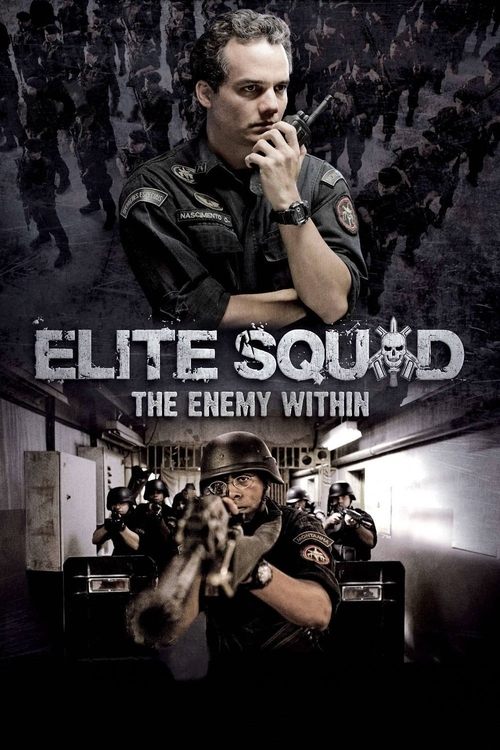
Elite Squad: The Enemy Within
A visceral political thriller where the war on crime implodes, revealing a city drowning under the weight of its own saviors.
Elite Squad: The Enemy Within

Elite Squad: The Enemy Within

Tropa de Elite 2

08 October 2010 Brazil 115 min ⭐ 7.8 (1,961)
Director: José Padilha
Cast: Wagner Moura, Irandhir Santos, André Ramiro, Pedro Van-Held, Maria Ribeiro
Drama Crime Action
Systemic Corruption The Futility of a Purely Violent Solution The Flawed Anti-Hero Media and Political Manipulation
Box Office: $63,027,681

Overview

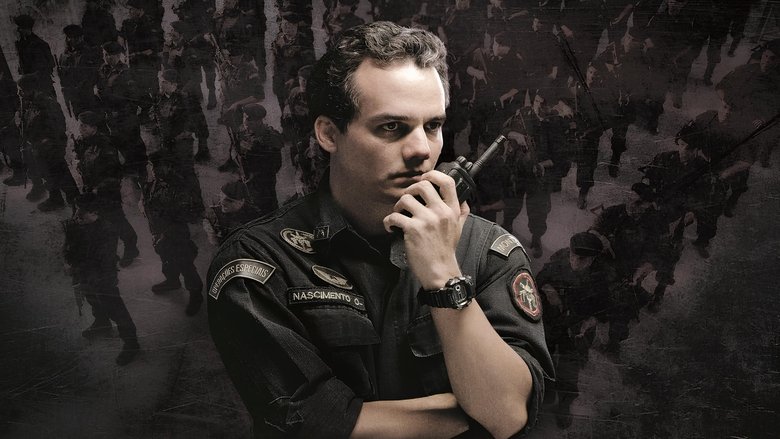
"Elite Squad: The Enemy Within" picks up over a decade after the first film. Roberto Nascimento (Wagner Moura), now a high-ranking Lieutenant Colonel in Rio de Janeiro's security apparatus, finds himself on the other side of the battle. After a bloody prison riot, which he is sent to quell, goes disastrously wrong, he is paradoxically promoted to a desk job as the Sub-Secretary of Intelligence. From this new vantage point, Nascimento believes he can finally dismantle the corrupt system from the inside out.

He launches an ambitious plan to expand and empower BOPE, the elite police squad he once led, to eradicate the drug lords from the favelas for good. However, his success creates a power vacuum that is quickly filled by a far more insidious threat: the militias, paramilitary groups formed by corrupt police officers and politicians. Nascimento discovers that the enemy is no longer just the drug dealer in the slum, but is now entrenched in the very political and law enforcement systems he serves. His fight becomes a lonely and perilous battle against an enemy that is everywhere, forcing him into an unlikely alliance with his ideological adversary, human rights activist Diogo Fraga (Irandhir Santos).
Core Meaning

The core meaning of "Elite Squad: The Enemy Within" is a scathing indictment of systemic corruption. Director José Padilha argues that the problem of violence in Brazil is not simply a matter of criminals versus police, but a deeply embedded political issue. The film's original title, "The Enemy is Now Another," explicitly states this shift in focus from the street-level drug dealers of the first film to the corrupt politicians, high-ranking police officials, and media figures who constitute "The System." Padilha's message is that simplistic, violent solutions to crime are futile because they fail to address the root causes. By clearing out the drug dealers, Nascimento inadvertently creates a more organized and powerful criminal enterprise—the militias—which is integrated with the state itself. The film posits that true change is impossible without confronting the political structure that profits from chaos and violence.

Thematic DNA

Systemic Corruption 40%
The Futility of a Purely Violent Solution 30%
The Flawed Anti-Hero 20%
Media and Political Manipulation 10%

Systemic Corruption

This is the central theme of the film. It moves beyond the street-level police corruption of the first movie to expose a deeply rooted network connecting police, paramilitary militias, politicians, and the media. Nascimento's journey from a frontline soldier to a high-level bureaucrat allows him (and the audience) to see how "The System" operates not as a conspiracy with a single leader, but as an "articulation of loathsome interests" that adapts and profits from violence and social decay. The militias taking over the favelas are not an unforeseen consequence but a logical evolution of this corruption.

The Futility of a Purely Violent Solution

Nascimento begins the film believing he can solve Rio's crime problem by empowering BOPE to be a more efficient killing machine. His strategy to wipe out the drug gangs is initially successful, but it only paves the way for a more dangerous and organized enemy: the militias. The film argues that violence without addressing the political and economic roots of crime merely displaces the problem. The state's focus on a "war on drugs" is shown to be a simplistic approach that ignores the real enemy within the political structure.

The Flawed Anti-Hero

Lt. Colonel Nascimento is a man of integrity trapped in a corrupt world. His relentless, violent methods made him a hero to some in the first film, but here he becomes more complex and disillusioned. As he gets promoted "upwards," he is forced to confront the moral compromises and the political game he despises. His transformation from a brutal police officer to a man who must use intelligence and political maneuvering to fight the system is the core of his arc. He ultimately has to ally with his nemesis, Fraga, recognizing that his old methods are useless against this new enemy.

Media and Political Manipulation

The film highlights the role of the media and populist politicians in shaping public opinion and perpetuating the cycle of violence. Characters like the TV host Fortunato use fear-mongering to gain ratings and political power, advocating for the very hardline police tactics that benefit the corrupt system. Nascimento's actions at the prison riot are spun into a heroic tale by the media, leading to his promotion, which is a political move to appease the public. This demonstrates how public perception is manipulated to serve the interests of the powerful.

Character Analysis

Roberto Nascimento

Wagner Moura

Archetype: The Disillusioned Anti-Hero
Key Trait: Relentless

Motivation

Initially, his motivation is to eradicate crime and corruption through force. As the film progresses, his motivation shifts to protecting his son, Rafael, and exposing the corrupt political system that he inadvertently helped strengthen. It becomes a personal quest for redemption and a desperate attempt to clean up the mess he helped create.

Character Arc

Nascimento evolves from a hardened BOPE commander who believes in absolute, violent justice to a politically savvy, but weary, strategist. After his promotion, he attempts to use the system's power against itself, only to realize he is a pawn. His arc is one of disillusionment, as he discovers the true enemy is not on the streets but in the halls of power. He is forced to abandon his black-and-white worldview and ally with his ideological opponent, Diogo Fraga, to achieve a small measure of justice.

Diogo Fraga

Irandhir Santos

Archetype: The Idealist
Key Trait: Principled

Motivation

Fraga is driven by a deep-seated belief in human rights and social justice. He is motivated to expose the militias and the corrupt politicians who support them, representing a path to change through democracy and law, rather than violence. His character was inspired by the real-life politician Marcelo Freixo.

Character Arc

Fraga begins as a human rights activist and history teacher who is Nascimento's ideological opposite, advocating for peaceful negotiation and condemning police brutality. After being involved in the prison riot, he is elected as a State Representative. His arc sees him move from an outsider critic to an insider fighting the system through legal and political means. He maintains his ideals but learns he must get his hands dirty and form an uneasy alliance with Nascimento to make a real difference.

André Matias

André Ramiro

Archetype: The Incorruptible Soldier
Key Trait: Honorable

Motivation

Matias is motivated by a soldier's sense of duty and a belief in the mission of BOPE. He wants to clean up the streets and believes in the unit's code. When he realizes the system itself is the problem, his motivation becomes to expose it, even at great personal cost.

Character Arc

Captain Matias represents the pure, incorruptible ideal of a BOPE officer that Nascimento once championed. He is a skilled and loyal soldier who follows orders. However, after he is made a scapegoat for the prison riot and demoted, he becomes disillusioned with Nascimento and the system. His arc is tragic; he tries to fight corruption his own way by leaking information to a journalist, but his refusal to compromise ultimately leads to his death at the hands of the corrupt system he sought to defeat.

Major Rocha

Sandro Rocha

Archetype: The Corrupt Enforcer
Key Trait: Ruthless

Motivation

Rocha is motivated by greed and power. He sees the power vacuum in the favelas as a business opportunity. He leverages his position as a police officer to run a brutal protection racket, all while working with politicians to ensure his operation is protected by "The System."

Character Arc

Rocha is a minor character in the first film who rises to become a primary antagonist. He is the face of the new enemy: the militias. His arc is a climb to power. He and his corrupt allies seize the opportunity created by BOPE's crackdown on drug dealers to establish their own criminal empire, extorting residents and consolidating political power through violence and intimidation. He represents the successful adaptation of corruption.

Symbols & Motifs

The BOPE Skull Logo

Meaning:

The skull emblem of the BOPE (Batalhão de Operações Policiais Especiais) symbolizes an uncompromising, ruthless approach to justice—death to criminals. In the first film, it represented a clear-cut, albeit brutal, ideology. In the sequel, as BOPE's power is co-opted and the lines blur, the symbol becomes more ambiguous. It represents a brand of violence that, while effective against one enemy, becomes a tool for an even greater evil when wielded by the corrupt system.

Context:

The logo is seen on the black uniforms and vehicles of the BOPE officers. When Nascimento is promoted, he uses his power to expand BOPE's reach, believing in the power this symbol represents. However, the tragic fate of Captain Matias, a true believer in the BOPE ethos, shows the vulnerability of this ideal in a corrupt system.

The View from the Office

Meaning:

Nascimento's promotion takes him from the favela streets to a high-rise office with a panoramic view of the city. This symbolizes his shift in perspective. From the ground, the enemy was clear (drug dealers). From above, he can see the interconnected web of politics, media, and police corruption—the true 'system'—that governs the city. It represents a strategic, but detached, viewpoint, where he can see the whole board but is removed from the direct action he craves.

Context:

Several key scenes take place in Nascimento's office, where he monitors wiretaps and observes the city below. It is from this perch that he realizes his efforts to clean up the streets have only empowered the corrupt officials who operate from similar offices.

Wiretaps and Recordings

Meaning:

The constant use of wiretaps and hidden recordings symbolizes the new nature of the war. The battle is no longer won with guns alone, but with information. For Nascimento, wiretaps are his primary weapon to understand and expose the system. For the corrupt politicians, they are a tool for blackmail and control. This highlights the shift from a physical war in the favelas to a political thriller centered on intelligence and secrets.

Context:

Nascimento is put in charge of all wiretaps in Rio. He uses this power to uncover the militia's schemes. The film's climax involves a journalist's hidden recording that contains evidence of the politicians' crimes, which becomes the key to exposing them.

Memorable Quotes

O inimigo agora é outro.

— Roberto Nascimento (Narration)

Context:

This is a recurring idea in Nascimento's narration as he pieces together the new power structure in Rio after his crackdown on the drug trade inadvertently creates a vacuum for the militias to fill.

Meaning:

Translated as "The enemy is now another," this line is the film's original subtitle and its core thesis. It signifies the shift in Nascimento's understanding of the conflict, from a war against drug dealers to a battle against a corrupt political system and the militias it fosters.

O sistema é foda, parceiro.

— Roberto Nascimento (Narration)

Context:

This line is delivered in Nascimento's voiceover, often after he has witnessed a setback or a new level of political depravity, summarizing his growing disillusionment throughout the film.

Meaning:

Translated as "The system is a motherfucker, partner." This quote encapsulates Nascimento's ultimate realization of the scale and complexity of the corruption he faces. It's a statement of cynical resignation, acknowledging that "The System" is an impersonal, pervasive, and seemingly unbeatable force.

Um policial não puxa o gatilho sozinho.

— Roberto Nascimento

Context:

Nascimento says this during a confrontation, likely with a politician or Fraga, to explain that the violence on the streets is a symptom of a much deeper political disease.

Meaning:

"A cop doesn't pull the trigger by himself." This statement reflects Nascimento's matured understanding of responsibility. He realizes that a police officer's actions are the final result of a long chain of political decisions, media pressure, and systemic failures. It's his argument against blaming individual officers for a problem created and sustained by politicians.

Philosophical Questions

Can a fundamentally corrupt system be reformed from within?

The film explores this question through Nascimento's entire arc. He is given immense power within the Secretariat of Security and attempts to use the tools of the state—increased funding for BOPE, surveillance technology—to fix the problem. However, every action he takes is co-opted by "The System" to strengthen itself. His success in eliminating drug dealers only creates a new, more powerful criminal enterprise integrated with the state. The film bleakly suggests that working within the system may only serve to legitimize and empower it, implying that true reform might be impossible without a complete dismantling of the existing structures.

What is the relationship between state-sanctioned violence and organized crime?

"The Enemy Within" masterfully illustrates the porous boundary between law enforcement and criminality. It argues that the state's violent methods, embodied by BOPE, do not eliminate crime but transform it. The corrupt police officers who form the militias use their state-given training, weapons, and authority to run their own criminal enterprises. The film posits that when the state relies solely on violence and fails to address socio-economic issues and internal corruption, it inadvertently becomes the most efficient incubator for a more sophisticated and dangerous form of organized crime.

Where does the true responsibility for societal violence lie?

Nascimento's quote, "A cop doesn't pull the trigger by himself," is central to this question. The film systematically shifts the blame for violence away from individual actors—be they drug dealers or police officers—and towards the political and media figures who create and exploit the conditions for that violence. It holds politicians who trade votes for militia support, media moguls who profit from fear, and a public that demands simplistic, brutal solutions accountable. The film suggests that responsibility is collective and rooted in the political choices a society makes.

Alternative Interpretations

While the dominant interpretation sees the film as a powerful critique of systemic corruption, some alternative readings and debates exist. One perspective questions whether the film, despite its critical stance, still inadvertently glamorizes BOPE and its violent methods. Nascimento, though disillusioned, remains a charismatic and competent protagonist, and the action sequences are thrillingly choreographed, which could lead some viewers to sympathize more with his direct-action approach than the film's ultimate message about its futility.

Another interpretation focuses on the film's ending. Nascimento exposes several corrupt politicians, but his final narration over images of Brasília, the capital, suggests that he has only cut off a few heads of the hydra while "The System" remains intact and will simply adapt. Some view this as a deeply pessimistic and cynical conclusion, suggesting that real change is impossible. Others interpret it as a powerful call to arms, a final warning to the audience that the fight is far from over and must be waged at the highest levels of government. The film leaves it ambiguous whether Nascimento's actions represent a victory or a noble but ultimately failed gesture.

Cultural Impact

"Elite Squad: The Enemy Within" had a monumental cultural impact in Brazil, transcending cinema to become a significant part of the national discourse on public security, political corruption, and police violence. It broke all-time box office records, becoming the highest-grossing film in Brazilian history, indicating how deeply its themes resonated with the public.

The film's release coincided with and was partly inspired by real-life political investigations into paramilitary militias in Rio de Janeiro, most notably those led by state representative Marcelo Freixo, who served as the basis for the character Diogo Fraga. This grounding in reality gave the film an urgent, documentary-like feel that audiences responded to, sparking widespread debate. The term "The System" (O Sistema), as used in the film to describe the amorphous network of corrupt interests, became a popular shorthand in Brazilian media and daily conversation to refer to systemic corruption.

Critically, the film was hailed as a more mature and complex work than its predecessor, shifting the focus from the visceral action of BOPE to the political machinations behind the violence. It was selected as Brazil's entry for the Best Foreign Language Film at the 84th Academy Awards, although it was not shortlisted. Its success brought international attention to director José Padilha and star Wagner Moura, with Padilha going on to direct the "RoboCop" remake.

Audience Reception

Audience reception for "Elite Squad: The Enemy Within" was overwhelmingly positive, particularly in its native Brazil, where it became a cultural phenomenon and the country's all-time highest-grossing film. Viewers praised its thrilling action sequences, Wagner Moura's powerful performance as the hardened and evolving Nascimento, and its gripping, complex plot. Many lauded the film for its courage in tackling the sensitive and timely issue of political corruption and its connection to paramilitary militias, a subject that resonated deeply with the Brazilian public's own experiences and frustrations.

Points of criticism were relatively minor but did exist. Some viewers found the plot, with its many characters and political machinations, to be dense and occasionally hard to follow. The heavy reliance on Nascimento's voice-over narration to explain complex political details was criticized by some as an overly didactic storytelling device that told the audience what to think rather than showing them. Despite this, the general consensus among audiences was that it was a rare sequel that surpassed the original, elevating a gritty crime story into a sophisticated and urgent political thriller.

Interesting Facts

  • The film is the highest-grossing Brazilian film of all time at the domestic box office, surpassing "Avatar".
  • To prevent the rampant piracy that plagued the first film's release, the production team implemented extreme security measures. No digital copies were used; the entire film was shot and distributed on 35mm film, and post-production was done in-house.
  • The character of Diogo Fraga is heavily inspired by Marcelo Freixo, a real-life Rio de Janeiro state representative known for his investigations into paramilitary militias.
  • Director José Padilha considers this film to be the third part of a trilogy about violence, poverty, and the state in Brazil, beginning with his documentary "Bus 174" (2002) and continuing with the first "Elite Squad" (2007).
  • The intense prison riot scene was filmed over four days during the 2010 Carnival.
  • Production was denied permission to film inside the actual National Congress in Brasília, so they built a replica of the Ethics Committee room inside a Rio de Janeiro building.
  • Due to the film's immense popularity and critical message, director José Padilha believed it discouraged politicians from openly attacking the movie, as they didn't want to be seen as opposing a cultural phenomenon.
  • Padilha has stated he has no plans to make an "Elite Squad 3," feeling he has said everything he wanted to say about the topic of violence and corruption with these films.

⚠️ Spoiler Analysis

Click to reveal detailed analysis with spoilers

Frequently Asked Questions

Explore More About This Movie

Dive deeper into specific aspects of the movie with our detailed analysis pages

Comments (0)

Leave a comment

No comments yet. Be the first to share your thoughts!