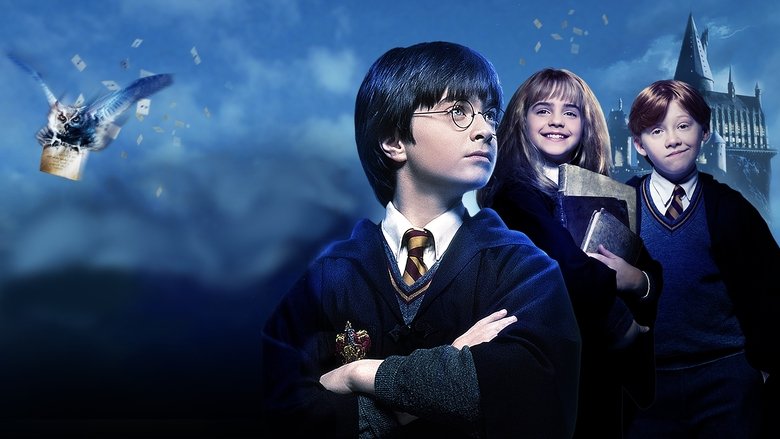
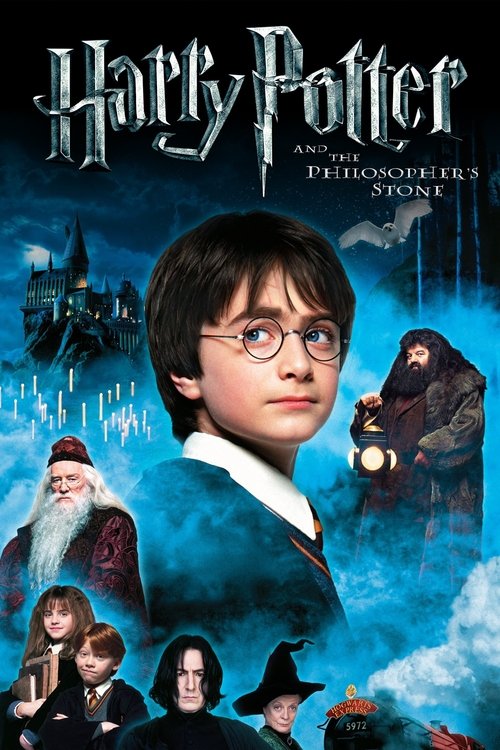
Harry Potter and the Philosopher's Stone
A whimsical fantasy adventure that blossoms with the warmth of newfound friendship, painting a world of magic through the wide eyes of a boy discovering his destiny.
Harry Potter and the Philosopher's Stone

Harry Potter and the Philosopher's Stone

"Let the magic begin."

16 November 2001 United Kingdom 152 min ⭐ 7.9 (28,740)
Director: Chris Columbus
Cast: Daniel Radcliffe, Rupert Grint, Emma Watson, Richard Harris, Tom Felton
Fantasy Adventure
Good vs. Evil Friendship and Loyalty The Power of Love Choice and Destiny
Budget: $125,000,000
Box Office: $976,475,550

Overview

"Harry Potter and the Philosopher's Stone" introduces Harry Potter, an orphaned boy living a miserable existence with his neglectful aunt, uncle, and cousin, the Dursleys. On his eleventh birthday, his life is turned upside down when a giant named Hagrid reveals a shocking truth: Harry is a wizard. He learns that his parents were powerful wizards murdered by the dark Lord Voldemort, and he somehow survived the attack that left him with a lightning-bolt scar on his forehead.

Whisked away from his mundane life, Harry is introduced to the vibrant and hidden wizarding world. He travels to Diagon Alley to buy his school supplies and boards the Hogwarts Express at Platform 9 3/4, where he befriends Ron Weasley and Hermione Granger. Upon arriving at Hogwarts School of Witchcraft and Wizardry, the trio is sorted into Gryffindor house. Harry begins his magical education, learning to fly a broomstick and becoming the youngest Quidditch player in a century, all while navigating the challenges of school life and a budding rivalry with Draco Malfoy from Slytherin house.

As the school year progresses, Harry, Ron, and Hermione become suspicious of the secretive actions of Professor Snape and discover the existence of the Philosopher's Stone, a legendary object that can grant immortality. Believing Snape is trying to steal the stone for Voldemort, they decide to protect it themselves. Their investigation leads them through a series of magical obstacles protecting the stone, testing their courage, intelligence, and friendship.
Core Meaning

At its core, "Harry Potter and the Philosopher's Stone" is a story about the triumph of good over evil, the profound power of love, and the importance of friendship and courage. The film explores the idea that our choices, not our abilities, define who we are. Director Chris Columbus brings to life a world where the mundane and the magical coexist, emphasizing that true magic lies not just in spells and potions, but in the bonds we form and the bravery we find within ourselves. The central message is one of hope and belonging, as an unloved orphan finds his true family and home in a world he never knew existed.

Thematic DNA

Good vs. Evil 35%
Friendship and Loyalty 30%
The Power of Love 25%
Choice and Destiny 10%

Good vs. Evil

The classic struggle between good and evil is the central pillar of the narrative. This is primarily embodied in the conflict between Harry Potter and Lord Voldemort. Voldemort represents the ultimate evil, driven by a lust for power and immortality, while Harry, even as a child, represents innate goodness, courage, and self-sacrifice. The film establishes this theme from the beginning, with the murder of Harry's parents and Voldemort's first downfall, setting the stage for their future confrontations.

Friendship and Loyalty

The film places immense value on the power of friendship. The bond between Harry, Ron, and Hermione is crucial to their success and survival. Each character brings unique strengths to the trio: Harry's bravery, Ron's loyalty and strategic thinking, and Hermione's intelligence and resourcefulness. Their willingness to stand by each other, even in the face of immense danger, is what allows them to overcome the obstacles guarding the Philosopher's Stone. Dumbledore himself highlights this by awarding Neville Longbottom points for having the courage to stand up to his friends, emphasizing the moral complexity and importance of these bonds.

The Power of Love

Love is depicted as the most powerful form of magic in the film. It is the sacrificial love of Harry's mother, Lily, that protects him from Voldemort's killing curse, leaving him with only a scar. Dumbledore explains to Harry at the end of the film that this love left a lasting magical protection on him, which is why Professor Quirrell, who was sharing a body with Voldemort, could not touch him without being burned. This theme posits that love is a force stronger than the darkest of magic.

Choice and Destiny

While Harry is often referred to as "The Chosen One," the film suggests that his destiny is not predetermined but is shaped by the choices he makes. The Sorting Hat initially considers placing Harry in Slytherin, but it is Harry's own choice to be in Gryffindor that ultimately decides his fate. This theme is reinforced throughout the series, emphasizing that one's character and path are defined by their actions and decisions rather than their innate talents or heritage.

Character Analysis

Harry Potter

Daniel Radcliffe

Archetype: The Hero
Key Trait: Courageous

Motivation

Harry is primarily motivated by a desire for belonging and to understand his past. He longs for the family he never knew and finds a surrogate one in his friends and the Hogwarts community. His motivation evolves to include protecting his new home and friends from the evil that threatens them, driven by a strong sense of right and wrong.

Character Arc

Harry begins the film as a neglected and unassuming orphan, unaware of his magical heritage. His journey to Hogwarts is a path of self-discovery, where he transforms from a timid boy into a brave young wizard who stands up to evil. He finds a sense of belonging and family for the first time, learns about his past, and takes his first steps towards embracing his destiny. By the end, he has faced his parents' murderer and has proven his courage and moral strength.

Hermione Granger

Emma Watson

Archetype: The Sage/The Loyal Companion
Key Trait: Intelligent

Motivation

Hermione is driven by a deep desire to prove herself and succeed academically. As a Muggle-born witch, she may feel an additional pressure to excel in the wizarding world. Her motivation expands to include a fierce loyalty to her friends and a commitment to doing what is right, even if it means breaking the rules.

Character Arc

Hermione is introduced as an intelligent, rule-abiding, and somewhat socially awkward know-it-all. Initially, her insistence on following the rules puts her at odds with Harry and Ron. However, after they save her from a mountain troll, she learns the value of friendship over cleverness and rules. She becomes fiercely loyal and an indispensable member of the trio, using her vast knowledge and quick thinking to help them overcome challenges.

Ron Weasley

Rupert Grint

Archetype: The Sidekick/The Everyman
Key Trait: Loyal

Motivation

Ron's motivation stems from a desire for friendship and to prove his own worth. He is drawn to Harry's unassuming nature despite his fame. He is also motivated by a strong sense of loyalty to his friends and family and a desire to stand up against injustice, particularly as represented by the Slytherins.

Character Arc

Ron starts as a good-natured but insecure boy from a large, poor wizarding family. He often feels overshadowed by his older brothers and is initially intimidated by Harry's fame. Throughout the film, he proves himself to be a loyal and brave friend. His moment to shine comes during the giant chess game, where he demonstrates brilliant strategic thinking and makes a heroic self-sacrifice, showing his growth in confidence and courage.

Albus Dumbledore

Richard Harris

Archetype: The Mentor
Key Trait: Wise

Motivation

Dumbledore's primary motivation is the protection of the wizarding world from the return of Voldemort and, more specifically, the protection and guidance of Harry Potter. He orchestrates events to test Harry and allow him to grow, believing in Harry's capacity to choose the right path.

Character Arc

Dumbledore is presented as the wise, powerful, and slightly eccentric Headmaster of Hogwarts. His arc in this film is less about personal change and more about guiding and protecting Harry. He acts as a benevolent, albeit mysterious, guardian, providing Harry with crucial information and support at key moments. He reveals his wisdom through his cryptic advice and his understanding of deep magic, particularly the magic of love.

Symbols & Motifs

The Lightning-Bolt Scar

Meaning:

Harry's scar is a powerful symbol of his past trauma, his survival, and his unique connection to Lord Voldemort. It represents the enduring power of his mother's love, which saved him from the killing curse. It also serves as a constant physical reminder of his destiny and the ever-present threat of evil.

Context:

The scar is a prominent feature on Harry's forehead throughout the entire film. It often tingles or burns when Voldemort is near or when Harry experiences a strong connection to him, acting as a kind of early warning system and a tangible link to his adversary.

The Mirror of Erised

Meaning:

The Mirror of Erised (Desire spelled backward) symbolizes the deepest, most desperate desires of a person's heart. For Harry, it shows him the family he never had. Dumbledore warns that it shows neither truth nor knowledge and that men have wasted away before it, lost in their dreams. It symbolizes the danger of dwelling on unobtainable desires and the importance of living in the present.

Context:

Harry discovers the mirror in a deserted classroom and is captivated by the image of his parents and extended family. Later, the mirror becomes the final protection for the Philosopher's Stone. Harry is able to retrieve the stone from the mirror because he wants to find it to protect it, not to use it for his own gain, a desire Voldemort cannot comprehend.

The Philosopher's Stone

Meaning:

The Philosopher's Stone represents the ultimate temptations of eternal life and unlimited wealth. It is the object of Voldemort's desire as he seeks to regain his physical form and conquer death. Ultimately, its destruction signifies the film's message that there are things more important than longevity and power, and that death, as Dumbledore says, can be seen as "the next great adventure" to a well-organized mind.

Context:

The stone is hidden within Hogwarts for safekeeping. The central mystery of the film revolves around who is trying to steal it. Harry, Ron, and Hermione brave numerous enchantments to reach the stone and prevent it from falling into the wrong hands, leading to Harry's final confrontation with Professor Quirrell and Voldemort.

Quidditch

Meaning:

On the surface, Quidditch is a magical sport. Symbolically, however, it represents the importance of teamwork, courage, and facing challenges. Harry's role as the Seeker, who must catch the elusive Golden Snitch to win the game, mirrors his larger role in the fight against Voldemort—a difficult and crucial task that often isolates him but is essential for victory.

Context:

Harry's natural talent for flying leads to him being recruited for the Gryffindor Quidditch team. The Quidditch match is a major set piece in the film, filled with excitement and danger, particularly when Harry's broomstick is jinxed, leading Hermione to suspect Snape.

Memorable Quotes

It does not do to dwell on dreams and forget to live.

— Albus Dumbledore

Context:

Harry has been secretly visiting the Mirror of Erised, which shows him his deepest desire: to be with his deceased parents. Dumbledore finds him there and gently explains the mirror's dangerous allure before telling him it will be moved.

Meaning:

This quote encapsulates one of the film's key themes. Dumbledore says this to Harry after finding him mesmerized by the Mirror of Erised. It is a profound piece of wisdom about the dangers of living in the past or in fantasy, and the importance of engaging with the present reality.

You're a wizard, Harry.

— Rubeus Hagrid

Context:

After the Dursleys try to escape the barrage of Hogwarts letters, Hagrid tracks them down to a remote hut on his eleventh birthday. He delivers Harry's acceptance letter personally and reveals his true identity when Harry expresses confusion.

Meaning:

This is the pivotal line that changes Harry's life forever. It's the moment the magical world is revealed to him and the audience. The quote signifies the beginning of Harry's journey of self-discovery and his transition from a neglected orphan to a central figure in a world of magic.

It takes a great deal of bravery to stand up to our enemies, but just as much to stand up to our friends.

— Albus Dumbledore

Context:

During the end-of-year feast, Dumbledore is awarding last-minute house points. After giving points to Harry, Ron, and Hermione for their heroism, he awards crucial points to Neville for his bravery, which ultimately wins Gryffindor the House Cup.

Meaning:

This quote highlights the film's emphasis on moral courage. Dumbledore praises Neville Longbottom for attempting to stop Harry, Ron, and Hermione from breaking the rules, even though they are his friends. It suggests that true bravery isn't just about fighting external foes but also about upholding one's principles, even when it's difficult or unpopular.

Fear of a name only increases fear of the thing itself.

— Albus Dumbledore

Context:

Early in the film, Dumbledore speaks to Professor McGonagall about Voldemort. He calmly uses Voldemort's name, while most others refer to him as "You-Know-Who" or "He-Who-Must-Not-Be-Named."

Meaning:

This line, spoken by Dumbledore (and later echoed by Hermione in the books), addresses the wizarding world's terror surrounding Lord Voldemort. By refusing to even speak his name, they give him more power. The quote is a lesson on confronting fears directly rather than avoiding them, suggesting that acknowledging something is the first step to overcoming it.

We could all have been killed - or worse, expelled.

— Hermione Granger

Context:

Spoken by Hermione after the trio has just survived a dangerous encounter with Fluffy, the three-headed dog, on the forbidden third floor. Despite the mortal danger, her immediate concern is the risk of being expelled from Hogwarts.

Meaning:

This line perfectly encapsulates Hermione's character at the beginning of the film. It's played for comedic effect but reveals her deep-seated fear of failure and her prioritization of rules and academic achievement above all else. It humorously shows her perspective before she fully embraces the value of friendship and bravery over strict adherence to regulations.

Philosophical Questions

What is the nature of true bravery?

The film explores different facets of bravery. There is the overt heroism of Harry facing down Voldemort, but the film also highlights quieter forms of courage. Ron's self-sacrifice in the chess game demonstrates strategic bravery and loyalty. However, the most profound exploration comes from Dumbledore's statement about Neville: "It takes a great deal of bravery to stand up to our enemies, but just as much to stand up to our friends." This suggests that true courage is not just about physical conflict, but also about moral integrity and the willingness to do what is right, even when it means opposing those you care about.

Are our lives governed by destiny or by choice?

"Harry Potter and the Philosopher's Stone" introduces the idea of Harry as a figure of destiny, "The Boy Who Lived." However, it immediately complicates this notion. The Sorting Hat reveals that Harry possessed the qualities to be in Slytherin but was placed in Gryffindor because he chose it. This pivotal moment suggests that while people may have certain predispositions or be placed on a certain path by fate, it is ultimately their choices that define their character and shape their future. The film posits a compatibility between destiny and free will, where one's fated role is actualized through conscious moral decisions.

What is the relationship between desire and happiness?

The Mirror of Erised serves as a powerful philosophical tool to explore this question. It shows the viewer nothing less than their "deepest, most desperate desire." Harry finds temporary solace in the image of his parents, but Dumbledore's warning that it "does not do to dwell on dreams and forget to live" conveys a clear message. The film suggests that true happiness cannot be found by passively yearning for what we don't have. Instead, it is found in accepting reality and actively living in the present. The mirror is a trap for those who cannot let go of their desires, illustrating that unchecked longing leads to stagnation and sorrow, not fulfillment.

Alternative Interpretations

While the film presents a relatively straightforward narrative of good versus evil, some alternative interpretations exist. One perspective views the story through a lens of social commentary on the British class system and prejudice. The pure-blood versus Muggle-born conflict, personified by the disdain Draco Malfoy shows for Hermione, can be seen as an allegory for racism and bigotry. The Dursleys represent the worst of middle-class conformity and intolerance for anything different.

Another interpretation delves into the psychological aspects of Harry's journey. His initial life in the cupboard under the stairs can be read as a metaphor for childhood neglect and trauma. The discovery of the magical world, therefore, represents a form of escapism and the creation of a rich inner world to cope with an unbearable reality. From this viewpoint, Hogwarts is not just a school but a sanctuary and a place for psychological healing, where Harry finds a supportive community and builds the self-esteem that was denied to him in his early life.

Cultural Impact

The release of "Harry Potter and the Philosopher's Stone" in 2001 was a monumental event in pop culture. It successfully translated the magic of J.K. Rowling's wildly popular book series to the big screen, launching one of the most successful film franchises in history. The movie, along with the books, is credited with igniting a passion for reading among a generation of children and young adults, proving that longer, more complex novels could be commercially successful in the youth market. This phenomenon became known as the "Harry Potter effect."

The film's success revitalized the fantasy genre and created a blueprint for future young adult book-to-film adaptations, paving the way for franchises like "The Hunger Games" and "Twilight." It established a globally recognized brand that extends far beyond literature and film, encompassing theme parks, merchandise, and a dedicated global fanbase that remains active decades later. The film captured the public imagination by creating a richly detailed and immersive world that felt both magical and relatable, touching on universal themes of friendship, courage, and the struggle between good and evil. It became a cultural touchstone, with its characters, spells, and locations becoming an ingrained part of the global cultural lexicon.

Audience Reception

"Harry Potter and the Philosopher's Stone" was met with a highly positive reception from audiences worldwide. Fans of the book series largely praised the film for its faithful adaptation of the source material, appreciating the detailed re-creation of the magical world and the casting of the main characters. The performances of the young lead actors, Daniel Radcliffe, Rupert Grint, and Emma Watson, were widely celebrated, as they were seen to perfectly embody their literary counterparts. The film received an "A" grade from audiences surveyed by CinemaScore, indicating strong satisfaction. Viewers were particularly impressed by the film's magical atmosphere, the stunning set design of locations like Hogwarts and Diagon Alley, and John Williams' iconic musical score. While some critics and viewers noted the film's lengthy runtime and occasionally dated CGI, especially in the Quidditch scenes, the overwhelming consensus was that it was a charming and captivating beginning to the franchise that successfully brought the beloved book to life.

Interesting Facts

  • The child actors' reactions to seeing the Great Hall for the first time were genuine, as they had not been allowed to see the set beforehand.
  • Richard Harris only accepted the role of Albus Dumbledore after his 11-year-old granddaughter threatened to never speak to him again if he didn't.
  • Due to an allergic reaction, Daniel Radcliffe couldn't wear the green contact lenses that would have matched Harry's eyes in the book, so his eyes remained blue in the films.
  • The floating candles in the Great Hall were initially created using real candles suspended by wires. However, the heat from the flames kept burning through the wires, causing the candles to drop. The effect was then changed to be computer-generated.
  • Scenes for the film were shot mostly in chronological order to help the young, inexperienced actors better develop their characters and feel the story's progression.
  • The character of Peeves the Poltergeist was cast and filmed, with comedian Rik Mayall playing the part, but all of his scenes were ultimately cut from the final film.
  • To create the illusion of Hagrid's immense size, the production team built two different versions of some sets. A larger-scale set was used to make other characters appear smaller, while a smaller-scale set was used to make Hagrid appear giant.
  • J.K. Rowling was heavily involved in the production, including having input on the script and insisting that the cast be predominantly British.

Easter Eggs

Anne Boleyn's Portrait

In a scene where Harry, Ron, and Hermione are walking up the moving staircases, a portrait of Anne Boleyn can be seen. Anne Boleyn, the second wife of King Henry VIII, was famously accused of witchcraft and executed. Her inclusion in a Hogwarts portrait is a clever historical nod, suggesting that in the wizarding world, she was indeed a witch.

Trophy Room Names

In the Hogwarts trophy room, one of the plaques for Quidditch Captain has the name "M.G. McGonagall." This is a nod to Professor Minerva McGonagall, who, in her younger days, was a skilled Quidditch player for Gryffindor. Another trophy shown lists James Potter as a Seeker for the Gryffindor team, and another plaque shows Tom Riddle (a young Voldemort) received an award for special services to the school.

Wizard's Chess Foreshadowing

Early in the film, Ron is seen teaching Harry how to play Wizard's Chess. The specific game they play, where Ron sacrifices his queen, foreshadows the life-sized game they must play to get to the Philosopher's Stone, where Ron heroically sacrifices himself as the knight to allow Harry and Hermione to proceed.

The Disappearing Leaky Cauldron Sign

When Hagrid and Harry approach the Leaky Cauldron pub in London, the sign is initially black and unreadable from a distance. As they, as magical beings, get closer, the sign magically reveals itself. This subtle detail shows how the magical world hides itself from the non-magical (Muggle) world.

⚠️ Spoiler Analysis

Click to reveal detailed analysis with spoilers

Frequently Asked Questions

Explore More About This Movie

Dive deeper into specific aspects of the movie with our detailed analysis pages

Comments (0)

Leave a comment

No comments yet. Be the first to share your thoughts!