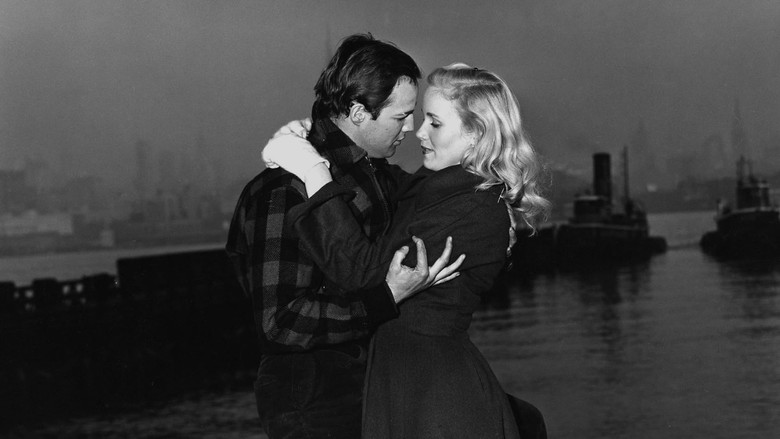
On the Waterfront
A gritty, black-and-white crime drama where the oppressive fog of corruption is pierced by one man's agonizing struggle for conscience, a battle fought not in a ring, but on the soul-crushing docks.
On the Waterfront

On the Waterfront

"The man lived by the jungle law of the docks!"

22 June 1954 United States of America 108 min ⭐ 7.9 (1,685)
Director: Elia Kazan
Cast: Marlon Brando, Karl Malden, Lee J. Cobb, Eva Marie Saint, Rod Steiger
Drama Crime Romance
Corruption and Power Individual Conscience vs. Group Loyalty Redemption and Sacrifice The Transformative Power of Faith and Love
Budget: $910,000
Box Office: $960,000

Overview

"On the Waterfront" tells the powerful story of Terry Malloy (Marlon Brando), a former prize-fighter now working as a longshoreman on the mob-controlled docks of Hoboken, New Jersey. His brother, Charley (Rod Steiger), is the right-hand man to the corrupt union boss, Johnny Friendly (Lee J. Cobb), which affords Terry a relatively easy life. However, Terry's complicity is tested when he is unwittingly used to lure a fellow dockworker, Joey Doyle, to his death for planning to testify against Friendly's racketeering.

Haunted by his role in the murder, Terry's conscience is further stirred by the passionate crusade of the local priest, Father Barry (Karl Malden), and his burgeoning relationship with Joey's grieving sister, Edie (Eva Marie Saint). As Terry grapples with his loyalty to the mob and his growing desire for justice and redemption, he finds himself on a collision course with the powerful and ruthless forces that control the waterfront. The film chronicles his painful journey from a passive bystander to a man who must decide whether to remain "deaf and dumb" or to speak out and challenge the entire corrupt system.

Core Meaning

The core meaning of "On the Waterfront" revolves around the profound moral struggle of an individual's conscience against a corrupt and oppressive system. Director Elia Kazan, through Terry Malloy's journey, explores the immense pressure and profound cost of breaking a code of silence. The film serves as a powerful allegory for speaking truth to power, regardless of the personal consequences.

Furthermore, the film is widely interpreted as Kazan's personal and public justification for his own controversial decision to testify before the House Un-American Activities Committee (HUAC), where he named former colleagues as communists. Terry's climactic cry, "I'm glad what I done!" is seen by many as a direct reflection of Kazan's own feelings about his testimony, framing the act of informing not as a betrayal, but as a painful yet necessary moral imperative to combat a greater evil. The film champions the idea that individual integrity and redemption are attainable, but often through great personal suffering and sacrifice.

Thematic DNA

Corruption and Power 35%
Individual Conscience vs. Group Loyalty 30%
Redemption and Sacrifice 25%
The Transformative Power of Faith and Love 10%

Corruption and Power

The film paints a bleak picture of the Hoboken docks, where the longshoremen's union, led by the iron-fisted Johnny Friendly, is riddled with corruption, extortion, and violence. Friendly and his cronies exploit the workers, controlling their livelihoods through the dehumanizing "shape-up" system and demanding absolute loyalty. This power is maintained through fear and a strict code of silence ("deaf and dumb"). The film meticulously details how this corruption poisons the community, making honest work and justice seem impossible.

Individual Conscience vs. Group Loyalty

Terry Malloy's central conflict is a battle between his loyalty to his brother and Johnny Friendly's mob and the awakening of his own conscience. Initially, he lives by the local code of not "ratting," but witnessing brutality, falling for Edie, and being influenced by Father Barry forces him to confront the immorality of his silence. The film dramatizes the intense psychological turmoil of this choice, highlighting the isolation and danger that comes with standing alone against the group.

Redemption and Sacrifice

"On the Waterfront" is fundamentally a story of redemption. Terry begins as a "bum," a washed-up fighter who has thrown away his potential. His journey to testify against the mob is also a path to reclaiming his dignity and self-worth. This redemption is not easily won; it requires immense sacrifice. He loses the protection of the mob, the trust of his peers, and ultimately his brother. His final, brutal beating on the docks serves as a form of penance, a physical manifestation of his struggle through which he emerges, broken but morally triumphant.

The Transformative Power of Faith and Love

Two characters are crucial catalysts for Terry's transformation: Father Barry and Edie Doyle. Father Barry represents the power of moral and religious conviction, delivering powerful sermons that equate the mob's actions with the crucifixion and demanding the men fight for their souls. Edie represents the power of love and innocence. Her unwavering belief in justice and her gentle nature awaken a tenderness in Terry, giving him a personal stake in the fight against the corruption that killed her brother.

Character Analysis

Terry Malloy

Marlon Brando

Archetype: Anti-hero
Key Trait: Conflicted

Motivation

Initially motivated by a desire for an easy life under Friendly's protection, his motivation shifts to a need for redemption and self-respect. He is driven by his guilt, his love for Edie, and his desire to finally be "a contender" in a moral sense, to prove he is not just a "bum."

Character Arc

Terry begins the film as an errand boy for the mob, a former boxer whose spirit was broken when his own brother forced him to throw a fight. He is initially passive and concerned only with self-preservation. Through his guilt over Joey's death, his relationship with Edie, and Father Barry's guidance, he undergoes a profound moral transformation. He evolves from a mumbling, conflicted man into a courageous figure who reclaims his dignity by testifying against Friendly and enduring a brutal beating to inspire his fellow workers.

Edie Doyle

Eva Marie Saint

Archetype: The Innocent / Moral Compass
Key Trait: Righteous

Motivation

Her primary motivation is to uncover the truth and achieve justice for her brother's murder. She is driven by a powerful sense of right and wrong, which she tries to impart to Terry and the other longshoremen.

Character Arc

Raised in the neighborhood but educated in a convent, Edie returns to the waterfront as an outsider, shielded from its brutality. The murder of her brother forces her into this corrupt world. While she starts as naive, her resolve to find justice never wavers. She remains a beacon of purity and goodness, but her arc sees her develop the strength and courage to stand by Terry, even after learning of his involvement in her brother's death.

Father Barry

Karl Malden

Archetype: Mentor / The Crusader
Key Trait: Unyielding

Motivation

He is motivated by his Christian faith and the belief that the church must be active in the struggles of the common person. He aims to break the workers' "deaf and dumb" silence, convincing them that allowing the mob's evil to persist is a profound sin.

Character Arc

Father Barry begins as a priest who is somewhat disconnected from the harsh realities of the dockworkers' lives. Provoked by Edie after her brother's death, he transforms into a militant crusader for justice. He moves his ministry from the safety of the church to the dangerous docks, delivering a fiery sermon over a murdered worker and actively organizing resistance against the mob, becoming a key mentor and conscience for Terry.

Johnny Friendly

Lee J. Cobb

Archetype: The Tyrant / The Antagonist
Key Trait: Ruthless

Motivation

Friendly is motivated by greed and the love of power. He boasts of having clawed his way to the top and is determined to maintain his control over the docks and the flow of money through any means necessary, including murder.

Character Arc

Johnny Friendly does not have a significant arc; he remains the corrupt, violent, and intimidating union boss throughout the film. He starts in a position of absolute power and ends with that power shattered. His character serves as the embodiment of the systemic corruption that Terry must overcome. His downfall is a direct result of Terry's testimony.

Charley "the Gent" Malloy

Rod Steiger

Archetype: The Conflicted Lieutenant
Key Trait: Compromised

Motivation

Charley is motivated by the money and status that come with his position next to Friendly. However, he is also motivated by a deep, albeit compromised, love for his brother, which ultimately leads to his own demise.

Character Arc

Charley is Terry's older, more educated brother and Johnny Friendly's trusted advisor. He is complicit in the mob's corruption and responsible for ruining Terry's boxing career. His arc is tragic; when forced by Friendly to either silence or kill Terry, his underlying love for his brother wins out. In their famous taxi cab scene, he shows deep remorse before accepting his own fate, ultimately being murdered for failing to control Terry.

Symbols & Motifs

Pigeons

Meaning:

The pigeons Terry raises on the tenement rooftop symbolize the dockworkers. Like the workers, they are trapped in a system, cooped up, and preyed upon by "hawks" (representing Johnny Friendly's mob). They also represent Terry's own gentle and vulnerable side, a spirit that dreams of freedom but is confined by the harsh environment of the waterfront.

Context:

Terry's rooftop pigeon coop is his sanctuary, a place where he can escape the corruption of the docks. When Joey Doyle, who also kept pigeons, is killed, Terry takes care of his birds. The killing of Terry's pigeons by the mob near the end of the film is a final violation that solidifies his resolve to testify, symbolizing the mob's destruction of the very innocence and community they claim to protect.

Joey's Jacket

Meaning:

The jacket belonging to the murdered Joey Doyle symbolizes honor, resistance, and the passing of a moral mantle. By wearing the jacket, a character signifies their alignment with the cause of justice against the mob.

Context:

After Kayo Dugan is killed for agreeing to testify, he is wearing Joey's jacket, which Edie had given him. In the final confrontation, Terry wears the same jacket when he goes to the docks. By putting on the jacket, he is explicitly identifying with the victims of the mob and publicly accepting his role as the one to carry on their fight.

The Hudson River

Meaning:

The Hudson River functions as a symbolic barrier, separating the grim, oppressive world of the Hoboken docks from the promise and opportunity of Manhattan, visible in the distance. For the longshoremen, it represents an impassable border between their constrained lives and a world of freedom and success they can see but not reach.

Context:

The river is a constant visual presence in the film. The skyline of Manhattan is often seen through fog or behind fences, emphasizing the sense of isolation and entrapment felt by the characters on the New Jersey side. It visually reinforces their status and the seemingly inescapable nature of their circumstances.

Gloves

Meaning:

Gloves appear in key moments to symbolize vulnerability, connection, and shifts in power dynamics. They represent a delicate, almost intimate, part of a person's identity.

Context:

The most significant use is when Edie drops her white glove in the park. Terry picks it up and, instead of returning it immediately, playfully puts it on his own rough hand. This act is a turning point in their relationship, a moment of gentle intimacy where his tough exterior is breached, and he symbolically tries on a piece of her more innocent world.

Memorable Quotes

You don't understand! I coulda had class. I coulda been a contender. I coulda been somebody, instead of a bum, which is what I am, let's face it. It was you, Charley.

— Terry Malloy

Context:

Spoken in the back of a taxi cab as Charley tries to convince Terry not to testify. Charley has just pulled a gun on him, and Terry gently pushes it away. The confrontation is not one of violence, but of profound emotional intimacy and sorrow, as Terry lays bare the soul-crushing impact of his brother's actions on his life.

Meaning:

This is the film's most iconic quote, encapsulating Terry's deep-seated pain, regret, and the loss of his pride and potential. It is the moment he finally confronts his brother about the pivotal betrayal that defined his life, blaming Charley for his current status as a 'bum'. It signifies the death of his past and the beginning of his quest to reclaim his self-worth.

I'm standing over here now. I was rattin' on myself all those years, and I didn't even know it.

— Terry Malloy

Context:

Terry shouts this at Johnny Friendly during their final confrontation on the docks, after he has testified. Friendly has just accused him of being a rat, and this is Terry's defiant, public declaration of his new moral stance.

Meaning:

This line serves as the moral climax of the film and is often seen as director Elia Kazan's own justification for his HUAC testimony. Terry reframes the act of 'ratting' not as a betrayal of his community, but as a betrayal of his own conscience. By staying silent, he was complicit in a corrupt system that was destroying him and others. Speaking out is an act of self-reclamation.

Some people think the Crucifixion only took place on Calvary. They better wise up! ... And every time the Mob puts the pressure on a good man, tries to stop him from doing his duty as a citizen, it's a crucifixion.

— Father Barry

Context:

After Kayo Dugan is killed in a staged accident for speaking with the crime commission, the longshoremen retrieve his body from the ship's hold. Father Barry stands over him on the dock and delivers a fiery, impassioned speech to the assembled men, shaming them for their inaction and imploring them to fight back.

Meaning:

This quote from Father Barry's sermon over Kayo Dugan's body explicitly frames the struggle on the docks in religious and moral terms. He elevates the fight against corruption from a mere labor dispute to a spiritual battle between good and evil, urging the men to see their silence as a form of complicity in an ongoing crucifixion of justice.

Conscience... that stuff can drive you nuts!

— Terry Malloy

Context:

Terry says this to Edie during one of their early conversations as they walk in the park. He is trying to articulate the confusing and distressing feelings that have been plaguing him since Joey's death, trying to explain why he can't simply do what she asks and help her find the killers.

Meaning:

This quote succinctly captures Terry's internal turmoil. It's a simple, colloquial expression of the profound and maddening moral crisis he is experiencing. It highlights his unsophisticated nature while simultaneously pointing to the universal and deeply troubling nature of a guilty conscience.

Philosophical Questions

What is the true nature of loyalty and betrayal?

The film delves into the complex nature of loyalty. Is it more important to be loyal to a corrupt group that provides protection and a sense of belonging, or to a higher moral principle of justice? Terry's journey is a painful exploration of this question. His decision to testify is seen as a betrayal by the longshoremen and his brother, but from his and Father Barry's perspective, the true betrayal was his long-standing silence and complicity with the evil of the mob. The film forces the audience to question to whom or what our ultimate loyalty is owed.

Can an individual's moral action truly defeat a corrupt system?

"On the Waterfront" explores the power and limitations of individual action. Terry's singular act of courage does break Johnny Friendly's immediate hold on the docks. However, the film leaves the answer to the larger question ambiguous. The workers follow him, but are they truly liberated, or have they just switched allegiance from one leader to another? The ending can be read as both a testament to the power of one person to inspire change and a cautionary note about the fragility of such victories against entrenched, systemic corruption.

What is the relationship between suffering and redemption?

The film strongly suggests that redemption requires suffering. Terry cannot simply apologize for his past; he must go through a trial by fire. This is most evident in the final act, where he is brutally beaten by Friendly's thugs. This physical suffering acts as a public penance for his sins, purging his guilt and solidifying his moral transformation. It is only after he endures this beating and staggers to his feet that he earns the respect of the other men and fully reclaims his dignity, linking redemption directly to sacrifice and pain.

Alternative Interpretations

The most significant alternative interpretation of "On the Waterfront" challenges its heroic portrayal of the informer. While Kazan intended the film as a justification for his HUAC testimony, many critics, then and now, view it as a self-serving piece of propaganda. From this perspective, Terry's struggle is not a universal tale of conscience, but a specific and biased allegory for Kazan's own actions. Critics like Orson Welles and Arthur Miller (who wrote an early version of the script) saw the film as a "celebration of the informer," arguing that it equates standing up to mobsters with informing on political associates, which they considered a false and dangerous parallel.

The ending has also been subject to alternative readings. On the surface, it appears to be a triumph for Terry, who leads the men back to work, breaking the mob's power. However, a more pessimistic interpretation suggests this victory may be temporary and hollow. The workers only follow Terry after he has been brutally beaten into a near-martyr; they do not rise up on their own. Johnny Friendly, though defeated for the moment, shouts that he'll be back, and the larger corrupt system represented by the unseen "Mr. Upstairs" remains untouched. The dissonant, uneasy final notes of Leonard Bernstein's score support the idea that the future of the docks is uncertain and that one man's sacrifice may not be enough to truly change a deeply ingrained system of corruption.

Cultural Impact

"On the Waterfront" had a profound and lasting cultural impact, largely driven by its political context and groundbreaking performances. Released during the McCarthy era, the film was inextricably linked to director Elia Kazan's and writer Budd Schulberg's cooperation with the House Un-American Activities Committee (HUAC). It was widely seen as their artistic defense for 'naming names,' presenting the act of informing as a heroic choice against a corrupt establishment. This made the film deeply controversial and a subject of intense debate for decades.

Artistically, the film's influence was monumental, primarily through Marlon Brando's performance as Terry Malloy. His naturalistic, emotionally raw method acting style was a watershed moment in American cinema, redefining the possibilities of on-screen performance and influencing generations of actors. The film's gritty, documentary-like realism, achieved through on-location shooting in Hoboken and Boris Kaufman's stark black-and-white cinematography, set a new standard for social-realist drama in Hollywood.

The film was a major critical and commercial success, winning eight Academy Awards, including Best Picture, Best Director, Best Actor for Brando, and Best Supporting Actress for Eva Marie Saint. Its line, "I coulda been a contender," has become one of the most famous and quoted lines in film history, entering the cultural lexicon as a poignant expression of regret and lost potential. The film is consistently ranked as one of the greatest American films ever made.

Audience Reception

Upon its 1954 release, "On the Waterfront" was met with widespread critical acclaim and was a significant commercial success. Critics lauded the film for its powerful storytelling, gritty realism, and exceptional performances, particularly Marlon Brando's groundbreaking portrayal of Terry Malloy. New York Times critic A. H. Weiler called it an "uncommonly powerful, exciting, and imaginative use of the screen." The film resonated strongly with audiences, with some theatrical screenings reportedly eliciting such violent reactions that police were called to maintain order.

Today, the film holds an overwhelmingly positive reputation among viewers and critics. It has a 99% approval rating on Rotten Tomatoes, with the consensus praising Brando's performance for having "redefined the possibilities of acting for film and helped permanently alter the cinematic landscape." While the political subtext related to Kazan's HUAC testimony remains a point of controversy and criticism for some, the film's raw power, emotional depth, and iconic scenes have solidified its status as a classic. Most audience praise centers on the tour-de-force acting, the tense and moving story of redemption, and the unforgettable "contender" scene.

Interesting Facts

  • Marlon Brando initially refused the role of Terry Malloy due to his disapproval of director Elia Kazan's testimony before the House Un-American Activities Committee. Frank Sinatra, a native of Hoboken, was informally cast before producer Sam Spiegel successfully persuaded Brando to take the part.
  • The iconic taxi cab scene between Marlon Brando and Rod Steiger was shot with tight constraints. Brando had to leave by 4 p.m. each day for therapy sessions, so all of Steiger's close-ups were filmed with a crew member reading Brando's lines off-camera. Steiger later expressed bitterness about the experience but used the frustration in his performance.
  • Grace Kelly was offered the role of Edie Doyle but turned it down to star in Alfred Hitchcock's "Rear Window." The part then went to Eva Marie Saint, who won the Academy Award for Best Supporting Actress for her debut film performance.
  • The film was shot on location in the winter in Hoboken, New Jersey, for 36 days to enhance its gritty realism. Many real longshoremen were used as extras.
  • The character of Terry Malloy was based in part on whistle-blowing longshoreman Anthony DeVincenzo, who sued Columbia Pictures after the film's release.
  • The screenplay was based on a 24-part series of articles titled "Crime on the Waterfront" by journalist Malcolm Johnson, which won the Pulitzer Prize in 1949.
  • The film had a budget of just under $1 million and went on to gross about ten times that amount in its initial run, making it a major commercial success.
  • Three of the film's actors—Lee J. Cobb, Karl Malden, and Rod Steiger—were all nominated for the Best Supporting Actor Oscar, splitting the vote and resulting in none of them winning.

⚠️ Spoiler Analysis

Click to reveal detailed analysis with spoilers

Frequently Asked Questions

Explore More About This Movie

Dive deeper into specific aspects of the movie with our detailed analysis pages

Comments (0)

Leave a comment

No comments yet. Be the first to share your thoughts!