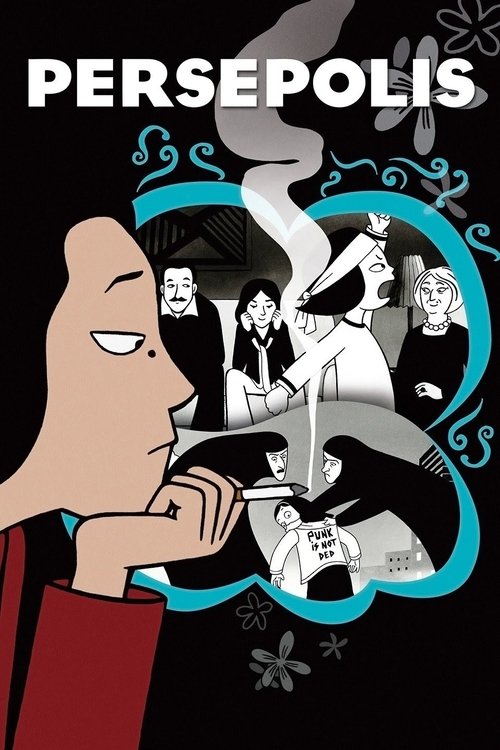
Persepolis
"The film Iran didn't want the world to see."
Overview
"Persepolis" is the poignant, autobiographical animated film from Marjane Satrapi, chronicling her childhood and young adulthood in Iran during and after the Islamic Revolution. The story is told through the eyes of Marjane, a precocious and outspoken girl from a modern, educated family in Tehran. As a child, she witnesses the overthrow of the Shah's regime, an event her family initially welcomes with hope for a more democratic future.
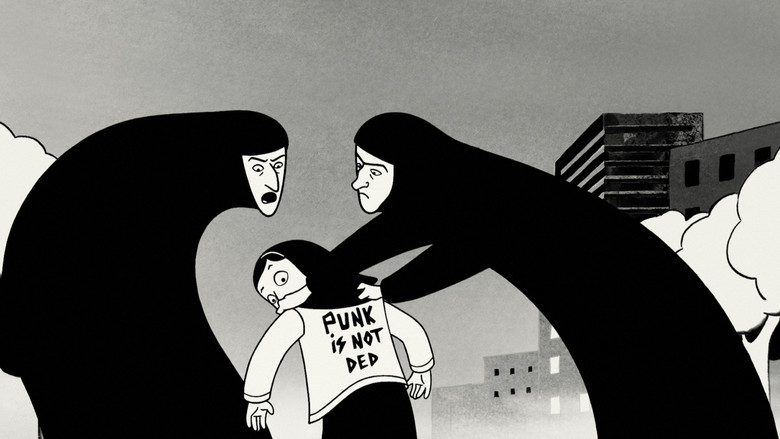
However, the rise of the Islamic fundamentalist government brings about a new form of oppression. Women are forced to wear the veil, Western culture is banned, and political dissent is brutally suppressed. Marjane's rebellious spirit clashes with the increasingly restrictive society. Fearing for her safety, her parents send her to Vienna at the age of fourteen. There, she grapples with the alienation of being an outsider, the complexities of adolescence, and the pain of being separated from her family during the brutal Iran-Iraq War.
The film follows Marjane's journey of self-discovery as she navigates two vastly different cultures, ultimately returning to Iran before making the difficult decision to leave again for good. It's a deeply personal and humorous, yet politically charged, narrative about identity, family, and the search for freedom.

Core Meaning
At its heart, "Persepolis" is a powerful testament to the resilience of the human spirit in the face of political turmoil and cultural repression. Director Marjane Satrapi sought to provide a nuanced, personal perspective on Iran, challenging the simplistic and often negative stereotypes prevalent in the Western world. The film's core message is about the importance of retaining one's identity, integrity, and sense of self when confronted with oppressive ideologies. It explores the universal struggle for freedom and the idea that the personal is inextricably political. Through Marjane's journey, the film argues that one can be deeply connected to their homeland and culture while rejecting the oppressive regimes that may govern it. It is a story of remembrance, of holding onto one's roots while forging a path of individual freedom.
Thematic DNA
Identity and Exile
Marjane's struggle with her identity is a central theme. In Iran, she is a rebel who doesn't conform to the strict religious codes. In Europe, she is often stereotyped and feels like an outsider. This constant negotiation of her identity—being too Western for Iran and too Iranian for Europe—highlights the complexities of cultural belonging and the feeling of displacement experienced by exiles. The film explores how personal identity is shaped by national history and the pain of being separated from one's roots.
War, Politics, and Loss of Innocence
The film portrays the brutal realities of revolution and war through the innocent eyes of a child. Marjane's coming-of-age is accelerated by the political upheaval around her, from witnessing protests to the execution of her beloved Uncle Anouche and the death of her friend in a bombing. These events strip away her childhood naivety, forcing her to confront the harsh realities of violence, loss, and political injustice. The personal and the political are shown to be inseparable, as historical events directly and tragically impact individual lives.
Feminism and Rebellion
"Persepolis" is a powerful feminist story, depicting the struggles of women under a patriarchal, theocratic regime. The forced veiling and strict social codes are symbols of the oppression faced by women. Marjane's rebellious acts, whether it's wearing a punk rock jacket, buying illegal Western music, or speaking out in university, are acts of defiance against a system that seeks to control her body and mind. The film celebrates female strength, intelligence, and the fight for bodily autonomy and self-expression.
Family and Memory
Despite the turmoil, Marjane's family is her anchor. Her parents are progressive and supportive, encouraging her critical thinking and independence. Her relationship with her wise and witty grandmother is particularly formative, providing her with moral guidance and strength. The film is an act of remembrance, a tribute to the family members who shaped her. Their stories and sacrifices are woven into her own, highlighting the importance of memory and lineage in forming one's character and values.
Character Analysis
Marjane 'Marji' Satrapi
Chiara Mastroianni (adult), Gabrielle Lopes Benites (child)
Motivation
Marjane is driven by a powerful desire for freedom, justice, and self-expression. She is motivated to live a life of integrity, a value instilled by her family, especially her grandmother. She constantly pushes back against injustice and hypocrisy, whether from the government or individuals, seeking to find her own place in a world that tries to define her.
Character Arc
Marjane begins as a precocious, imaginative, and deeply religious child who wants to be a prophet. The trauma of the revolution, war, and the execution of her uncle shatters her faith and innocence, transforming her into a cynical and rebellious teenager. Her time in Vienna is marked by alienation and heartbreak, leading to a loss of self and a deep depression. Upon returning to Iran, she struggles to reconcile her Westernized self with the oppressive society she finds. Ultimately, she realizes that to be true to herself, she must leave her home for good, fully embracing her complex identity as an Iranian woman living in exile.
Grandmother
Danielle Darrieux
Motivation
Her primary motivation is to protect and guide Marjane. She wants her granddaughter to live a full life without sacrificing her dignity or integrity. She represents the link to a more liberal Iranian past and encourages Marjane to always be true to herself.
Character Arc
Marjane's grandmother is a consistent source of wisdom, strength, and unconditional love throughout the film. She doesn't have a traditional arc of change but serves as the moral and emotional bedrock for Marjane. She is frank, funny, and deeply principled, representing the best of Marjane's heritage and providing the guidance Marjane needs to navigate her difficult life.
Uncle Anouche
François Jerosme
Motivation
Anouche is motivated by his strong political ideals and his love for his country. He believes in fighting for a free and just Iran, even at the cost of his own life. He is also motivated by his love for his family, especially his bond with Marjane, to whom he passes on his story.
Character Arc
Anouche is a revolutionary hero in Marjane's eyes. He is imprisoned for his communist beliefs under the Shah, released after the revolution, and then re-arrested and executed by the new Islamic regime. His arc is tragic; his initial optimism for a new Iran is brutally crushed. For Marjane, he represents the ideals of heroism and sacrifice, and his death is a pivotal moment that cements her disillusionment with the revolution and her loss of faith.
Taji Satrapi (Mother)
Catherine Deneuve
Motivation
Her motivations are twofold: a desire for a free and progressive Iran, and an overwhelming need to protect her daughter. She fights for her own rights while trying to create a safe space for Marjane to grow, eventually realizing that the only way to truly protect her is to send her away.
Character Arc
Marjane's mother is a fiercely independent and modern woman who actively participates in the protests against both the Shah and the fundamentalist regime. Her arc sees her move from a hopeful revolutionary to a worried parent, deeply concerned for her daughter's safety in an increasingly dangerous country. Her ultimate act of love is letting Marjane go, knowing she may never be able to return, prioritizing her daughter's freedom over her own desire to be with her.
Ebi Satrapi (Father)
Simon Abkarian
Motivation
He is motivated by a desire for a secular, modern Iran and a deep love for his family. He wants Marjane to be educated, informed, and free. He provides her with books and knowledge, fostering the critical thinking that defines her character.
Character Arc
Like his wife, Marjane's father is a modern, educated intellectual who opposes the oppressive regimes. He is less of a frontline activist and more of an observer and educator for Marjane, explaining the complex political situations to her. His arc is one of growing disillusionment. He sees the hope of the revolution curdle into fanaticism and must make the heartbreaking decision to send his only child away to give her a chance at a better life, accepting the limitations of his ability to change his country.
Symbols & Motifs
The Veil (Hijab)
The veil symbolizes the oppression of the Islamic regime, particularly its control over women. It represents the loss of individuality, freedom, and modernity. For Marjane and her friends, it is initially a confusing and unwanted imposition, but it becomes a potent symbol of the regime's power and her rebellion against it. Showing a bit of hair becomes a small but significant act of defiance.
The film opens with the imposition of the veil in schools after the Revolution. It is a constant presence throughout the Iranian sections of the film. Marjane is frequently admonished by the Guardians of the Revolution for not wearing it properly. The difference in how women wear the veil also signifies their political leanings.
Bread Swan
The bread swan symbolizes hope, beauty, and the memory of Uncle Anouche's resilience. It represents the small acts of humanity and creativity that can exist even within the grim reality of a prison. It's a symbol of his spirit and the political ideals he fought for.
Uncle Anouche, while imprisoned, made a swan out of bread. He gives a second bread swan to Marjane just before he is executed. It is the last thing she has from him, and its memory is a source of both pain and inspiration for her.
Jasmine
Jasmine flowers symbolize the comfort, wisdom, and love of Marjane's grandmother. They are a sensory link to her memory and the values she instilled in Marjane: dignity and self-respect.
Marjane's grandmother would put jasmine flowers in her bra every day to smell nice. In a touching scene before Marjane leaves for Vienna, she sleeps with her grandmother, and jasmine petals fall around them, visually representing the grandmother's loving and protective presence.
Cigarette
The cigarette represents a significant step in Marjane's coming-of-age and her embrace of rebellion. Smoking it is a symbolic act of defiance against her mother and the restrictive world she lives in, marking her transition from childhood to adolescence and her decision to live life on her own terms.
After a series of disillusioning events and feeling that her childhood is over, a 14-year-old Marjane secretly smokes a cigarette she stole from her uncle. She describes it as the symbolic end of her childhood and the beginning of her journey as an adult.
Memorable Quotes
Listen. I don't like to preach, but here's some advice. You'll meet a lot of jerks in life. If they hurt you, remember it's because they're stupid. Don't react to their cruelty. There's nothing worse than bitterness and revenge. Keep your dignity and be true to yourself.
— Marjane's Grandmother
Context:
The grandmother gives Marjane this advice before she leaves for Vienna, and its wisdom resonates throughout Marjane's experiences abroad and upon her return to Iran. It's a foundational piece of her moral education.
Meaning:
This quote encapsulates the core moral message of the film. It is the grandmother's guiding philosophy, which she imparts to Marjane. It emphasizes resilience, integrity, and the importance of rising above negativity, which becomes a crucial mantra for Marjane as she faces prejudice and hardship.
I wish he were alive and in jail rather than dead and a hero.
— Pardisse
Context:
In class, after Pardisse's father dies, the teacher and students praise him as a hero of the war. When Marjane tells Pardisse she should be proud, Pardisse's heartbreaking response undercuts the romanticized notion of dying for one's country.
Meaning:
Spoken by Marjane's friend whose father, a fighter pilot, was killed in the Iran-Iraq war. This quote powerfully challenges the state-sanctioned narrative of heroic martyrdom. It reveals the devastating personal cost of war and patriotism, highlighting the simple, human desire to have a loved one back, regardless of their heroic status.
Fear lulls our minds to sleep.
— Marjane's Grandmother
Context:
The grandmother says this to Marjane, encouraging her to be brave and not to let the fear pervading Iranian society control her thoughts and actions. It's part of her ongoing lesson to Marjane about living with courage and integrity.
Meaning:
This concise and powerful line speaks to the way oppressive regimes maintain control. It suggests that fear is a tool used to stifle dissent, critical thinking, and action. It's a call to courage and awareness, urging one not to become complacent or paralyzed by fear.
One can forgive but one should never forget.
— Marjane Satrapi (narrating)
Context:
This sentiment is woven throughout the narrative as Marjane learns about the suffering of political prisoners like her Uncle Anouche. It reflects her decision to bear witness to the events she lived through by creating "Persepolis".
Meaning:
This quote, a recurring idea in Satrapi's work, speaks to the importance of historical memory. It suggests that while forgiveness is possible, forgetting the injustices of the past is a betrayal of those who suffered. It is the underlying principle of her memoir itself—to tell the story so that it is not forgotten.
For a revolution to succeed, the entire population must support it.
— Ebi Satrapi (Marjane's Father)
Context:
Marjane's father explains this political theory to a young Marjane as she tries to understand the events unfolding around her. It frames the family's disappointment when the revolution doesn't lead to the free, democratic society they had hoped for.
Meaning:
This quote reflects the initial intellectual optimism of the revolutionaries and the complex reality of political change. It underscores the disillusionment that follows when the revolution is co-opted by a single faction, the Islamic fundamentalists, without the consensus of the entire population, leading to a new form of tyranny.
Philosophical Questions
What is the relationship between personal identity and national identity?
The film constantly explores this question through Marjane's life. Is she defined by her nationality, even when she rejects its ruling ideology? How much of her "Iranian-ness" does she carry with her in exile? "Persepolis" suggests that one's national identity is an inescapable part of the self, forged by language, family, and history, but that personal identity is a constant, conscious act of rebellion and self-definition against the restrictive labels that nationality can impose.
Can one truly be free when separated from their roots?
Marjane is sent to Europe to be safe and free, but she experiences profound alienation, depression, and a loss of identity. Her freedom in the West is complicated by loneliness and prejudice. Conversely, in Iran, she is with her family and culture but is severely oppressed. The film questions the nature of freedom, suggesting it is not merely the absence of political restraint but also a sense of belonging and purpose, which Marjane struggles to find in either world. Her final choice to live in exile is a pragmatic one, but the film leaves the question of her ultimate freedom ambiguous.
How do political events shape an individual's moral and spiritual development?
"Persepolis" directly links Marjane's moral and spiritual journey to the political events surrounding her. Her childhood faith in God is shattered by the execution of her uncle. Her sense of justice is forged by witnessing the hypocrisy and brutality of the new regime. The film argues that in a politically charged environment, morality is not an abstract concept but a series of daily choices and acts of defiance. One's character is not formed in a vacuum, but in direct response to the pressures and injustices of their society.
Alternative Interpretations
While the film is largely a straightforward autobiographical narrative, different interpretations exist regarding its central message and Marjane's final decision. One interpretation sees the ending not just as a personal choice but as a tragic political statement: that a true synthesis between her Iranian identity and her desire for freedom is impossible under the current regime. Her final departure is therefore a form of political and spiritual exile, a reluctant acceptance that she can only be herself by leaving her homeland.
Another perspective focuses on the film as a critique of nostalgia. While Marjane clearly loves her family and aspects of her culture, the film doesn't romanticize the past. The pre-revolution era under the Shah was also oppressive. The narrative can be seen as a work of "reflective nostalgia," which acknowledges the longing for a lost home but remains critical and aware of the reasons for that loss. Her story is not about returning to a perfect past, but about carrying the complex, imperfect memory of that past into the future. Some viewers have also interpreted Marjane's final, simple statement, "Iran," when asked where she is from, as a final, powerful act of reclaiming her identity, free from the need to explain or apologize for her origins.
Cultural Impact
"Persepolis" had a significant cultural impact upon its release, offering a rare and deeply personal glimpse into life in Iran during a tumultuous period of its history. It served as a powerful counter-narrative to the often monolithic and negative portrayal of Iran in Western media. By telling her story through the accessible and universal medium of animation, Marjane Satrapi was able to bridge cultural divides and foster empathy and understanding. The film, like the graphic novel before it, was lauded by critics for its wit, emotional depth, and unique visual style, proving that animation could be a powerful tool for serious, adult-oriented biographical and political storytelling.
The film was received with near-universal acclaim from critics, praised as a masterful work of cinematic storytelling that was both deeply personal and politically resonant. It was nominated for an Academy Award for Best Animated Feature. However, the Iranian government condemned the film, viewing it as an inaccurate and negative portrayal of the country and the Islamic Revolution. Despite this, "Persepolis" resonated strongly with audiences worldwide, particularly within the Iranian diaspora, who saw their own experiences of revolution, displacement, and cultural negotiation reflected on screen. It has become a staple in academic discussions on graphic novels, autobiography, feminist cinema, and post-colonial studies, cementing its place as a landmark work of international animation.
Audience Reception
Audience reception for "Persepolis" was overwhelmingly positive. Viewers praised its ability to tell a complex historical and political story in a way that was deeply human, accessible, and emotionally engaging. Many were particularly struck by the film's unique black-and-white animation, finding it stylish and effective in conveying the story's emotional weight. The humor and warmth, balanced with the tragic events, were frequently highlighted as one of the film's greatest strengths, allowing it to be profound without being preachy or overly somber. Marjane's character was celebrated as a relatable and inspiring protagonist—rebellious, funny, and resilient.
Criticism of the film was minimal but did exist. Some viewers who were not familiar with the graphic novel found the episodic nature of the storytelling somewhat fragmented, feeling it was more a series of vignettes than a tightly-structured plot. A very small minority found the arthouse style and pacing to be slow. The most significant controversy came from the Iranian government, which officially complained about the film's screening at the Cannes Film Festival, calling it Islamophobic and an unrealistic representation of Iran. However, for the vast majority of international viewers, the film was seen as an important and enlightening work of art.
Interesting Facts
- The film is presented primarily in black-and-white, mirroring the style of the original graphic novel. Director Marjane Satrapi explained this was a deliberate choice to make the story feel more universal and to prevent the characters and setting from feeling 'foreign'.
- The present-day scenes that frame the story are shown in color, creating a stark contrast with the black-and-white flashbacks of Marjane's past.
- Catherine Deneuve, who voices Marjane's mother, is the real-life mother of Chiara Mastroianni, who voices the adult Marjane.
- Marjane Satrapi insisted on being filmed acting out all the scenes herself. This footage was then used by the animators as a primary reference for the characters' movements and emotions, giving the animation a uniquely personal and accurate feel.
- The animation was created using traditional techniques with paper and ink, as Satrapi and the animation team were unsatisfied with the look of digital pen tablets.
- The film co-won the Jury Prize at the 2007 Cannes Film Festival.
- The historical sequences in the film, such as the explanation of the Shah's rise to power, are depicted in a distinct shadow puppet theater style, a nod to traditional Persian art forms.
- The title "Persepolis" refers to the ancient capital of the Persian Empire, a symbol of Iran's rich and complex history before the revolution.
⚠️ Spoiler Analysis
Click to reveal detailed analysis with spoilers
Frequently Asked Questions
Explore More About This Movie
Dive deeper into specific aspects of the movie with our detailed analysis pages
Comments (0)
No comments yet. Be the first to share your thoughts!