Skip to content
Tunnel
A suffocating claustrophobic thriller wrapped in biting black comedy, Tunnel balances mortal dread with quiet human warmth, framing an ordinary man buried beneath concrete rubble as a fractured mirror to a nation’s crumbling institutional conscience.
Tunnel

Tunnel

터널

"When all collapsed, only hope remained."

10 August 2016 South Korea 126 min 7.3 (664)

Director: Kim Seong-hun

Cast: Ha Jung-woo, Bae Doona, Oh Dal-su, Shin Jung-keun, Nam Ji-hyun

Drama Thriller Incompetence of Institutions and Bureaucratic Neglect The Value of Human Life vs. Economic Utility Media Sensationalism and Ethical Corrosion Human Resilience, Empathy, and Solidarity Public Apathy and Collective Fatigue
Budget: $1,000,000
Box Office: $52,444,295

Overview

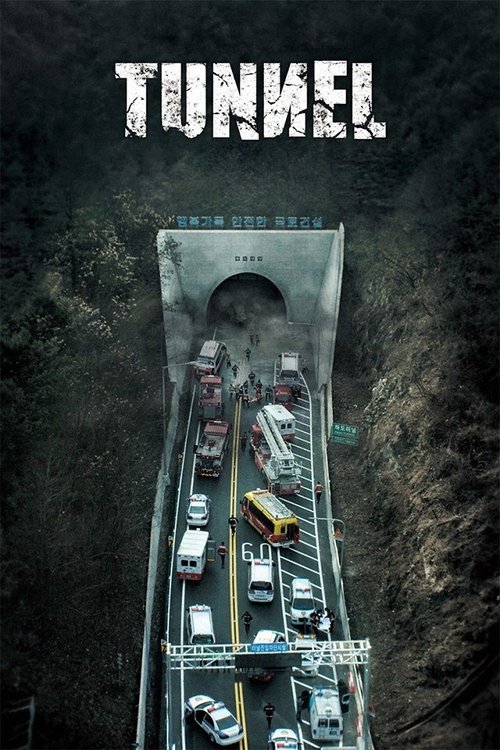
Tunnel (2016), written and directed by Kim Seong-hun, centers on Lee Jung-soo, an everyday car salesman driving home from work to celebrate his young daughter’s birthday. While passing through the recently opened Hado Tunnel beneath a mountain, the structural concrete and mountain rock suddenly give way, instantly burying his car under hundreds of tons of collapsed debris. Finding himself alive but trapped in pitch-black confinement, Jung-soo assesses his meager inventory: a phone with 78% battery, his daughter's birthday cake, and two bottles of water mistakenly handed to him at a gas station earlier that evening.

Outside, news of the catastrophe triggers an immediate public spectacle. A sprawling emergency response team is assembled under rescue chief Kim Dae-kyung, while Jung-soo’s frantic wife, Bae Se-hyun, rushes to the command center to maintain a tenuous connection with her husband. Dae-kyung coaches Jung-soo on rationing his provisions, conserving his phone power to one scheduled call a day, and holding onto psychological endurance while heavy machinery begins drilling from above.

However, what should be an urgent humanitarian mission quickly disintegrates into bureaucratic friction, political maneuvering, and a rapacious media circus. As drilling errors, administrative incompetence, and shifting public sentiment compound the delays, the rescue timeline drags from days into weeks. Trapped in an ever-shrinking air pocket, Jung-soo must survive not only physical starvation and encroaching panic, but also the agonizing reality of the outside world slowly weighing his survival against financial and operational costs.

Core Meaning

At its core, Tunnel is an indictment of systemic negligence, shoddy construction driven by corrupt deregulation, and the transactional valuation of human life in modern South Korean society. Director Kim Seong-hun uses the disaster movie formula not to celebrate macho heroism, but to expose the moral bankruptcy of bureaucratic institutions and the voyeuristic exploitation of human tragedy.

The film conveys that the greatest disaster is not the initial structural collapse, but the systemic decay of empathy on the surface. In a rapidly modernized society governed by cost-benefit analyses, an individual citizen's survival is treated as disposable the moment it inconveniences capital expenditure or government public relations. By contrasting Jung-soo's persistent decency underground with the performative hypocrisy of politicians and journalists above, Kim argues that genuine human dignity resides in individual conscience and solidarity rather than state systems.

Thematic DNA

Incompetence of Institutions and Bureaucratic Neglect 30%
The Value of Human Life vs. Economic Utility 25%
Media Sensationalism and Ethical Corrosion 20%
Human Resilience, Empathy, and Solidarity 15%
Public Apathy and Collective Fatigue 10%

Incompetence of Institutions and Bureaucratic Neglect

The disaster response is perpetually hindered by incompetence: the rescue headquarters uses incorrect blueprints, ministers stage photo opportunities for the press, and safety manuals offer no practical guidance. The state is revealed to be hollow, concerned primarily with protocol, liability management, and political optics rather than human preservation.

The Value of Human Life vs. Economic Utility

As the rescue stalls, the adjacent Second Tunnel construction project sits dormant at a cost of tens of millions of won per day. The film examines how corporate and state actors reframe the rescue from a moral duty into an economic liability, forcing the victim's family to sign waivers abandoning hope for the sake of the broader economy.

Media Sensationalism and Ethical Corrosion

Broadcast journalists prioritize clickbait headlines and live ratings over life safety, using up Jung-soo's precious cell phone battery on the air and flying unapproved camera drones into the unstable tunnel. The media serves as an exploitative machine feeding the public's morbid curiosity rather than holding power accountable.

Human Resilience, Empathy, and Solidarity

Jung-soo’s willingness to share his scarce water with another trapped victim and her dog highlights basic human decency under extreme duress. This mirrors the quiet dedication of rescue chief Kim Dae-kyung, whose refusal to treat Jung-soo as a statistic forms the emotional spine of the story.

Public Apathy and Collective Fatigue

The initial wave of nationwide grief quickly curdles into irritation and resentment as the tragedy drags on. The film scrutinizes the ephemeral nature of public sympathy, showing how easily citizens turn against victims when a disaster becomes inconvenient.

Character Analysis

Lee Jung-soo

Ha Jung-woo

Archetype: The Everyman Survivor Key Trait: Pragmatic resourcefulness laced with dry, self-preserving humor

Motivation

Returning home alive to his wife and young daughter.

Character Arc

Starts as a pragmatic, cheerful car salesman eager to reach his family. Trapped under the rubble, his easygoing optimism is battered by starvation and isolation, but he maintains human empathy and moral clarity, refusing to succumb to animalistic despair.

Bae Se-hyun

Bae Doona

Archetype: The Steadfast Anchor Key Trait: Unflinching stoicism masking profound grief

Motivation

Keeping her husband tethered to hope while protecting their family's dignity.

Character Arc

Moves from panicked shock to quiet, resolute endurance. She serves warm meals to rescue crews at the base camp while shielding herself and her daughter from relentless media hounds and public vitriol.

All 5 characters and cast

Symbols & Motifs

The Birthday Cake

Meaning:

Represents domestic normality, familial love, and innocence suddenly buried underground. Eating the cake crumb by crumb turns a festive artifact into an instrument of survival, charting Jung-soo’s temporal degradation.

Context:

Kept inside the car for his young daughter's birthday, it serves as his primary food source during the early weeks of entrapment.

The Two Bottles of Water

Meaning:

A motif of serendipity and life preservation, symbolizing how everyday human interactions—unlike grand state institutions—are what unexpectedly sustain life.

Context:

Handed over to Jung-soo by an elderly gas station attendant as an apology for an accidental overcharge right before he enters the tunnel.

The Trapped Vehicle (Kia)

Meaning:

A visual metaphor for middle-class life. The automobile, a quintessential symbol of modern mobility and status, becomes a metal tomb that simultaneously traps Jung-soo and acts as the protective roll-cage preserving him.

Context:

The confined cabin of the car serves as the primary stage for Jung-soo's survival throughout the 35-day ordeal.

The Car Radio (Classic FM)

Meaning:

Jung-soo's only real-time connection to the outside world after his phone dies, transitioning from an impersonal broadcast medium to an intimate conduit for empathy and family connection.

Context:

Jung-soo listens to the radio daily to track time and eventually hears his wife's broadcasted messages.

The Outdated Blueprints

Meaning:

The physical manifestation of administrative failure and institutional corruption, illustrating how corner-cutting literally misdirects life-saving efforts.

Context:

Supplied by the ministry to the rescue crew, resulting in the heavy drill rig penetrating an empty ventilation shaft instead of Jung-soo's actual location.

The Pug (Ttaeng-yi)

Meaning:

Symbolizes the absurd, unpredictable shared burdens of survival and mutual companionship amidst existential isolation.

Context:

Discovered inside another crushed vehicle alongside Lee Mi-na; after Mi-na passes away, the dog remains in Jung-soo's car, eating his cake but offering living warmth.

Memorable Quotes

다 꺼져, 개새끼들아!
— Lee Jung-soo / Kim Dae-kyung

Context

Whispered by the rescued Jung-soo to Dae-kyung on the tarmac, and subsequently bellowed through a megaphone by Dae-kyung to the assembled press and officials.

Meaning

The cathartic climax of the film, providing a blunt, unfiltered condemnation of self-serving politicians and exploitative media parasites.

기자님들, 지금 방송이 중요합니까? 생명이 중요합니까? 그 쉬운 질문에도 대답 못합니까?!
— Kim Dae-kyung

Context

Dae-kyung storms over and disconnects a live telephone interview that a reckless reporter initiated with Jung-soo, wasting the trapped man's critical battery.

Meaning

Condemns sensationalist news agencies that commodify disasters for ratings, highlighting their complete absence of journalistic ethics.

All 5 quotes

Philosophical Questions

How much financial and operational cost can a society legitimately incur to save one individual?

The story pits deontological ethics—the principle that every single human life holds absolute intrinsic worth—against utilitarian calculations, where diverting heavy machinery and halting commercial construction costs the state and private enterprises millions of won daily.

What is the purpose of the state if it fails to protect the citizen in their most vulnerable hour?

The film explores whether the social contract between the citizen and the state remains valid when governing institutions prioritize self-preservation, protocol, and public relations over active life preservation.

What are the limits of collective compassion in the 24-hour media age?

Through the shift in public reaction after an on-site rescuer dies, the film interrogates how collective empathy degrades over time, demonstrating how rapidly compassion can curdle into media fatigue, annoyance, and victim-blaming.

How It Ends

Alternative Interpretations

The film can be examined through several critical lenses:

Full ending explanation

Cultural Impact

Released in August 2016 alongside major titles like The Handmaiden, The Wailing, and Train to Busan, Tunnel resonated deeply due to its political and social subtext. Coming roughly two years after the 2014 MV Sewol ferry disaster—which claimed 304 lives due to deregulation, overloaded cargo, and bungled rescue operations—the film directly engaged the unresolved collective trauma of the South Korean public.

Furthermore, it invoked long-standing national anxieties regarding structural disasters rooted in South Korea's rapid post-war economic acceleration (Compressed Modernity) and pervasive ppalli-ppalli (hurry-hurry) culture, echoing historical tragedies such as the 1994 Seongsu Bridge collapse, the 1995 Sampoong Department Store collapse, and the 2014 Mauna Ocean Resort gym collapse. The film's depiction of bureaucratic incompetence and state neglect carried prescient weight, arriving mere months before the political scandals that culminated in the impeachment of President Park Geun-hye.

Audience Reception

Tunnel achieved both commercial success and broad critical acclaim, attracting over 7.1 million moviegoers and earning ratings of approximately 78% on Rotten Tomatoes and 6.9/10 on IMDb.

Praise:

  • Ha Jung-woo received widespread acclaim for anchoring the film almost entirely alone in an enclosed space, striking a delicate balance between survival drama and deadpan humor.
  • Director Kim Seong-hun was lauded for his tonal mastery, deftly combining suspenseful disaster tropes with biting social satire.
  • Bae Doona and Oh Dal-su were praised for their grounded, emotionally resonant supporting roles, providing a moral anchor against the absurdity of the surface response.

Criticism:

  • Some critics pointed out pacing issues in the third act, arguing that repetitive rescue setbacks caused narrative drag.
  • A few commentators felt the politicians and journalists outside were depicted with overly broad, caricatured strokes that bordered on farce.
  • The plot point featuring the death of a drill operator and the public's swift turn against Jung-soo's wife prompted debates over whether public cruelty was exaggerated or a realistic reflection of societal apathy.

Interesting Facts

  • Adapted from So Jae-won's 2013 novel Tunnel, the film diverges from the book's bleak ending where the protagonist and his wife commit suicide.
  • Ha Jung-woo spent weeks filming inside cramped car sets surrounded by real dust, cement shards, and charcoal powder.
  • Bae Doona acted throughout the entire production completely bare-faced without makeup to realistically portray the exhaustion of a victim's family.
  • The pet pug Ttaeng-yi was portrayed by two nearly identical pug dogs named Gomi and Bomi.
  • The film dominated the South Korean box office in 2016, maintaining the number one spot for 28 consecutive days and drawing over 7.1 million admissions.
  • Crew members used powdered soil, crushed volcanic ash, and bean flour to simulate subterranean dust safely around the lead actor.
  • Ha Jung-woo improvised multiple comedic moments inside the car, such as tasting windshield washer fluid and his interactions with the pug.

Easter Eggs

Film Critic Lee Dong-jin Cameo

Renowned South Korean film critic Lee Dong-jin provides a voice cameo as the midnight radio host on Classic FM, functioning as Jung-soo's primary emotional link to the world outside.

Visual Parody of the Presidential Disaster Response

The scenes featuring Minister Kim Hae-sook posturing for photo opportunities directly satirized the controversial public response and photo-ops of President Park Geun-hye during national disasters.

Homage to Billy Wilder's Ace in the Hole (1951)

The transformation of the disaster site into a media circus with food vendors, satellite trucks, and intrusive reporters serves as an intentional homage to Billy Wilder’s classic media satire.

The Gas Station Attendant Chekhov’s Gun

The opening scene's elderly gas station attendant accidentally overfilling Jung-soo's tank leads to an apology gift of two water bottles, which serves as the essential survival tool that keeps him alive underground.

Frequently Asked Questions

Explore More About This Movie

Dive deeper into specific aspects of the movie with our detailed analysis pages

Comments (0)

Leave a comment

No comments yet. Be the first to share your thoughts!

Similar Movies