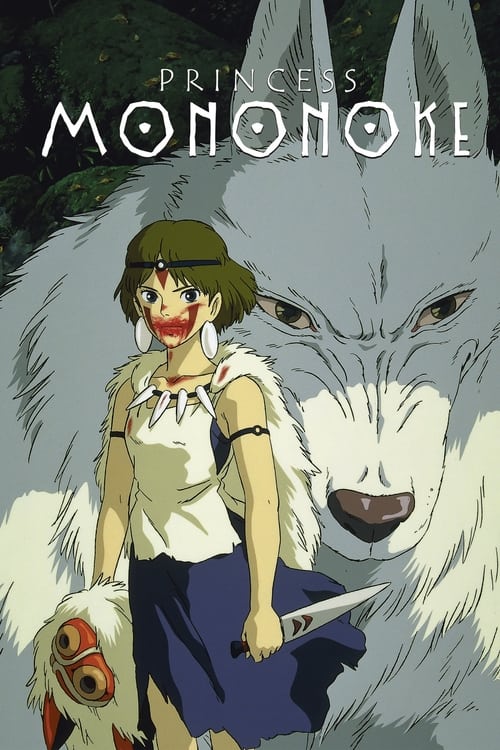
Princess Mononoke
もののけ姫
"The fate of the world rests on the courage of one warrior."
Overview
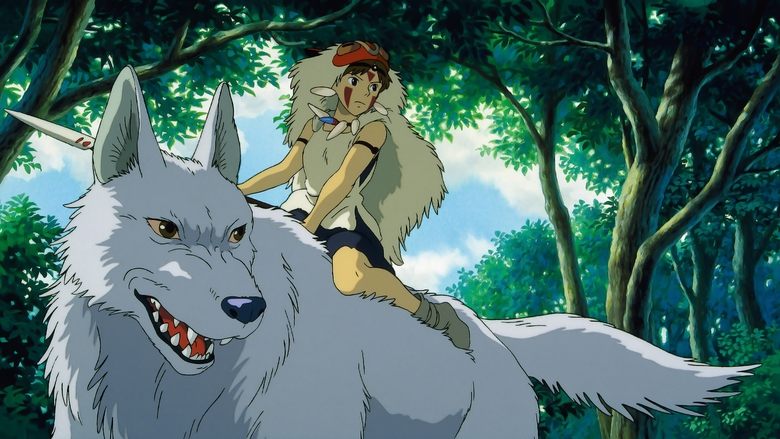
Set in the late Muromachi period of Japan, "Princess Mononoke" follows the journey of Ashitaka, the last prince of the Emishi people. After defending his village from a rampaging demon god, he is afflicted with a deadly curse. To find a cure, he must travel to the western lands from which the demon came. His quest leads him to the heart of a fierce conflict between the industrious Irontown, led by the pragmatic Lady Eboshi, and the inhabitants of the ancient forest, including the wolf goddess Moro and her human daughter, San, the titular Princess Mononoke.
Ashitaka finds himself caught in the middle of a war where there are no clear villains. Lady Eboshi's Irontown provides a sanctuary for societal outcasts, including former prostitutes and lepers, but its prosperity comes at the cost of clear-cutting the forest to mine for iron. San and the forest gods, on the other hand, fight violently to protect their home from humanity's encroachment. Ashitaka, an outsider to both sides, must attempt to mediate the conflict and "see with eyes unclouded by hate" to prevent mutual destruction.
Core Meaning
"Princess Mononoke" explores the complex and often destructive relationship between humanity and the natural world. Director Hayao Miyazaki avoids a simplistic good-versus-evil narrative, instead presenting a nuanced portrayal of conflict where both sides have valid motivations. The film's core message is not a condemnation of humanity or progress, but a plea for balance and coexistence. It suggests that hatred and violence, whether from humans destroying nature or nature retaliating in kind, only beget more suffering. The film ultimately argues that even in the midst of conflict and hatred, there are things worth living for, and that understanding and compassion are the only paths toward a future where both humanity and nature can thrive.
Thematic DNA
Environmentalism vs. Industrialization
The central conflict of "Princess Mononoke" is the struggle between the natural world, represented by the forest gods and San, and human industry, embodied by Lady Eboshi and Irontown. The film does not present a simple pro-environment, anti-industry message. Irontown's deforestation is destructive, but it also provides a home for social outcasts. The forest, while sacred, is also shown as savage and unforgiving. The film highlights the devastating consequences of unchecked industrial expansion on the environment, leading to the corruption and death of ancient gods. Ultimately, it calls for a harmonious balance rather than a victory for either side.
The Ambiguity of Good and Evil
Miyazaki deliberately avoids clear-cut heroes and villains. Lady Eboshi is the primary antagonist from the forest's perspective, yet she is a compassionate leader who has created a sanctuary for the marginalized. San fights ruthlessly against the humans but is driven by a deep love for her forest home and wolf family. Ashitaka serves as the moral center, refusing to take a side and striving to understand the complexities of the conflict. The film suggests that good and evil are not absolute but rather dependent on perspective and circumstance.
Hatred, Revenge, and Forgiveness
A powerful theme throughout the film is the destructive nature of hatred. Ashitaka's curse is a physical manifestation of the boar god's hatred, born from pain. This curse grants him superhuman strength but also slowly kills him, symbolizing how hatred can consume a person. The conflict between the humans and the forest is fueled by a cycle of revenge. The film's resolution does not come from one side defeating the other, but through Ashitaka's attempts to foster understanding. While San cannot fully forgive humanity, the ending offers a glimmer of hope for coexistence and moving beyond hatred.
Feminism and Strong Female Characters
"Princess Mononoke" features powerful and complex female characters who defy traditional gender roles. Lady Eboshi is a charismatic and capable leader of a thriving industrial town, providing agency and equality to women who were formerly prostitutes. San is a fierce warrior, raised by wolves, who is unapologetically wild and independent. Moro, the wolf goddess, is a wise and formidable matriarch. These characters drive much of the film's narrative and conflict, presenting a vision of female strength and autonomy.
Character Analysis
Ashitaka
Yoji Matsuda
Motivation
His primary motivation is to "see with eyes unclouded by hate" and find a way for both humans and the forest to live. Cursed by the physical embodiment of hatred, he seeks to prevent others from being consumed by it. He is driven by a profound sense of empathy and a desire for balance, refusing to accept that destruction is the only answer.
Character Arc
Ashitaka begins as a prince of a secluded tribe, bound by duty and honor. After being cursed, he is exiled and forced to journey into the wider world. Initially seeking only a cure for himself, his journey evolves into a quest to understand the hatred that created his curse and to find a way for humanity and nature to coexist. He consistently acts as a neutral party, attempting to quell the violence on both sides. By the end, while his curse is lifted, he chooses to remain in the world of men to help rebuild Irontown with a newfound understanding, forever changed by his experiences and his bond with San.
San (Princess Mononoke)
Yuriko Ishida
Motivation
San's driving motivation is the protection of her forest home and her wolf family. She is fueled by a righteous fury against the humans who destroy the forest and kill the animals. She is willing to die to defend her world and avenge the spirits harmed by Irontown's expansion.
Character Arc
Raised by wolves, San completely rejects her humanity at the start of the film, identifying as a wolf and despising all humans. Her initial interactions with Ashitaka are hostile, as she sees him as just another enemy. Through her relationship with him, she begins to see that not all humans are like Lady Eboshi. While she never fully embraces her human side or forgives humanity for its transgressions against the forest, her character arc shows a softening of her absolute hatred. By the end, she is able to see Ashitaka as an individual and expresses a willingness to coexist, even if from a distance.
Lady Eboshi
Yuko Tanaka
Motivation
Lady Eboshi is motivated by a desire to create a prosperous and safe community for her people, particularly for the marginalized and forgotten members of society. She sees the forest and its gods as obstacles to this goal, believing that controlling nature is necessary for human advancement and security.
Character Arc
Lady Eboshi is introduced as a seemingly ruthless industrialist, willing to destroy the forest and kill its gods for the sake of progress and the prosperity of her people. As the film progresses, her character is revealed to be more complex; she is a progressive leader who has created a society where women, lepers, and other outcasts are treated with respect and given purpose. Her primary flaw is her belief that humanity must conquer nature to survive. After losing an arm and seeing the destructive power of a dying god, she is humbled. In the end, she resolves to "build a better town," implying a newfound respect for the balance between humanity and nature.
Symbols & Motifs
The Forest Spirit (Shishigami)
The Forest Spirit, also known as the Deer God, represents the pure, untamed essence of nature itself. It embodies the dualistic forces of life and death, having the power to both create and destroy. It is not a benevolent or malevolent deity but a neutral force that maintains the natural balance. Its decapitation signifies humanity's ultimate transgression against nature, leading to catastrophic consequences.
The Forest Spirit appears in two forms: a deer-like creature by day and the giant, celestial Night Walker by night. It heals Ashitaka's gunshot wound but does not remove his curse. The central conflict of the film's latter half revolves around Lady Eboshi's plan to kill the spirit and Jigo's mission to deliver its head to the Emperor for a reward. After being beheaded, its body unleashes a destructive ooze that kills everything it touches until its head is returned, at which point it brings life back to the devastated land before disappearing.
Ashitaka's Curse
The curse on Ashitaka's arm, which appears as writhing, worm-like tendrils, is a physical manifestation of hatred and rage. It grants him immense power but at the cost of his life force, mirroring how hatred can empower yet ultimately consume an individual. His journey to find a cure is a quest to understand the root of this hatred and to find a way to live with it without being destroyed by it.
Ashitaka receives the curse after killing the demon boar god Nago at the beginning of the film. The curse flares up when he feels strong emotions like anger or when he uses his superhuman strength. It represents the corrupting influence of the iron bullet that poisoned Nago, linking industrial violence directly to the spiritual sickness of hatred. The curse is finally lifted at the end of the film when the Forest Spirit is healed and balance is restored.
San's Mask
San's mask, made of wood and fur, symbolizes her rejection of her own humanity and her identity as a member of the wolf clan. It is a representation of her fierce, untamed nature and her role as a warrior of the forest. When she wears it, she is the fearsome "Princess Mononoke"; when she removes it, her human vulnerability is revealed, particularly in her interactions with Ashitaka.
San is almost always seen wearing the mask when she is in combat or confronting humans. It serves to intimidate her enemies and to visually separate her from them. Ashitaka is one of the few humans to see her without it, signifying the bond that develops between them. The mask is a crucial part of her iconic design and represents her liminal state between the human and animal worlds.
The Kodama
The Kodama are small, white, rattling tree spirits that symbolize the health and vitality of the forest. Their presence indicates that the forest is thriving and spiritually pure. Their disappearance is a sign of the forest's decline due to human activity. They are silent observers of the conflict, representing the innocent life that is threatened by the war.
The Kodama appear in great numbers in the healthy parts of the forest. As the conflict escalates and the forest suffers, they begin to disappear. When the Forest Spirit is killed, all the Kodama die, but they reappear at the very end of the film after the land is rejuvenated, signifying the return of life and hope to the forest.
Memorable Quotes
憎しみに身を委ねれば、そなたももののけになっちまうぞ。
— Ashitaka
Context:
Ashitaka says this to a woman in Irontown who is filled with rage and a desire for revenge against San. He shows her his cursed arm as proof of what hatred does, trying to stop the cycle of violence.
Meaning:
"If you give in to your hatred, you too will become a demon." This quote encapsulates one of the film's central themes: the corrupting and dehumanizing power of hatred. Ashitaka speaks from his own cursed experience, warning others of the path he is on.
生きろ…そなたは美しい。
— Ashitaka
Context:
Ashitaka says this to San after she attacks him and holds a blade to his throat. Despite her hostility, he expresses his admiration for her, which deeply affects and confuses her, as she has never been shown such compassion by a human.
Meaning:
"Live... You are beautiful." This is a pivotal moment in Ashitaka and San's relationship. Ashitaka sees past San's wild exterior and her hatred, recognizing the inherent beauty and value of her life. It is a simple, profound plea for life over death and hatred.
曇りなき眼で見定め、決める。
— Ashitaka
Context:
Ashitaka says this to Lady Eboshi when she questions his motives for being in Irontown. It defines his role in the story as a mediator who seeks understanding rather than victory for one side.
Meaning:
"To see with eyes unclouded by hate." This is Ashitaka's personal mantra and the philosophical core of the film. It represents the ideal of looking at a conflict from a neutral, empathetic perspective, understanding all sides without being swayed by prejudice or anger.
黙れ小僧!お前にサンが救えるか。
— Moro
Context:
The wolf goddess Moro says this to Ashitaka when he pleads for her to release San. Moro explains that San is neither human nor wolf and has no place in either world, emphasizing the tragic nature of her existence.
Meaning:
"Silence, boy! Can you save San?" Moro's question challenges Ashitaka's naive idealism. It highlights the depth of San's suffering and her seemingly irrevocable separation from the human world, questioning whether a peaceful resolution is truly possible.
Philosophical Questions
Can humanity and nature ever truly coexist in harmony?
The film delves into this question by refusing to provide a simple answer. It presents the conflict as deeply complex, with both Irontown's need for resources and the forest's right to exist being valid. The ending is not a perfect resolution; San returns to the forest, unable to forgive humanity, and Ashitaka stays to help rebuild Irontown. However, they promise to see each other, suggesting that while perfect harmony may be unattainable, communication and a mutual desire for coexistence offer a path forward. The film posits that balance, not domination, is the key, but it is a balance that must be constantly negotiated and maintained.
Is there such a thing as absolute good or evil?
"Princess Mononoke" challenges the traditional binary of good versus evil. Lady Eboshi, who is responsible for the destruction of the forest, is also a benevolent and progressive leader to her people. The forest gods, while fighting for a just cause, are violent and capable of immense destruction. Ashitaka's journey is a lesson in seeing the good within the perceived 'evil' and the 'evil' within the perceived 'good'. The film argues that these concepts are relative and that actions are driven by complex motivations that cannot be easily categorized.
What is the cost of hatred?
The film explores the destructive nature of hatred through Ashitaka's curse. The curse is a physical manifestation of the boar god's pain and rage, and it slowly consumes Ashitaka's life. It symbolizes how hatred, even when justified, ultimately destroys the one who carries it. The war between the humans and the forest is perpetuated by a cycle of hatred and revenge. The film suggests that the only way to break this cycle is through empathy and a willingness to see beyond one's own pain and anger, as embodied by Ashitaka's quest "to see with eyes unclouded by hate."
Alternative Interpretations
While the central theme of environmentalism is widely recognized, "Princess Mononoke" allows for several alternative or complementary interpretations. One perspective is that the film is a critique of modernity and the loss of traditional values. Set during the Muromachi period, a time of great social and technological change in Japan, the film reflects on the consequences of moving away from a life more in tune with nature, which is a core tenet of Shintoism. The introduction of firearms represents a disruptive technology that upsets the balance of power between humans and gods.
Another interpretation focuses on the social commentary within Irontown. Lady Eboshi's community is a microcosm of a new social order, a place where marginalized groups—women from brothels, lepers, and mercenaries—are given a chance to build a new life. From this viewpoint, the film can be seen as an exploration of societal progress and the creation of new forms of community, even if that progress comes into conflict with the natural world. Miyazaki himself was inspired by John Ford's Westerns in his depiction of Irontown as a gritty frontier town.
A more philosophical reading suggests the film is about the nature of hatred itself. Ashitaka's curse is not just a plot device but a symbol for how unresolved conflict and rage can physically and spiritually poison a person. The entire narrative can be seen as an allegory for the struggle to overcome the destructive cycle of hatred and revenge that plagues humanity, with Ashitaka embodying the difficult path of empathy and mediation.
Cultural Impact
"Princess Mononoke" was a landmark film in Japanese animation and had a significant cultural impact both domestically and internationally. In Japan, it broke box office records, becoming the highest-grossing film in the country's history until it was surpassed by "Titanic". Its success demonstrated that animated films could tackle mature, complex themes and attract a massive adult audience.
Internationally, it was one of the first Studio Ghibli films to receive a wide theatrical release in the West, spearheaded by a distribution deal with Disney and Miramax. This release, with an English script adapted by author Neil Gaiman, introduced many Western viewers to the work of Hayao Miyazaki and the depth of anime as a storytelling medium beyond children's entertainment. The film's critical acclaim and cult status helped to pave the way for the international success of later anime films, including Miyazaki's own "Spirited Away".
The film's philosophical and environmental themes resonated deeply with audiences and critics. Its nuanced portrayal of the conflict between humanity and nature, refusing to offer easy answers, set it apart from more simplistic environmental narratives. The film draws heavily on Japanese history (the Muromachi period) and Shinto beliefs, which posit that spirits (kami) reside in all aspects of nature, introducing these cultural concepts to a global audience. Its complex characters, particularly the strong and independent San and Lady Eboshi, have been praised for their depth and contribution to feminist portrayals in animation. "Princess Mononoke" remains a highly influential work, celebrated for its artistic beauty, thematic complexity, and its profound impact on the perception of animation worldwide.
Audience Reception
Audiences have overwhelmingly praised "Princess Mononoke" for its stunning animation, complex story, and mature themes. Many viewers appreciate that the film avoids a simplistic good vs. evil narrative, instead presenting morally ambiguous characters and a nuanced central conflict. The epic scale of the action sequences, combined with Joe Hisaishi's powerful score, is frequently highlighted as a major strength. The strong female characters of San and Lady Eboshi are also often cited as a departure from typical animated heroines and villains.
Points of criticism are relatively few but do exist. Some viewers, particularly those accustomed to lighter family-friendly fare from Studio Ghibli, found the film's violence and dark tone to be shocking or excessive for an animated feature. The film's complex plot and large cast of characters have also been described by some as occasionally overwhelming. A minority of viewers have found the protagonist, Ashitaka, to be somewhat bland or overly stoic compared to the more fiery characters surrounding him. Despite these minor criticisms, the overall verdict from audiences is that "Princess Mononoke" is a masterpiece of animation and a powerful, thought-provoking film.
Interesting Facts
- The word 'Mononoke' is not a name, but a general term in Japanese for a spirit or monster.
- Princess Mononoke was the most expensive animated film ever made in Japan at the time of its release, with a budget of 2.35 billion yen.
- The film is composed of approximately 144,000 hand-drawn cels, of which Hayao Miyazaki is said to have personally drawn or corrected around 80,000.
- Miyazaki was inspired to make the film in part by the Yugoslav Wars, which made him feel that humanity "doesn't learn."
- The landscape of the ancient forest was inspired by the real-life forests of Yakushima Island in Japan.
- It was the first animated film to win Best Picture at the Japanese Academy Awards.
- About 10% of the film utilizes computer-generated imagery, a first for a Miyazaki film, which was mainly used for things like the writhing tendrils of the curse.
- When Harvey Weinstein, the film's American distributor, wanted to make cuts, producer Toshio Suzuki sent him a samurai sword with the message "No cuts."
- The original concept for the film, developed in the late 1970s, was about a princess who marries a beast, but the story evolved significantly over time.
- Hayao Miyazaki originally preferred the title "The Legend of Ashitaka."
⚠️ Spoiler Analysis
Click to reveal detailed analysis with spoilers
Frequently Asked Questions
Explore More About This Movie
Dive deeper into specific aspects of the movie with our detailed analysis pages
Comments (0)
No comments yet. Be the first to share your thoughts!